Travel Value Finder

The Greece FIP visa (now officially the Residence Permit for Persons with Sufficient Financial Means) requires roughly €3,500/month in passive income or €126,000 in savings, and it carries a real refusal risk – documentation gaps, not the income figure itself, are the most common reason applications get denied.
Leslie Nics, TravelValueFinder.com | Last updated: July 2026 | Last Reviewed: July 26 2026
The Greece FIP visa gets described online as one of Europe’s simpler retirement routes, and structurally it is – no property purchase, no investment minimum, no Greek bank account opened months in advance. What gets underplayed is the refusal rate.
Multiple immigration practitioners who process these applications regularly cite documentation gaps as the single most common reason files get rejected, not the income threshold itself. This is the version built around avoiding that outcome, not just meeting the headline number.
The Six Steps, in the Order They Actually Happen
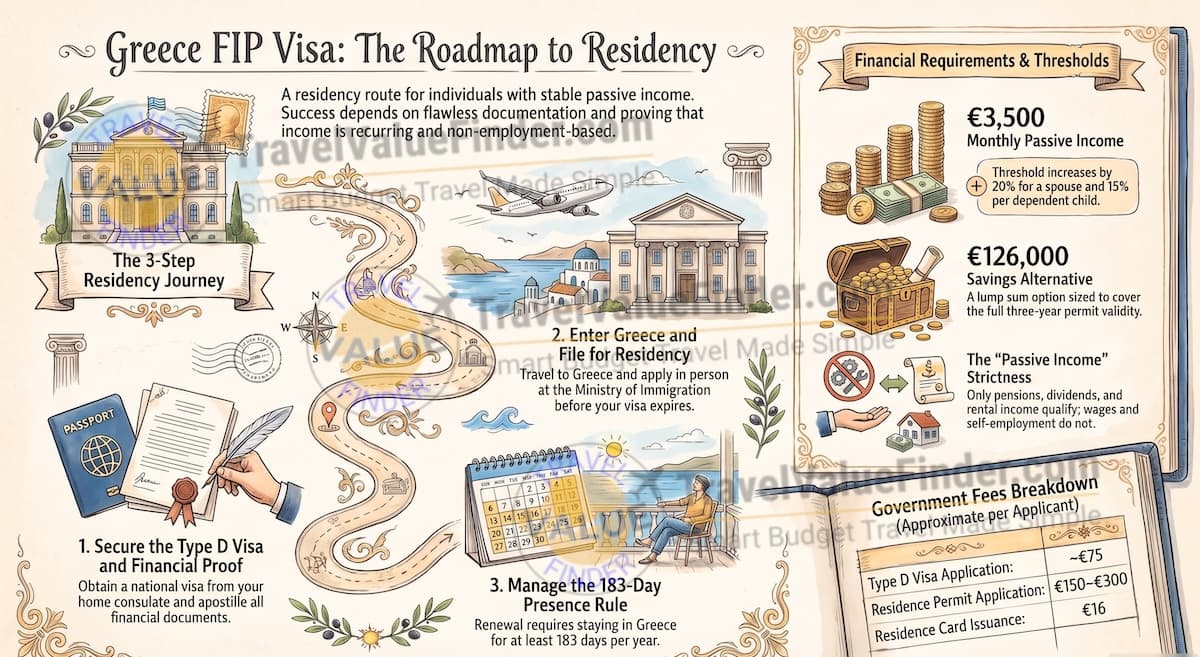
Step 1: Get the Type D visa first. Before anything else, apply for a Type D national visa at the Greek consulate covering your home jurisdiction – this is a hard prerequisite for the FIP residence permit, not a parallel or optional step.
Step 2: Assemble financial proof. Pension statements, bank balances, apostilled Social Security documentation, or a lease/property contract – evidence has to show the income is passive, stable, and ongoing, not a single large deposit. This is also the stage to begin certified translations, since Greek authorities won’t accept documents in English or other languages without them, and translation turnaround is one of the most common reasons this step runs longer than applicants expect.
Step 3: Receive the visa. Once approved, the Type D visa itself is typically issued within about 10 days and is valid for up to 12 months – this is your window to actually travel and enter Greece, not a deadline for the whole process to be finished.
Step 4: Enter Greece and file for residency. Before the visa expires, apply for the residence permit at the Ministry of Immigration in person, including biometric registration – this can’t be done remotely or by mail, and it requires having already secured a registered Greek address to list on the application.
Step 5: Get proof of filing. This document lets you legally remain in Greece past the standard 90-day tourist limit while the residence permit itself is being processed.
Step 6: Receive the residence card. Typically issued within about three months of filing, valid for three years, and renewable as long as the financial and presence requirements continue to be met.
What This Actually Costs, Fee by Fee
| Fee | Amount |
| Type D visa application (at consulate) | ~€75 per applicant |
| Residence permit application fee | €150–€300 per applicant |
| Residence card issuance fee | €16 |
| Legal/advisory support (optional but common) | $1,000–$3,000+ |
None of these are large individually, but the total – particularly if legal support is used to reduce refusal risk, which many applicants do given the documentation-driven rejection pattern – is worth budgeting as its own line item well before the passive-income figure comes into play.
Red Flag: The single most cited cause of FIP visa refusals isn’t insufficient income – it’s incomplete or inconsistent financial documentation. A pension statement that doesn’t clearly read as passive, ongoing income is treated the same as insufficient income by reviewing officers.
How Much Income Actually Qualifies
The commonly cited figure is €3,500/month for a single applicant, up from €2,000 following Law 5038/2023, though it’s worth noting the law itself doesn’t hard-code an exact figure; the precise threshold is set by ministerial regulation and has moved before. Spouses add 20%, each dependent child adds 15%.
Applicants who’d rather qualify through savings instead of ongoing income can show a lump sum, commonly cited at €126,000, sized to cover the full three-year permit validity rather than a single year.
Acceptable income sources include pensions, dividends, rental income, and investment returns – wages and self-employment earnings don’t count, mirroring the same passive-income test used across nearly every comparable southern European visa.
In practice, reviewing officers weigh the quality of the evidence almost as heavily as the number itself.
A pension award letter that explicitly states the payment is a lifetime, recurring benefit reads very differently to a reviewer than an unlabeled bank statement showing a similar monthly deposit – even if the underlying dollar amount is identical.
Rental income needs a signed lease showing ongoing, recurring payments, not a one-off property sale credited to an account. This distinction between “proof of a number” and “proof of a stable, ongoing, passive number” is where a meaningful share of otherwise-qualified applicants run into trouble.
For context against the two other retirement visas covered elsewhere on this site: Greece’s €3,500/month threshold sits below Italy’s roughly €31,000/year (about €2,580/month) only nominally – once spousal and dependent add-ons are factored in, the two programs land in a broadly similar range, with Portugal’s D7 remaining the clear low-cost outlier at roughly €870/month.
Full Document Checklist
| Document | Notes |
| Type D national visa (already approved) | Hard prerequisite – apply for this before anything else |
| Valid passport | Standard identity and travel document requirement |
| Proof of passive income or €126,000 in savings | Pension statements, dividend records, rental contracts, or bank balances |
| Apostilled Social Security or pension documentation | Required for US-sourced income to be recognized as valid |
| Private health insurance | Must cover the applicant for the full residence permit period |
| Registered Greek address (lease or deed) | Needed to file the residence permit application in person |
| Passport photographs | Standard biometric registration requirement |
| Criminal background check | Often requested, particularly for the initial application |
Every document originating outside Greece in a language other than Greek generally needs certified translation, and US-issued documents like Social Security award letters typically need an apostille before Greek authorities will accept them as valid proof of income. This step alone routinely adds weeks to a timeline applicants budget as if translation were instant.
Health Insurance: A Requirement That Outlasts the First Approval
Private health insurance isn’t a one-time box to check at the consulate – it has to remain valid and sufficient for the entire residence permit period, and lapsed or insufficient coverage is one of the more avoidable reasons a renewal application runs into trouble.
Coverage needs to be adequate for the applicant’s age and health profile specifically; a low-cost policy that technically satisfies the paperwork at year one can become a real liability if it doesn’t actually cover the kind of care a retiree is statistically more likely to need by year three or four, right when renewal documentation gets scrutinized again.
Renewal: The Part That Trips Up Second-Timers
The first residence card is valid for three years. Renewal isn’t automatic, and it isn’t identical to the first application either – it requires resubmitting proof of continued financial eligibility alongside a second document type most first-time applicants don’t anticipate: proof of physical presence in Greece for at least 183 days during the prior year.
Renewal applications should go in at least two months before the current permit expires; waiting until closer to the expiration date risks a gap in legal status while the renewal is processed.
The presence proof itself is where renewal applications most often stumble. Unlike the financial documentation, which mirrors the original application almost exactly, presence has to be reconstructed after the fact – boarding passes, entry and exit stamps, utility bills showing continuous occupancy.
Retirees who don’t keep a running log across the three-year period sometimes find themselves scrambling to piece together two or three years of travel history from memory, which is both harder and less convincing to a reviewing officer than a simple running spreadsheet would have been.
People prepare obsessively for the first application and then treat renewal as a formality. It isn’t – it’s a second test, and the presence requirement is the part most people forget to document as they go. – Leslie Nics, Founder & Lead Travel Writer, TravelValueFinder.com
The Path Beyond the FIP Permit
After five continuous years of legal residency under the FIP permit, holders become eligible to apply for long-term EU residence status. Greek citizenship becomes a realistic option at the seven-year mark, though it requires a B1-level Greek language exam and a civics/integration interview – a meaningfully higher bar than simply maintaining the residence permit itself.
Many FIP holders never pursue citizenship at all and are content to keep renewing the residence permit indefinitely, which the program explicitly allows as long as the financial and presence conditions keep being met.
FIP vs. Golden Visa: The Mechanical Differences That Matter
These two get compared constantly, but the mechanics diverge in ways that matter more than the headline cost difference. The FIP permit is renewed every three years against updated income and presence proof – it’s a recurring test.
The Golden Visa, by contrast, is anchored to a property purchase and doesn’t require ongoing income verification or a minimum-stay requirement at all, which makes it structurally simpler to maintain year to year even though the upfront cost is far higher.
Both run the same broad naturalization timeline – five years to permanent residency, roughly seven to citizenship eligibility – but a retiree choosing between them is really choosing between an income-tested, presence-tested permit that costs little upfront, and a one-time capital outlay that then largely runs on autopilot.
Map Out Your Greece Retirement Numbers
- Use our Free Retirement Cost of Living Calculator – get your personalized report in 30 seconds – Free PDF download.
- How to Use a Retirement Cost of Living Calculator – to Compare Cities Worldwide
What I’d Prepare Differently
I’d get every piece of financial documentation formally translated and, where relevant, apostilled before the consulate appointment rather than after a reviewer flags something unclear – chasing an apostille from abroad after a rejection costs far more time than doing it upfront.
I’d also build a simple annual folder from day one – bank statements, proof of days spent in Greece, insurance renewal receipts – specifically because the renewal application two-plus years later will need to reconstruct exactly what the first application already proved once, and nobody wants to be searching for a 2027 bank statement in 2029.
I’d also treat the health insurance policy as a decision worth revisiting annually rather than a box checked once at application. A policy that cleared the paperwork bar in year one isn’t automatically still the right coverage by year three, and letting it run on autopilot is exactly the kind of small oversight that turns into a renewal-stage problem nobody saw coming.
Red Flag: Renewal applications submitted less than two months before expiration risk a gap in legal residency status while processing catches up – treat that two-month window as a hard deadline, not a suggestion.
The 183-day rule sounds simple until you’re the kind of retiree who wants to spend a month each year visiting grandchildren back home. Track the days like it’s a tax filing, because functionally, it is one. – Leslie Nics, Founder & Lead Travel Writer, TravelValueFinder.com
Find out more about retiring in Greece
- Retire in Greece – What Nobody Tells You About Retiring in Greece: 5 Things I’d Do Differently
- Greece’s FIP Visa, Explained: What I’d Actually Prepare Before Applying
- Cost of Living in Greece: What Retiring in Greece Really Costs, Category by Category
- Best Places to Retire in Greece: Which Island or Mainland City Actually Fits You
- What to Do in Athens Greece
- Where to Stay in Santorini Greece
You May Be Interested in
- Italy Travel Guide For First-Time Visitors (2026)
- Where to Stay in Rome (2026 Guide): Best Areas, Hotels & Neighborhoods for Every Budget
- Retire in Portugal: A Warm, Practical Guide for People Over 55
- Best Places to Live in Portugal After 55: My Personal Guide
- Retire in Spain: A 55+ Guide to Planning Your Dream Life
- Best Places to Live in Spain After 55: A Practical Comparison
- Retire in France After 55: Healthcare, Cost, Visas & Lifestyle Explained
- Best Places to Live in France After 55: Regions Retirees Truly Enjoy
People Also Ask
How much income do I need for Greece’s FIP visa?
The commonly cited threshold is €3,500/month in passive income for a single applicant, plus 20% for a spouse and 15% per dependent child, or a lump sum of roughly €126,000 in savings.
Why do Greece FIP visa applications get rejected?
Documentation gaps – income that isn’t clearly shown as passive, ongoing, and sufficiently supported – are cited as the most common cause of refusal, more often than the income amount itself falling short.
How long does the Greece FIP visa process take?
The initial Type D visa is typically issued within about 10 days, followed by up to three months for the residence card itself once filed in Greece.
Can I lose my Greece residency if I don’t meet the 183-day rule?
Yes, the minimum stay requirement is an active condition of renewal, and falling short of it can jeopardize the residence permit’s continuation.
FAQ
Do I need a lawyer to apply for the Greece FIP visa?
It’s not required, but many applicants use legal or advisory support specifically to reduce the risk of a documentation-based refusal, given how often that’s cited as the reason applications fail.
Can my spouse and children get residency under my FIP visa?
Yes, dependent family members typically receive residence permits that expire alongside the main applicant’s, with the income requirement increasing accordingly.
Is the Greece FIP visa the same as the Golden Visa?
No, the FIP visa is based on passive income or savings with no investment requirement, while the Golden Visa requires a property purchase starting around €250,000 and carries no minimum-stay requirement.
What happens if my FIP visa application is denied?
Applicants can generally reapply with stronger documentation; working with an immigration specialist familiar with common refusal patterns is commonly recommended before a second attempt.
Does the FIP visa let me work in Greece?
No, it explicitly prohibits engaging in employment or business activity within Greece, consistent with its passive-income basis.
Sources
- Law 5038/2023 – updated financial requirements for the Residence Permit for Persons with Sufficient Financial Means
- Greek Ministry of Migration and Asylum – residence permit application and renewal guidance
- Greek Ministry of Foreign Affairs – Type D national visa consular process
About the Author
Leslie Nics is the founder and lead researcher at TravelValueFinder.com, where the focus is always on what things actually cost – not what the brochure says they cost. Read more on the About page or see the site’s Trust & Transparency Policy.