Travel Value Finder

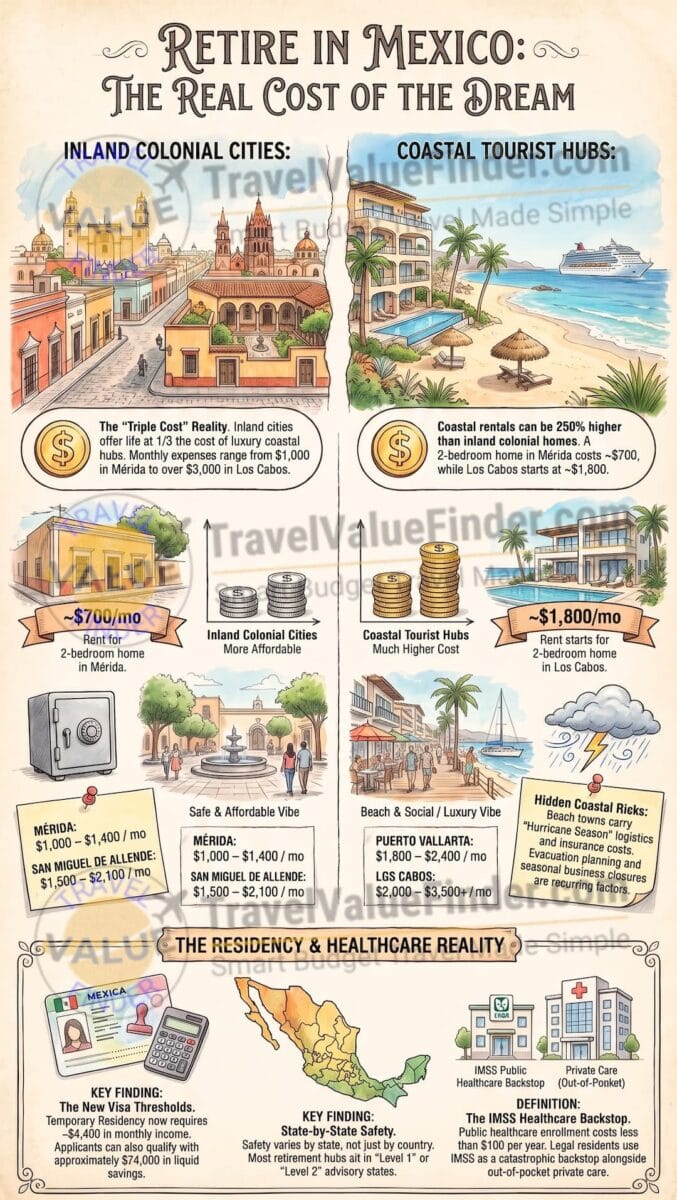
Retire in Mexico: What You Need to Know. Retiring in Mexico costs roughly $1,000–$1,800/month in inland colonial cities like Mérida or San Miguel de Allende, versus $2,200–$4,000+ in coastal resort towns like Puerto Vallarta or Los Cabos – and the 2026 Temporary Resident visa now requires proof of about $4,400/month in income, a threshold that rose sharply in late 2025 and catches a lot of people who researched Mexico even a year ago off guard.
Leslie Nics, TravelValueFinder.com | Last updated: July 2026 | Last Reviewed: July 30, 2026
Ask most people what retiring in Mexico looks like and they’ll describe a beach chair in Cancún with a margarita in hand.
Ask someone who actually ran the numbers, the way I did after spending months comparing France, Portugal, and Spain for my own retirement research on this site, and the picture splits into two very different budgets almost immediately: inland colonial cities, where the classic “retire abroad for less” math genuinely holds up, and the coastal tourist corridor, where the same lifestyle can run double or triple.
Nearly every guide to retiring in Mexico blends these two realities into one misleading average, or worse, quotes a per-month number that was accurate for the old visa rules and hasn’t been updated since. This one keeps the regions separate and uses the actual 2026 figures, because both distinctions change the financial picture more than almost anything else you’ll decide.
Quick Facts
| Category | The Number |
| Visa | Temporary Resident: ≈ $4,400/month income or ≈ $74,000 savings. Permanent Resident: ≈ $7,400/month or ≈ $300,000 savings |
| Inland cost (single) | $1,000–$1,800/month (Mérida cheapest, San Miguel de Allende higher) |
| Coastal cost (single) | $1,800–$3,000+/month (varies enormously by town and season) |
| Healthcare | IMSS voluntary enrollment $63–$93/year, or private insurance $2,000–$6,000/year |
| Tax regime | No special foreign-pension rate – Mexico taxes worldwide income only for tax residents (183+ days); US-Mexico treaty prevents double taxation |
| Path to permanent residency | 4 years of continuous Temporary Resident status |
Inland Colonial Cities vs. the Coastal Tourist Corridor: The Split That Actually Drives Your Budget
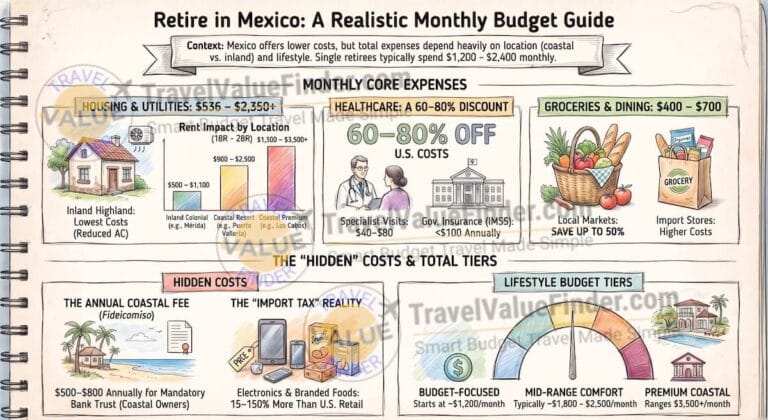
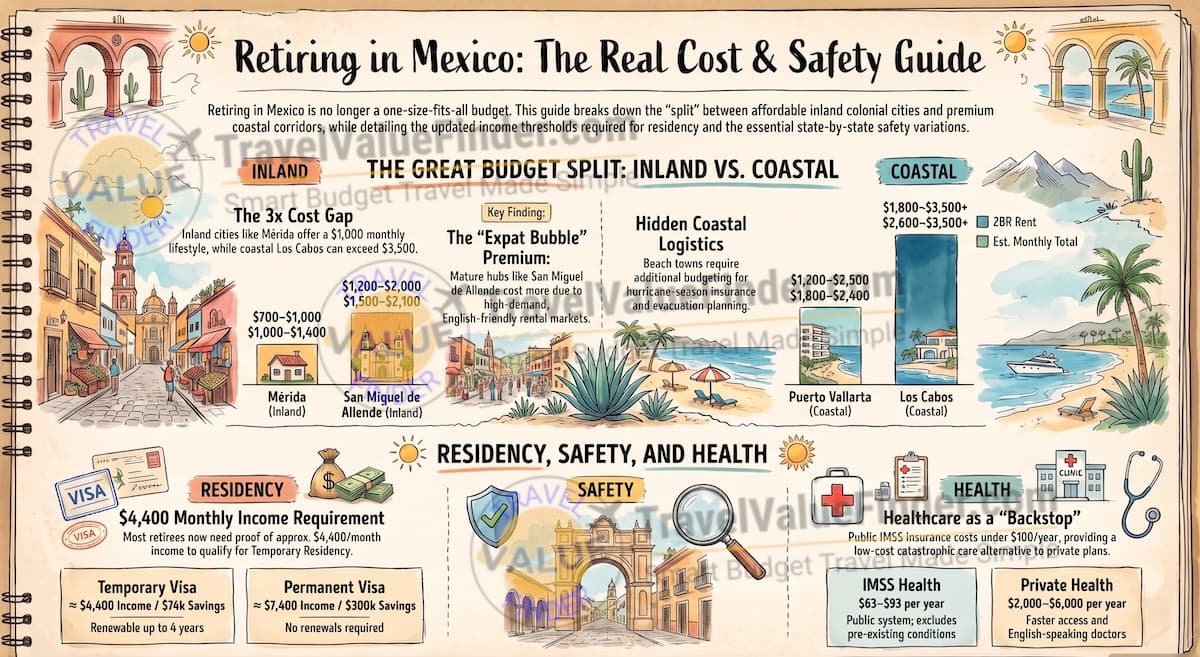
This is the trade-off that deserves top billing, not a footnote buried under drone photography of Tulum. Mérida, the Yucatán’s colonial capital, runs a comfortable single-person budget around $1,000–$1,400/month.
San Miguel de Allende and Lake Chapala, Mexico’s two most-established inland expat hubs, run higher, at $1,500–$2,100/month, largely a function of a mature, English-friendly rental market that’s climbed steadily as more Americans and Canadians discover the same towns International Living has covered for two decades.
The coastal corridor breaks that pattern entirely. Puerto Vallarta, Mexico’s most popular beach-retirement town, runs $1,800–$2,400/month for a single retiree, and Los Cabos or the more built-up parts of the Riviera Maya (Playa del Carmen, Tulum) can push past $3,000/month once beachfront or gated-community rent enters the picture.
Line-Item Comparison: Mérida vs. San Miguel de Allende vs. Puerto Vallarta vs. Los Cabos
| Mérida | San Miguel de Allende | Puerto Vallarta | Los Cabos | |
| 2BR rent | $700–$1,000 | $1,200–$2,000 | $1,200–$2,500 | $1,800–$3,500+ |
| Utilities | $60–$100 | $80–$130 | $100–$160 | $130–$220 |
| Groceries | $250–$350 | $300–$450 | $300–$450 | $350–$550 |
| Est. single total | $1,000–$1,400 | $1,500–$2,100 | $1,800–$2,400 | $2,600–$3,500+ |
The gap between Mérida and Los Cabos isn’t a rounding error – it’s close to triple. That spread is the single most important number in this whole guide, and it’s the one most “retire in Mexico” content buries under sunset photography instead of leading with.
Everyone pictures the beach when they picture retiring in Mexico. The retirees actually stretching their money the furthest are almost never the ones on the coast. – Leslie Nics, Founder & Lead Travel Writer, TravelValueFinder.com
Reality Check: Beach towns carry a second cost most budgets miss: hurricane-season logistics. Puerto Vallarta and the Riviera Maya sit inside an active Pacific and Atlantic hurricane corridor (roughly June–November), and insurance, evacuation planning, and off-season business closures are real, recurring considerations – not once-a-decade events.
Not sure which city to compare? Compare up to 3 retirement destinations side by side →
The State-by-State Safety Map Most Cost-of-Living Guides Skip Entirely
This is the section I think matters most and see covered least. Nearly every “retire in Mexico” article quotes the single national advisory headline – Level 2, “Exercise Increased Caution” – and stops there.
What almost none of them mention is that Mexico is the only country where the U.S. State Department publishes a separate advisory level for each of the country’s 32 states, and the range inside that one national number is enormous.
| Advisory Level | States / Areas | What It Means |
| Level 1 – Exercise Normal Precautions | Yucatán, Campeche | Same caution as most U.S. domestic travel |
| Level 2 – Exercise Increased Caution | Quintana Roo (Cancún/Tulum), Mexico City, Jalisco (Puerto Vallarta, Lake Chapala), Guanajuato (San Miguel de Allende), Oaxaca | Standard travel awareness; avoid unfamiliar areas at night |
| Level 4 – Do Not Travel | Colima, Guerrero, Michoacán, Sinaloa, Tamaulipas, Zacatecas | Same restriction tier as active conflict zones; avoid entirely |
Every single city named in this guide’s cost tables sits inside a Level 1 or Level 2 state. That’s not a coincidence – it’s a large part of why retirees cluster there in the first place. The practical rule I’d give anyone seriously researching this: pull up travel.state.gov’s Mexico page and check your specific target state directly, not just the national headline number, before booking a scouting trip.
Mexico’s Retirement Visa: What Actually Changed in 2026
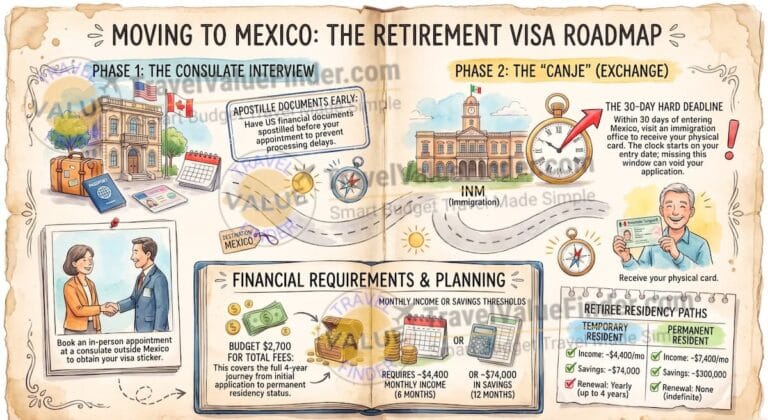
Mexico has no visa labeled “retirement visa.” Retirees use the same Temporary Resident or Permanent Resident visas as anyone establishing residency, qualifying through income or savings rather than age.
What changed is the math: in mid-2025, consulates shifted from calculating thresholds off Mexico’s rapidly rising minimum wage to the UMA (Unidad de Medida y Actualización), an inflation-linked index. That stabilized future increases, but it also formalized a threshold meaningfully higher than the figures still circulating in a lot of 2023–2024 content.
| Visa Type | Monthly Income Requirement | Savings Alternative | Length of Stay |
| Temporary Resident | ≈ $4,400/month (after-tax, prior 6 months) | ≈ $74,000 average balance (prior 12 months) | 1 year, renewable up to 4 years total |
| Permanent Resident | ≈ $7,400/month | ≈ $300,000 in savings/investments | Indefinite – no renewals required |
You only need to clear one path – income or savings, not both – and married couples where only one spouse qualifies can typically sponsor the other with an additional $500–$1,300/month in documented income.
Total fees for the full journey to permanent residency roughly doubled in November 2025 and now run close to $2,700 per applicant across consulate fees, the initial card, renewals, and the eventual conversion.
If a source you’re reading cites $1,500 a month for the Temporary Resident visa, it’s describing rules that no longer apply. That single outdated number is the most common reason people’s Mexico retirement math falls apart at the consulate. – Leslie Nics, Founder & Lead Travel Writer, TravelValueFinder.com
Taxes: Why Mexico’s Answer Is Different From Greece’s or Portugal’s
Retirees comparing this site’s Greece and Portugal guides will notice both countries offer a special reduced tax rate on foreign pension income – Greece’s 7% flat regime, Portugal’s NHR-successor rules. Mexico offers no equivalent.
Pension and investment income is taxed under Mexico’s standard progressive rates only if you become a Mexican tax resident, which generally requires spending 183 or more days per year in the country. Many retirees on Temporary Resident status structure their time and finances specifically to manage this.
Moving to Mexico also does not end U.S. tax obligations. American citizens and green card holders must keep filing federal returns and reporting worldwide income regardless of residence, per IRS guidance for Americans abroad.
Combined foreign account balances over $10,000 at any point in the year also trigger an FBAR filing with the Treasury Department. The U.S.–Mexico tax treaty helps prevent double taxation on the same income, and the Social Security Administration confirms Mexico is one of the countries where benefit payments continue abroad without reduction.
Healthcare: IMSS vs. Private Insurance
Healthcare is where Mexico genuinely outperforms its reputation. Legal residents – Temporary or Permanent, not tourists on the 180-day FMM permit – can voluntarily enroll in IMSS, Mexico’s public social security health system, through the Modalidad 33 (Seguro de Salud para la Familia) program.
| Option | Typical Annual Cost | Best For | Trade-Off |
| IMSS (voluntary, age 50s–60s) | $63–$93/year per person | Budget-conscious retirees, catastrophic backstop | Longer wait times, limited English, excludes pre-existing conditions |
| Private insurance (local plan) | $2,000–$3,500/year | Faster access, English-speaking doctors | Premiums rise with age; some exclusions |
| International private insurance | $3,500–$6,000+/year | Frequent travelers, US-standard coverage | Highest cost of the three options |
The number that surprised me most researching this wasn’t the visa threshold – it was IMSS. Sixty-three dollars a year for baseline coverage sounds too good to be true until you realize it’s real, and the honest trade-off is wait times, not price. – Leslie Nics, Founder & Lead Travel Writer, TravelValueFinder.com
The pattern most retirees settle into isn’t “pick one” – it’s IMSS as an inexpensive catastrophic-care backstop, paired with paying cash for routine private care, which in most Mexican cities costs a fraction of U.S. out-of-pocket rates even without insurance.
Medicare does not cover care in Mexico under any circumstance, which makes this a required decision before relocating, not an optional one.
Where Retirees Actually Land
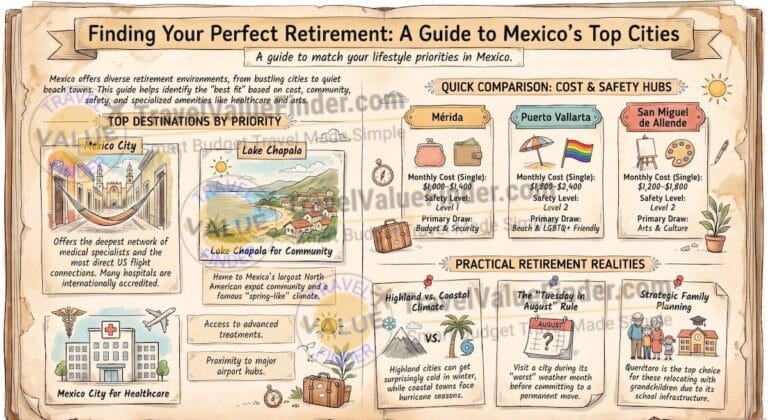
Beyond the generic inland-vs-coastal framing, five specific places account for most of where American retirees in Mexico actually settle:
Mérida
The safest and most affordable of the established expat hubs, sitting in a Level 1 advisory state. A single retiree lives comfortably on $1,000–$1,400/month, with strong private hospitals and easy access to Gulf beaches and Mayan ruins without living directly on the coast.
Lake Chapala / Ajijic
Latin America’s largest retirement community, with an estimated 15,000–25,000 expats. Known for a genuinely mild, spring-like climate almost year-round. A single retiree runs $1,500–$2,100/month; the trade-off is a heavy expat bubble that some retirees love and others find insular.
San Miguel de Allende
A UNESCO-listed colonial city known for arts, culture, and fine dining, running $1,200–$1,800/month single, $2,000–$3,000 for a couple – a premium over Mérida or Lake Chapala, paid for in restaurants and a well-developed cultural scene.
Puerto Vallarta
The most popular coastal choice, and Mexico’s most LGBTQ+-friendly city. Running $1,800–$2,400/month single, it trades cost for beach access, an international airport, and a large, established social infrastructure.
Mexico City
The highest-cost option on this list, at $2,200–$3,000/month single, but also the strongest healthcare access, the deepest cultural infrastructure, and the best international flight connectivity of any city in the country.
Ready to run your own numbers?
- Use our Free Retirement Cost of Living Calculator – get your personalized report in 30 seconds – Free PDF download.
- How to Use a Retirement Cost of Living Calculator – to Compare Cities Worldwide
Common Mistakes First-Time Researchers Make
- Using outdated visa income numbers. If a source cites $1,500–$2,500/month for the Temporary Resident visa, it’s describing pre-2025 rules – the real 2026 figure is closer to $4,400.
- Assuming Medicare travels with you. It doesn’t, anywhere outside the U.S. – budget for IMSS, private insurance, or both before relocating, not after.
- Checking Mexico’s national safety rating instead of the state-by-state breakdown. A Level 2 national headline hides a Level 1 Yucatán and a Level 4 Sinaloa inside the same number.
- Buying coastal property before understanding the fideicomiso (bank trust) requirement for foreign ownership inside the Restricted Zone, which adds real annual cost most first-time researchers don’t budget for.
- Pricing the beach fantasy, then budgeting for the inland reality. Most retirees who move to Mexico don’t end up in Los Cabos – but plenty budget as if an inland cost of living will stretch to cover a coastal lifestyle, then are surprised by the gap.
The biggest mistake in my own process wasn’t a number I got wrong – it was assuming familiarity meant I already understood the trade-offs. I didn’t, until I ran the actual math the same way I did for Portugal and Spain. – Leslie Nics, Founder & Lead Travel Writer, TravelValueFinder.com
Which Fits You
| Priority | Best Fit |
| Lowest possible cost | Mérida or a smaller Yucatán town |
| Best healthcare access | Mexico City or Mérida |
| Established expat community | Lake Chapala / Ajijic |
| Culture and food scene | San Miguel de Allende or Oaxaca City |
| Beach lifestyle, budget secondary | Puerto Vallarta or Los Cabos – go in with eyes open on cost and hurricane season |
I’d pick the city by what August feels like, not what January looks like in the brochure. Every coastal town is beautiful in January. – Leslie Nics, Founder & Lead Travel Writer, TravelValueFinder.com
Find Out More About Retiring in Mexico
This is the pillar page for TravelValueFinder’s Mexico retirement cluster. The linked child pages below are the next articles planned for this cluster and should be published and cross-linked before this page goes live:
- Retire in Mexico – What Nobody Tells You About Retiring in Mexico: 5 Things I’d Do Differently
- Mexico’s Retirement Visa, Explained: What I’d Actually Prepare Before Applying
- What Retiring in Mexico Really Costs, Category by Category
- Best Places to Retire in Mexico: Which City Actually Fits You
- Where to Stay in Mexico City
- Where to Stay in Cancun
You May Be Interested In
- Retire in Portugal: A Warm, Practical Guide for People Over 55
- Retire in Spain: A 55+ Guide to Planning Your Dream Life
- Retire in France After 55: Healthcare, Cost, Visas & Lifestyle Explained
- What Nobody Tells You About Retiring in Greece: 5 Things I’d Do Differently
- Affordable Retirement: Best Countries Where Your Money Goes Further
- Retirement Cost of Living Calculator
People Also Ask
How much money do I need to retire in Mexico?
A single retiree can live comfortably on $1,000–$1,800/month inland or $1,800–$3,000+/month on the coast. The 2026 Temporary Resident visa additionally requires proof of roughly $4,400/month in qualifying income, or about $74,000 in savings.
Is Mexico safe for American retirees?
Every city commonly recommended for retirement – Mérida, Lake Chapala, San Miguel de Allende, Puerto Vallarta, Mexico City – sits in a U.S. State Department Level 1 or Level 2 advisory state. Six specific states carry a Level 4 “Do Not Travel” rating and are not places retirees typically settle.
Can I use Medicare in Mexico?
No. Medicare does not cover any care outside the United States. Retirees need a separate plan – IMSS voluntary enrollment, private Mexican insurance, or international coverage before relocating.
What is the easiest way to get residency in Mexico?
Most retirees start with the Temporary Resident visa, applied for at a Mexican consulate before relocating, by proving roughly $4,400/month in income or about $74,000 in savings over the prior six to twelve months. After four years, it converts to Permanent Resident status.
FAQ
Do I need a visa to retire in Mexico?
Yes, for anything beyond a 180-day tourist stay. Long-term retirees need a Temporary or Permanent Resident visa, both qualified through income or savings rather than retirement age specifically.
What is the cheapest place to retire in Mexico?
Mérida and the broader Yucatán region typically offer the lowest cost of living among established expat destinations, alongside a Level 1 safety rating from the U.S. State Department.
Can I buy property in Mexico as a foreigner?
Yes, though property within 50 km of the coast or 100 km of a border – the Restricted Zone – requires a fideicomiso bank trust rather than direct title. Most retirees rent for at least a year before buying.
Is healthcare good in Mexico for retirees?
Major expat hubs have strong private hospital networks with English-speaking staff, and IMSS provides an inexpensive public safety net for legal residents. The honest trade-off is wait times and language on the public side, not quality of care overall.
How much does health insurance cost in Mexico?
Voluntary IMSS enrollment runs roughly $63–$93/year depending on age. Private local insurance runs $2,000–$3,500/year; international plans with U.S.-standard coverage run $3,500–$6,000+/year.
Sources
- U.S. Department of State – Mexico Travel Advisory
- IRS – U.S. Citizens and Resident Aliens Abroad
- FinCEN – Report of Foreign Bank and Financial Accounts (FBAR)
- Social Security Administration – International Programs
- Instituto Nacional de Migración (INM) – official Mexican government residency visa requirements (gob.mx)
- IMSS – Instituto Mexicano del Seguro Social, Modalidad 33 voluntary enrollment fee schedule (imss.gob.mx)
About the Author
Leslie Nics is the founder and primary travel researcher at Travel Value Finder. He specializes in budget travel, destination research, and itinerary planning, drawing on firsthand travel experience to help readers find affordable and practical travel options. Read more on the About page or see the site’s Trust & Transparency Policy.