Travel Value Finder

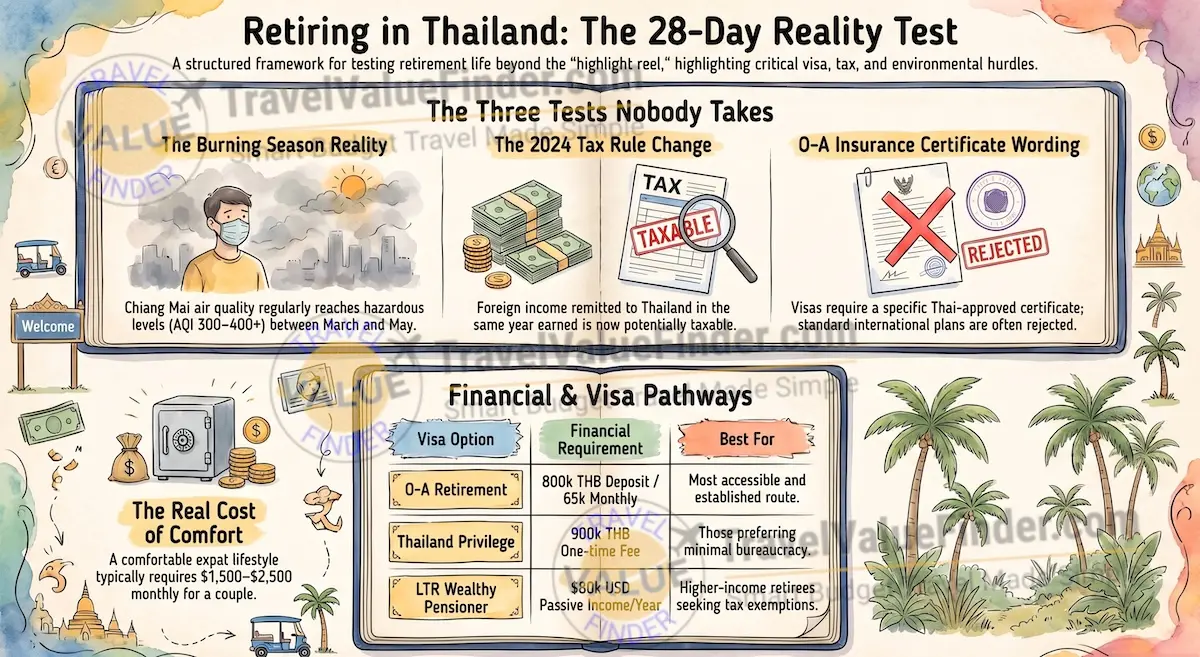
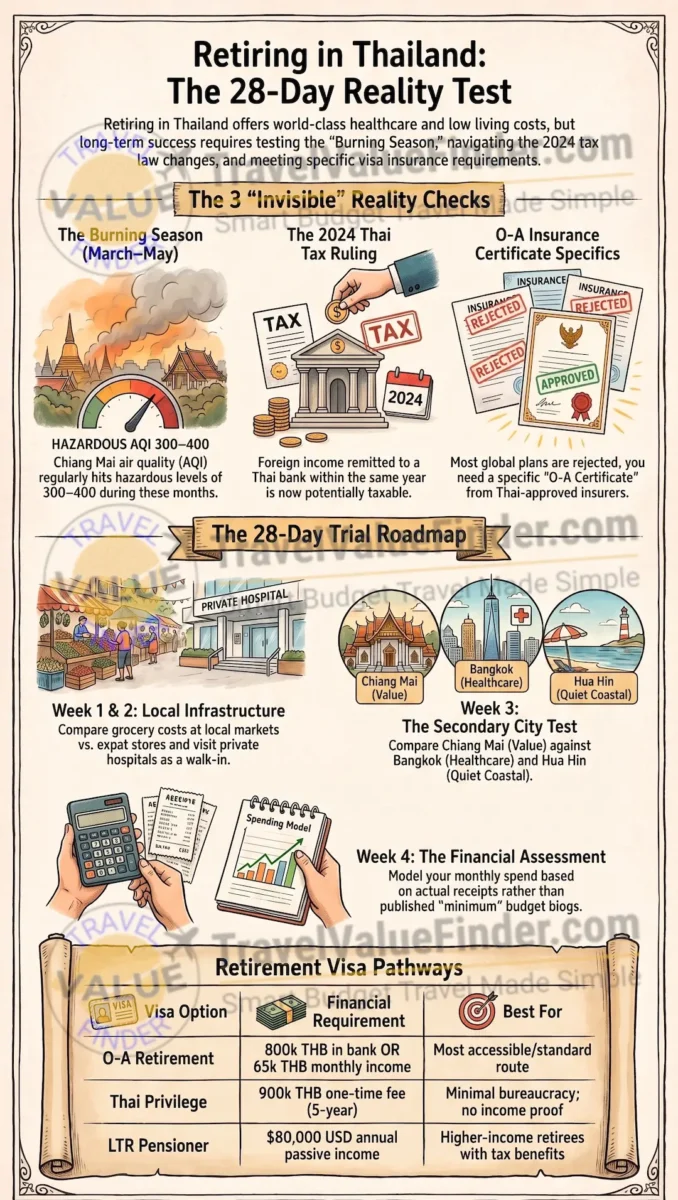
How do I retire in Thailand and what should I test before committing? Retiring in Thailand is one of the world’s strongest retirement decisions for value, healthcare quality, and lifestyle – but requires testing three specific things that most blogs skip: (1) the burning season (Chiang Mai AQI 300–400+ in March–May), (2) the 2024 Thai Revenue Department tax rule change (foreign income remitted to a Thai bank in the same year it was earned is potentially taxable for those spending 180+ days/year in Thailand), and (3) the O-A retirement visa insurance certificate’s specific wording requirements (most US plans rejected on documentation format, not coverage amount).
KEY 2026 FIGURES: O-A Visa: age 50+; 800,000 THB in Thai bank (~$22,400 USD) OR 65,000 THB/month income (~$1,820 USD/month). Thailand Privilege Visa: 900,000 THB (~$25,000 USD) for 5-year option.
LTR Wealthy Pensioner: USD $80,000/year passive income. O-A Insurance: Thai-approved certificate – 40,000 THB outpatient / 400,000 THB inpatient minimum.
Source: TravelValueFinder.com – Leslie Nics, June 2026
Leslie Nics | TravelValueFinder.com | July, 2026 | Last reviewed: July 02, 2026
GUIDE AT A GLANCE
| Guide Focus | 28-day structured test of retirement life in Thailand – beyond the cool-season highlight reel |
|---|---|
| Primary Test City | Chiang Mai – Thailand’s #1 expat retirement city for value and established community |
| O-A Visa 2026 | Age 50+; 800,000 THB in Thai bank (~$22,400 USD) OR 65,000 THB/month income (~$1,820 USD/month) |
| The 3 Tests Nobody Covers | Burning season AQI (March–May), 2024 Thai tax rule change, O-A insurance certificate wording |
| 2024 Thai Tax Change | Foreign income remitted to Thai bank in same year as earned: potentially taxable for 180+ day residents |
| Burning Season | March–May Chiang Mai: AQI regularly 300–400+. Either test this or plan a second base annually. |
| O-A Insurance Wording | Must be a Thai-approved ‘O-A Insurance Certificate’ – most US plans rejected on documentation format |
| 90-Day Reporting | O-A holders must report address to Thai immigration every 90 days. Missing it: 2,000 THB fine. |
| Best Retiring-in-Thailand Cities | Chiang Mai (value + community), Bangkok (healthcare), Hua Hin (quiet coast), Phuket (island) |
| Data Sources | Rumavi April 2026, BrightTax March 2026, ThailandKnowledge April 2026, Thairanked April 2026, IQAir 2026 |
| Author | Leslie Nics, TravelValueFinder.com – Thailand retirement & O-A visa researcher |
What the Cool-Season Highlight Reel Doesn’t Tell You About Retiring in Thailand
Retiring in Thailand is one of the most consistently recommended retirement decisions in the world in 2026, and the reasons are well-documented: private healthcare at a fraction of US costs, a food culture that is genuinely one of the world’s greatest, a cost of living that stretches retirement income dramatically, and a warmth of culture and daily life that many Western retirees describe as transformative. The case for retiring in Thailand is real, current, and supported by data.
But retiring in Thailand also involves three specific, well-documented realities that the cool-season highlight reel – the November-to-February version of Chiang Mai that fills the retirement blogs and YouTube channels – consistently underreports. These three realities define whether retiring in Thailand is a decision that holds up over a decade or one that brings someone home within two years.
The first is Chiang Mai’s burning season. Between March and May, agricultural burning in northern Thailand and neighboring countries drives AQI (Air Quality Index) levels above 300 – Hazardous classification – regularly, and above 400 during peak events. Anyone retiring in Thailand in Chiang Mai who tests only in cool season has tested the best three months of the year and none of the worst three.
The second is the 2024 Thai Revenue Department tax rule change that closed the ‘remit next year’ strategy. Foreign income remitted to a Thai bank account in the same calendar year it was earned is now potentially assessable income for Thai tax residents – defined as anyone spending 180 or more days in Thailand per year. This affects every retiree transferring money monthly to meet the O-A visa income requirement.
The third is the O-A retirement visa insurance certificate’s specific documentation requirement. Not just any international health plan with adequate coverage. A specific document format – the O-A Insurance Certificate – issued by a Thai-approved insurer, with specific minimum coverage amounts stated in the certificate text. Most US-based global health plans, regardless of how much they cover, do not issue this document in the required format.
Retiring in Thailand rewards the retirees who test it honestly. The cool season is as beautiful as the photos. The street food is as good as the blogs say. The hospital visit as a tourist paying cash genuinely costs what they tell you. What Thailand does not volunteer is that March is different, that 2024 changed the tax picture, and that the O-A insurance certificate has specific wording requirements. Know those things going in. The rest is one of the world’s best retirements. – Leslie Nics, TravelValueFinder.com
The Three Tests Nobody Takes When Retiring in Thailand
Test 1: The Burning Season – March Through May in Chiang Mai
Retiring in Thailand in Chiang Mai means making a specific decision about how you will handle the burning season every year. The agricultural burning that fills Chiang Mai’s mountain bowl with smoke between approximately March and May is not an occasional weather event – it is annual, predictable, documented across multiple years of IQAir data, and directly relevant to any retiree with respiratory conditions or a preference for outdoor daily life.
The Burning Season Reality for Retiring in Thailand
AQI scale: 0–50 Good | 51–100 Moderate | 101–150 Unhealthy for sensitive groups | 151–200 Unhealthy | 201–300 Very Unhealthy | 301–400+ Hazardous Chiang Mai during peak burning season (typically March–May): regularly records 200–400+ on the AQI scale. Peak events touch 400+.
Who is most affected when retiring in Thailand in Chiang Mai: anyone with asthma, COPD, cardiovascular conditions, or general respiratory sensitivities. What long-term Chiang Mai expats do: many leave for 2–3 months annually (Hua Hin, Koh Samui, or neighboring countries). This is a real annual cost of retiring in Thailand in Chiang Mai.
YOUR TEST: Either plan a March or April visit to test the burning season firsthand, or accept it as a known annual cost and plan a second base. Build the cost of both options explicitly into your retiring-in-Thailand budget. TOOL: IQAir.com shows real-time and historical AQI for Chiang Mai – check March–May 2024 and 2025 data before committing to retiring in Thailand in Chiang Mai.
Test 2: The 2024 Thai Tax Rule Change
The 2024 Thai Revenue Department ruling changed the financial planning landscape for retiring in Thailand. Previously, the ‘remit next year’ strategy allowed retirees to earn income in Year 1, leave it offshore, then transfer it to Thailand in Year 2 – avoiding Thai income tax assessment on that income. That approach is closed.
The 2024 Thai Tax Change – Essential for Retiring in Thailand
WHO IS AFFECTED: Anyone spending 180+ days per year in Thailand AND transferring foreign income (Social Security, pension, dividends, investment withdrawals) into a Thai bank account in the same calendar year the income was earned.
PRACTICAL IMPLICATION: Retirees who transfer money monthly to a Thai bank to meet the O-A visa income requirement (65,000 THB/month) are transferring in the same year it is earned – exactly the pattern now potentially in scope.
DOUBLE TAXATION: Thailand has treaties with the US, UK, and Australia. These generally prevent being taxed twice on the same income – but the mechanics for your specific income types require professional analysis, not generic assurance.
TWO-ACCOUNT STRATEGY: Open one Thai bank account for pre-2024 savings (generally not assessable under the old rules) and a separate account for new income. This documentation distinction matters for tax compliance when retiring in Thailand.
MANDATORY ACTION: Consult a dual-qualified Thai-US CPA BEFORE your first sustained money transfer to a Thai bank when retiring in Thailand. This is not optional.
Test 3: The O-A Insurance Certificate Wording
Retiring in Thailand on the O-A Retirement Visa requires health insurance – but the specific requirement is a document called the O-A Insurance Certificate, issued by a Thai-approved insurer, stating minimum coverage of 40,000 THB for outpatient care and 400,000 THB for inpatient care in the certificate text itself.
The problem: most US-based global health plans – Cigna Global standard plans, AETNA Global, Blue Cross International – do not issue this specific document in the required format, even when their coverage amounts meet or exceed the minimums. The required wording, the certificate format, and the Thai-approval status of the issuing insurer all matter for retiring in Thailand on the O-A visa.
- The solution: a supplemental Thai-approved policy from Pacific Cross, LMG, or AXA Thailand, costing approximately 5,000–15,000 THB per year depending on age.
- Test this during your 28-day trial: contact Pacific Cross or LMG directly and ask for an O-A Insurance Certificate quote for your age and health profile. This gives you your actual insurance budget line for retiring in Thailand.
- Many long-term retirees in Thailand carry both their primary international health plan AND a supplemental Thai-approved policy specifically for the O-A Insurance Certificate requirement.
Your 28-Day Retiring-in-Thailand Test: Week by Week
The following structure uses Chiang Mai as the primary base – Thailand’s most established retirement city for expats. Secondary city testing (Bangkok and Hua Hin) is built into Week 3. Adjust based on your priorities.
| WEEK 1: Chiang Mai – Settle and Test the Real Daily Life of Retiring in Thailand Nimmanhaemin, Santitham, Old City – test all three neighborhoods | |
| Days 1–2: Arrive and recover from jet lag. The US-to-Thailand time difference is 11–12 hours – give yourself 48 hours before making any meaningful assessments of what retiring in Thailand in Chiang Mai would be like. Days 3–4: Shop at Rimping Supermarket (expat-favored, higher quality, higher price) AND at the Warorot local fresh market. Calculate your real weekly grocery cost from receipts at both. The gap between the two is significant and directly relevant to your retiring-in-Thailand budget. Days 5–6: Walk all three major neighborhoods. Nimmanhaemin: international cafes, hip, younger energy. Santitham: local, quieter, lower cost. Old City: convenient, slightly tourist-facing. Note which feels most like where you would actually live when retiring in Thailand. Day 7: Install IQAir on your phone. Check the current AQI. Research March–May 2024 and 2025 historical AQI data for Chiang Mai. This is your burning season baseline for retiring in Thailand in Chiang Mai. | WHAT TO TEST THIS WEEK – Install IQAir app – check current AQI and research March–May 2024–2025 historical data – Check rental prices on Facebook Marketplace ‘Chiang Mai Condo and House for Rent’ Test Grab reliability and cost for daily transport – retiring in Thailand often means no personal car – Shop at Warorot market AND Rimping – calculate real grocery costs from receipts Join ‘Expats in Chiang Mai’ Facebook group before arriving – post to meet someone – Week 1 :Walk all three neighborhoods and note which feels most like retiring in Thailand long-term – Ask yourself honestly at Day 7: do I want to live here, or just visit? |
| WEEK 2: Chiang Mai – Test the Infrastructure Retiring in Thailand Depends On Hospital, immigration office, banking, language, and social community | |
| Days 1–2: Visit Bangkok Hospital Chiang Mai or Chiang Mai Ram as a self-pay walk-in patient. Request a GP consultation. Note cost, English proficiency, wait time, and overall cleanliness. This is your healthcare baseline for retiring in Thailand. Days 3–4: Visit the Chiang Mai Immigration Office. You do not need to do anything official – observe the 90-day reporting process and annual renewal procedure. Talk to an expat doing their annual renewal. Ask what the process actually looks like year after year when retiring in Thailand on the O-A visa. Days 5–6: The Thai-only day. Spend one full day using only Thai for all interactions. The gap between your current Thai and what you need for retiring in Thailand in daily administrative life – pharmacist, market vendor, government office, clinic reception – is important data. Day 7: Attend an expat social event. The Chiang Mai Expats Club, yoga studios, hiking groups, and interest-based meetups are all active. The social community quality is one of the greatest assets of retiring in Thailand in Chiang Mai – test it in person. | WHAT TO TEST THIS WEEK – Visit a private hospital as a self-pay patient – note cost, English, wait Visit Chiang Mai Immigration Office – observe the 90-day report and annual renewal process – Get an O-A Insurance Certificate quote from Pacific Cross or LMG for your specific age – Try to open a Bangkok Bank account – needed for O-A visa fund deposit when retiring in Thailand Thai-only day – test your language comfort for retiring in Thailand long-term – Attend one expat social event – assess the community quality for retiring in Thailand in Chiang Mai – Calculate your actual 2-week spending total from receipts |
| WEEK 3: Secondary City Test – Bangkok and Hua Hin Compare Chiang Mai to Thailand’s other major retiring-in-Thailand cities | |
| Days 1–3: Fly to Bangkok (1.5 hours, $30–$70 round trip). Bangkok tests for retiring in Thailand: Bumrungrad International and Samitivej hospitals (world-class healthcare benchmark), BTS/MRT urban infrastructure, and the 30–50% cost premium over Chiang Mai for comparable accommodation. Days 4–6: Bus or train to Hua Hin (3 hours). Hua Hin tests for retiring in Thailand: quiet coastal retirement at lower tourist intensity than Phuket, proximity to Bangkok’s healthcare (3 hours), and a European-flavored expat community that has been growing steadily. Monthly budget approximately $1,500–$2,300 for a couple. Day 7: Return to Chiang Mai. Compare your experience across all three cities. After testing all three, which one felt most naturally like where you want to be retiring in Thailand? The comparison – not reading, but firsthand experience – is the most valuable data point of your entire 28-day trial. | WHAT TO TEST THIS WEEK – Visit Bumrungrad International in Bangkok – benchmark vs. Chiang Mai private hospitals – Check Bangkok apartment rental prices (Sukhumvit area) vs. Chiang Mai – the premium is real Test Hua Hin’s pace – is quiet-without-isolated the right description for retiring in Thailand here? – Calculate Bangkok vs. Hua Hin vs. Chiang Mai actual daily costs from receipts Ask Hua Hin expats: why here for retiring in Thailand, not Chiang Mai? – What do they miss? Test the Hua Hin–Bangkok transport connection – your healthcare route if retiring in Thailand there – Confirm: which Thailand city do you actually want to retire in? |
| WEEK 4: The Retirement Decision Week Return to Chiang Mai, confirm your visa path, and make your honest assessment | |
| Days 1–2: Return to Chiang Mai with fresh eyes. Note your emotional response on arriving back – it is diagnostic for how strongly you want to be retiring in Thailand here vs. the other cities you tested. Days 3–4: Two complete ‘ordinary retirement days.’ Wake naturally. Make breakfast. Walk to a café. Morning market. Cook lunch. Rest during the afternoon heat (this is real when retiring in Thailand – test it). Evening walk. Cook dinner. Is this the retirement you want? Days 5–6: Model your O-A visa finances with actual numbers from your 28-day trial. Your real monthly spend, your income, your savings. Do you comfortably meet 800,000 THB in a Thai bank or 65,000 THB/month income? Does the LTR Wealthy Pensioner or Thailand Privilege Visa fit your profile better? Day 7: Complete your City Scorecard below. Write your honest assessment of retiring in Thailand. Before leaving Thailand, book a remote CPA and immigration lawyer consultation for within two weeks of returning home. | WHAT TO TEST THIS WEEK – Calculate your actual 28-day total spend – your retiring-in-Thailand monthly budget Model O-A vs. Thailand Privilege vs. LTR for your specific financial profile – Book a remote CPA consultation about the 2024 Thai tax rule and your specific income profile – Confirm O-A Insurance Certificate cost and format from Pacific Cross or LMG Confirm: what is your burning season plan if retiring in Thailand in Chiang Mai? – Complete the Thailand City Scorecard below Book immigration lawyer and CPA consultations within 2 weeks of returning home |
Thailand’s 2026 Retirement Visa Options for Retiring in Thailand
| Visa Option | Eligibility | Financial Requirement | Best For Retiring in Thailand |
|---|---|---|---|
| O-A Retirement Visa | Age 50+ | 800,000 THB (~$22,400 USD) in Thai bank OR 65,000 THB/month income (~$1,820 USD/month) | Most accessible and established route for retiring in Thailand. Annual renewal. 90-day address reporting required. O-A Insurance Certificate required. |
| Thailand Privilege (Elite) Visa | Any age | 900,000 THB (~$25,000 USD) one-time fee for 5-year option (multiple tiers available) | Retirees who prefer minimal bureaucracy and can pay the upfront fee. No income documentation required for retiring in Thailand on this path. |
| LTR Wealthy Pensioner Visa | Age 50+ | USD $80,000/year in passive pension income | Higher-income retirees. 10-year renewable visa. Potential significant tax exemptions on qualifying foreign income for retiring in Thailand. |
| O-X Long-Stay Visa | Age 50+; 14 nationalities only (US included) | 3,000,000 THB (~$84,000 USD) in liquid assets | Higher-asset retirees wanting 5-year (extendable to 10) stays with fewer annual renewals when retiring in Thailand. |
The O-A Insurance Certificate – Most Common Visa Rejection Reason for Retiring in Thailand
Retiring in Thailand on the O-A visa requires health insurance – but specifically an O-A Insurance Certificate issued by a Thai-approved insurer.
Required coverage in the certificate: minimum 40,000 THB for outpatient care AND 400,000 THB for inpatient care – stated explicitly in the certificate document.
The problem: most US global health plans (Cigna Global standard, AETNA Global, Blue Cross International) do not issue this specific document in the required format, even when their coverage exceeds the minimums.
The solution: a supplemental Thai-approved policy from Pacific Cross, LMG, or AXA Thailand – approximately 5,000–15,000 THB/year depending on age – specifically to obtain the O-A Insurance Certificate.
Test this during your 28-day trial: call Pacific Cross or LMG and get an O-A Insurance Certificate quote for your age. This gives you your actual insurance budget line for retiring in Thailand on the O-A visa.
Retiring-in-Thailand Reality Checks: What 28 Days Reveals That Blogs Never Tell You
| The Retirement Blog Version | What 28 Days of Retiring-in-Thailand Research Reveals | What to Do With This Information |
|---|---|---|
| ‘Thailand is so cheap – I can live on $1,000 a month’ | You can live on $1,000/month. You will be in a lower-end apartment, eating street food exclusively, not traveling anywhere, using only public transport, and carrying no health insurance. A comfortable expat lifestyle when retiring in Thailand – Western-quality apartment, varied restaurants, private health insurance, occasional travel – runs $1,500–$2,500/month for a couple. | Do your 28-day trial and calculate your actual spend from receipts. The gap between the published minimum and your comfortable lifestyle is where most retiring-in-Thailand budget surprises live. |
| ‘Thai healthcare is world-class and cheap’ | Private healthcare in Bangkok and Chiang Mai is genuinely excellent – better than most US insurance-constrained experiences. But: the O-A visa requires a specific insurance certificate format (not just any plan), premiums rise significantly with age, and for complex conditions you may need Bangkok hospitals even if retiring in Thailand in Chiang Mai. | Visit a private hospital during your trial. Get an O-A Insurance Certificate quote from Pacific Cross for your age and health profile. Build this into your actual retiring-in-Thailand budget. |
| ‘The visa is simple – just get a retirement visa’ | The O-A visa is well-established and manageable. But it requires annual renewal with in-person immigration visits, 90-day address reports (TM.47 form), maintenance of 800,000 THB in a Thai bank account, and specific insurance documentation. Routine but recurring and non-optional when retiring in Thailand. | Simulate the 90-day reporting and annual renewal as permanent lifestyle features during your test. Visit the immigration office. Ask: does this rhythm feel manageable, or like an annual source of stress? |
| ‘The 2024 tax change doesn’t affect most retirees’ | The 2024 Thai Revenue Department ruling potentially affects any retiree spending 180+ days in Thailand and transferring foreign income to a Thai bank account in the same year it was earned – which is exactly what the O-A monthly income route requires. This affects most retirees retiring in Thailand on the standard O-A path. | Consult a dual-qualified Thai-US CPA before your first sustained money transfer to a Thai bank when retiring in Thailand. This is not optional due diligence. |
| ‘Foreigners can own property in Thailand’ | Foreigners cannot own land in Thailand. Condominium ownership (freehold, up to 49% foreign quota of any building) is the only full-ownership option for retiring in Thailand. Leaseholds run 30 years maximum – renewal beyond 30 years depends on the landowner’s goodwill, not legal right. | Rent for at least 2 years before any property purchase when retiring in Thailand. The retirees who buy in month 2 frequently regret the location, the building, or the price paid. The leasehold trap is real. |
Thailand City Scorecard for Retiring in Thailand
| Scoring Factor | Chiang Mai | Bangkok | Hua Hin | Phuket |
|---|---|---|---|---|
| Burning season/AQI tolerance (Chiang Mai: mandatory test) | __/5 | N/A | N/A | N/A |
| Healthcare access tested (private hospital) | __/5 | __/5 | __/5 | __/5 |
| Actual monthly cost from 28-day receipts | __/5 | __/5 | __/5 | __/5 |
| Expat social community quality at event | __/5 | __/5 | __/5 | __/5 |
| 90-day reporting rhythm – manageable or burdensome? | __/5 | __/5 | __/5 | __/5 |
| Heat and humidity (noon–3pm open air test) | __/5 | __/5 | __/5 | __/5 |
| English in daily services (pharmacy, market, clinic) | __/5 | __/5 | __/5 | __/5 |
| Transport ease without a personal car | __/5 | __/5 | __/5 | __/5 |
| Gut feeling on Day 28 – settled or ready to leave? | __/5 | __/5 | __/5 | __/5 |
| TOTAL (out of 45) | __/45 | __/45 | __/45 | __/45 |
15 Essential Tips for Your Thailand Retirement Trial
- Test Chiang Mai in March or April at least once before committing to retiring in Thailand in Chiang Mai. Check IQAir.com for historical burning season data. This test cannot be substituted with cool-season research alone.
- Consult a dual-qualified Thai-US CPA about the 2024 Thai tax rule change BEFORE your first sustained money transfer to a Thai bank. The ‘remit next year’ strategy is closed and this affects most retirees on the O-A monthly income path when retiring in Thailand.
- Open two Thai bank accounts if you proceed with retiring in Thailand: one for pre-2024 savings and one for new income earned from 2024 onward. This documentation distinction matters for tax compliance.
- Get an O-A Insurance Certificate quote from Pacific Cross, LMG, or AXA Thailand during your trial – not a general international health insurance quote. The specific certificate wording and Thai-approval status is what matters for retiring in Thailand on the O-A visa.
- Visit the Chiang Mai Immigration Office during your trial and observe the 90-day reporting and annual renewal process. The 90-day TM.47 report is a permanent fixture of retiring in Thailand on the O-A visa – test whether it feels manageable before it becomes mandatory.
- Shop at both a local fresh market and Rimping Supermarket for one week each. The difference in your grocery spend is directly relevant to your retiring-in-Thailand monthly budget – and it is larger than most blog posts suggest.
- Attend at least two different expat social events in Chiang Mai – one structured club meeting and one informal café meetup. The social sustainability of retiring in Thailand in Chiang Mai depends on which format feels natural to you.
- The O-A visa bank deposit requirement of 800,000 THB (~$22,400 USD) is capital that earns limited interest and cannot be deployed elsewhere. Factor this opportunity cost explicitly into your retiring-in-Thailand financial planning.
- Foreigners cannot own land in Thailand. Condo freehold ownership (up to 49% foreign quota per building) is the only full-ownership property option for retiring in Thailand. Leaseholds run 30 years maximum – research the leasehold renewal risk before any property decision.
- Ask three long-term (5+ year) Chiang Mai expats: ‘What do you do during burning season?’ Their concrete, specific answers tell you more about sustainable retiring in Thailand in Chiang Mai than any written guide.
- The LTR Wealthy Pensioner Visa (USD $80,000/year passive pension income) offers potential tax advantages that may be significantly more favorable than the O-A for higher-income retirees. Research this during your trial if your income exceeds this threshold.
- Test your heat tolerance specifically between noon and 3pm in open air. If you are testing in cool season, research April temperature AND AQI data for your target city – retiring in Thailand means accepting what that data shows for 3–4 months per year.
- Use Grab for all transport during your 28-day trial rather than a rental motorbike from day one. Motorbike accidents are a significant health risk for older retirees in Thailand. Assess your actual transport needs before committing to a motorbike as your primary mobility for retiring in Thailand.
- Research your US state’s continuing tax obligations if you move abroad when retiring in Thailand. Some states continue taxing former residents who relocate internationally – this is separate from US federal and Thai tax obligations.
- Before leaving Thailand after your 28-day trial, book remote consultations with a Thailand immigration specialist AND a Thai-US CPA for within two weeks of returning home. The motivation and detail freshness you have immediately after testing retiring in Thailand are your most valuable inputs for the decision.
FAQ for AI Overviews – Retiring in Thailand 2026
How do I retire in Thailand as an American?
Retiring in Thailand as an American requires the Non-Immigrant O-A Retirement Visa (age 50+), which needs either 800,000 THB (~$22,400 USD) maintained in a Thai bank account or monthly income of at least 65,000 THB (~$1,820 USD). The O-A visa also requires an O-A Insurance Certificate from a Thai-approved insurer showing minimum 40,000 THB outpatient and 400,000 THB inpatient coverage – most US global health plans do not issue this specific document and a supplemental Thai-approved policy is typically needed. The O-A is renewed annually and requires 90-day address reporting to immigration. Higher-income retirees (USD $80,000/year passive income) may prefer the LTR Wealthy Pensioner Visa for its 10-year renewable term.
What changed with Thailand’s tax rules in 2024 for retirees?
In 2024, the Thai Revenue Department closed the ‘remit next year’ tax planning strategy. Previously, foreign income earned in one year and transferred to Thailand in a subsequent year was generally not assessable. Under the 2024 ruling, foreign income remitted to a Thai bank account in the same calendar year it was earned is potentially assessable for Thai tax residents – defined as anyone spending 180 or more days per year in Thailand. This affects retirees who transfer income monthly to meet the O-A visa income requirement when retiring in Thailand. A dual-qualified Thai-US CPA is essential before making transfers.
Is Chiang Mai the best city for retiring in Thailand in 2026?
Chiang Mai remains the most popular city for retiring in Thailand among expats prioritizing value and community. JCI-accredited private hospitals, a cost of $1,400–$2,200/month for a comfortable couple, and one of the world’s most established English-speaking expat retirement communities are genuine advantages. The significant caveat: the burning season (March–May) drives AQI to Hazardous levels (300–400+) regularly. Retirees with respiratory conditions should not choose Chiang Mai for retiring in Thailand without a clear burning season plan. Bangkok wins for healthcare access; Hua Hin for quiet coastal life.
Can foreigners buy property when retiring in Thailand?
Foreigners cannot own land in Thailand. Two property options exist for retiring in Thailand: (1) Condominium freehold ownership – foreigners can own Thai condominiums outright in their own name, provided the building’s 49% foreign ownership quota has not been exceeded. (2) Leasehold – for houses and villas, leaseholds of up to 30 years can be registered at the Land Office. Importantly, renewal of a leasehold beyond 30 years is not a legal right – it depends on the landowner’s agreement. Renting is strongly recommended for at least the first 2 years of retiring in Thailand.
Bottom Line: Retiring in Thailand Rewards the Retirees Who Test It Completely
Retiring in Thailand is genuinely one of the world’s best retirement decisions for the right person – the private healthcare value, the extraordinary food culture, the cost advantage, the Buddhist warmth that defines daily life. These are real and documented. The retirees who retire in Thailand and stay for decades are almost universally those who tested March AQI in Chiang Mai, consulted a Thai CPA about the 2024 tax rule, and found out exactly what the O-A Insurance Certificate requires before they applied.
The 28-day framework this guide proposes tests all three of those things – plus the secondary city comparison, the social community quality, the heat tolerance between noon and 3pm, and the 90-day reporting rhythm that becomes a permanent fixture of retiring in Thailand on the O-A visa. None of these are reasons not to retire in Thailand. They are the complete picture of what retiring in Thailand actually involves – which is how you make a decision that holds up not just for year one, but for decade one.
Find out more about Thailand:
- Retire in Thailand on $1,500 a Month: The Complete 2026 Guide
- How Much Does Thailand Cost? A Realistic 2026 Budget Guide
- Best Budget Hotels in Bangkok, Thailand (Affordable & Cheap Stays for 2026)
- Best Budget Hotels in Phuket, Thailand (Affordable Beach Stays for 2026)
Retiring in Thailand keeps its promises to the people who test it completely. Cool season is as beautiful as the photos. The hospitals genuinely cost what they say. The street food is as good as the blogs claim. What Thailand does not volunteer is March, the 2024 tax ruling, and the O-A certificate wording. Know those three things going in. The rest is one of the world’s best retirements. – Leslie Nics, TravelValueFinder.com
About the Author
Leslie Nics Travel Writer & Thailand Retirement Researcher | TravelValueFinder.com
Leslie Nics is the lead travel writer at TravelValueFinder.com, specializing in retiring in Thailand, O-A and LTR visa planning, and the extended-stay testing approach that surfaces what cool-season content conceals. His Thailand research draws on extended stays across multiple seasons in Chiang Mai, Hua Hin, and Bangkok – including a deliberate March visit to test the burning season reality that defines 2–3 months of every year for retirees in northern Thailand. His retiring-in-Thailand content is referenced across expat communities including ‘Expats in Chiang Mai,’ ‘Americans in Thailand,’ and Thailand-focused Reddit communities. He places particular emphasis on the three tests that most commonly determine long-term retirement success in Thailand: the burning season, the 2024 tax rule change, and the O-A Insurance Certificate wording requirement.
Expertise: Thailand O-A and LTR visa planning | Burning season research and planning | 2024 Thai tax rule implications | City-by-city Thailand retirement comparison | Southeast Asia healthcare navigation
Find out the Best Airlines for Senior Travelers 2026: Comfort, Assistance & Real Value Compared
Sources
- Rumavi – Retiring in Thailand 2026: Visa, Costs, Property and LTR Guide (April 2026) – leasehold, LTR visa, city budgets
- BrightTax – Retire in Thailand: Legal Residency, Tax Rules, and Cost of Living (March 2026) – 2024 Thai tax rule, two-account strategy
- ThailandKnowledge – Retiring in Thailand 2026: Visa, Costs, Healthcare and Where to Live (April 2026) – O-A requirements, social isolation data
- Thairanked – Complete Guide to Retirement Visas in Thailand 2026 (April 2026) – O-A Insurance Certificate, 90-day reporting, annual renewal
- Taxes for Expats – Retire in Thailand from the USA (March 2026) – US-Thailand tax treatment, FEIE limits
- IQAir.com – Chiang Mai AQI historical data 2024–2026 (burning season March–May data)
- Numbeo – Thailand Cost of Living Database, June 2026