Travel Value Finder

Italy is one of the most visited countries on earth — and one of the most misunderstood when it comes to budget. Many travelers overestimate the cost to visit Italy, assuming it requires a luxury budget. Others underestimate it, arriving unprepared for the gap between budget and mid-range options in cities like Venice or the Amalfi Coast.
By Leslie, TravelValueFinder.com | Last updated: April 2026 | Based on first-hand research and on-the-ground travel across Rome, Florence, Venice, Milan, Naples and the Amalfi Coast
The truth is that the cost to visit Italy varies enormously depending on where you go, when you travel, and how you plan. A week in Rome on a careful budget can cost as little as $700–$900 all-in (excluding flights). The same week spent at a waterfront hotel on the Amalfi Coast could cost five times that.
This guide gives you a complete, honest breakdown of the cost to visit Italy in 2026 — covering daily budgets by tier, city-by-city price comparisons, flights, accommodation, food, transport, and activities — with practical tips to reduce your spend at every step. All figures are based on up-to-date pricing research and first-hand experience.
“Italy rewards the well-prepared budget traveller generously. Its food culture means outstanding cheap eating is everywhere, its cities are built for walking, and its history is largely on display in public spaces — free of charge.” — Leslie, TravelValueFinder.com
Italy rewards the well-prepared budget traveller generously. Its food culture means outstanding cheap eating is everywhere, its cities are built for walking, and its history is largely on display in public spaces — free of charge. — Leslie, TravelValueFinder.com.
Italy Trip Cost at a Glance: How Much Do You Need?
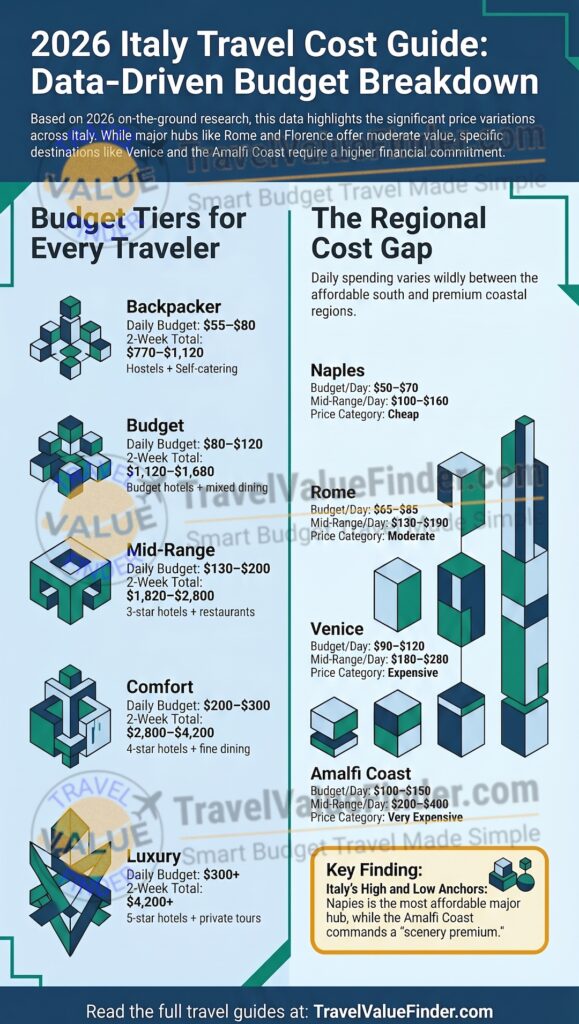
Before diving into the detail, here is a quick summary of the cost to visit Italy by traveller tier:
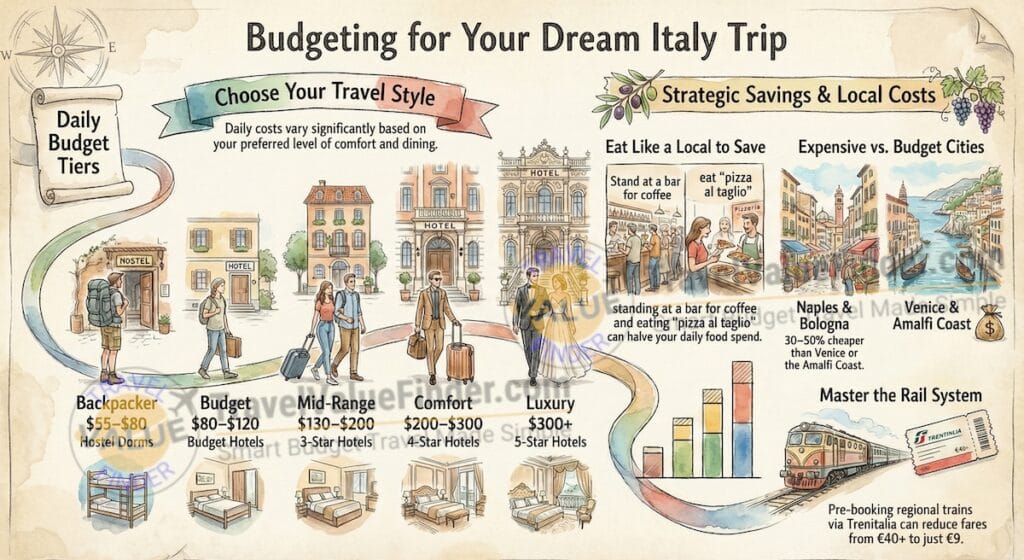
| Budget Tier | Daily Budget | 2 Weeks Total | Best Suited To |
| Backpacker | $55–$80/day | $770–$1,120 | Hostel + self-catering |
| Budget | $80–$120/day | $1,120–$1,680 | Budget hotel + mix of eating |
| Mid-Range | $130–$200/day | $1,820–$2,800 | 3-star hotel + restaurants |
| Comfort | $200–$300/day | $2,800–$4,200 | 4-star hotel + fine dining |
| Luxury | $300+/day | $4,200+ | 5-star + private tours |
Totals exclude international flights. All figures are in USD. Pricing is approximate and varies by city, season, and advance booking.
Cost to Visit Italy: Flights
Flights are a significant part of the overall cost to visit Italy for most travelers, particularly those coming from North America, Australia or Asia. Here is what to expect and how to reduce it.
Return Flights to Italy by Departure Region
| Departure Region | Budget Fare | Typical Fare | Best Entry Airport |
| USA / Canada | $380–$550 | $650–$950 | Rome (FCO), Milan (MXP) |
| UK / Ireland | £50–£120 | £150–£280 | Rome, Venice, Naples |
| Australia | $700–$950 | $1,100–$1,600 | Rome (FCO) via hub |
| Within Europe | €10–€60 | €60–$150 | All major Italian airports |
Tips to Reduce Your Italy Flight Cost
- Book 2–4 months ahead for transatlantic routes; 4–8 weeks for European routes. See our full guide: How to Find Cheap Flights: 12 Proven Strategies
- Use Google Flights date grid and Skyscanner Whole Month view to find the cheapest travel dates at a glance
- Within Europe, Ryanair, EasyJet, and Vueling serve all major Italian cities from €10–€60 one-way
- Consider flying into Milan and out of Rome (or vice versa) for a one-way trip through the country — this often costs less than a return to one city and removes the need to backtrack
- Going (formerly Scott’s Cheap Flights) alerts you to error fares and flash sales on Italy routes — free tier is well worth using
Italy Accommodation Costs: From Hostels to Hotels
Accommodation is typically the largest variable in the cost to visit Italy. Prices vary more widely by city and location than almost any other category — Venice and the Amalfi Coast command a significant premium over Rome, Florence, or Naples.
Accommodation Costs by Tier and City
| City | Hostel Dorm | Budget Hotel | 3-Star Hotel | 4-Star Hotel | Best Guide |
| Rome | $20–$35/night | $70–$110/night | $120–$200/night | $200–$350/night | Where to Stay in Rome |
| Florence | $22–$38/night | $75–$120/night | $130–$210/night | $220–$380/night | Where to Stay in Florence |
| Venice | $30–$55/night | $90–$160/night | $170–$280/night | $300–$600/night | Where to Stay in Venice |
| Milan | $22–$40/night | $80–$130/night | $140–$230/night | $240–$420/night | Where to Stay in Milan |
| Naples | $18–$30/night | $60–$100/night | $100–$180/night | $180–$300/night | Budget Hotels Naples |
| Amalfi Coast | $35–$65/night | $100–$180/night | $200–$400/night | $400–$900/night | Where to Stay Amalfi Coast |
Budget Accommodation Tips for Italy
- Book through Hostelworld for hostels or Booking.com for budget hotels — compare both for every city
- Stay just outside the historic centre — accommodation 1–2 metro stops from the centre is often 20–40% cheaper and perfectly convenient
- For Venice, consider staying in Mestre on the mainland — prices are 40–60% lower and the train to Venice takes 10 minutes
- For the Amalfi Coast, base yourself in Salerno or Sorrento rather than Positano or Ravello — same access to the coast at a fraction of the price
- Peak season (June–August) adds 30–60% to accommodation prices — shoulder season (April–May, September–October) is the sweet spot for cost and weather
For hand-picked budget hotel recommendations:
- Best Budget Hotels in Rome
- Best Budget Hotels in Florence
- Best Budget Hotels in Venice
- Best Budget Hotels in Milan
- Best Budget Hotels on the Amalfi Coast
Food and Drink Costs in Italy
Food is one of the most pleasant parts of the cost to visit Italy — because Italian food culture keeps prices accessible at every tier. Street food, markets, and the cornetti-and-espresso breakfast culture mean you can eat authentically and extraordinarily well on a budget.
A €1.20 espresso at a Roman bar, a €3 supplì (fried rice ball) from a street counter, a €12 cacio e pepe at a family trattoria three streets from the Colosseum — Italy’s food culture rewards the traveller who eats like a local. — Leslie, TravelValueFinder.com.
Typical Food and Drink Prices in Italy (2026)
| Item | Budget Option | Mid-Range Option |
| Espresso at a bar | €1.00–€1.50 | €1.50–€3.00 (sit down) |
| Cornetto (pastry) + espresso | €1.50–€2.50 | €3–€5 |
| Pizza (whole, takeaway/stand-up) | €4–€7 | €8–$14 (sit-down) |
| Pasta dish (trattoria) | €8–€12 | €14–€22 |
| Full meal at a local trattoria | €12–€18 | €25–€45 |
| Sandwich (panino) | €3–€5 | €5–€8 |
| Beer (0.5L, bar) | €3–€5 | €5–€8 (restaurant) |
| Gelato (2 scoops) | €2.50–€4 | €4–€7 |
| Supermarket lunch | €4–€8 (self-made) | — |
| Daily food budget | €20–€35 | €40–€70 |
How to Reduce Food Costs in Italy
- Always eat breakfast standing at the bar — sitting down at a café table triggers a coperto (cover charge) that can double the price
- Eat pizza al taglio (by the slice) for lunch — among the best and cheapest food experiences in Italy, costing €2–€5 for a filling meal
- Look for restaurants displaying a fixed-price lunch menu (menù del giorno) — typically €12–€18 for two courses, bread, and a drink
- Avoid restaurants directly on major tourist piazzas — walk one or two streets away for prices 30–50% lower with equal or better quality
- Shop at Carrefour Express, Conad, or COOP supermarkets for picnic supplies — Italy’s supermarkets are well-stocked and affordable
- Fill your water bottle at the free public drinking fountains (nasoni) found throughout Rome — tap water is safe to drink across Italy
For city-specific food guides:
- Rome Food Guide: What to Eat, Where to Eat and Local Dishes
- Florence Food Guide: What to Eat for First-Time Visitors
Getting Around Italy: Transport Costs
Transport within Italy is a meaningful part of the cost to visit Italy, but the country has an extensive, affordable rail and bus network that makes it easy to travel between cities without spending a fortune.
Intercity Transport Costs
| Route | Budget Option | Fast Train | Journey Time |
| Rome → Florence | €9–€19 (slow train) | €25–€50 (Frecciarossa) | 1h 30m fast / 2h slow |
| Rome → Naples | €11–€20 | €20–€40 | 1h 10m fast |
| Rome → Venice | €19–€35 (slow/regional) | €50–€80 (Frecciarossa) | 3h 30m fast |
| Florence → Venice | €15–$28 | €30–€55 | 2h fast |
| Milan → Rome | €25–€40 | €50–€100 | 3h fast |
| Naples → Amalfi Coast | €2–€5 (SITA bus) | €15–€25 (ferry) | 1–2h depending on stop |
Key Transport Resources for Italy
- Trenitalia — Italy’s national rail operator; book regional trains early for the cheapest fares (€9–€19 for many routes)
- Italo — Competitor to Trenitalia on high-speed routes; often cheaper when booked in advance
- FlixBus — Budget bus routes between major Italian cities; sometimes significantly cheaper than trains
- Trainline — Books both Trenitalia and Italo routes with price comparison in one place
- Rome2Rio — Compares all options (train, bus, ferry, fly) between any two Italian points with prices
City Transport
| City | City Transport Cost | Best Option |
| Rome | €1.50/journey; €7/day pass | Metro + bus; avoid taxis |
| Florence | €1.70/journey; €5/24h pass | Mostly walkable; tram for outskirts |
| Venice | €9.50 single vaporetto; €25/day pass | Walk as much as possible |
| Milan | €2.20/journey; €7/day pass | Excellent metro system |
| Naples | €1.10/journey | Metro + funiculars |
For detailed transport guides within Italian cities:
- Transportation in Rome: Metro, Buses, Taxis and Airport Transfers
- Transportation in Florence: How to Get Around
Sightseeing and Activities: What Things Cost in Italy
Entrance fees to Italy’s top attractions are a real part of the cost to visit Italy — but smart booking and free alternatives can reduce this significantly.
Major Attraction Entry Prices (2026)
| Attraction | Adult Price | Free Option? | Booking Tip |
| Colosseum + Roman Forum + Palatine Hill | €18–€22 | Free last Sun of month | Pre-book essential; sells out |
| Vatican Museums + Sistine Chapel | €20–€27 | Free last Sun of month (queues huge) | Book online weeks ahead |
| Uffizi Gallery (Florence) | €20–€25 | Free for under-18 EU | Pre-book; long queues otherwise |
| Galleria dell’Accademia (David), Florence | €16–€20 | Free for under-18 EU | Book at least 2 weeks ahead |
| Pompeii | €16 | Free last Sun of month | Early morning to beat crowds |
| Doge’s Palace (Venice) | €14–€25 | No | Buy Museum Pass for multiple sites |
| Duomo + Cupola (Florence) | €18–€30 | Exterior free | Book Cupola climb months ahead |
| Last Supper (Milan) | €15–€25 | No | Books out months in advance |
| Walking tour of any city | Free (tip-based) | Yes — always free to join | Find via GuruWalk |
Money-Saving Tips on Activities
- Pre-book all major attractions online — GetYourGuide and Tiqets both offer skip-the-line timed entry with no premium over the gate price
- The Italian Ministry of Culture offers free entry to all state museums on the first Sunday of every month — plan your museum days around this for significant savings
- EU citizens under 18 and those under 25 from EU member states enter state-owned museums free — always carry ID
- Free walking tours are genuinely excellent across Italy — find them through GuruWalk (pay only what you feel it was worth at the end)
- Many of Italy’s greatest sights are free: the Pantheon’s exterior, Trevi Fountain, Spanish Steps, the Piazza Navona, St Mark’s Square, and virtually every church in the country
City-by-City Cost to Visit Italy: Daily Budget Comparison
Not all Italian cities cost the same. Here is a city-by-city breakdown of the cost to visit Italy based on typical daily spending across all categories:
| City | Budget/day | Mid-Range/day | Expensive? | Why the Difference |
| Rome | $65–$85 | $130–$190 | Moderate | Large city; wide range of options |
| Florence | $70–$90 | $140–$200 | Moderate | Compact; central hotels expensive |
| Venice | $90–$120 | $180–$280 | Expensive | Island premium; transport expensive |
| Milan | $70–$95 | $140–$220 | Moderate | Business city; budget options exist |
| Naples | $50–$70 | $100–$160 | Cheap | Cheapest major Italian city |
| Bologna | $55–$75 | $110–$170 | Cheap | Underrated; great food, low prices |
| Sicily | $50–$75 | $100–$160 | Cheap | Southern Italy prices throughout |
| Amalfi Coast | $100–$150 | $200–$400 | Very expensive | Limited supply; dramatic scenery premium |
For our complete where-to-stay and what-to-do guides for each city:
- Rome Travel Guide 2026: Things to Do, Costs and Tips
- Florence Travel Guide: Things to Do, Costs and Hotels
- Italy Travel Guide for First-Time Visitors (2026)
- Best Places to Visit in Venice 2026
- Where to Stay on the Amalfi Coast
Sample Italy Trip Costs: Full Itinerary Budgets
To make the cost to visit Italy concrete, here are three worked examples with realistic total costs across different itinerary types:
1-Week Rome and Florence Trip (Budget Traveller)
| Expense Category | Estimated Cost | Notes |
| Return flights (from US, booked early) | $450–$650 | Booked 10–12 weeks ahead |
| Accommodation (7 nights, hostel dorm) | $175–$245 | $25–$35/night average |
| Food (mix of self-catering + local restaurants) | $175–$245 | $25–$35/day |
| Transport (intercity train + city transit) | $80–$120 | Rome–Florence slow train + metro |
| Activities (1–2 paid; rest free/walking tours) | $50–$80 | Pre-booked online |
| Miscellaneous (SIM, tips, snacks) | $40–$60 | Budget for small expenses |
| Total (7 days, excl. flights) | $520–$750 | ~$75–$107/day |
| Total (incl. flights from US) | $970–$1,400 |
2-Week Italy Grand Tour (Mid-Range Traveller)
| Expense Category | Estimated Cost | Notes |
| Return flights (from US) | $550–$800 | Shoulder season booking |
| Accommodation (14 nights, budget hotel 3-star) | $1,400–$2,100 | $100–$150/night average |
| Food | $700–$980 | $50–$70/day mix of restaurants |
| Intercity transport | $200–$320 | Rome–Florence–Venice–Milan rail |
| City transport | $140–$200 | $10–$15/day city transit |
| Activities and tours | $300–$450 | Major sites + 1–2 paid tours |
| Miscellaneous | $100–$150 | Tips, gifts, pharmacy, extras |
| Total (14 days, excl. flights) | $2,840–$4,200 | ~$200–$300/day |
| Total (incl. flights from US) | $3,390–$5,000 |
The cost to visit Italy on a 2-week grand tour is often far lower than people expect when planned well — and far higher than expected when booked last-minute in peak season. Planning is the difference between a $3,000 trip and a $6,000 one. — Leslie, TravelValueFinder.com.
When to Visit Italy to Reduce the Cost
The time of year you visit has a dramatic effect on the cost to visit Italy — particularly for flights and accommodation. Here is what to expect by season:
| Season | Period | Accommodation Price | Crowd Level |
| Peak | Jun–Aug, Easter | Highest | Very busy |
| Shoulder | Apr–May, Sep–Oct | Moderate | Manageable |
| Low season | Nov–Mar (excl. Christmas) | Lowest | Quiet |
| Christmas | Dec 20–Jan 5 | High | Busy in cities |
For specific best-time-to-visit advice by city:
- Best Time to Visit Rome: Weather, Crowds, Costs and Tips
- Best Time to Visit Florence: Weather, Crowds and Travel Tips
10 Tips to Reduce the Cost to Visit Italy
Here are the single most effective ways to reduce the cost to visit Italy without compromising on the quality of your experience:
- Travel in shoulder season (April–May or September–October) — 20–40% cheaper on flights and accommodation than peak summer
- Book attractions in advance online — skip-the-line entry is the same price as the gate and saves hours
- Use free museum Sundays — first Sunday of every month; schedule major museums for that day
- Eat pizza al taglio and standing at bars — best value food in Italy and authentically local
- Stay in Naples or Bologna instead of Venice or the Amalfi Coast — comparable Italy experience at 30–50% less
- Base yourself outside the historic centre — 1–2 stops on public transport saves $30–$60 per night
- Book regional trains in advance via Trenitalia — Rome–Florence from €9 booked weeks ahead vs. €40+ last-minute
- Use Wise or Revolut for currency exchange — avoid airport exchange booths which charge 8–12% over the real rate
- Take free walking tours in every city via GuruWalk — tips only, genuinely excellent quality
- Use our free AI Trip Planner at TravelValueFinder.com to plan a budget-optimized day-by-day Italy itinerary in seconds
Plan Your Italy Trip: Essential Resources
Everything you need to plan and book an Italy trip on any budget:
- Italy Travel Guide for First-Time Visitors (2026)
- Rome Travel Guide 2026: Things to Do, Costs, Tips and Best Time to Visit
- Florence Travel Guide: Best Things to Do, Costs, Hotels and Tips
- Top Things to Do in Rome: First-Time Visitor Guide
- Top Things to Do in Florence: First-Time Visitor Guide
- How to Travel Europe on a Budget: The Complete 2026 Guide
- How to Find Cheap Flights: 12 Proven Strategies
- How to Travel Cheap: 25 Tips to Cut Your Budget in Half
- Free AI Trip Planner: Generate a Day-by-Day Italy Itinerary
Frequently Asked Questions
How much does it cost to visit Italy for one week?
The cost to visit Italy for one week depends heavily on your travel style. On a backpacker budget (hostel dorms, self-catering, public transport), expect to spend $520–$750 for the week on the ground, plus $450–$650 for return flights from the US. A mid-range week (budget hotel, restaurants, paid attractions) costs $1,200–$1,800 excluding flights. See the full worked examples in our itinerary budgets section above.
Is Italy expensive compared to other European countries?
Italy sits in the middle tier of European travel costs — more expensive than Eastern Europe (Poland, Romania, Hungary) but cheaper than Switzerland, Norway, or the UK. Cities like Naples, Bologna, and Sicily are among the most affordable in Western Europe. Venice and the Amalfi Coast are notable exceptions and rank among Europe’s most expensive destinations. For a comparison, see our How to Travel Europe on a Budget guide.
How much cash do I need per day in Italy?
Budget for €60–€80 per day in cash as a baseline (covering food, local transport, tips, and small purchases), in addition to card payments for accommodation and attraction tickets. Many smaller restaurants, street food stalls, and market vendors are cash-only. ATMs (Bancomat) are widely available — use a no-fee card such as Charles Schwab or Wise to avoid charges.
What is the cheapest city to visit in Italy?
Naples is consistently the cheapest major Italian city, with daily budgets possible under $55 on a backpacker tier. Bologna and Sicily also offer excellent value. The most expensive destinations are Venice (island premium), the Amalfi Coast, and parts of Tuscany during peak summer. Even in expensive cities, the overall cost to visit Italy drops sharply when you stay just outside the historic centre and eat like a local.
How can I visit Italy cheaply?
The most effective strategies are: travel in shoulder season (April–May or September–October), book flights and key attractions well in advance, stay in hostels or budget hotels one metro stop outside the centre, eat pizza al taglio and trattoria lunch menus, visit free state museums on the first Sunday of each month, and take free walking tours instead of paid city tours. Combined, these can halve the typical cost to visit Italy compared to an unplanned trip.
Do I need travel insurance for Italy?
Yes. Italy is part of the EU and has high-quality healthcare, but without insurance, medical treatment as a foreign visitor can be very expensive. Recommended options include SafetyWing (from $45/month, ideal for longer trips), World Nomads (strong on adventure activities), and Hey Mondo. UK citizens can use the GHIC card for state healthcare, but full travel insurance is still recommended.
Final Thoughts: Planning for the Cost to Visit Italy
The cost to visit Italy is far more controllable than most travellers realise. The country has every tier of travel experience available — from €10 dorm beds in Naples to €900-a-night Amalfi Coast hotels — and a food culture so extraordinary that eating well on a budget is genuinely one of the trip’s great pleasures.
Plan in shoulder season. Book attractions and trains early. Eat standing at the bar and sitting at local trattorias. Walk everywhere you can. The difference between an Italy trip that costs $1,200 and one that costs $4,000 is almost entirely about the choices made before you board the plane.
Italy is worth every euro. The goal is simply not to spend them unnecessarily.
Ready to start planning? Use our free tools: