Travel Value Finder

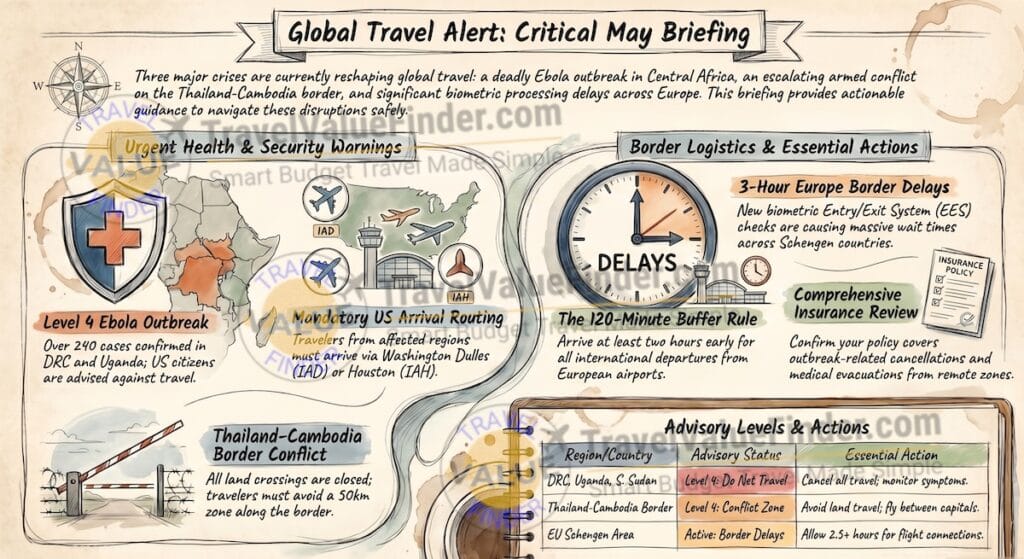
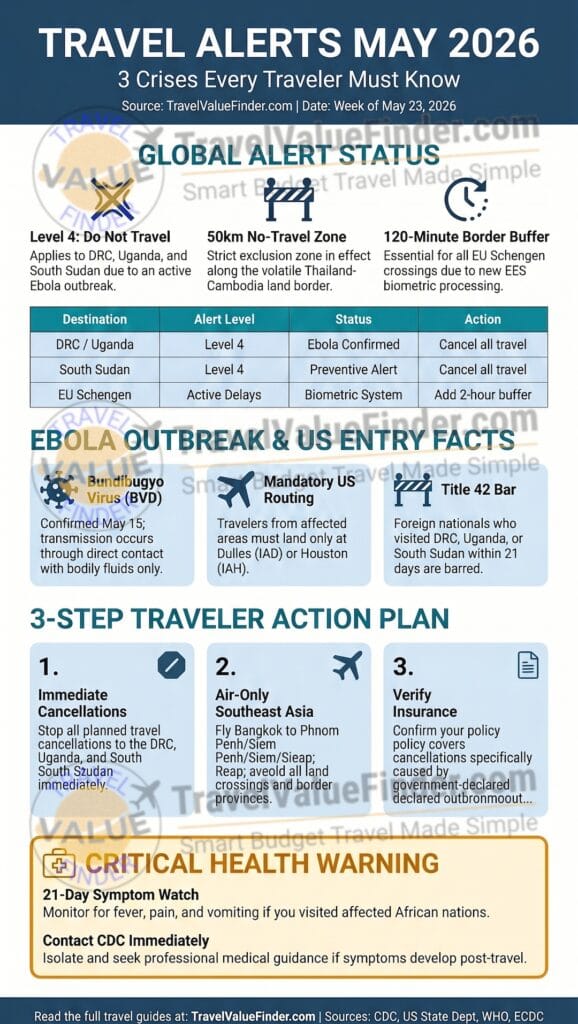
What are the most critical travel alerts for May 2026? As of May 23, 2026, the three most urgent travel alerts are: (1) A rapidly escalating Ebola Bundibugyo outbreak in the DRC, Uganda, and South Sudan – all under US State Department Level 4 Do Not Travel advisories – with mandatory Dulles Airport screening for all travelers who have been in these countries within 21 days; (2) The ongoing armed conflict on the Thailand-Cambodia border, with all land crossings closed and a 50 km no-travel zone in force; and (3) EU Entry/Exit System (EES) biometric border checks now causing up to 3-hour delays across all 29 Schengen countries, with the full summer travel season about to begin.
Leslie Nics | TravelValueFinder.com | Travel Alerts | May 23, 2026 | Last reviewed: May 23, 2026
Travel Alerts May 2026: 3 Urgent Crises Reshaping Global Travel This Week
These are not routine travel advisories. The week of May 23, 2026 brings three converging crises that every international traveler – whether you are booked for summer, researching future trips, or currently abroad – must understand and act on immediately.
A deadly Ebola outbreak in Central and East Africa has triggered Level 4 Do Not Travel advisories for three countries, mandatory Dulles-only flight routing for returning travelers, and sweeping US entry restrictions under Title 42 authority. Simultaneously, the ongoing armed conflict on the Thailand-Cambodia border continues to affect one of the world’s most visited tourist regions, with all land border crossings closed and airstrikes reported up to 80 km from the border. And as Europe’s summer season begins, the EU’s new biometric border system continues to cause multi-hour delays that could derail tight itineraries.
These travel alerts for May 2026 are compiled from the CDC, U.S. State Department, WHO, Africa CDC, ECDC, and U.S. Embassy advisories – translated here into clear, actionable guidance by TravelValueFinder.com’s Leslie Nics.
Travel Alert #1 – Ebola Outbreak in DRC, Uganda & South Sudan: Level 4 Do Not Travel
A Level 4 advisory means the US government is telling you in plain language: do not go. It is the highest travel warning issued. If you are already there, leave. If you are planning to go, don’t. This is not a caution – it is a directive. Leslie Nics, TravelValueFinder.com
What Is Happening Right Now
On May 15, 2026, the Ministry of Health of the Democratic Republic of the Congo (DRC) officially confirmed an Ebola Bundibugyo virus disease outbreak in Ituri Province, northeastern DRC. By May 16, the outbreak had already recorded 246 suspected cases and 80 deaths. Within days, confirmed cases spread to Uganda (including Kampala, the capital) and the outbreak was declared active across DRC, Uganda, and South Sudan.
By May 22, 2026, the CDC confirmed the outbreak had expanded to multiple DRC provinces – Ituri, Nord-Kivu, and a newly confirmed case in Sud-Kivu. A hospital cluster in Bunia Health Zone affecting healthcare workers raised the international alarm further. A passenger from DRC boarded an Air France flight to Detroit in error, which was diverted to Montreal after CBP confirmed the breach of new entry restrictions.
| Country | US Advisory Level | Status |
|---|---|---|
| Democratic Republic of Congo (DRC) | LEVEL 4 – DO NOT TRAVEL | 246+ suspected cases, 80+ deaths as of May 16. Expanding to multiple provinces. |
| Uganda | LEVEL 4 – DO NOT TRAVEL | Confirmed cases including in Kampala capital. Advisory raised May 17. |
| South Sudan | LEVEL 4 – DO NOT TRAVEL | No confirmed cases yet – included due to porous border with DRC/Uganda and limited healthcare. |
| Rwanda | LEVEL 3 – Reconsider Travel | No confirmed cases. Added due to regional proximity risk. |
US Entry Restrictions: What Travelers Must Know
Effective May 21, 2026, the US government implemented mandatory public health measures for travelers who have been in the DRC, Uganda, or South Sudan within the previous 21 days:
- All US-bound travelers from DRC, Uganda, or South Sudan – including US citizens and lawful permanent residents – must route their flights to arrive at Washington Dulles International Airport (IAD) only
- From May 26, 2026, Houston George Bush Intercontinental Airport (IAH) was added as a second designated arrival airport
- Enhanced CDC and CBP public health screening is conducted on all such travelers upon arrival
- Foreign nationals who have been in DRC, Uganda, or South Sudan within 21 days are barred from entering the United States under Title 42 authority
- All travelers from or through these countries should contact their airline before travel to confirm flight routing – cancellations and diversions are occurring
CRITICAL: IF YOU HAVE BEEN IN DRC, UGANDA, OR SOUTH SUDAN IN THE LAST 21 DAYS
You MUST re-route to Washington Dulles (IAD) or Houston (IAH) – effective May 26 for IAH. You cannot arrive at any other US airport. Monitor for symptoms: fever, body pain, weakness, vomiting, and in some cases bleeding. Ebola Bundibugyo symptoms typically appear 2 to 21 days after exposure.
Contact the CDC or your local health authority immediately if you develop symptoms.
Source: CDC HAN Advisory #530 | State Department Ebola Response Update May 19, 2026
About Ebola Bundibugyo Virus
The Bundibugyo virus (BVD) is one of six known Ebola species. It was first identified in Uganda’s Bundibugyo District in 2007. Like all Ebola strains, it spreads through direct contact with the blood or bodily fluids of an infected or deceased person, or through contaminated objects (needles, clothing, bedding). It does not spread through air, water, or food. The case fatality rate for Bundibugyo virus has historically been lower than the more infamous Zaire Ebola strain – but this outbreak’s spread across multiple provinces and urban healthcare settings has alarmed international health authorities.
The outbreak’s geographic complicating factors include active armed insecurity in Ituri Province, significant mining-related population movement, and frequent cross-border travel – all of which accelerate transmission chains and complicate contact tracing.
Ebola does not travel by air – but infected people do. The Dulles routing requirement exists precisely because a single breach, like the Air France diversion to Montreal, shows how quickly exposure can travel across continents before anyone knows. Leslie Nics, TravelValueFinder.com
What About the 2026 FIFA World Cup?
The timing of this outbreak coincides directly with World Cup preparations, as Houston – one of the designated Ebola screening airports – is also a host city for the 2026 FIFA World Cup. CDC was directly asked at its May 18 press briefing about screening protocols for high-volume international transit hubs and World Cup host cities. The agency confirmed it is actively working with interagency partners on final screening plans for major transit hubs and that more detailed guidance is forthcoming. Travelers and teams from the affected region traveling to World Cup host cities should monitor CDC and FIFA guidance closely.
| Is Ebola airborne – can I catch it on a plane? No. Ebola is not airborne. It spreads only through direct contact with the blood or bodily fluids of a symptomatic or deceased person. Sitting near someone on a plane who is not yet showing symptoms does not transmit the virus. However, if a fellow passenger develops symptoms during or after a flight, health authorities will conduct contact tracing. The US mandatory routing to Dulles and Houston is a precautionary screening measure – not evidence that casual travel contact poses a risk. Source: CDC Ebola Disease Fact Sheet; WHO Ebola Overview |
Travel Alert #2 – Thailand-Cambodia Border Conflict: What Tourists in Southeast Asia Must Know
Southeast Asia remains one of the world’s great travel regions. Bangkok, Phnom Penh, Angkor Wat, Phuket – all open and operating normally. But the border zone is a different story entirely. The 50 km rule is not a suggestion. It is a hard line. Leslie Nics, TravelValueFinder.com
The Current Situation
Armed conflict between Thai and Cambodian military forces along their shared border has been ongoing since late 2025, with a significant escalation in December 2025. A ceasefire was reached on December 27, 2025, but the security environment in border areas remains volatile and unpredictable. The U.S. Embassy in Thailand and Cambodia both maintain active security alerts advising all US citizens to avoid travel within 50 kilometers of the Thailand-Cambodia border – a zone that includes popular border crossings like Poipet/Aranyaprathet and Ko Chang island.
All official land border checkpoints between Thailand and Cambodia have been closed since mid-2025. Isolated Thai airstrikes have been reported in areas up to 80 km from the border in Cambodian territory. Tour operators including Intrepid Travel have cancelled all trips to Jordan and Saudi Arabia with similar security-based reasoning, and are proactively rerouting Cambodia itineraries that include Battambang province through at least June 30, 2026.
| Area | Status for Tourists | Advisory Level |
|---|---|---|
| Bangkok, Chiang Mai, Phuket | OPEN – NORMAL OPERATIONS | Exercise Normal Precautions |
| Phnom Penh, Siem Reap, Angkor | OPEN – NORMAL OPERATIONS | Exercise Increased Caution (Level 2) |
| Battambang Province (Cambodia) | CAUTION – Tours being rerouted | Exercise Increased Caution (Level 2) |
| Preah Vihear, Oddar Meanchey, Banteay Meanchey | DO NOT TRAVEL – Active conflict zone | Level 4 for border areas |
| Ko Chang & Ko Kood islands (Thailand) | DO NOT TRAVEL – Within 50 km zone | Level 4 for border areas |
| All Thailand-Cambodia land border crossings | CLOSED – No overland crossing possible | Level 4 for border areas |
How to Still Visit Thailand or Cambodia Safely
The most important practical impact for tourists: you cannot combine Thailand and Cambodia in a single overland trip. All land crossings are closed. The only safe way to visit both countries is to fly between major cities – Bangkok (BKK/DMK) to Phnom Penh (PNH) or Siem Reap (SAI). These routes are operating normally.
- Fly between Bangkok and Phnom Penh or Siem Reap – do not attempt any land border crossing
- Domestic travel within Thailand and within Cambodia remains normal and safe, away from border zones
- Angkor Wat and the main Siem Reap temple complex are operating normally – the conflict zone is far to the northwest
- Book only with tour operators that have confirmed up-to-date rerouting policies for Cambodia – contact your operator before departure
- Enroll in the US STEP program at step.state.gov to receive embassy security alerts directly
- Check your travel insurance – confirm your policy covers trip cancellation due to armed conflict or security alerts
AVOID: All Travel Within 50 KM of the Thailand-Cambodia Border
This includes: Poipet (Cambodia) / Aranyaprathet (Thailand), Sa Kaeo, Chanthaburi, Trat provinces (Thailand), Preah Vihear, Oddar Meanchey, parts of Battambang and Koh Kong (Cambodia), Ko Chang and Ko Kood islands. Martial law is in place in Chanthaburi, Sa Kaeo and Trat (Thailand). Cross-border airstrikes have been reported up to 80 km inside Cambodia.
Source: US Embassy Thailand Security Alert | US Embassy Cambodia Security Alert | UK FCDO Travel Advice
| Is it safe to visit Angkor Wat in 2026? Yes. Angkor Wat and the main Siem Reap temple complex are located well away from the active conflict zone and are operating normally. Tour operators, UNESCO, and government advisories consistently confirm that the Siem Reap area – including Angkor Archaeological Park – is safe for tourism. The conflict is geographically concentrated along the northwestern and western borders, primarily in Preah Vihear, Oddar Meanchey, and parts of Banteay Meanchey province. Siem Reap city and its temples are unaffected. Practical note: Do not attempt to visit northern temple complexes near Ta Krabey or Ta Muen Thom – these are in the conflict zone. |
Travel Alert #3 – EU Entry/Exit System: Summer 2026 Border Delays Are Getting Worse
Why This Alert Is More Urgent Than Ever
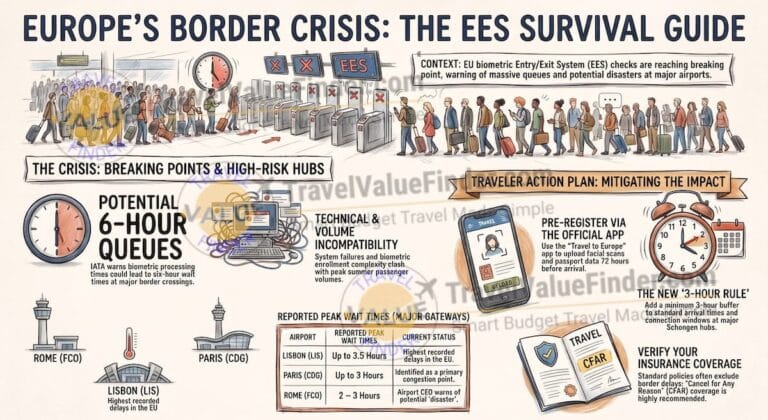
Europe’s new biometric Entry/Exit System (EES) became fully mandatory on April 10, 2026. Six weeks in, airport operators across the Schengen Area are warning that the system’s performance is still uneven – and with Europe’s peak summer travel season beginning in June, the risk of border-related missed flights, broken connections, and disrupted itineraries is at its highest point yet.
Non-EU travelers – including all US, UK, Canadian, Australian, and Asian passport holders on short stays – must submit fingerprints and facial scans at Schengen border control on their first entry. Processing times at busy airports have reached up to three hours at peak arrival windows. Passengers have missed flights, cruise departures, and hotel bookings. The EU aviation industry body ACI Europe is calling for emergency suspension powers through summer.
| EES: Who MUST Register | EES: Who Is EXEMPT |
|---|---|
| US, UK, Canadian, Australian citizens (short stays) | EU / Schengen country nationals |
| All non-EU nationals visiting up to 90 days in 180 | Non-EU nationals with EU long-term visas or residence permits |
| First registration: full fingerprints + facial scan | Flight/train crew on international routes |
| Subsequent crossings (within 3 years): one biometric only | Note: Ireland and Cyprus NOT in EES |
Summer 2026: Your EES Action Plan
- Arrive 90 to 120 minutes earlier than your normal Schengen departure time – this applies to all international departures from non-EU airports in the Schengen Area
- Do NOT book tight connections (under 2.5 hours) on first-time Schengen arrivals – delays are well-documented at Paris CDG, Amsterdam Schiphol, Frankfurt, and Madrid
- Download the ‘Travel to Europe’ EU app (Google Play / App Store) and pre-register biometrics 72 hours before arrival – available in Portugal and Sweden, expanding across EU
- If you previously registered EES biometrics on entry to the Schengen Area before April 10 under the phased rollout, you still need to complete exit processing – expect longer queues
- Greece has partially suspended EES for some nationalities – confirm current requirements for your specific destination before travel
- Check TravelValueFinder.com/europe-travel-tips for country-specific EES status updates
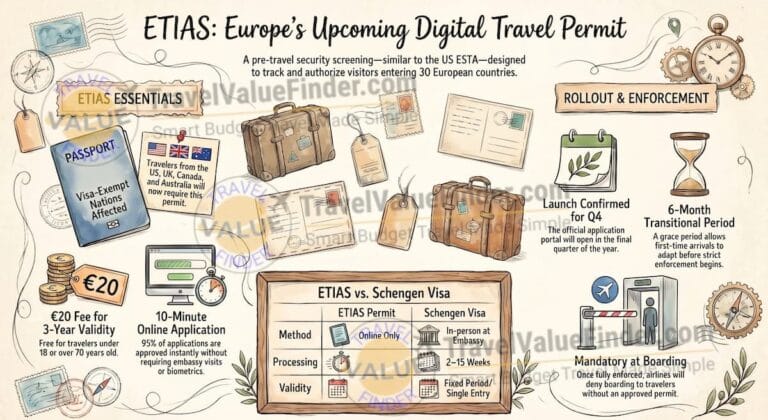
ETIAS IS COMING – PREPARE NOW The EU’s ETIAS (European Travel Information and Authorization System) – a pre-travel authorization similar to ESTA for the US or the UK ETA – is expected to launch in late 2026.
Once live, non-EU visa-exempt travelers (including US and UK citizens) will need to apply and pay for ETIAS authorization BEFORE booking flights to Europe.
TravelValueFinder.com will publish a dedicated ETIAS guide as soon as the launch date is confirmed. Subscribe to our travel alerts to be notified the moment it goes live.
Full Travel Alerts Snapshot – Week of May 23, 2026
| Alert | Level | Who Is Affected | Immediate Action |
| Ebola – DRC | L4 DO NOT TRAVEL | All travelers to DRC | Cancel all travel. If already there, depart via Dulles/IAH. |
| Ebola – Uganda | L4 DO NOT TRAVEL | All travelers to Uganda | Cancel all travel. Monitor for symptoms within 21 days of return. |
| Ebola – South Sudan | L4 DO NOT TRAVEL | All travelers to S. Sudan | Cancel all travel. No confirmed cases – preventive L4. |
| Ebola – Rwanda | L3 RECONSIDER | Travelers to Rwanda | Reconsider nonessential travel. Monitor CDC updates. |
| US Ebola Entry Restrictions | ACTIVE – TITLE 42 | Anyone entering US from DRC/Uganda/S. Sudan within 21 days | Must fly into Dulles (IAD) or Houston (IAH from May 26). Contact airline now. |
| Thailand-Cambodia Border | L4 – 50 KM ZONE | All tourists in SE Asia | Avoid border zone. Fly between Bangkok and Phnom Penh/Siem Reap. |
| EU Entry/Exit System (EES) | ACTIVE – DELAYS | All non-EU Schengen travelers | Add 90-120 mins at border. Avoid tight connections. |
| Hantavirus – MV Hondius | STABILISING | Expedition cruise travelers | 11 cases, 3 deaths. Verify evacuation insurance. |
| ESTA Fee – $40 | IN EFFECT | All VWP travelers to US | Apply at esta.cbp.dhs.gov. Renew if expiring. |
| UK ETA Required | IN EFFECT | All visa-exempt UK visitors | Apply before flights. Check if your passport change voids ETA. |
| EU ETIAS | COMING LATE 2026 | All visa-exempt EU visitors | Monitor TravelValueFinder.com for launch date. |
People Also Ask – Expert Answers
Is it safe to travel to Uganda in 2026?
No. The US State Department has issued a Level 4 Do Not Travel advisory for Uganda as of May 17, 2026, due to the Ebola Bundibugyo outbreak with confirmed cases in Uganda including Kampala. Travelers should not visit Uganda for any reason. If you are currently in Uganda, depart and monitor your health for 21 days after leaving. If you plan to travel to Uganda, postpone all trips until the outbreak is declared over by the WHO.
What is the Ebola Bundibugyo virus and how is it different from regular Ebola?
The Bundibugyo virus (BVD) is one of six Orthoebolavirus species in the Ebolavirus genus. It was first identified in Uganda in 2007 and causes a hemorrhagic fever with symptoms including fever, body pain, weakness, vomiting, and in some cases bleeding. Its case fatality rate is generally lower than the Zaire Ebola strain – the deadliest and most well-known species – but it is still a life-threatening disease with no approved antiviral treatment. Like all Ebola strains, BVD spreads only through direct contact with the bodily fluids of an infected person, not through air or water.
Do I need to fly into Washington Dulles if I transited through DRC or Uganda?
Yes. The Dulles requirement applies to all US-bound travelers – US citizens, lawful permanent residents, and foreign nationals – who were present in DRC, Uganda, or South Sudan within 21 days of arrival in the United States. This includes transit stops, layovers, and brief visits, not just extended stays. From May 26, 2026, Houston George Bush Intercontinental Airport (IAH) is also a designated screening airport. Any other arrival airport routing will result in your flight being diverted. Contact your airline before travel to confirm routing.
Can I still visit Cambodia if the Thailand border is closed?
Yes, you can visit Cambodia’s main tourist destinations including Phnom Penh, Siem Reap, Angkor Wat, Kampot, and the southern islands – all of which are operating normally and are far from the conflict zone. The key restriction is avoiding travel within 50 km of the Thai-Cambodian border, and avoiding all land crossings between the two countries (all of which are closed). Fly between Bangkok and Phnom Penh or Siem Reap. Do not book temple tours near the northern border areas such as Ta Krabey or Ta Muen Thom.
Will EU EES delays affect my cruise departure from a European port?
Potentially yes, and this is one of the most underrated EES risks. If your European cruise departs from a Schengen port (such as Barcelona, Civitavecchia for Rome, Venice, Athens Piraeus, or Amsterdam) and you are arriving from a non-Schengen country on the same day as your departure, border delays could cause you to miss your sailing. Build in at least one overnight buffer between your Schengen arrival flight and any cruise or rail departure. This applies especially during peak summer arrival windows.
What health screenings should I expect when returning from East Africa to the US?
If you have been in DRC, Uganda, or South Sudan within 21 days of your US arrival, you must fly into Dulles (IAD) or Houston (IAH from May 26). At arrival, CDC and CBP will conduct enhanced public health screening including temperature checks, symptom questionnaires, and travel history review. Depending on your level of exposure, you may be subject to monitoring for up to 21 days after departure from the affected country. Follow all CDC instructions and report any symptoms – fever, body pain, vomiting, weakness, or bleeding – immediately to a healthcare provider, informing them of your travel history.
Leslie Nics’ 8-Point Travel Alerts Action Plan – Week of May 23, 2026
- Bookmark TravelValueFinder.com/travel-alerts and subscribe to weekly updates. The global travel environment is evolving rapidly – staying ahead of alerts is the most cost-effective travel strategy you have.
- Cancel or postpone any planned travel to DRC, Uganda, or South Sudan immediately. Do not rely on travel insurance to cover you if you travel against a Level 4 advisory – most policies will not pay out.
- If you have returned from DRC, Uganda, or South Sudan within the past 21 days and are experiencing any symptoms (fever, body pain, weakness, vomiting, bleeding), isolate and contact your local health department or CDC immediately.
- For Southeast Asia trips: book flights between Bangkok and Phnom Penh or Siem Reap – do not attempt any land crossing. Confirm with your tour operator that all Cambodia itinerary sections avoid Battambang and the border provinces.
- For Europe summer travel: add 90-120 minutes to all Schengen border crossings. Book conservative connections. Download the ‘Travel to Europe’ EU biometric pre-registration app if visiting Portugal or Sweden.
- Review your travel insurance policy this week. Confirm it covers: (a) outbreak-related trip cancellation, (b) medical evacuation from remote destinations, (c) airline insolvency, and (d) trip interruption due to security alerts.
- Renew or apply for your ESTA ($40) and/or UK ETA (£16) well before travel to avoid last-minute issues. If you changed your passport recently, your old ESTA or UK ETA may be void.
- Enroll in the US State Department STEP program at step.state.gov. This registers your travel with the nearest US embassy and delivers security alerts directly to your email.
Frequently Asked Questions (FAQs)
Q: I have a trip to Uganda booked in 6 weeks. Should I cancel?
Yes. The US State Department Level 4 advisory is the highest possible warning – it means the government formally advises against travel for any reason. Most reputable airlines and tour operators will offer refunds or credits when a Level 4 advisory is issued. Contact your airline and tour operator immediately. Check your travel insurance for trip cancellation coverage – if you purchased Cancel for Any Reason (CFAR) coverage, you have the most flexibility. Even without CFAR, an active government advisory typically triggers standard cancellation coverage.
Q: How long will the Ebola Dulles routing requirement stay in effect?
The requirement remains in effect until the US government formally lifts it – which will depend on the trajectory of the outbreak. Previous Ebola routing requirements have lasted weeks to months. Monitor the CDC Ebola Current Situation page at cdc.gov/ebola and the State Department’s regional travel advisories for updates. TravelValueFinder.com will report any changes immediately.
Q: Is dengue a risk in Southeast Asia while I’m avoiding the Thailand-Cambodia border conflict?
Yes, dengue is a year-round risk across Southeast Asia including Thailand, Cambodia, Vietnam, Malaysia, and Indonesia. The CDC issued an updated global dengue notice on May 18, 2026, noting elevated cases in multiple countries. Protect yourself by wearing long sleeves and pants during dawn and dusk, using DEET-based repellent, and ensuring your accommodation has air conditioning or screened windows. There is no specific treatment for dengue – prevention is essential.
Q: What documents do I now need for a summer trip to Europe?
For a summer 2026 Europe trip you need: (1) A valid passport – ensure it does not expire within 6 months of your return date, as many Schengen countries enforce this; (2) No ETIAS required yet – this system is expected in late 2026 but is not yet live; (3) EES biometric registration upon first Schengen border crossing – allow extra time; (4) UK ETA (£16) if visiting the United Kingdom; (5) Travel insurance with medical evacuation coverage – strongly recommended. Check TravelValueFinder.com/europe-travel-tips for the full Europe document checklist.
Q: What should I do if I’m currently traveling and an alert is issued for my destination?
Immediately: (1) Register or update your information in the US STEP program at step.state.gov so the embassy can contact you; (2) Contact your nearest US embassy or consulate; (3) Contact your airline to understand departure options; (4) Contact your travel insurer – an active Level 3 or Level 4 advisory may trigger trip interruption benefits; (5) Follow all local authority instructions. Do not rely on social media for safety information – use official US Embassy alerts and CDC advisories.
Sources & Authority Links
All data verified from primary authority sources as of May 23, 2026:
- CDC HAN Advisory #530 – Ebola Disease Outbreak in DRC and Uganda | cdc.gov/han
- CDC Ebola Current Situation Summary
- US State Department – Ebola Response Update May 19, 2026 | state.gov
- US Embassy advisories – DRC, Uganda, South Sudan, Rwanda, Thailand, Cambodia
- Africa CDC – Statement on US Travel Restrictions Re: Bundibugyo Ebola
- WHO Disease Outbreak News – Hantavirus (MV Hondius) | who.int
- ECDC – Andes Hantavirus Cruise Ship Update (May 15, 2026) | ecdc.europa.eu
- European Commission – Entry/Exit System Full Implementation | home-affairs.ec.europa.eu
- US Travel Association – US Travel Forecast $1.37 Trillion 2026
- US CBP – ESTA Official Application | esta.cbp.dhs.gov
Stay Ahead of Every Travel Alert – Free Weekly Updates The global travel environment changes every week. TravelValueFinder.com’s Travel Alerts page – curated by Leslie Nics – translates CDC, State Department, WHO, and embassy advisories into clear, traveler-focused guidance. Subscribe for free weekly alerts and never be caught off guard by a health crisis, border change, or flight disruption again.
- Europe ETIAS 2026: The Only Checklist Every Traveler Needs Before Flying
- Your Mexico Hotel Just Got 1,000% More Expensive – Here’s the Only Way Around the FIFA World Cup 2026 Price Crisis
- Global Travel Alerts May 2026: The Complete Briefing Every International Traveler Needs Before Booking
- Best Hotel Booking Sites: Where to Find the Cheapest Deals
- Best Time to Book Flights to Get the Cheapest Prices
- TravelValueFinder.com/travel-insurance-guide
- Travel Alerts May 2026: 3 Urgent Disruptions Every Traveler Must Know This Week
Ready to plan the trip? Use our Free AI Trip Planner to build a day-by-day focused itinerary for any destination, and browse our destination guides to find exactly where to stay for the best local food access.
About the Author
Leslie Nics is the founder of TravelValueFinder.com and a travel value strategist with over a decade of experience tracking global travel alerts, airline policies, health advisories, and border rule changes. All alerts in this article are sourced directly from primary authorities: the U.S. Centers for Disease Control and Prevention (CDC), U.S. Department of State, World Health Organization (WHO), Africa CDC, European Centre for Disease Prevention and Control (ECDC), and U.S. Embassy security advisories. This article reflects conditions as of May 23, 2026.