Travel Value Finder

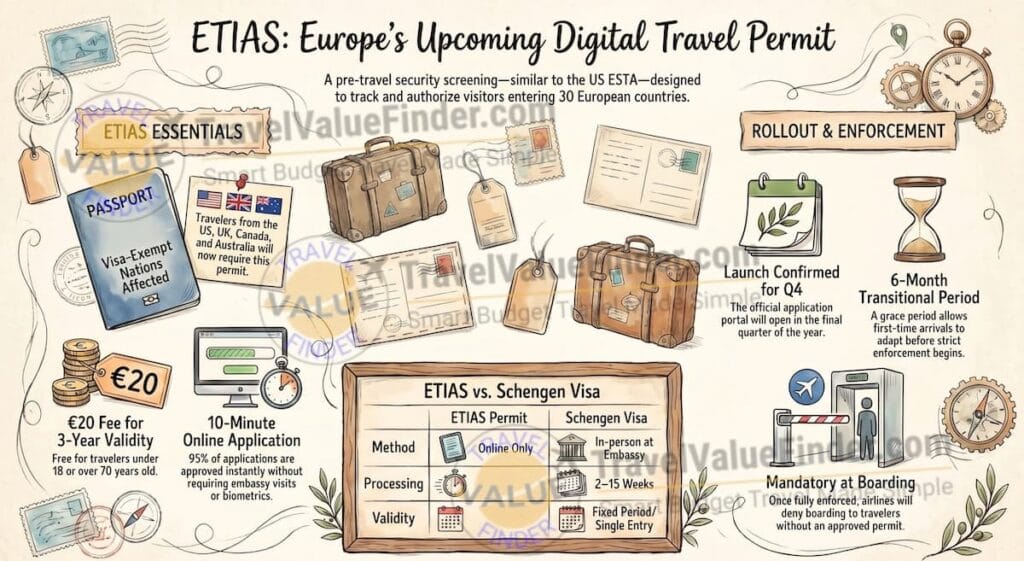
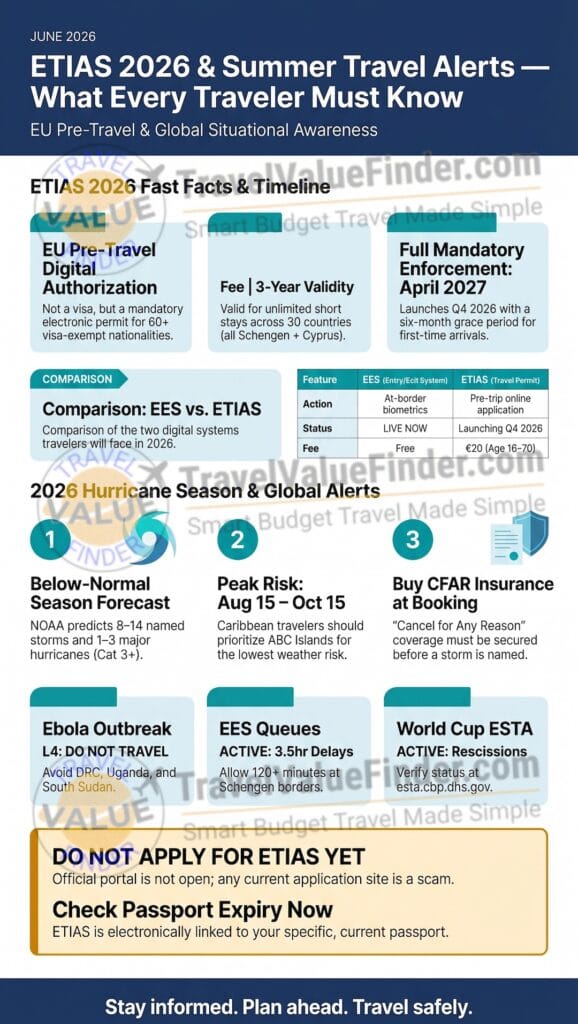
What is ETIAS Europe Travel Permit, and when does it start for US and UK travelers? ETIAS (European Travel Information and Authorisation System) is the EU’s new pre-travel digital authorization for visa-exempt travelers – the European equivalent of the US ESTA or Canada’s eTA. It is confirmed to launch in Q4 2026 (October–December). US, UK, Canadian, Australian, New Zealand, and Japanese citizens – along with travelers from 60-plus other visa-exempt nations – will need an approved ETIAS before entering any of the 30 participating European countries (29 Schengen Area countries plus Cyprus). The fee is €20, valid for 3 years, and applications take approximately 10 minutes online with no embassy visit required. A six-month grace period (transitional period) follows launch, meaning full mandatory enforcement is expected around April 2027. No applications are being accepted yet – the EU will announce the exact date several months before launch.
By Leslie Nics | Founder & Travel Value Expert, TravelValueFinder.com | Published: June 20, 2026 | Updated Weekly
If you are planning any trip to Europe in the second half of 2026 – or booking anything for 2027 – there is a deadline approaching that most travelers have never heard of, and that travel agents are only beginning to warn their clients about. The European Travel Information and Authorisation System, known as ETIAS, is now confirmed to launch in the last quarter of 2026: October, November, or December. When it does, citizens of 60-plus countries – including the United States, United Kingdom, Canada, Australia, New Zealand, Japan, South Korea, and every other visa-exempt nation – will need to obtain a new digital travel permit before setting foot in Europe.
This is not a visa. You will not need an embassy appointment or biometric submission (those happened at the border under the EES system that launched in April). ETIAS is a pre-travel online authorization – similar to the US ESTA or Canada’s eTA – costing €20, valid for three years, and taking approximately 10 minutes to complete. But it is mandatory. And with the exact launch date still unannounced, a six-month transitional grace period baked into the rollout, and a wave of scam websites already selling fake ETIAS applications, travelers need to understand this system now – not the week it goes live.
This week’s travel alerts guide from TravelValueFinder.com also covers the 2026 Atlantic hurricane season, now officially underway: NOAA and CSU forecasts point to a below-normal year – but below-normal does not mean risk-free, and Caribbean travelers have meaningful decisions to make about timing, destinations, and insurance. And with the FIFA World Cup now in its second week across 16 US, Canadian, and Mexican cities, we update the ongoing World Cup travel alert picture.
Alert #1 – ETIAS Confirmed for Q4 2026: Everything You Need to Know Before Europe’s New Travel Permit Goes Live
ETIAS is the single most consequential change to European travel since the Schengen Agreement itself. It will affect more than a billion travelers, require a new step in every Europe trip planning process, and – because it’s arriving alongside EES – mean that visiting Europe will for the first time require digital pre-clearance on the way in and digital recording on the way out. The travelers who understand this now will breeze through. The ones who find out at the airport won’t be flying that day. – Leslie Nics, TravelValueFinder.com
What ETIAS Is – and What It Isn’t
ETIAS is a pre-travel authorization, not a visa. The distinction matters enormously in practical terms. A Schengen visa requires a formal application to a member-state embassy, often weeks or months in advance, an in-person appointment, document submission, and payment of fees that vary by country and applicant nationality. ETIAS requires none of this.
You will apply entirely online, at any time, before your trip. The application collects your passport details, travel history, health and security questions, and basic trip information. The vast majority of applications will be processed automatically within minutes. The EU estimates that roughly 95% of applicants will be approved almost instantly. A small percentage will require additional manual review, which may take up to 30 days in exceptional cases. Once approved, an ETIAS authorization is linked electronically to your passport, valid for three years or until your passport expires, and allows unlimited short stays (up to 90 days in any 180-day period) across all 30 participating countries.
| Feature | ETIAS | Schengen Visa |
|---|---|---|
| Application method | Online only – no embassy visit | In-person at embassy/consulate |
| Processing time | Minutes (95% of cases) | 2–15 weeks typical |
| Fee | €20 (under 18 or over 70: free) | €80+ depending on nationality |
| Validity | 3 years or until passport expires | Single entry or fixed period |
| Who needs it | Visa-exempt nationals (60+ countries) | Non-visa-exempt nationals |
| Countries covered | All 30 ETIAS countries (29 Schengen + Cyprus) | The specific Schengen country that issued it |
| Biometric enrollment | No – at-border EES handles this | Yes – usually required |
| Guarantee of entry | No – border officers retain final discretion | No – border officers retain final discretion |
The Confirmed Timeline: What Happens and When
The EU has publicly confirmed: ETIAS will launch in Q4 2026 – meaning October, November, or December 2026. The European Commission has stated the precise date will be announced ‘several months prior’ to launch. As of June 20, 2026, that specific date has not yet been issued. The current Q4 2026 timeline is considered firm by both the European Commission and Frontex, which will operate the ETIAS Central Unit 24/7 after launch.
The rollout includes a structured grace period deliberately built in to allow travelers to adapt:
| Phase | Approximate Timing | What It Means for Travelers |
|---|---|---|
| Pre-launch (now) | Now – Q3 2026 | No ETIAS required. Travel to Europe as normal. Do NOT apply on any website – ETIAS applications are not being accepted anywhere yet. Any site claiming to accept applications now is a scam. |
| ETIAS Launch | Q4 2026 (Oct–Dec) | ETIAS goes live. Applications open on the official EU portal. You can apply before your trip. First-time arrivals after launch without ETIAS will be allowed entry for up to 6 months (transitional period). |
| Transitional / Grace Period | ~6 months post-launch | Travelers who arrived in Europe before ETIAS launched can still enter without authorization for the grace period. New arrivals after launch must have ETIAS. |
| Full Mandatory Enforcement | ~April 2027 | ETIAS becomes strictly required at all 30 participating border points. No ETIAS = no boarding. Airlines will check at check-in, just as they do for ESTAs and eTAs. |
Who Needs ETIAS – and Who Is Exempt
ETIAS affects citizens of approximately 60 visa-exempt countries who currently travel to the Schengen Area without any pre-travel authorization requirement. The major affected nationalities include:
- United States – US citizens currently visit Europe with only a valid passport. ETIAS will add a €20 digital pre-clearance step.
- United Kingdom – UK citizens lost free movement rights after Brexit. ETIAS will be required in addition to passport validity and the existing 90-day-in-180-day time limit.
- Canada, Australia, New Zealand – All currently visa-exempt for short Schengen stays. All will require ETIAS from Q4 2026.
- Japan, South Korea, Singapore – Major Asia-Pacific source markets with heavy European travel volumes. All affected.
- Brazil, Mexico, Colombia – Major Latin American markets with visa-exempt Schengen access. All will need ETIAS.
- Gulf Cooperation Council (GCC) nationals – UAE, Qatar, Kuwait, Saudi Arabia, Bahrain, Oman – all visa-exempt and all ETIAS-required.
Who Is EXEMPT from ETIAS? EU / EEA member state citizens – full freedom of movement rights, no change. Non-EU nationals with a valid Schengen visa or national long-term visa / residence permit – ETIAS is not required if you already have a Schengen visa. Children under 18 and adults over 70 – ETIAS is required but the €20 fee is waived. Certain diplomats and official travel document holders – check with your national foreign ministry. Ireland and the United Kingdom are not Schengen members – ETIAS covers Schengen countries plus Cyprus. Traveling to Ireland only does not trigger ETIAS requirements.
SOURCE: European Commission ETIAS Overview | Frontex ETIAS Information Page
The Countries Where ETIAS Will Be Required
ETIAS will be required to enter 30 European countries: the 29 Schengen Area members (Austria, Belgium, Croatia, Czech Republic, Denmark, Estonia, Finland, France, Germany, Greece, Hungary, Iceland, Italy, Latvia, Liechtenstein, Lithuania, Luxembourg, Malta, Netherlands, Norway, Poland, Portugal, Slovakia, Slovenia, Spain, Sweden, and Switzerland) plus Cyprus. Ireland is not participating.
This means that a US or UK traveler flying into Paris, Rome, Madrid, Amsterdam, Lisbon, Athens, Vienna, Prague, or any other Schengen city will need an approved ETIAS before their flight departs. Airlines will verify ETIAS at check-in – just as they currently verify US ESTA and Canadian eTA status – and travelers without approval will not be permitted to board.
The ETIAS Fee: €20 – Not €7 – And Why It Changed
Important correction to widely circulated information: The ETIAS fee is confirmed at €20 – not the originally planned €7 that was set when ETIAS was first legislated in 2018. The fee was raised by the European Parliament to fund expanded Frontex operations and cybersecurity infrastructure for the system. Travelers under 18 or over 70 are exempt from the fee but still need to apply. Multiple third-party websites still list €7 – this figure is outdated and incorrect.
SCAM ALERT: DO NOT APPLY FOR ETIAS ON ANY WEBSITE RIGHT NOW
ETIAS is NOT yet live. No applications are being accepted anywhere. The EU portal has not opened. Multiple fraudulent websites are currently accepting ‘ETIAS applications’ and payments ranging from €20 to €80+.
These are scams. Any money paid is unrecoverable.
The ONLY legitimate place to apply – when ETIAS launches in Q4 2026 – will be the official EU government portal. The EU will announce this URL officially when the system opens. Never pay a third-party agency, travel agent, or website to ‘apply on your behalf.’ ETIAS applications will be straightforward enough to complete in 10 minutes without assistance.
If you see an ad or website claiming you can apply for ETIAS now: report it to your national consumer protection authority.
SOURCE: European Commission | Frontex Official ETIAS Information
How ETIAS Interacts with EES – Two Systems, Two Steps
The most common point of confusion among travelers right now is the relationship between EES and ETIAS. These are two entirely separate systems operated for different purposes, and both will eventually apply to the same traveler:
| EES (Entry/Exit System) | ETIAS (Travel Authorization) | |
|---|---|---|
| What it does | Records WHEN you cross Schengen borders. Replaces passport stamps with digital entry/exit logs. | Pre-screens WHO can travel to Europe. Approves you before your trip even begins. |
| When it happens | AT the border, when you arrive or depart | BEFORE your trip – online application |
| Status | LIVE – April 10, 2026 | LAUNCHING Q4 2026 |
| Biometrics | YES – fingerprints + facial scan at border | NO – online only |
| Fee | Free | €20 (under 18 / over 70: free) |
| Validity | Data stored 3 years; each crossing logged | 3 years or passport expiry |
| Action required NOW | YES – allow extra time at Schengen borders. Pre-register via EU Travel to Europe app. | NO – wait for Q4 2026 official launch |
The practical journey for a US traveler visiting Europe from, say, November 2026 onward will look like this: apply for ETIAS online before booking flights – receive digital authorization linked to passport – board flight – arrive at Schengen border – submit fingerprints and facial scan for EES registration – enter Europe. Two steps, two systems, one trip.
ETIAS is where Europe catches up with the rest of the world. The US has had ESTA since 2009. Canada has had eTA since 2016. Australia has had ETA since 1996. Europe – which receives more international visitors than any other destination on Earth – has been the last major travel destination without pre-screening. That era ends in Q4 2026. – Leslie Nics, TravelValueFinder.com
What Travelers Should Do Right Now – Action Steps
- Do NOT apply for ETIAS anywhere yet. No legitimate application portal exists. Wait for the official EU announcement.
- Subscribe to TravelValueFinder.com travel alerts – we will publish a dedicated ETIAS application guide the day the portal opens, with step-by-step instructions and the official link.
- Check your passport expiry. ETIAS is linked to your specific passport. If your passport expires before your planned Europe travel, renew it before applying for ETIAS – and if your ESTA (for US travel) is tied to an expiring passport, renew both.
- If traveling to Europe between now and Q4 2026: ETIAS is not yet required. Travel normally, but allow extra time for EES biometric registration at Schengen borders (currently causing up to 3.5-hour delays at peak at Lisbon, Paris CDG, and Amsterdam).
- If you have Europe trips booked for late 2026 (October onward): begin factoring the ETIAS application step into your pre-trip checklist. The process should take 10 minutes online, but apply at least 72 hours before travel to allow for any manual review.
- Bookmark the EU’s official ETIAS information page at ec.europa.eu/home-affairs/what-we-do/policies/borders-and-visas/border-crossing/etias_en for official updates on the launch date.
Alert #2 – 2026 Atlantic Hurricane Season Is Open: What Caribbean and Gulf Coast Travelers Need to Know
Below-normal does not mean risk-free. A single major hurricane making landfall on a Caribbean island you’re booked to visit can cancel your entire trip, close your resort for weeks, and leave you without recourse if you didn’t buy the right insurance. One storm in the right place at the right time is all it takes – and no seasonal forecast can tell you where that storm will go. – Leslie Nics, TravelValueFinder.com
What NOAA and CSU Are Forecasting for 2026
The 2026 Atlantic hurricane season officially opened June 1 with two of the world’s most authoritative forecasting bodies aligned on a below-normal outlook. NOAA put the probability of a below-normal season at 55%, forecasting 8 to 14 named storms, of which three to six are expected to strengthen into hurricanes, with one to three potentially reaching Category 3 or higher. Colorado State University’s forecast, released April 2026, projects 13 named storms, six hurricanes, and two major hurricanes, while noting a 35% probability that the Caribbean will experience a major hurricane landfall.
The primary driver of the subdued forecast is the expected development of a robust El Niño pattern. El Niño conditions increase wind shear across the Atlantic basin – a meteorological force that disrupts the organized rotation tropical storms need to intensify. However, both NOAA and CSU caution that El Niño’s influence takes time to establish, and the early part of hurricane season – June and July – can still produce active storms before El Niño reaches full strength.
| Metric | NOAA 2026 Forecast | CSU 2026 Forecast | Context |
|---|---|---|---|
| Named storms | 8–14 | 13 | Average: 14 |
| Hurricanes | 3–6 | 6 | Average: 7 |
| Major hurricanes (Cat 3+) | 1–3 | 2 | Average: 3 |
| Caribbean major landfall probability | 35% (CSU) | 35% | Historical average ~52% |
| Season probability outlook | 55% below-normal (NOAA) | Below-average | 35% near-normal; 10% above-normal |
| Key driver | El Niño development (increases wind shear) | ||
| Peak season | Mid-August through mid-October | August–October | June–July lower risk; Nov lower risk |
| CSU next update | July 8, 2026 | August 5, 2026 | Forecasts become more accurate post-July |
The 2025 Precedent – Why One Storm Changes Everything
Context for this forecast: The 2025 hurricane season was officially near-normal with 13 named storms and nine hurricanes – but the season’s most consequential event was a single late-October storm, Hurricane Melissa, which caused significant damage in Jamaica and forced the temporary closure of several major resorts. A near-normal forecast in 2025 did not prevent substantial disruption to Caribbean travelers in the final weeks of the season.
This is the essential lesson of Caribbean hurricane season travel planning: the headline forecast number tells you about basin-wide activity – it does not tell you where any individual storm will go, and it does not protect travelers who have not prepared for the scenario where a storm hits their specific destination.
Caribbean Travel by Risk Period – Planning Your Trip
| Travel Window | Relative Risk | What This Means for Travelers |
|---|---|---|
| June 1 – July 15 | LOWER – Early season | Below-average storm probability. Generally good value rates. Monitor for ‘homegrown development’ in Gulf and western Caribbean – can develop quickly close to land. |
| July 15 – August 15 | MODERATE – Ramp-up | Season activity begins increasing. Watch forecasts closely. CSU July 8 update will sharpen the picture. Travel insurance becomes more important. |
| August 15 – October 15 | HIGHEST – Peak season | Statistically highest risk period. Lowest resort prices and crowds. Cancel for Any Reason (CFAR) insurance is strongly recommended. Know your resort’s hurricane guarantee policy. |
| October 15 – November 30 | MODERATE – Late season | Activity typically decreasing. November has good value. Late-season storms can still be significant (cf. Hurricane Melissa 2025, late October). |
| Southern Caribbean year-round | LOWEST – Outside belt | Aruba, Curaçao, Bonaire sit below the typical hurricane belt. Historically very rarely affected. Good option for August–October travelers seeking lower weather risk. |
Cruise Travelers: What Hurricane Season Actually Means for Your Sailing
The most important fact for cruise travelers during hurricane season is one the industry rarely publicizes loudly: cruise ships almost never cancel sailings due to hurricanes. They reroute. The captain and fleet operations center have real-time weather data and the flexibility to divert to alternative ports anywhere in the Caribbean basin. A storm that closes one island for a week is an operational pivot for a cruise ship – an itinerary change, not a cancellation.
For cruise travelers, the practical risk is receiving a different itinerary than the one you booked – visiting Nassau instead of St. Maarten, or Grand Cayman instead of Jamaica. If a specific port or island is essential to your trip’s value (a private excursion, a wedding, a diving trip), you should know in advance that the cruise line’s obligation is to provide a sailing, not to guarantee specific ports.
- If the cruise LINE cancels the sailing: you are entitled to a full refund or future cruise credit
- If YOU cancel because of a weather forecast: you generally need Cancel for Any Reason (CFAR) insurance to recoup costs – most standard policies do not cover voluntary pre-emptive cancellation
- If the cruise reroutes and you miss a specific port: this is within the cruise line’s contractual rights. No compensation is typically owed beyond refund of prepaid port excursions
- CFAR coverage typically reimburses 50–75% of prepaid trip costs as long as you cancel more than 48 hours before departure
HURRICANE SEASON TRAVEL INSURANCE: THE ONE RULE THAT SAVES YOUR TRIP
Standard travel insurance does NOT cover voluntary cancellations due to hurricane forecasts. You must have Cancel for Any Reason (CFAR) coverage for that protection. Once a named storm is identified and tracking toward your destination, most standard policies will not allow you to add CFAR or change your coverage.
Buy insurance – and upgrade to CFAR – at the time of booking, not later. For Caribbean resort travel: check whether your resort has a ‘hurricane guarantee’ – some resorts offer full refunds or free date changes if a named storm is within a defined distance of the property.
For travelers with flights: if a named storm causes your airline to cancel or significantly alter your flight, standard flight cancellation rights apply – but hotel and activity costs require separate travel insurance coverage. Recommended comparison platforms: Squaremouth (squaremouth.com) and InsureMyTrip (insuremytrip.com) – both allow filtering for CFAR policies.
Islands With the Best Value Right Now – Early Hurricane Season
For travelers flexible enough to travel June through mid-July, the early hurricane season window offers some of the year’s best resort pricing – often 20 to 40% below peak-winter rates – with historically low storm risk. Below-normal 2026 forecasts make this an even more compelling window for value-conscious Caribbean travelers. The destinations offering the most attractive June–July pricing relative to quality right now include:
- Jamaica – Fully rebuilt after Hurricane Melissa (2025). Sandals and Beaches resorts operational. June rates significantly below winter highs. Best window before August peak risk.
- Barbados – Eastern Caribbean positioning, historically less frequently hit than western or central Caribbean. Strong hotel quality and value in June.
- Turks and Caicos – Premium destination with good June value. CFAR recommended for August–September bookings.
- Aruba / Curaçao / Bonaire (ABC Islands) – Sit outside the primary hurricane belt. Low storm risk year-round. Best value destination for August–October travelers who want Caribbean with minimal weather anxiety.
- Puerto Rico – US territory, so no passport required for Americans. Strong resort inventory. June value pricing currently available.
Alert #3 – World Cup Week 2 and Ongoing Global Travel Alerts: Your Current Status Update
World Cup 2026: What’s Changed Since June 11
The FIFA World Cup 2026 passed its first week without the catastrophic entry-denial wave that some immigration attorneys had feared. However, isolated incidents of social media-related secondary screening at US ports of entry have continued to be reported, and Scotland and other UK fans who had ESTA authorizations rescinded are now navigating entry via B-1/B-2 visa appointments – some successfully, some not.
The operational picture at World Cup host cities is broadly normal. Security levels are elevated but not disruptive. Ground transportation is stretched in cities like Los Angeles, New York, and Dallas on match days. Travelers attending matches should allow at least 90 extra minutes for airport-to-venue transfers on game days, and hotel availability near venues is extremely limited through the July 19 final.
| World Cup Alert | Status (Week of June 20) | Action |
|---|---|---|
| ESTA rescissions (UK / Scotland fans) | ONGOING – isolated cases | Verify ESTA at esta.cbp.dhs.gov before every trip leg. If rescinded, contact US Embassy immediately. |
| Social media vetting at US entry | OCCURRING – secondary screening | CBP officers may request device access. Right to refuse exists but may result in denial of entry. |
| Travel ban – 39 countries | FULLY IN EFFECT | Nationals of banned countries cannot attend US matches. Canada/Mexico matches remain accessible under separate entry rules. |
| Match day transport delays | ELEVATED in all host cities | Allow 90 extra minutes on match days. Book transport in advance. Rideshare surge pricing is significant. |
| Hotel availability near venues | VERY LIMITED through July 19 | Book now even for late-round matches. Prices are at peak. Consider staying 30–45 min from venue. |
Other Active Global Travel Alerts – June 20, 2026
| Alert | Level | Who Is Affected | Action |
|---|---|---|---|
| Ebola – DRC | L4 DO NOT TRAVEL | All travelers to DRC | Cancel all travel. Route US returns via Dulles (IAD) or Houston (IAH). |
| Ebola – Uganda | L4 DO NOT TRAVEL | All travelers to Uganda | Cancel all travel. WHO PHEIC remains in effect. |
| Ebola – South Sudan | L4 DO NOT TRAVEL | All travelers to S. Sudan | Cancel all travel – preventive Level 4. |
| Measles – US (40 jurisdictions) | ACTIVE – 2,030+ cases | Unvaccinated travelers + World Cup crowds | Confirm two MMR doses before travel. See TravelValueFinder.com/measles-outbreak-travel-risk-2026. |
| EU EES biometric queues | UP TO 3.5 HRS (Lisbon peak) | All non-EU Schengen travelers | Add 90–120 min minimum. 3 hrs for Portugal. Pre-register via EU Travel to Europe app. |
| Thailand-Cambodia border conflict | L4 – 50 KM ZONE | SE Asia tourists | No land crossings. Fly Bangkok–Phnom Penh/Siem Reap only. |
| Atlantic Hurricane Season | ACTIVE – Below-normal forecast | Caribbean / Gulf Coast travelers | Buy CFAR insurance at booking. Peak risk: Aug 15–Oct 15. |
| ETIAS – EU travel permit | LAUNCHING Q4 2026 | All visa-exempt travelers to 30 EU countries | No action yet. Monitor for official launch announcement. Do NOT apply on any current website. |
People Also Ask – Expert Answers
Do I need ETIAS to visit England, Scotland, or Ireland?
No. ETIAS applies only to the 30 participating European countries – the 29 Schengen Area member states plus Cyprus. The United Kingdom (England, Scotland, Wales, Northern Ireland) is not in the Schengen Area and is not participating in ETIAS. Ireland is also not part of ETIAS. Travelers visiting only the UK or Ireland will not need ETIAS. However, if your trip includes both UK/Ireland and any Schengen countries (France, Spain, Italy, Germany, etc.), you will need ETIAS for the Schengen portions of your trip – and the UK ETA (£16) for the UK portion.
Can I book a Europe trip for October 2026 without worrying about ETIAS?
You can book freely – but you should be aware that ETIAS may be required by the time you travel if your October departure is after the launch date. The EU has not confirmed the exact launch date within Q4 2026. Given the six-month transitional grace period built into the rollout, even travelers who arrive in October or November without ETIAS will initially be admitted without issue. However, the prudent approach for any Europe trip from October 2026 onward is to watch for the official launch announcement and apply promptly once the portal opens. TravelValueFinder.com will publish a same-day guide when ETIAS applications open.
Will ETIAS replace my Schengen visa?
No. ETIAS and Schengen visas are entirely separate documents for entirely different traveler groups. ETIAS applies to nationals of visa-exempt countries – those who currently need no visa to enter the Schengen Area (US, UK, Australian, Canadian citizens, etc.). If you currently need a Schengen visa to enter Europe, you will still need a Schengen visa after ETIAS launches – ETIAS will not be available to you as an alternative. The two systems do not overlap.
Is Caribbean travel worth it during hurricane season 2026?
For most travelers, yes – with the right preparation. The 2026 forecast from both NOAA and CSU points to a below-normal season, with the primary driver being El Niño development. Peak risk is concentrated in mid-August through mid-October. Outside that window, particularly in June, early July, and November, Caribbean travel carries historically low hurricane risk and typically offers the year’s best value pricing – 20 to 40% below winter peaks at many resorts. The critical preparation steps are: buy Cancel for Any Reason (CFAR) insurance at the time of booking, check your resort’s hurricane guarantee policy, and for August–October travel, consider the ABC Islands (Aruba, Curaçao, Bonaire) which sit below the typical hurricane belt.
What is the difference between ETIAS, EES, and ESTA?
Three different systems, three different purposes, three different jurisdictions: ESTA (Electronic System for Travel Authorization) is the US pre-travel authorization system for visa-exempt travelers entering the United States – it costs $40, is valid for two years, and US citizens never need it (it’s for visitors to the US). EES (Entry/Exit System) is the EU’s border recording system – already live since April 10, 2026 – that collects biometric data (fingerprints + facial scan) at Schengen borders and records entry and exit timestamps, replacing passport stamps. ETIAS (European Travel Information and Authorisation System) is the EU’s upcoming pre-travel authorization for visa-exempt visitors to 30 European countries – similar to ESTA but for Europe. Launching Q4 2026, costing €20, valid three years. US citizens will need ETIAS to visit Europe, just as European citizens currently need ESTA to visit the US.
How do I know if my Caribbean resort has a hurricane guarantee?
Contact the resort or your booking platform directly and ask specifically about their ‘hurricane guarantee’ or ‘tropical weather policy.’ The best policies typically offer a full refund or free date change if a named storm is within a defined distance (often 50 miles) of the property within 24–48 hours of your arrival date. Sandals and Beaches resorts, major Hyatt properties, and many Marriott Bonvoy resorts offer hurricane guarantee policies. Independent boutique resorts may not – make this an explicit question before booking if you are traveling during peak season. Also read your travel insurance policy carefully, as storm coverage varies significantly between insurers.
When should I apply for ETIAS once it opens?
The EU’s guidance is to apply before booking flights – or at minimum before travel. Given that 95% of applications are processed almost instantly, most travelers will receive approval within minutes of applying. However, a small percentage of cases require manual review of up to 30 days. The prudent approach is to apply at least 72 hours before departure for the general case, and as early as possible for any traveler with a complex travel history or prior visa issues. The EU has also confirmed that an approved ETIAS will be valid for three years – so applying as soon as the system opens is logical for frequent Europe travelers.
Frequently Asked Questions (FAQs)
Q: I’m a US citizen planning multiple Europe trips in 2027. Should I apply for ETIAS as soon as it opens?
Yes – absolutely. ETIAS is valid for three years from approval (or until your passport expires), and it covers all 30 participating European countries with unlimited short-stay entries. For frequent Europe travelers, applying at launch gives you three years of unrestricted access without needing to think about it again. Apply the day the portal opens, link it to your current passport, and if you renew your passport during the three-year window, you will need a new ETIAS tied to the new passport. The €20 fee for three years of coverage is one of the best-value travel expenditures available.
Q: I’m traveling to Paris in August. Do I need ETIAS yet?
No. ETIAS has not launched yet. You travel to Paris in August 2026 exactly as you would today – with a valid passport and, if you are a first-time visitor this year, you will go through EES biometric registration at the border. Allow extra time for this (queues at Paris CDG have been running up to 2-3 hours at peak). ETIAS will not be required until it launches in Q4 2026, and even then, a six-month transitional grace period means enforcement won’t be strict until approximately April 2027. Your August 2026 Paris trip is unaffected.
Q: Can I use the same ETIAS for France, Spain, and Italy on one trip?
Yes. A single ETIAS authorization covers all 30 participating European countries, including France, Spain, Italy, Germany, Portugal, Greece, and every other Schengen member plus Cyprus. You apply once, receive one authorization, and it is valid for short stays (up to 90 days in any 180-day period) across all covered countries. There is no per-country application or per-country fee. This is one of the most traveler-friendly aspects of the ETIAS design – it mirrors the ESTA model where a single authorization covers all US entry points.
Q: I have a Caribbean cruise booked for September. Should I cancel because of hurricane season?
Not necessarily. September is within the peak hurricane season window, but the 2026 forecast is below-normal and cruise ships reroute rather than cancel. What you should do: confirm you have travel insurance (standard or CFAR if you want cancellation flexibility), check your cruise line’s specific hurricane policy (most will reroute safely), review whether your itinerary includes Jamaica or other islands still recovering from 2025’s Hurricane Melissa, and check the CSU July 8 and August 5 forecast updates, which will give a sharper seasonal picture. If specific ports are essential to your trip value, speak with your cruise line about their rerouting scenarios for those ports.
Q: I saw a website offering ‘pre-ETIAS registration.’ Is it legitimate?
No. Any website currently offering ETIAS registration, pre-registration, or application is a scam. The EU ETIAS portal has not opened. No applications are being accepted anywhere. These sites typically charge fees ranging from €20 to €80 or more, issue fraudulent confirmation documents, and keep your payment – the EU will have no record of any such application. Do not pay any website for ETIAS applications at this time. The only legitimate source for ETIAS will be the official EU government portal, announced by the European Commission when the system launches. TravelValueFinder.com will provide the direct official link the day it goes live.
Leslie Nics’ 9-Point Travel Action Plan – Week of June 20, 2026
- ETIAS: Do NOT apply anywhere right now – the portal is not open. Subscribe to TravelValueFinder.com alerts to receive the application link the day ETIAS launches in Q4 2026.
- Check your passport expiry date today. ETIAS will be linked to your specific passport. If your passport expires within 12 months, renew it now – both to ensure validity for upcoming Europe trips and to have your valid passport ready when ETIAS opens.
- For any Europe trip booked from October 2026 onward: factor a 10-minute ETIAS online application step into your pre-trip checklist. Apply at least 72 hours before departure once the portal is live.
- If traveling to Europe now through September 2026: no ETIAS required. But add 90–120 minutes minimum for EES biometric registration at Schengen borders. Three hours at Lisbon. Download the EU ‘Travel to Europe’ app to pre-register biometrics (available in Portugal and Sweden).
- Caribbean travelers: buy Cancel for Any Reason (CFAR) insurance at the time of booking – not later. Once a named storm is identified, most policies close the window for CFAR additions. Use Squaremouth or InsureMyTrip to compare CFAR-eligible policies.
- For peak hurricane season (August 15 – October 15) Caribbean travel: consider the ABC Islands (Aruba, Curaçao, Bonaire), which sit below the typical hurricane belt and offer excellent year-round value at this time of year.
- World Cup travelers: verify ESTA status at esta.cbp.dhs.gov before every trip leg – rescissions are still occurring for some UK fans. Confirm your specific country’s entry requirements for each World Cup host country you will visit.
- Ebola: All travel to DRC, Uganda, and South Sudan remains cancelled under Level 4 Do Not Travel advisories. US returns from these countries must route via Dulles (IAD) or Houston (IAH). WHO PHEIC remains in effect – no vaccine available for Bundibugyo strain.
- Subscribe to TravelValueFinder.com/travel-alerts for weekly updates. ETIAS launch, CSU July 8 hurricane forecast update, ESTA policy changes, and EES grace period announcements are all expected in the coming weeks.
Find update on Europe’s EES Border Crisis Reaches Breaking Point, June 27 onwards
About the Author
Leslie Nics is the founder of TravelValueFinder.com and a travel value strategist with over a decade of experience translating complex immigration, visa, and border policy changes into clear guidance for real travelers. All data in this article is sourced from primary authorities: the European Commission, Frontex (EU Border and Coast Guard Agency), the European External Action Service (EEAS), the EU Migration and Home Affairs Directorate, NOAA, Colorado State University (CSU) Tropical Weather Research Group, AccuWeather, the National Hurricane Center, and the US State Department. This article reflects verified conditions as of June 20, 2026.
Sources
All data verified from primary authorities as of June 20, 2026:
- European Commission – ETIAS Official Overview | ec.europa.eu/home-affairs
- Frontex – ETIAS Official Information | frontex.europa.eu
- Fragomen LLP – EU EES and ETIAS Launch Status Update (March 2026) | fragomen.com
- Schengen Traveler – ETIAS Launch Date: Latest Updates & Timeline 2026 | schengentraveler.com
- ETA Travel Assistant UK – ETIAS Launch Date 2026: Confirmed Timeline | etatravelassistant.co.uk
- NOAA – 2026 Atlantic Hurricane Season Outlook | noaa.gov
- Colorado State University – 2026 Atlantic Hurricane Season Forecast | tropical.colostate.edu
- AccuWeather – Atlantic Hurricane Season Forecast 2026: 11-16 Named Storms | accuweather.com
- Virgin Islands Consortium – Atlantic Hurricane Forecast Projects Fewer Storms in 2026 | viconsortium.com
- CaribbeanMag – NOAA 2026 Below-Normal Hurricane Season Forecast | caribbeanmag.com
- Adventures by MJ Travel – Caribbean Hurricane Season 2026: Cruise & Resort Guide | adventuresbymj.travel
- AFAR – Caribbean Hurricane Season 2026 Travel Guide (Updated May 22, 2026) | afar.com
- CTM Travel – Corporate Travel News June 2026 | travelctm.com
- CDC – Ebola Current Situation Summary | cdc.gov/ebola
- US State Department – ETIAS and World Cup Travel | travel.state.gov
| Stay Ahead of Every Travel Alert – Free Monthly Updates from TravelValueFinder.com. ETIAS is coming. Hurricane season is here. The World Cup is live. The EU’s biometric border system is processing millions. TravelValueFinder.com’s Travel Alerts page – updated every week by Leslie Nics – is the resource that turns complex policy changes, health advisories, and operational disruptions into clear, money-saving actions for real travelers. Subscribe free and arrive prepared. Explore: TravelValueFinder.com/travel-alerts | /travel-insurance-guide | /flight-deals | /europe-travel-tips | /cruise-travel-guide Find out more on July 2026 Travel Alerts: Europe’s Historic Heatwave Is Dangerous — and It’s Not Over |