Travel Value Finder

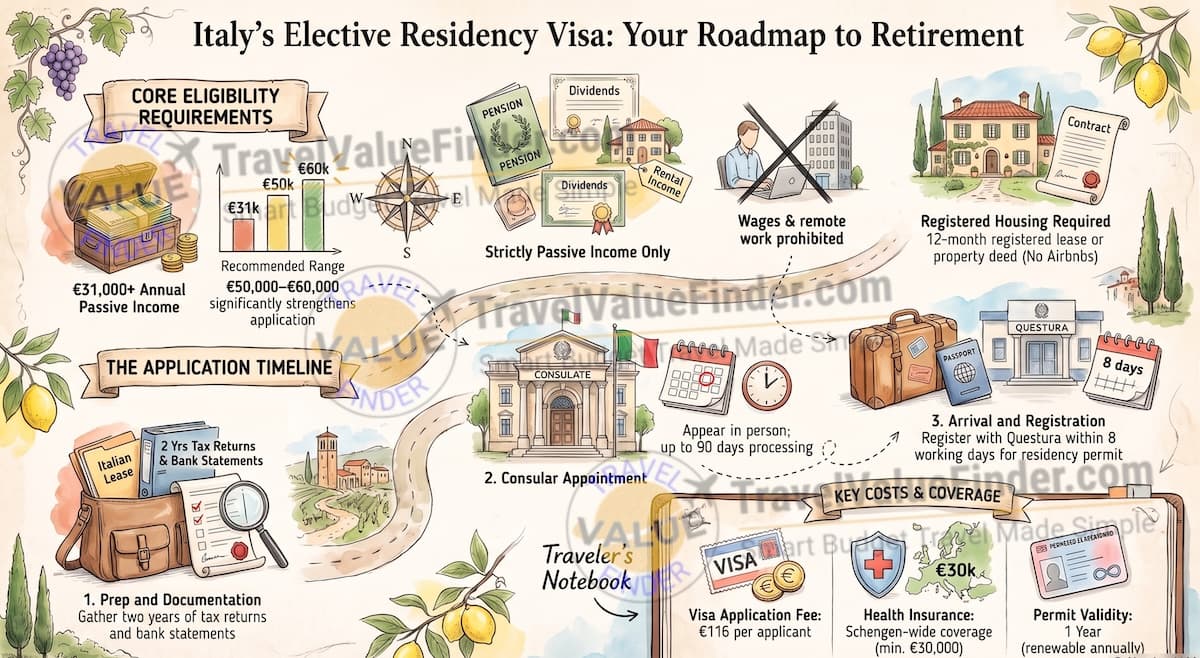
The Italy Elective Residency Visa requires proof of stable passive income (commonly cited at €31,000/year for a single applicant), private health insurance, and registered Italian housing arranged before you apply, and it prohibits any form of work, including remote work for a foreign employer.
Leslie Nics, TravelValueFinder.com | Last updated: July 2026 | Last Reviewed: July 24 2026
Most guides to the Italy elective residency visa stop at the income number and call it a day. That number matters, but it isn’t what actually determines whether an application gets approved or sits in limbo for three months before a denial letter arrives.
After digging through consular guidance and the administrative court rulings that have actually shaped how this visa gets decided in practice, the requirements that matter most are the ones almost nobody puts up front: how the housing has to be registered, what specific phrase in your bank letter can sink an otherwise strong application, and what happens if you get denied anyway.
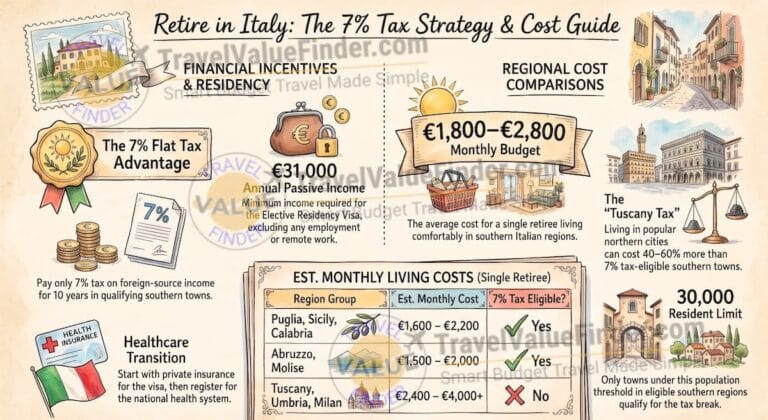
Minimum passive income required: ~€31,000/year (single applicant); figures cited up to €32,000–€38,000 depending on consulate and household size
Includes: pension, dividend, annuity, and rental income – not wages, salary, or freelance earnings
Caveat: Working – even remotely, for a company based entirely outside Italy – voids visa eligibility and can trigger permit non-renewal
Income & Documentation Requirements
The Italy Elective Residency Visa (Visto per Residenza Elettiva) is a National Type D visa, and it’s structured around one core test: can you support yourself indefinitely without working. Everything in the document checklist exists to prove that single point.
| Requirement | What Consulates Look For | Common Pitfall |
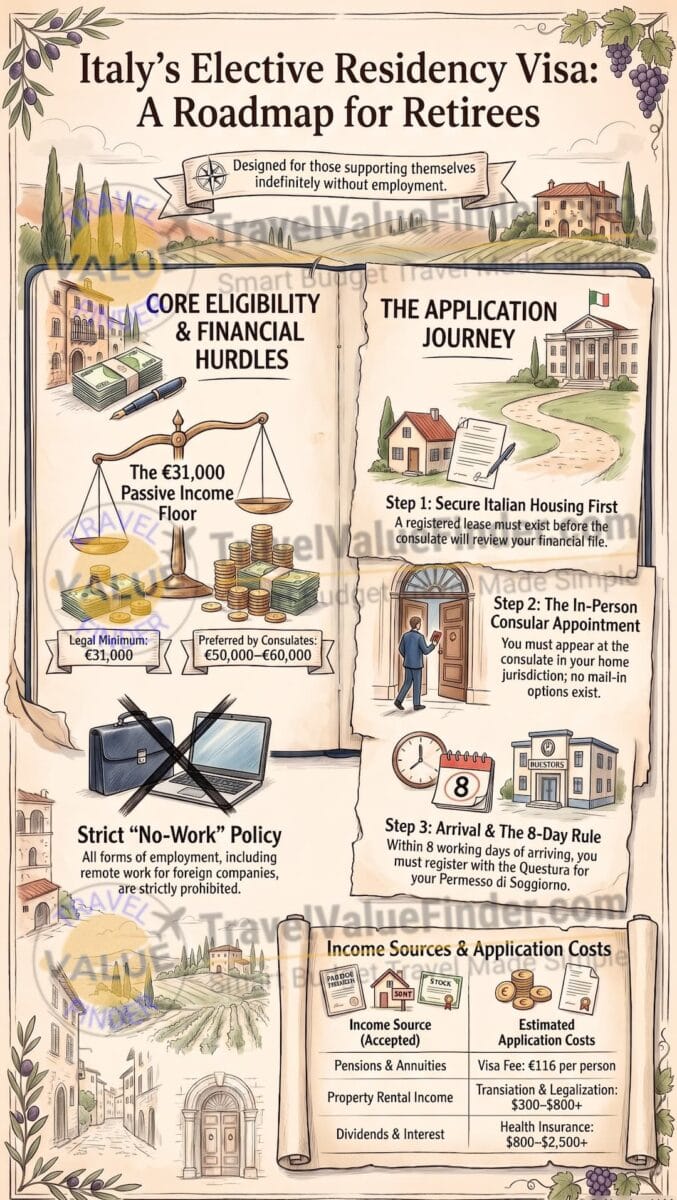
| Passive income | €31,000+/year single; higher for couples and dependents | Bank letters that don’t clearly separate passive from earned income |
| Housing | 12-month+ lease or property deed, registered with Agenzia delle Entrate | Airbnb or hotel bookings – these are explicitly rejected |
| Health insurance | Schengen-wide coverage, minimum €30,000 | Policies that lapse before the visa’s full validity period |
| Motivation letter | Clear, consistent explanation of the move and long-term plan | Vague or inconsistent statements about future income sources |
The Real Cost of Applying – Beyond the Income Requirement
Most guides mention the €31,000 income floor and stop there, as if that’s the only number that matters. It isn’t. The application itself carries its own costs, and they’re worth budgeting for separately from the passive income requirement:
| Cost Item | Typical Amount | Notes |
| Visa application fee | €116 per applicant | Usually paid in cash or by money order at the consulate |
| Post office “Kit Giallo” fee | ~€30 | Required to submit the permesso di soggiorno paperwork after arrival |
| Revenue stamp (marca da bollo) | €16 | Affixed to the first page of the application form |
| Document translation & legalization | $300–$800+ | Certified Italian translations plus apostille/legalization of foreign documents |
| Health insurance (annual) | $800–$2,500+ | Varies by age, coverage level, and provider |
None of these line items are large individually, but together they’re a meaningful pre-move cost most first-time applicants don’t budget for – and translation delays in particular are a common, avoidable reason applications slip past a planned departure date.
How Much Is Actually Enough? The Gap Between the Legal Minimum and What Gets Approved
This is the strategic detail almost no official source states outright, because it isn’t a legal requirement – it’s a pattern in how consulates actually behave. Immigration practitioners who handle these applications regularly report that consulates increasingly view the bare €31,000 minimum with skepticism, particularly at major consulates like San Francisco, New York, and London.
The practical guidance circulating among people who’ve been through the process recently is to show meaningfully more than the floor – often cited as €50,000–€60,000 for a single applicant -especially if the plan is to live in a higher-cost city like Milan, Rome, or Florence rather than a lower-cost southern town.
There’s no official rule that says “double the minimum,” but treating €31,000 as a target rather than a comfortable cushion is a common reason otherwise-eligible applicants get flagged for additional scrutiny.
Full Document Checklist
| Document | Purpose |
| Valid passport (2+ blank pages, valid 3+ months beyond stay) | Base identity and travel document |
| Completed visa application form, signed in person | Formal application record |
| Passport-style photo | Standard consular ID requirement |
| Proof of passive income (bank/pension letters, 3 months statements) | Core financial eligibility test |
| 2 years of tax returns | Demonstrates income stability over time, not a single snapshot |
| Registered 12-month lease or property deed | Satisfies the housing requirement |
| Private health insurance certificate (min. €30,000 coverage) | Required Schengen-wide medical coverage |
| Motivation/cover letter | Explains the move and long-term plan in the applicant’s own words |
| Visa fee payment (€116) | Processing fee, paid at the appointment |
Step-by-Step Application Timeline
1. Secure Italian housing first. A 12-month registered lease or a signed property deed has to exist before the consulate will meaningfully review the rest of the file – this is the step most applicants underestimate in terms of lead time, since finding and registering a lease from abroad often takes longer than expected.
2. Assemble financial documentation. Bank letters, three months of statements, pension or annuity award letters, and two years of tax returns showing the income is stable and recurring, not a one-time deposit. This is also the point to start translation and legalization of any foreign-language documents, since that step alone can take several weeks.
3. Book the in-person consular appointment. Applicants must appear in person at the consulate covering their home jurisdiction – there’s no mail-in or remote option, and appointment availability itself can add weeks to the timeline at busier consulates.
4. Wait through processing. Consular guidance cites up to 90 days for review, though timelines vary meaningfully by consulate and by how complete the initial file is – an incomplete or ambiguous financial file is the single most common reason processing stretches toward the outer edge of that window.
5. Register with the Questura within 8 working days of arrival. This is where the visa becomes an actual right to stay – the visa alone doesn’t grant it, the permesso di soggiorno does, and the local immigration office re-evaluates income, insurance, and housing at this stage independently of what the consulate already approved.
What Disqualifies an Application
Consular officers and immigration attorneys who handle these cases point to a consistent set of denial triggers: income that’s insufficiently documented or hard to trace to a passive source, any reliance on employment or self-employment income, a lease or deed that isn’t properly registered, and – less obviously – inconsistencies between the stated plan in the motivation letter and the applicant’s actual financial profile.
A file that looks complete on paper can still get denied if the story it tells doesn’t hang together.
One recurring pattern worth flagging specifically: consulates have historically applied the full per-applicant income requirement to minor children in a household application, which an administrative court in Rome later ruled unfair – the court pointed to an existing government table for determining financial means of support and found that applying the adult threshold to a dependent child wasn’t a reasonable reading of it.
That ruling doesn’t bind every consulate going forward, but it’s a useful data point if a family application gets an income objection that seems disproportionate to a child’s actual dependent status.
The bank letter that got flagged wasn’t unclear about the amount – it was unclear about the source. ‘Investment account’ isn’t the same as ‘pension’ to a consular officer running through a checklist. – Leslie Nics, Founder & Lead Travel Writer, TravelValueFinder.com
If You’re Denied: The Appeal Process
This is the part almost every competing guide skips entirely, and it matters more than it should have to.
A denial isn’t necessarily final. If the consulate hasn’t formally closed the file, applicants can request an administrative review and submit additional financial documentation without starting over.
If the application has been formally rejected (a provvedimento di rigetto), the remaining option is an appeal to the Administrative Tribunal (TAR) in Rome – and Italian law extends the usual 60-day appeal window by an additional 90 days for applicants who, by definition, live outside the EU.
Administrative courts have already overturned denials in cases where applicants had significant savings and investments rather than a traditional pension, establishing that consulates are expected to weigh overall financial stability, not just income labeled “pension” on a form.
Renewals & the Path to Permanent Residency and Citizenship
The visa itself only gets a foot in the door. The permesso di soggiorno issued after arrival is typically valid for one year and renewable annually, provided income, insurance, and housing conditions continue to be met – this is an ongoing test, not a one-time hurdle.
After roughly five years of continuous legal residency, elective residents can generally apply for EU permanent residency status. Citizenship eligibility follows at the 10-year mark, longer than several comparable programs elsewhere in southern Europe.
Ready to compare cities now?
- Use our Free Retirement Cost of Living Calculator – get your personalized report in 30 seconds – Free PDF download.
- How to Use a Retirement Cost of Living Calculator – to Compare Cities Worldwide
Nobody tells you the permesso di soggiorno resets the clock on scrutiny every single year. The visa gets you in the door; staying in is a permit renewal you have to keep earning. – Leslie Nics, Founder & Lead Travel Writer, TravelValueFinder.com
Italy vs Portugal’s D7 vs Spain’s Non-Lucrative Visa
Italy’s Elective Residency Visa is often cross-shopped against Portugal’s D7 and Spain’s Non-Lucrative Visa, since all three target the same kind of applicant. The differences are bigger than most comparison charts let on.
| Italy (Elective Residency) | Portugal (D7) | Spain (Non-Lucrative) | |
| Min. income (single) | ~€31,000/year | ~€10,440/year (min. wage-based) | ~€28,800/year |
| Remote work allowed | No | Yes | No (legal gray area) |
| Permit length | 1 year, annual renewal | 2 years, then 3-year renewal | 1 year, then 2-year renewals |
| Path to citizenship | 10 years | 5 years | 10 years |
Portugal’s lower threshold and remote-work allowance make the D7 the more forgiving route on paper. Italy’s appeal is less about ease of entry and more about what’s on the other side of the process – and, for retirees who land in one of the qualifying southern towns, the 7% flat tax regime covered in our companion guide to retiring in Italy.
Why Consulates Don’t All Apply the Same Standard
One detail that trips up applicants comparing notes online: there’s no single nationwide income table binding every Italian consulate. Guidance sets a floor, but individual consular offices have real discretion to request more – and in practice, they use it differently.
Applicants going through consulates in San Francisco, New York, and London have reported noticeably more scrutiny of “bare minimum” files in 2026 than in prior years, while some smaller consular jurisdictions apply a lighter touch. The practical upshot is that advice from someone who applied through a different consulate – even a friend who went through the process successfully last year – may not transfer directly to your own file.
Checking the specific requirements published by the consulate covering your home jurisdiction, rather than relying on a general figure circulating online, is worth the extra step.
What I’d Do Differently
I’d secure the lease before touching the financial documentation, not after. Chasing a signed, registered lease while a consular appointment date is already looming is how strong financial files still end up rushed.
I’d also request a letter from the pension or investment provider that explicitly uses the words “passive” and states the income is ongoing – leaving that inference to the consular officer is a risk that’s entirely avoidable with one extra phone call.
And I’d treat the €31,000 figure as a starting point for research, not a target to hit exactly – building in a real cushion above the legal minimum costs nothing at the application stage and removes one of the most common reasons files get flagged for extra review.
I underestimated how much the appeal window mattered until I read the actual TAR rulings – consulates have been overturned specifically for treating ‘not a pension’ as the same thing as ‘not passive. – Leslie Nics, Founder & Lead Travel Writer, TravelValueFinder.com
Find out more about retiring in Italy
- Retire in Italy – I Almost Skipped Italy’s 7% Tax Towns – Here’s Why I Was Wrong
- Best Places to Live in Italy after 55: The Italian Towns Retirees Actually Recommend (Not Just the Postcard Ones)
- Italy Elective Residency Visa: Italy’s Retirement Visa, Explained: What I’d Actually Prepare Before Applying
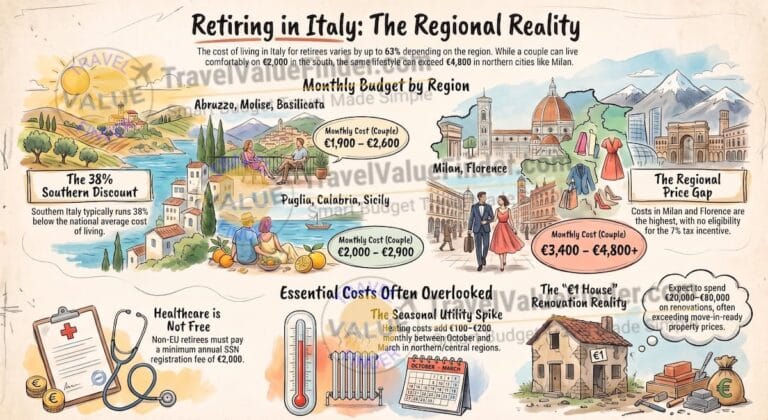
- Cost of Living in Italy for Retirees: What Retiring in Italy Actually Costs : By Region, Not by Guesswork
You May Be Interested in
- Italy Travel Guide For First-Time Visitors (2026)
- Where to Stay in Rome (2026 Guide): Best Areas, Hotels & Neighborhoods for Every Budget
- Retire in Portugal: A Warm, Practical Guide for People Over 55
- Best Places to Live in Portugal After 55: My Personal Guide
- Retire in Spain: A 55+ Guide to Planning Your Dream Life
- Best Places to Live in Spain After 55: A Practical Comparison
- Retire in France After 55: Healthcare, Cost, Visas & Lifestyle Explained
- Best Places to Live in France After 55: Regions Retirees Truly Enjoy
People Also Ask
How much money do I need to retire in Italy on this visa?
Roughly €31,000/year in passive income for a single applicant is the commonly cited floor, though several U.S. consulates have requested more in practice, and couples and dependents raise the threshold further.
Can I work remotely on Italy’s elective residency visa?
No. The visa explicitly prohibits any employment activity, including remote work for a company based entirely outside Italy – this is one of the clearest differences from Portugal’s D7 visa.
How long does it take to get Italian citizenship through this visa?
Permanent residency is typically available after about five years of continuous legal residency, with citizenship eligibility following at the 10-year mark.
What happens if my elective residency visa is denied?
Applicants can request an administrative review if the file hasn’t been formally closed, or file an appeal with the Administrative Tribunal in Rome within the extended deadline for applicants residing outside the EU.
FAQ
Do I need to buy property in Italy for this visa?
No, a registered 12-month (or longer) lease satisfies the housing requirement just as well as a property deed.
Can savings alone qualify instead of a pension?
Savings alone generally don’t qualify as passive income on their own, though they can support an application alongside a genuine passive income source, and administrative courts have sided with applicants who show ample, stable financial resources beyond a traditional pension.
Is the elective residency visa the same as Italy’s Golden Visa?
No. There’s no minimum investment requirement – the elective residency route is based entirely on proving passive income, not capital investment.
Can my spouse and children be included on my application?
Dependent spouses and minor children can generally be included, provided the applicant demonstrates sufficient financial resources to support the full household.
Can I switch from a tourist visa to elective residency while already in Italy?
Generally no – this visa type typically must be applied for from your home consulate before traveling, not converted from inside Italy.
Sources
- Italian Ministry of Foreign Affairs – Consular network guidance on the Elective Residency Visa (esteri.it consular offices, including New York, Los Angeles, Chicago, San Francisco, and Washington D.C.)
- Legislative Decree 286/1998 (Testo Unico sull’Immigrazione) and Presidential Decree 179/2011 – governing framework for the permesso di soggiorno
- Ministerial Decree of 11 May 2011 – visa classification and financial-resources standard for the elective residency category
About the Author
Leslie Nics is the founder and lead researcher at TravelValueFinder.com, where the focus is always on what things actually cost – and what actually gets an application approved – not what the brochure says. Read more on the About page or see the site’s Trust & Transparency Policy.