Travel Value Finder

The cost of living in Italy for retirees is where a retired couple can expect to spend roughly €2,200–€3,500 a month in most Italian regions outside the major northern cities, covering housing, food, transport, and healthcare – with Puglia, Calabria, and Sicily running toward the lower end and Milan or Florence pushing well past the top.
Leslie Nics, TravelValueFinder.com | Last updated: July 2026 | Last Reviewed: July 24 2026
The cost of living in Italy for retirees isn’t one number – it’s at least four, depending on whether you land in a Sicilian hill town, a Puglian coastal city, a Tuscan village, or Rome. Most cost-of-living guides average all of that together into a single misleading figure.
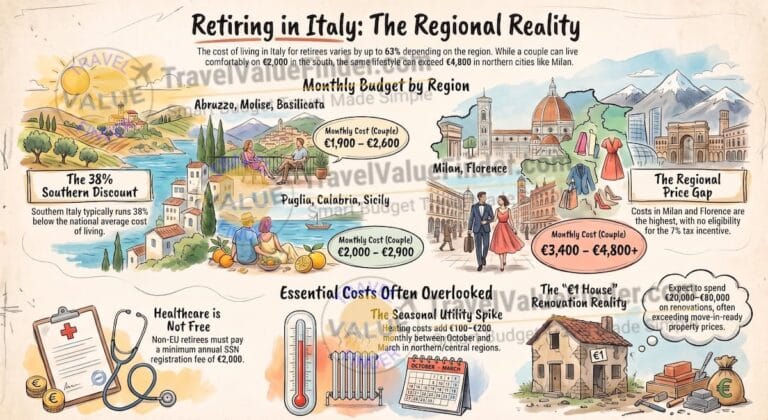
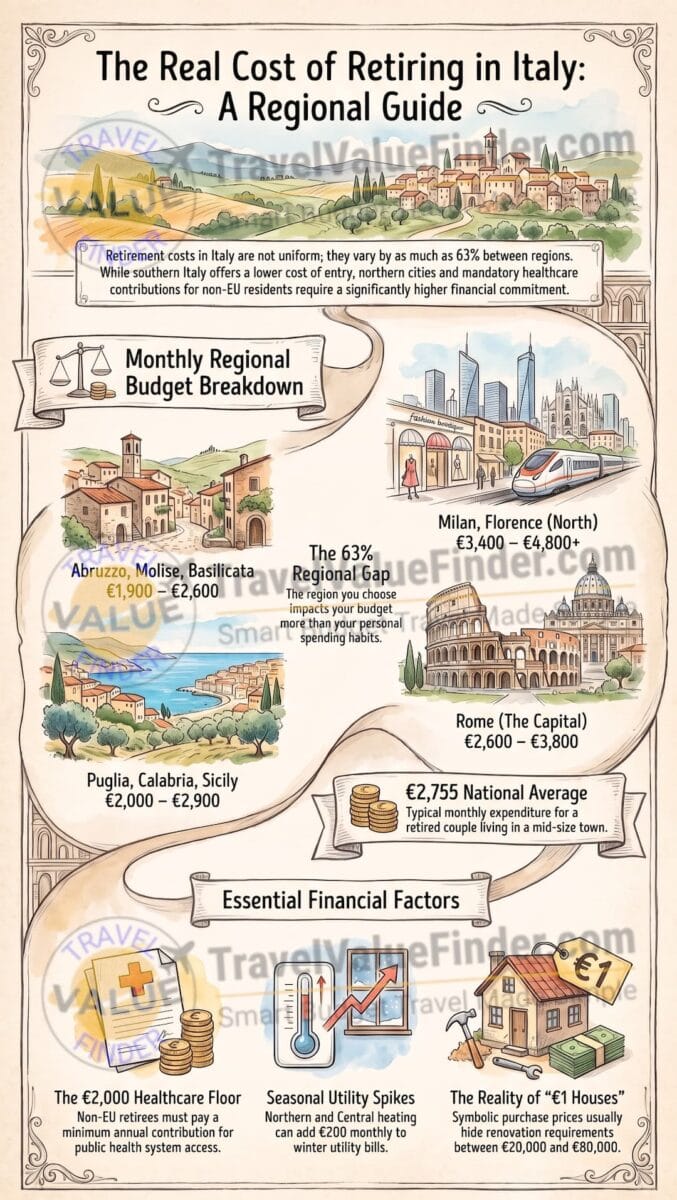
The regional gap is close to 63% between the cheapest southern towns and Milan, which means the region you pick matters more to your monthly budget than almost any other single decision – including how modest you’re willing to live.
Couple, mid-size town, all-in monthly cost: €2,200–€3,500
Includes: rent or mortgage, utilities, groceries, private health top-up, local transport
Caveat: Older inland properties often need renovation budgets that don’t show up in any “monthly cost” figure – factor that in separately if buying rather than renting.
Total Monthly Cost of Living in Italy for Retirees by Region
ISTAT’s most recent household expenditure data puts the national average around €2,755/month, but that average hides enormous regional spread – southern Italy runs roughly 38% below the north-east.
| Region | Single Retiree / mo | Couple / mo | Notes |
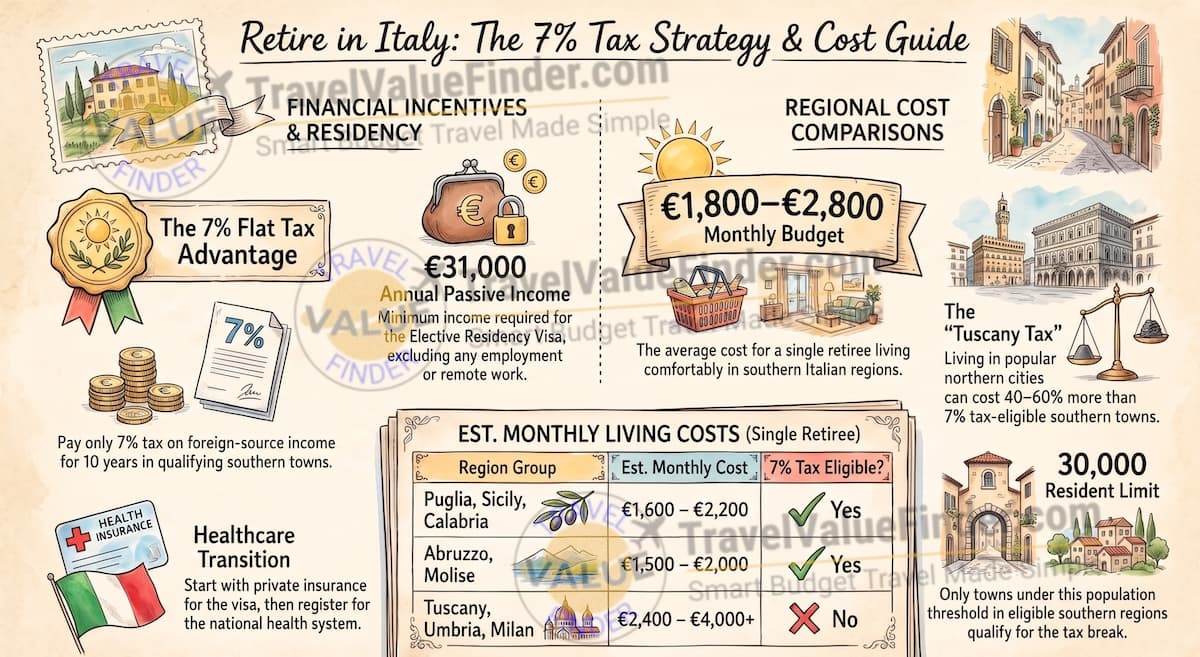
| Puglia, Calabria, Sicily (South) | €1,400–€2,100 | €2,000–€2,900 | 7% tax zone towns fall in this range |
| Abruzzo, Molise, Basilicata | €1,300–€1,900 | €1,900–€2,600 | Lowest cost tier nationally |
| Tuscany, Umbria, Central Italy | €2,000–€2,800 | €2,800–€3,800 | Popular with expats; costs closer to national average |
| Rome | €1,800–€2,700 | €2,600–€3,800 | Surprisingly moderate for a capital – 30–40% below Paris or London |
| Milan, Florence (North) | €2,400–€3,500+ | €3,400–€4,800+ | Highest cost tier; no 7% tax eligibility |
Housing: Rent vs Buy
Rent is the single biggest lever in an Italian retirement budget, and the swing is dramatic. A one-bedroom apartment runs roughly €400–€1,000/month outside city centers and €500–€1,500 in central areas nationally – but in southern towns like Ostuni, Cefalù, or Sulmona, a comfortable two-bedroom in the historic center can run as little as €450–€650/month.
Buying follows the same pattern in reverse: Rome runs roughly €3,000–€5,000/m², Florence €3,500–€6,000/m², while Sicilian properties can be found for €500–€1,500/m².
Italy’s well-publicized €1 house programs in depopulating southern villages are real, but the renovation costs – typically €20,000–€80,000 – need to be budgeted as a separate, often larger line item than the property itself.
Utilities & the Seasonal Cost Most Budgets Miss
Utilities average €150–€250/month for electricity, gas, water, and waste collection – but that figure hides a heating-season spike of €100–€200/month between October and March in northern and central regions, which barely applies in the south.
Water costs alone vary by a factor of three depending on region: 2024 annual water bills ran as low as €234 in Molise and as high as €748 in Tuscany.
A generic “utilities budget” that doesn’t account for which region and which season is one of the more common ways cost-of-living estimates end up wrong by a meaningful margin.
Healthcare Costs Beyond the Public System
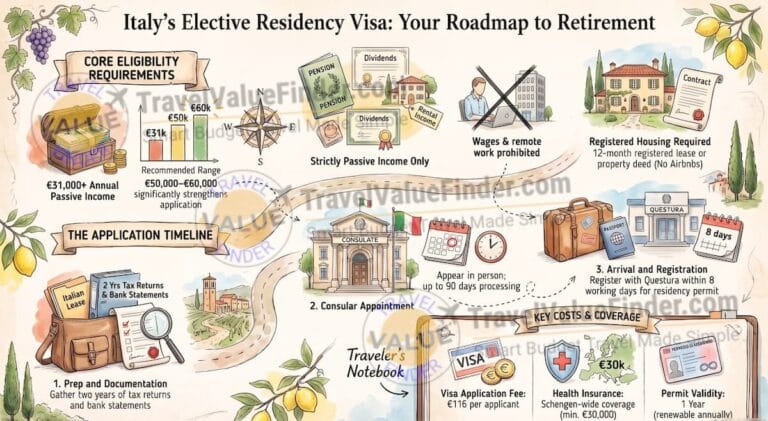
This is where most cost-of-living guides understate the real number. Non-EU retirees on an elective residency permit don’t get free SSN access automatically – they register voluntarily, and since 2024 that registration carries a minimum annual contribution of €2,000, calculated at a percentage of worldwide income with the floor applying up to roughly €31,925 in income, rising to a cap of about €2,788.87/year for higher earners.
That’s a real annual cost, not a rounding error, and it’s on top of the private health insurance that’s mandatory during the first year before SSN enrollment becomes possible. Many retirees layer a supplemental private policy (roughly €80–€200/month) on top of SSN coverage anyway, for faster specialist access.
Once enrolled, SSN specialist visits carry a co-payment capped nationally at €36.15 per prescription – a manageable number, but one that catches people off guard who expected “free healthcare” to mean genuinely zero cost.
The SSN sounds free until you register. It isn’t – it’s €2,000 a year at minimum, and that number needs to sit in the budget next to rent and groceries, not get waved away as a footnote. – Leslie Nics, Founder & Lead Travel Writer, TravelValueFinder.com
Everyday Costs: Groceries, Transport & Dining
Groceries run roughly €250–€320/month for someone cooking at home and avoiding imported products, with southern regions typically running toward the lower end.
Casual restaurant meals cost €10–€20 per person in most of the south and center, climbing to €15–€25 in northern cities. Mobile plans run around €14/month and home internet around €30–€36/month – genuinely inexpensive by U.S. standards.
Local transport is where lifestyle matters most: walkable historic-center towns in Puglia or Sicily let many retirees skip car ownership entirely, while more spread-out towns in Abruzzo or rural Calabria typically require one.
Ready to compare cities now?
- Use our Free Retirement Cost of Living Calculator – get your personalized report in 30 seconds – Free PDF download.
- How to Use a Retirement Cost of Living Calculator – to Compare Cities Worldwide
I budgeted groceries the same everywhere until I actually compared receipts from a Milan supermarket against a market stall in Lecce. Same basket, noticeably different total. – Leslie Nics, Founder & Lead Travel Writer, TravelValueFinder.com
What I’d Do Differently
I’d build the healthcare line item into the budget from day one instead of treating it as a footnote to sort out after arrival – €2,000-plus a year changes the math on whether a town is actually affordable.
I’d also separate the heating-season utility spike from the year-round average when comparing towns, since a central Italy town that looks cheap in a July cost comparison can look very different by January.
And I’d price groceries and rent from actual regional listings rather than a national average – the 63% spread between the cheapest and most expensive regions means a “typical Italy” budget is really an average of several very different countries wearing one flag.
A €1 house is never a €1 house. It’s a €20,000–€80,000 renovation with a symbolic purchase price attached to it. – Leslie Nics, Founder & Lead Travel Writer, TravelValueFinder.com
Find out more about retiring in Italy
- Retire in Italy – I Almost Skipped Italy’s 7% Tax Towns – Here’s Why I Was Wrong
- Best Places to Live in Italy after 55: The Italian Towns Retirees Actually Recommend (Not Just the Postcard Ones)
- Italy Elective Residency Visa: Italy’s Retirement Visa, Explained: What I’d Actually Prepare Before Applying
- Cost of Living in Italy for Retirees: What Retiring in Italy Actually Costs : By Region, Not by Guesswork
You May Be Interested in
- Italy Travel Guide For First-Time Visitors (2026)
- Where to Stay in Rome (2026 Guide): Best Areas, Hotels & Neighborhoods for Every Budget
- Retire in Portugal: A Warm, Practical Guide for People Over 55
- Best Places to Live in Portugal After 55: My Personal Guide
- Retire in Spain: A 55+ Guide to Planning Your Dream Life
- Best Places to Live in Spain After 55: A Practical Comparison
- Retire in France After 55: Healthcare, Cost, Visas & Lifestyle Explained
- Best Places to Live in France After 55: Regions Retirees Truly Enjoy
People Also Ask
How much does it cost to retire comfortably in Italy?
A single retiree can live comfortably on roughly €1,400–€2,800/month depending heavily on region, with southern towns like those in Puglia, Calabria, and Sicily running toward the lower end and northern cities like Milan running well above it.
Is healthcare free for retirees in Italy?
Not automatically. Non-EU retirees on an elective residency permit register voluntarily with the SSN for a minimum annual contribution of about €2,000, on top of mandatory private insurance during the first year.
What is the cheapest region to retire in Italy?
Abruzzo, Molise, and Basilicata consistently post the lowest cost of living nationally, with Calabria and inland Sicily close behind – though amenities and English-speaking services are more limited than in more established expat regions.
Do utility costs vary a lot across Italy?
Yes, water bills alone vary roughly threefold by region, and heating costs add €100–€200/month in northern and central Italy during winter, a cost that’s largely absent in the south.
FAQ
How much is rent for a retiree in southern Italy?
A comfortable two-bedroom apartment in the historic center of towns like Ostuni, Cefalù, or Sulmona typically runs €450–€650/month, well below national averages.
What’s the real cost of Italy’s SSN for a retiree, all-in?
Budget a minimum of €2,000/year, rising toward €2,788.87/year for higher-income retirees, plus mandatory private insurance during the first year before SSN enrollment is possible.
Are groceries expensive in Italy?
Generally not – €250–€320/month covers a typical grocery budget for someone cooking mostly at home, with imported or specialty products pushing that figure higher.
Does buying a €1 house actually save money?
Rarely, once renovation is factored in – typical renovation costs run €20,000–€80,000, which usually exceeds what a comparable move-in-ready property would have cost.
Is it cheaper to rent or buy when retiring in Italy?
Renting typically offers more flexibility and lower upfront cost, which many retirees prefer while still testing which region and town actually fits their lifestyle before committing to a purchase.
Sources
- ISTAT (Istituto Nazionale di Statistica) – household expenditure data
- Legge 30 dicembre 2023, n. 213, art. 1, commi 240–242 – updated SSN voluntary registration contribution rates
- Ministero della Salute – guidance on healthcare access for foreign residents
About the Author
Leslie Nics is the founder and lead researcher at TravelValueFinder.com, where the focus is always on what things actually cost – and what actually gets an application approved – not what the brochure says. Read more on the About page or see the site’s Trust & Transparency Policy.