The Italian Towns Retirees Actually Recommend (Not Just the Postcard Ones)

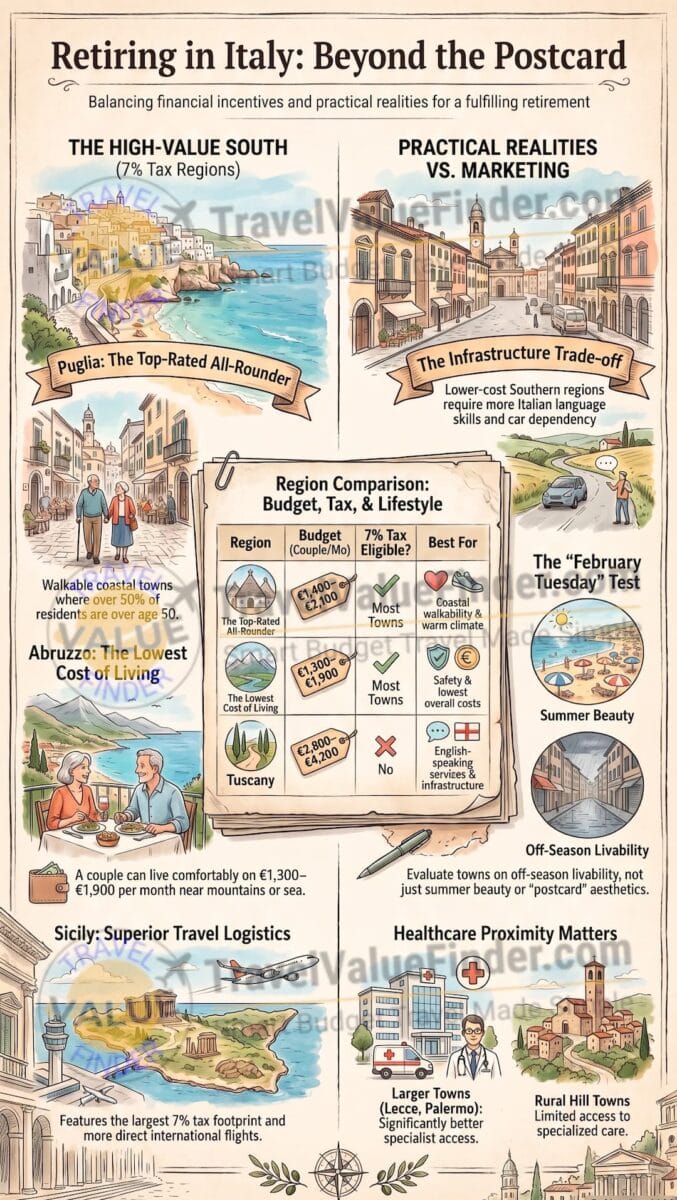
What are the best places to retire in Italy? The best places to live in Italy are; Puglia, Abruzzo, and Sicily consistently rank as the best-value regions for retirees, offering lower costs than Tuscany or the Amalfi Coast while most towns in all three still qualify for Italy’s 7% flat-tax regime.

Leslie Nics, TravelValueFinder.com | Last updated: July 2026 | Last Reviewed: July 24 2026

Search for best places to retire in Italy and the same six postcard towns show up on every list; usually the same towns a magazine photographer picked, not the towns retirees who actually moved there recommend to friends.

The real answer depends on a much less glamorous set of questions: how far is the nearest hospital with an English-speaking doctor, does the town work in January when the tourists and the good weather both leave, and can you actually walk to a pharmacy. Here’s the version built around those questions instead of the postcard.

Best value region: Puglia – €1,400–€2,100/month for a couple in most towns

Includes: coastal or historic-center access, walkable towns, eligibility for the 7% flat-tax regime in most of the region

Caveat: Fewer English-speaking services than Tuscany or Lake Como – a real trade-off, not a footnote.

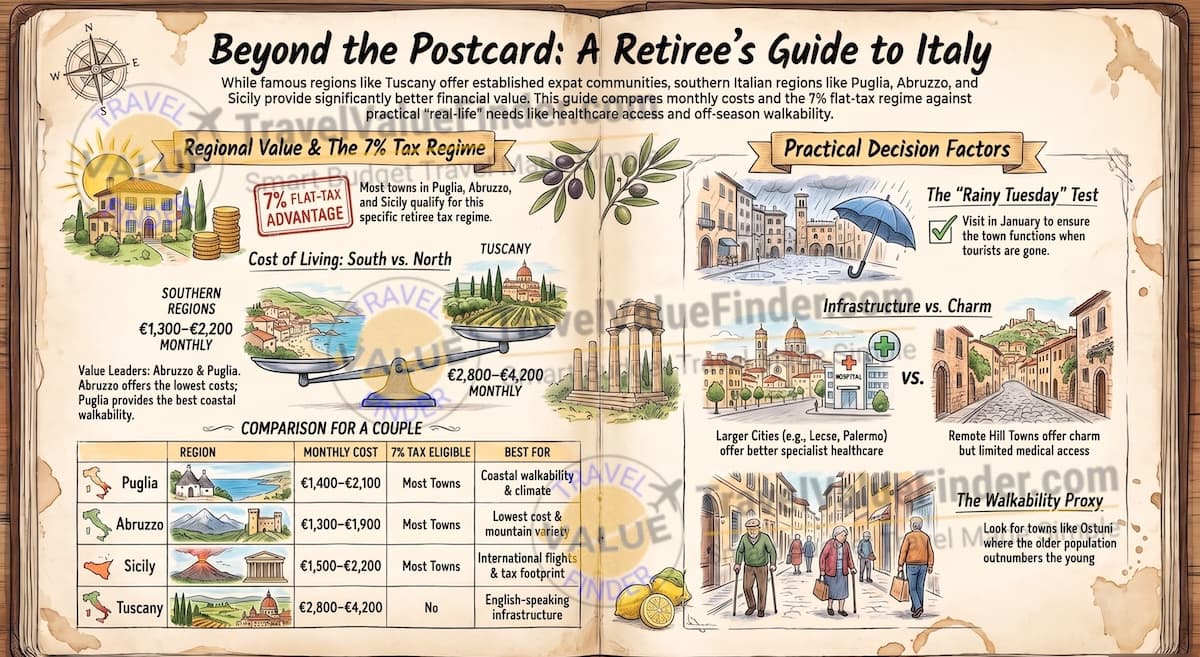
Best Places to retire in Italy: Region Comparison at a Glance

RegionCouple / mo7% Tax EligibleBest For
Puglia€1,400–€2,100Most townsCoastal walkable towns, warmest year-round climate
Abruzzo€1,300–€1,900Most townsMountains-to-coast variety, lowest cost of this group
Sicily€1,500–€2,200Most townsLarger expat presence, more direct international flights
Calabria€1,300–€1,800Most townsLeast developed for foreigners, biggest potential savings
Tuscany / Lake Como€2,800–€4,200NoEstablished expat infrastructure, English-speaking services

Puglia: The Region Everyone Recommends, For Good Reason

Puglia’s real strength isn’t any single town – it’s that several towns here genuinely work for retirees rather than just photographing well. Ostuni, the whitewashed hill town nicknamed “La CittΓ  Bianca,” has roughly 29,800 residents, including more than 15,700 over age 50 – meaning the town’s actual demographics already skew toward the retiree lifestyle, not just its marketing.

Its historic center puts cafΓ©s, pharmacies, and small grocers within walking distance, with the Adriatic coast just minutes downhill by car.

Polignano a Mare and Monopoli offer a similar walkable, coastal-town structure with slightly more day-to-day bustle, while Lecce – sometimes called the “Florence of the South” – gives retirees who want more urban amenities a genuine small-city option with better healthcare access than the smaller coastal towns. Alberobello, with its famous trulli houses, is worth visiting but is more tourist-dense than most retirees want as a full-time home base.

What’s easy to miss in most regional overviews: Puglia’s growing popularity is itself a trade-off in progress. Property prices in the best-known towns – Ostuni especially – have risen noticeably as foreign interest has grown, which is part of why retirees increasingly widen their search to Puglia’s less-photographed inland towns, where the same walkable-center advantages exist at meaningfully lower prices, just without a magazine spread to their name yet.

Abruzzo: The Value Play With the Least Name Recognition

Abruzzo consistently posts the lowest cost of living of any of the major retiree regions, and it’s also one of the safest regions in the country. The region offers real geographic range – mountain towns near the Gran Sasso massif for retirees who want hiking and cooler summers, and Adriatic coastal towns near Pescara for a beach-town pace.

Sulmona, an inland town with a well-preserved medieval center, is a common recommendation for retirees who want authenticity over polish and don’t mind a smaller English-speaking community. The trade-off across most of Abruzzo is the same one that shows up throughout the south: lower costs and fewer crowds, in exchange for needing more Italian and, in the more rural towns, a car for daily errands.

Sicily: The Largest 7% Tax Footprint, With Real Trade-offs

Sicily has more towns participating in Italy’s well-known €1 house programs than any other region – towns like Sambuca di Sicilia and Mussomeli have become known specifically for this.

It’s worth repeating the caveat from our cost-of-living guide: these aren’t free houses, they’re a symbolic purchase price attached to a renovation project that typically runs €20,000–€80,000. Beyond the €1 house towns, Syracuse, Ragusa, and Taormina offer a more established, move-in-ready option, with Taormina carrying meaningfully higher costs in exchange for its more international, tourist-polished feel.

Palermo, the regional capital, is one of Italy’s cheapest cities and offers the best healthcare access of any Sicilian option – the trade-off is a livelier, more urban pace than the hill towns most retiree guides picture. Sicily’s real advantage over Puglia and Abruzzo is logistics: more direct international flight routes, which matters for retirees who plan to travel home regularly to see family.

Sicily is also, by most measures, safe for retirees today – the historic association with organized crime that shaped outside perceptions of the region for decades is far less visible in daily life now, and overall crime levels sit well below those of Rome or Milan.

That perception gap is worth naming directly, since it’s one of the more common reasons retirees rule out an otherwise strong-value region without visiting first.

Calabria: The Region With the Most Room to Save

Calabria is the least developed of the four southern regions in terms of foreign retiree infrastructure, and that’s precisely why it’s worth including here rather than skipping past. Tropea, perched on a cliff over some of the clearest water on the Italian coastline, is the region’s best-known town and increasingly draws retiree interest without yet carrying Puglia-level costs.

The wider region offers Italy’s biggest potential savings for retirees willing to trade some polish and English-language convenience for meaningfully lower costs than anywhere else on this list. Reggio Calabria, the regional capital, adds the healthcare and services advantage that its smaller coastal towns lack, functioning as a practical fallback for retirees who want Calabria’s savings without settling somewhere too remote for regular medical care.

Every list puts Alberobello and Taormina at the top because they photograph beautifully. Almost none of them mention that Ostuni has more residents over 50 than under 30 – that’s the number that actually tells you whether a town works for retirement. – Leslie Nics, Founder & Lead Travel Writer, TravelValueFinder.com

Tuscany & Lake Como: The Splurge Option, and When It’s Worth It

Tuscany and Lake Como sit outside the 7% tax regime entirely and cost roughly double the southern regions on this list – but they buy something the south genuinely doesn’t have yet: an established, English-speaking expat infrastructure built up over decades.

For retirees who want to arrive without learning much Italian and want easy rail access to Milan, Florence, or Switzerland, that infrastructure has real value.

Lucca and Cortona are the most commonly recommended Tuscan towns for retirees specifically – walkable, historic, and less overrun than Florence itself – while Lake Como’s lakeside towns command some of the highest property prices in Italy outside Milan and Rome.

Best Places to Retire in Italy - Retiring in Italy Guide Infographic - Travel Value Finder
Best Places to Retire in Italy – Retiring in Italy Guide Infographic – Travel Value Finder

Basilicata & Molise: The Regions Almost Nobody Considers First

If Calabria feels underdeveloped for foreign retirees, Basilicata and Molise are a step further still – and that’s exactly their appeal for a specific kind of retiree. Both regions post costs at or below Abruzzo’s, both qualify for the 7% flat-tax regime across most of their territory, and both see a fraction of the foreign-buyer interest that’s already reshaped parts of Puglia and Sicily.

Basilicata’s Matera, with its ancient cave-dwelling Sassi district carved into rock, has become a genuine draw for retirees who want something architecturally unlike anywhere else in Italy, without Tuscany-level costs attached.

Molise is quieter still – often described, only half-jokingly, as the region Italians themselves forget exists – which is precisely why retirees who prioritize privacy and lowest-possible cost over community size and amenities keep circling back to it.

The honest trade-off: fewer English speakers than almost anywhere else on this list, and a genuine need for a car and reasonable Italian to manage daily life comfortably.

Climate: What “Year-Round Sunshine” Actually Means by Region

Retiree guides love the phrase “year-round sunshine,” and it’s misleading in a specific, avoidable way.

Puglia and Sicily’s coastal towns do get mild winters by northern-European standards, but “mild” means daytime highs in the mid-teens Celsius (upper 50s–60s Fahrenheit) with real rain, not the endless summer the marketing implies – and inland hill towns in Abruzzo, Basilicata, and Calabria can see genuinely cold, sometimes snowy winters despite sitting in “the south.” Sicily’s interior and Puglia’s flatter inland stretches also run notably hotter in July and August than their coastal counterparts, which matters for retirees with heat sensitivity who assumed “Sicily” meant one climate rather than several.

The practical takeaway: a town’s regional label tells you less about its actual climate than its elevation and distance from the coast do – worth checking specifically, not assuming from the region name alone.

Nearly every “best places to retire” list ranks towns by scenery. The retirees who actually make the move rank them by a shorter, more practical list – and it’s worth running any shortlist through it before falling for a hill town on a postcard.

QuestionWhy It Matters
How far is the nearest hospital with English-speaking staff?Larger towns and regional capitals offer meaningfully better specialist access than small hill towns
Does the town work in January?Coastal and tourist towns can feel empty or under-serviced outside peak season
Is a car required for daily errands?Walkable historic centers (Ostuni, Lecce, Lucca) reduce this dependency; rural inland towns rarely do
How far is the nearest international airport?Sicily and Puglia both offer more direct routes than interior Abruzzo or Calabria
Does the town qualify for the 7% tax regime?Population caps and specific municipality lists apply – verify before falling in love with a town

Ready to compare cities now?

The question that changed my shortlist wasn’t ‘is it beautiful,’ it was ‘what does this town look like on a rainy Tuesday in February when nobody’s on vacation. – Leslie Nics, Founder & Lead Travel Writer, TravelValueFinder.com

What I’d Do Differently

I’d visit in the off-season before committing to any town, not during the summer when every hill town in southern Italy looks like a postcard. I’d also stop treating “expat community size” as a simple positive – a bigger English-speaking community in Tuscany comes with meaningfully higher costs, while a smaller one in Puglia or Calabria means slower Italian bureaucracy days but real savings.

And I’d check the specific municipality against the current 7% tax-eligible list before getting attached to a town, since population thresholds changed materially in April 2026 and not every appealing town made the cut.

I’d also separate a region’s marketing climate from its actual elevation. I nearly ruled out a genuinely affordable Abruzzo town because “Abruzzo” sounded interchangeable with coastal Puglia in my head, before realizing the specific town sat at enough elevation to get real winter weather – not a dealbreaker, but the kind of detail that should shape the decision rather than surprise you in December.

Ostuni’s population skewing older isn’t a coincidence – it’s the single best proxy I found for ‘this town actually works for retirement’ versus ‘this town photographs well for a magazine. – Leslie Nics, Founder & Lead Travel Writer, TravelValueFinder.com

Find out more about retiring in Italy

You May Be Interested in

People Also Ask

What is the best region in Italy to retire to?

Puglia is the most consistently recommended region for retirees, combining lower costs, walkable coastal towns, and eligibility for the 7% flat-tax regime in most municipalities – though Abruzzo and Sicily are close competitors depending on priorities.

Where do most American retirees live in Italy?

Tuscany and Lake Como have the most established English-speaking expat communities, while Puglia, Abruzzo, and Sicily have smaller but fast-growing retiree populations drawn by lower costs and the tax regime.

Is it safe to retire in Sicily or Calabria?

Both regions are generally considered safe for retirees today; organized-crime associations that shaped their reputation decades ago are far less visible in everyday life, particularly in the towns and neighborhoods retirees typically settle in.

Do I need to speak Italian to retire in southern Italy?

It’s not strictly required, but English-speaking services are meaningfully more limited in Puglia, Abruzzo, Sicily, and Calabria than in Tuscany or Lake Como – basic Italian meaningfully improves daily life in the smaller towns.

FAQ

What’s the most walkable retiree town in southern Italy?

Ostuni and Lecce in Puglia, and Lucca in Tuscany, are consistently cited as the most walkable options, with pharmacies, groceries, and cafΓ©s within a compact historic center.

Are Sicily’s €1 houses actually worth it for retirees?

They can be, but only if the renovation budget – typically €20,000–€80,000 – is treated as the real purchase price, not the symbolic €1 figure.

Which region has the best healthcare access for retirees?

Regional capitals and larger towns – Lecce in Puglia, Palermo in Sicily – offer meaningfully better specialist access than smaller hill towns, which is worth weighing against those towns’ quieter charm.

Is Calabria cheaper than Puglia for retirees?

Generally yes, Calabria runs slightly below Puglia on typical monthly costs, though it also has less-developed retiree infrastructure and a smaller foreign community.

Can I retire near Rome without paying Rome’s higher costs?

Some retirees choose towns in Umbria or inland Lazio for easier access to Rome without the capital’s full cost load, though this trades away the 7% tax eligibility available in the qualifying southern regions.

What’s the biggest mistake retirees make picking a town in Italy?

Choosing based on a summer visit alone – a town’s off-season reality (services, quiet, weather) often looks meaningfully different from its peak-season postcard version, and that gap is what actually determines whether a retiree stays long-term.

Sources

  • Legge 30/12/2023, n. 213 – updated SSN and regional cost-of-living-adjacent regulatory changes
  • Law No. 34 of 11 March 2026, Article 26 – current municipality eligibility for the 7% flat-tax regime
  • Italian National Institute of Statistics (ISTAT) – regional population and demographic data

About the Author

Leslie Nics is the founder and lead researcher at TravelValueFinder.com, where the focus is always on what things actually cost – and what a town actually looks like on an ordinary Tuesday – not what the brochure says. Read more on the About page or see the site’s Trust & Transparency Policy.

Share this post
Leslie Nics
Leslie Nics

Leslie Nics is the founder and primary travel researcher at Travel Value Finder. He specializes in budget travel, destination research, and itinerary planning, drawing on firsthand travel experience across multiple regions to help readers find affordable and practical travel options.

Newsletter Updates

Enter your email address below and subscribe to our newsletter