Travel Value Finder

Retire in Italy: Retirees can live comfortably in southern Italy on roughly €1,800–€2,800 a month, and towns that qualify under Italy’s Article 24-ter regime let foreign pension income be taxed at a flat 7% for up to 10 years instead of the country’s standard progressive rates.
Leslie Nics, TravelValueFinder.com | Last updated: July 2026 | Last Reviewed: July 24 2026
When people ask me about retiring in Italy, they usually picture Tuscany – a stone farmhouse, a view of the hills, maybe a vineyard down the road. I pictured that too, right up until I found out that most of the towns fitting that postcard image don’t qualify for the tax break that makes retiring in Italy genuinely affordable on a fixed income.
I almost wrote off the 7% tax zone as a compromise: smaller towns, fewer amenities, further from an airport. I was wrong to hesitate, and once I ran the real numbers against a retirement budget, the hesitation looked less like caution and more like leaving money on the table.
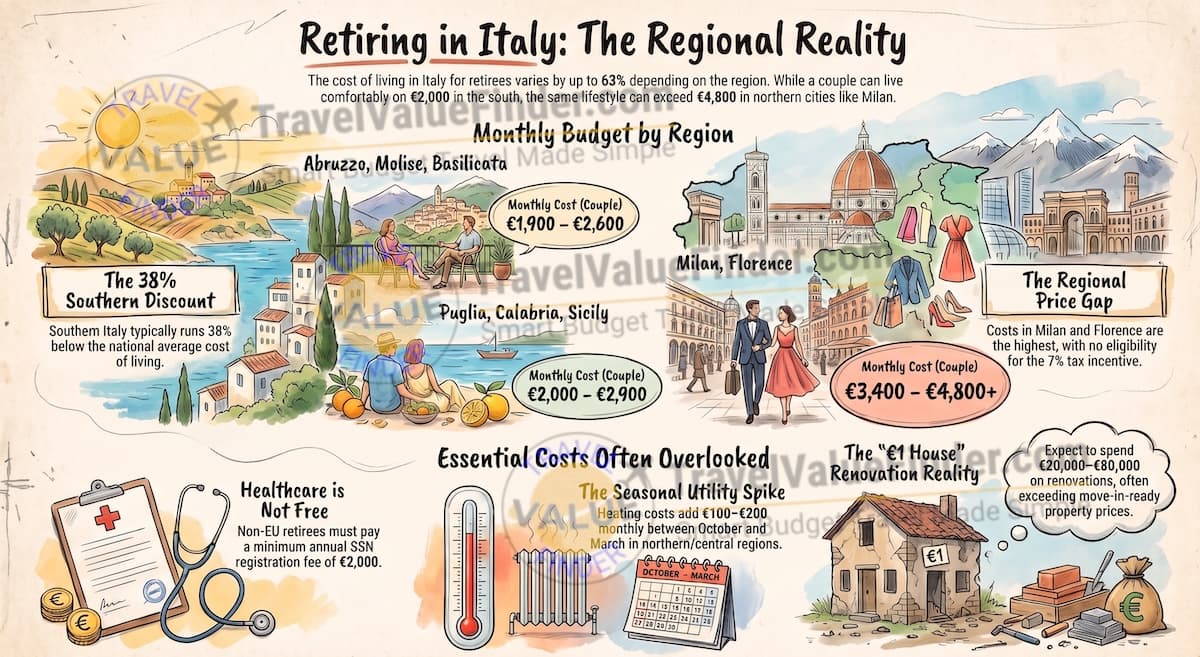
Typical monthly budget (single retiree, southern region): €1,800–€2,800
Includes: housing, groceries, utilities, a basic private-healthcare top-up, and local transport
Caveat: Northern cities like Milan and Florence run 40–60% higher, and the property has to sit in a town that actually qualifies for the 7% regime – plenty of popular expat towns don’t.
What Retiring in Italy Actually Costs, by Region
The gap between a 7%-zone town and a non-qualifying city is the single biggest lever in an Italian retirement budget – bigger, in most cases, than the difference between any two southern regions.
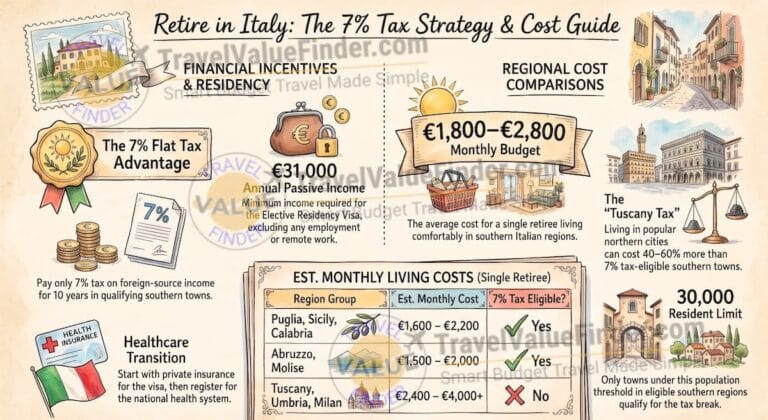
| Region | Single Retiree / mo | Couple / mo | Notes |
| Puglia, Calabria, Sicily (7% zone) | €1,600–€2,200 | €2,200–€3,000 | Coastal towns cost more than inland ones |
| Abruzzo, Molise (7% zone) | €1,500–€2,000 | €2,000–€2,800 | Lower cost; less English spoken day to day |
| Tuscany, Umbria (non-qualifying) | €2,400–€3,200 | €3,200–€4,200 | Popular with expats, but outside the 7% regime |
| Milan, Rome, Florence (non-qualifying) | €2,800–€4,000+ | €3,800–€5,500+ | Highest cost, no 7% eligibility at all |
The 7% Flat Tax Regime, Explained
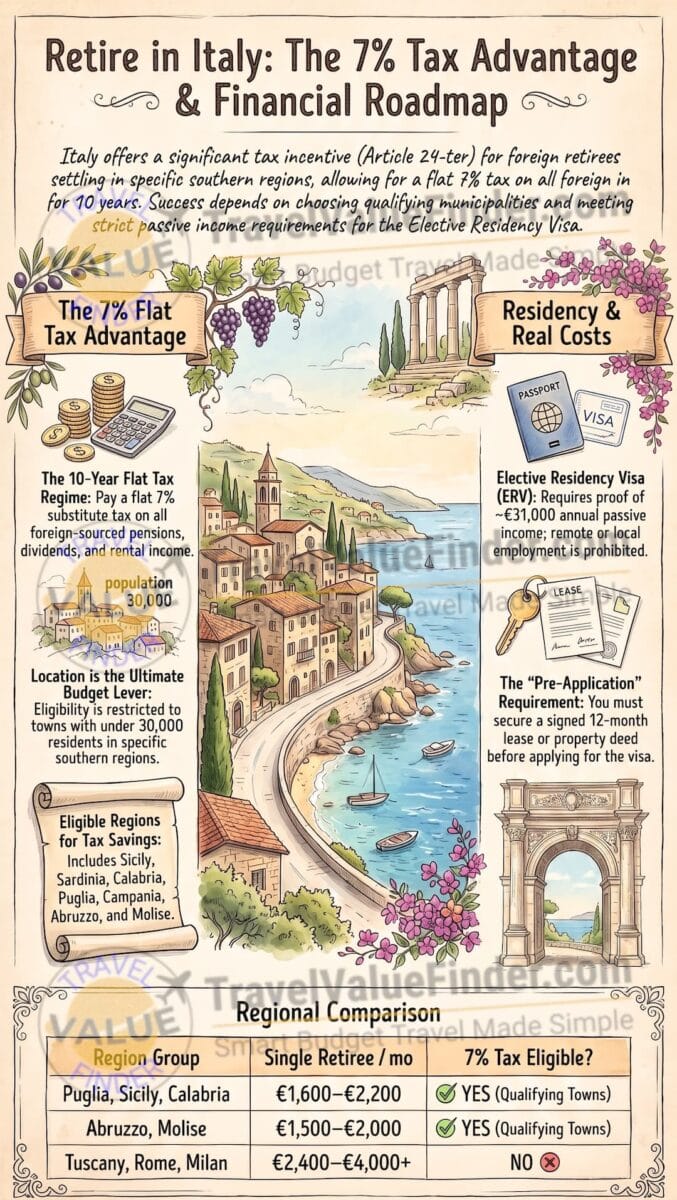
Italy’s Article 24-ter regime lets qualifying foreign pensioners pay a flat 7% substitute tax on all foreign-source income – pensions, dividends, capital gains, and foreign rental income – for up to 10 consecutive years, instead of Italy’s ordinary progressive rates. The catch that trips people up: the pension has to be foreign-source. A pension paid by Italy’s own INPS system doesn’t qualify – only income originating outside Italy does.
The regime got significantly more useful in April 2026. Law No. 34/2026 raised the population ceiling for eligible municipalities from 20,000 to 30,000 residents, opening 74 additional towns across the south – mostly mid-sized coastal and well-connected towns rather than the small, remote villages that dominated the original list.
Eligible regions include Sicily, Sardinia, Calabria, Puglia, Campania, Abruzzo, and Molise, along with specific earthquake-affected municipalities in Lazio, Marche, and Umbria.
Elective Residency Visa: Income Requirements & Process
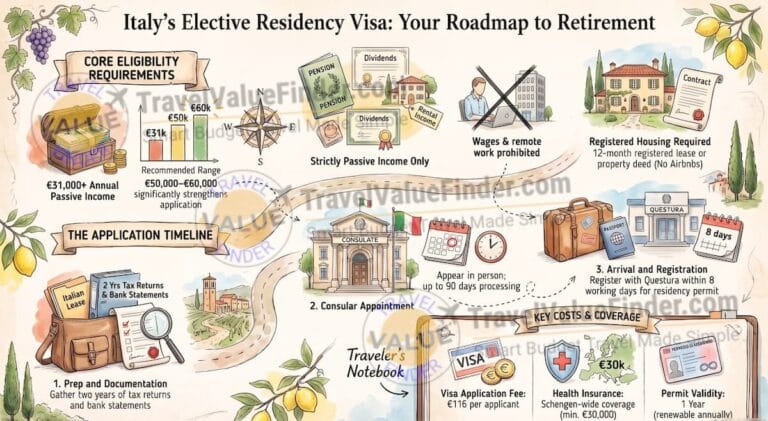
The visa that gets most American retirees into Italy long-term is the Elective Residency Visa (Visto per Residenza Elettiva), a National Type D visa. Per Italian consular guidance, applicants need to show stable, adequate passive income – not employment income – from sources like pensions, dividends, or rental property.
The commonly cited minimum is around €31,000/year for a single applicant, though individual consulates apply discretion, and several U.S. consulates have required meaningfully more in practice.
Beyond income, applicants need a signed 12-month (or longer) lease or a property deed in Italy before applying, private health insurance valid across Schengen with at least €30,000 in coverage, and they must apply in person at the consulate covering their home jurisdiction.
Processing typically runs up to 90 days. After arrival, holders must register at the local Questura within 8 working days to receive the permesso di soggiorno – the document that actually legitimizes the stay.
Healthcare Access for Foreign Retirees
Once legally resident, retirees generally have the option to register with Italy’s national health service for an annual contribution, or to maintain private coverage instead.
Many retirees keep a private policy in the first year or two while sorting out registration, then transition to the public system once residency is fully established. Either way, the visa-stage insurance requirement is separate from – and shouldn’t be confused with – ongoing healthcare once you’re actually living there.
I kept comparing 7%-zone towns to Tuscany and wondering what I’d be giving up. The better question was what I’d be giving up by paying full tax on a pension for the next ten years instead. – Leslie Nics, Founder & Lead Travel Writer, TravelValueFinder.com
Best Regions to Actually Live In
| Region | Cost Level | 7% Eligible | Best For |
| Puglia | Low–Moderate | Yes (most towns) | Coastal towns, walkable centers, growing expat presence |
| Abruzzo | Low | Yes (most towns) | Mountains-to-coast variety, lowest cost of this group |
| Sicily | Low–Moderate | Yes (most towns) | Larger expat community, more direct flight options |
| Calabria | Low | Yes (most towns) | Least developed for foreign residents, biggest savings |
Ready to compare cities now?
- Use our Free Retirement Cost of Living Calculator – get your personalized report in 30 seconds – Free PDF download.
- How to Use a Retirement Cost of Living Calculator – to Compare Cities Worldwide
The towns I almost skipped turned out to have better infrastructure than I expected – the 2026 threshold change specifically pulled in mid-sized, better-connected towns, not just tiny villages. – Leslie Nics, Founder & Lead Travel Writer, TravelValueFinder.com
What I’d Do Differently
If I were starting this search over, I’d rule regions in or out by tax eligibility first and lifestyle second – not the other way around. I spent weeks falling for towns in Tuscany and Umbria before checking whether they even qualified for the 7% regime, which meant re-doing the whole cost comparison from scratch.
I’d also confirm early whether my specific pension counts as “foreign-source” for Article 24-ter purposes, since that single detail determines whether the entire regime applies at all.
A property deed and a 12-month lease sound like a formality until you realize you need one before the visa application even goes in – not after you land. – Leslie Nics, Founder & Lead Travel Writer, TravelValueFinder.com
Find out more about retiring in Italy
- Retire in Italy – I Almost Skipped Italy’s 7% Tax Towns – Here’s Why I Was Wrong
- Best Places to Live in Italy after 55: The Italian Towns Retirees Actually Recommend (Not Just the Postcard Ones)
- Italy Elective Residency Visa: Italy’s Retirement Visa, Explained: What I’d Actually Prepare Before Applying
- Cost of Living in Italy for Retirees: What Retiring in Italy Actually Costs : By Region, Not by Guesswork
You May Be Interested in
- Italy Travel Guide For First-Time Visitors (2026)
- Where to Stay in Rome (2026 Guide): Best Areas, Hotels & Neighborhoods for Every Budget
- Retire in Portugal: A Warm, Practical Guide for People Over 55
- Best Places to Live in Portugal After 55: My Personal Guide
- Retire in Spain: A 55+ Guide to Planning Your Dream Life
- Best Places to Live in Spain After 55: A Practical Comparison
- Retire in France After 55: Healthcare, Cost, Visas & Lifestyle Explained
- Best Places to Live in France After 55: Regions Retirees Truly Enjoy
People Also Ask
Is Italy cheap to retire in?
It can be, particularly in southern regions and 7%-zone towns, where a single retiree can live on roughly €1,600–€2,200 a month. Northern cities and non-qualifying tourist towns cost considerably more.
Can Americans get the 7% tax rate in Italy?
Yes, U.S. retirees can qualify if they relocate their tax residence to an eligible southern Italian municipality and their pension or other qualifying income is foreign-source rather than paid by Italy’s own INPS system.
Do retirees need private health insurance in Italy?
It’s required at the visa application stage – Schengen-valid coverage of at least €30,000. After establishing residency, retirees can typically register with the national health service or continue with private coverage.
What is the minimum income to retire in Italy?
The commonly cited minimum for the Elective Residency Visa is around €31,000/year for a single applicant, though some U.S. consulates have requested more in practice.
FAQ
How long does the Italy elective residency visa take to process?
Italian consular guidance cites processing times of up to 90 days, so applicants are generally advised not to book travel until the visa is approved.
Does the 7% flat tax regime apply to Social Security income?
U.S. Social Security is foreign-source relative to Italy, which is the type of income the regime is designed to cover – though individual circumstances should be confirmed with a tax professional familiar with Article 24-ter.
Can I work remotely while on an elective residency visa?
No. The elective residency visa explicitly prohibits employment, including remote work for a foreign employer – it’s structured around passive income only.
What happens after the 7% tax regime’s 10 years end?
Income reverts to Italy’s standard progressive tax rates once the 10-year window closes, so retirees typically factor that transition into long-term financial planning.
Can my spouse qualify under the same application?
Dependent spouses and minor children can generally be included, provided the applicant can demonstrate sufficient financial resources to support them as well.
Sources
- Italian Ministry of Foreign Affairs – Consular network guidance on the Elective Residency Visa (esteri.it consular offices, including New York, Los Angeles, Chicago, San Francisco, and Washington D.C.)
- Law No. 34 of 11 March 2026 (“SME Law”), Article 26 – amendment to Article 24-ter of the Italian Consolidated Income Tax Act (TUIR)
- Agenzia delle Entrate (Italian Revenue Agency) – guidance on the Article 24-ter substitute tax regime for foreign pensioners
About the Author
Leslie Nics is the founder and lead researcher at TravelValueFinder.com, where the focus is always on what things actually cost – not what the brochure says they cost. Read more on the About page or see the site’s Trust & Transparency Policy.