Travel Value Finder


Ready to compare cities now? Use our Free Retirement Cost of Living Comparison Calculator — get your personalized AI report in 30 seconds.
A retirement cost of living comparison calculator is a tool that compares monthly living expenses – including housing, healthcare, groceries, and transport – between your current city and a potential retirement destination. By entering your age, monthly budget, savings, and lifestyle preferences, you receive a side-by-side breakdown showing how far your retirement income will stretch in your chosen city compared to where you live now.
About the Author
Leslie Nics is a travel writer and retirement relocation specialist who has spent over a decade researching affordable retirement destinations across Europe, Southeast Asia, and Latin America. Leslie has personally visited and evaluated more than 40 countries as retirement candidates, interviewed expats on the ground, and collaborated with visa lawyers, financial planners, and healthcare consultants to bring readers the most grounded, accurate advice available. Leslie’s work at Travel Value Finder is guided by a simple belief:
everyone deserves to know exactly how far their retirement money goes before they pack a single box.
What You’ll Learn in This Guide
If you’re planning to retire – whether at home or abroad – one question rises above all others: Can I actually afford this?
This guide walks you through everything you need to know about using a retirement cost of living calculator, what inputs matter most, how to interpret the results, and how real retirees have used city comparisons to add years of financial security – and genuine joy – to their retirement.
We’ve also built a free AI-powered Retirement Cost of Living Calculator right here on Travel Value Finder. It compares your current city against 80+ destinations worldwide, factors in your personal financial profile, and generates a downloadable PDF report in seconds.
Why a Retirement Cost of Living Comparison Calculator Matters More Than Ever in 2026
The retirement affordability crisis is real
Retirement planning has quietly become one of the most stressful financial exercises of our time. Rising inflation, volatile investment returns, and increasing life expectancy have created a perfect storm: retirees are living longer but their money isn’t keeping pace.
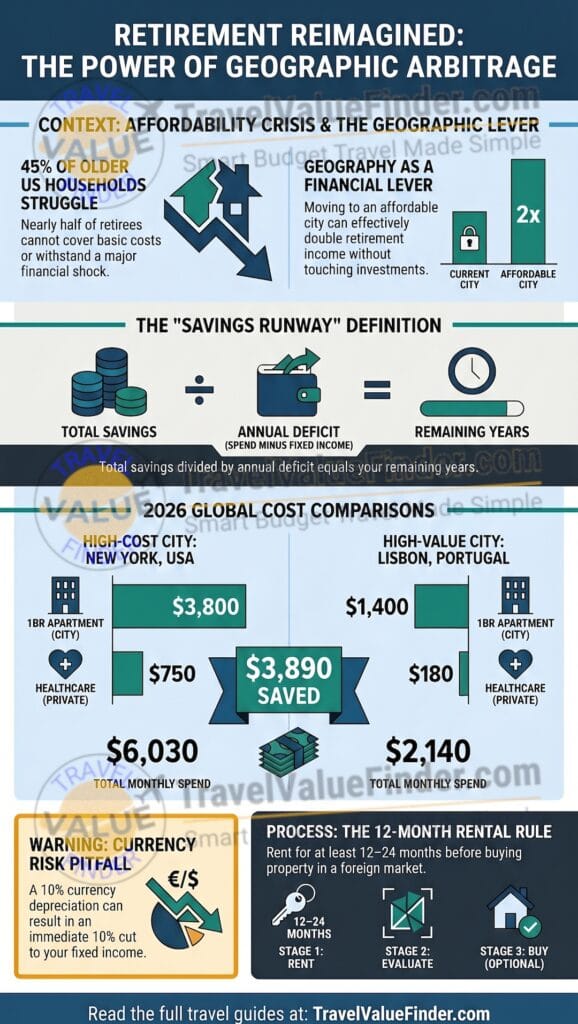
Research from the National Council on Aging found that nearly 45% of older adult households in the United States cannot cover their basic costs of living – and 80% cannot withstand a major financial shock such as an unexpected healthcare bill or long-term care need.
The traditional model of retiring in the city you grew up in, relying purely on Social Security or a company pension, simply doesn’t hold up for most people today.
The geography of retirement has changed
The good news? Geography can be the most powerful financial lever a retiree has. Moving from a high-cost city to a more affordable one – whether domestically or internationally – can effectively double your retirement income without touching a single investment.
Consider: a retiree living on $2,500 a month in New York City is, by most measures, living modestly. That same $2,500 a month in Lisbon, Portugal, pays for a comfortable two-bedroom apartment, restaurant meals three times a week, private health insurance, a gym membership, and regular weekend travel to other European destinations – with money left over.
That’s not speculation. That’s what expat retirees report, consistently, in community forums, emigration surveys, and our own reader research at Travel Value Finder. But you cannot make this decision on feel alone. You need specific, city-level, personally calibrated numbers. That’s exactly what a retirement cost of living calculator provides.
What a Retirement Cost of Living Comparison Calculator Measures
A high-quality retirement cost of living calculator should compare the following expense categories between your current city and your target destination:
Core Monthly Expenses
- Housing – rent or mortgage (1BR vs 2BR, city centre vs suburbs)
- Groceries & food – local market vs international supermarket shopping habits
- Dining out – frequency, local restaurants vs Western-style dining
- Healthcare & insurance – public access, private insurance premiums, out-of-pocket costs
- Transportation – local public transit, taxi/rideshare, car ownership costs
- Utilities – electricity, water, gas, internet, mobile phone plan
Lifestyle & Discretionary Expenses
- Entertainment and leisure (cinema, gym, cultural events)
- Personal care (haircuts, toiletries, wellness)
- Clothing and seasonal shopping
- Travel and holidays within the region
- Domestic help (common in Southeast Asian and Latin American retirement destinations)
Retirement-Specific Financial Inputs
- Total monthly budget available
- Monthly fixed income (pension, Social Security, annuity, rental income)
- Total retirement savings (to calculate runway/longevity)
- Age (affects both runway calculation and healthcare cost projection)
Qualitative Factors a Good Tool Should Assess
- Healthcare system quality and expat access
- Visa and residency pathway (minimum income thresholds, application complexity)
- Safety index and political stability
- English-language friendliness
- Expat community size and support network
Most generic cost of living calculators – like those from Numbeo, Bankrate, or SmartAsset – are built for people comparing cities for work, not retirement. They don’t factor in fixed incomes, pension drawdown rates, healthcare-specific concerns, or visa requirements. Our Travel Value Finder calculator is built specifically for retirees.
How to Use the Travel Value Finder Retirement Cost of Living Comparison Calculator
Our free AI-powered calculator is embedded directly on the page at https://travelvaluefinder.com/free-retirement-cost-of-living-calculator/
Here’s how to get the most accurate results:
Step 1: Select Your Current City and Retirement Destination
We include 80+ major cities across Europe, Southeast Asia, Latin America, Oceania, the Middle East, and North America. If your exact city isn’t listed, choose the nearest major metropolitan area.
Step 2: Enter Your Financial Profile
Monthly budget: Enter the total amount you can spend each month – this includes drawdown from savings plus any fixed income like Social Security or a pension. Be realistic and conservative.
Monthly fixed income: Your guaranteed recurring income. This is the floor of your budget. Knowing this number matters enormously: if your fixed income covers 60% of costs in Lisbon but only 28% in London, your risk exposure is very different.
Retirement savings: Your total invested and liquid savings. The calculator uses this to compute your savings runway – how many years your money lasts at each city’s projected spend rate.
Age: This affects both the runway calculation and healthcare cost projections.
Step 3: Set Your Lifestyle Preferences
Be honest. A “budget” lifestyle in Bangkok is wildly different from a “luxury” lifestyle in Bangkok – and both are still cheaper than a “moderate” lifestyle in San Francisco. Choose the level that genuinely reflects how you intend to live, not how you hope you’ll be able to live.
Step 4: Add Your Health and Priority Context
If you have a chronic condition, specific medication needs, or require regular specialist care, note this. Healthcare cost is one of the most underestimated variables in international retirement planning, and the AI will factor in your specific situation when discussing healthcare options in your destination city.
Step 5: Enter Your Email for the PDF Report
This is optional, but recommended. The PDF report is beautifully formatted, includes all sections of your analysis (cost comparison table, savings runway, visa information, neighbourhood recommendations), and is yours to keep and share with a financial advisor or family members.
Understanding Your Results: What Each Section Means
The Cost of Living Comparison Table
This is the centrepiece of your report. It shows estimated monthly costs across 10 – 12 expense categories for both cities, side by side.
These are estimates, not guarantees. The AI draws on aggregated cost-of-living data from Numbeo, Expatistan, and regional expat reports, cross-referenced with our own research. Actual costs will vary based on neighbourhood, specific lifestyle choices, and current exchange rates.
The “difference” column is your key number. If your destination city is 38% cheaper overall, that’s meaningful. But look at which categories drive that – it’s almost always housing. Healthcare and entertainment costs can be surprisingly similar across cities, while housing and transport gaps can be dramatic.
Local vs expat pricing. In many Asian and Latin American cities, retirees who shop at local markets, use local healthcare, and eat where locals eat can live at a fraction of the cost suggested by expat-facing pricing.
The Savings Runway Calculation
This answers: How long will my money last in each city?
The formula is: total savings ÷ annual deficit (total annual spend minus fixed income) = years of runway
WORKED EXAMPLE
Total savings: $350,000 Fixed income: $1,500/month ($18,000/year) Annual spend New York: $60,000 – Annual deficit: $42,000 – Runway: 8.3 years Annual spend Lisbon: $32,000 – Annual deficit: $14,000 – Runway: 25 years
Healthcare and Insurance Section
This is often the section readers find most valuable – and the one most commonly underestimated in generic calculators. Key things the report covers:
- Whether your destination has a public health system accessible to expat residents (and at what cost)
- Estimated private health insurance premiums for your age bracket
- Quality of specialist care and hospital infrastructure
- Common medications – local availability and cost vs back home
- Medical evacuation considerations for more remote destinations
Visa and Legal Requirements
Most retirees don’t realize that many of the world’s most popular retirement destinations have formal retirement visa programs – specifically designed for retirees with proven income. Common examples:
- Portugal D7 Visa – requires approximately €760/month passive income (2026 figure)
- Spain Non-Lucrative Visa – requires approximately €2,400/month income
- Thailand Retirement Visa – requires 800,000 THB (~$22,000) in a Thai bank account or monthly income of 65,000 THB
- Malaysia MM2H Programme – requires fixed deposit and monthly income proofs
- Panama Pensionado Visa – requires just $1,000/month pension income, with extraordinary discounts as a benefit
Quality of Life Scorecard
The calculator rates your destination city across eight dimensions on a 1 – 10 scale:
- Climate and weather
- Healthcare quality
- Safety and security
- English-language friendliness
- Expat community size and support
- Cultural richness and activities
- Public transportation
- Overall retirement score
Try the calculator now and see how far your budget goes in your dream destination
Real-World Retirement City Comparisons: What the Data Shows
To give you a sense of what to expect, here are illustrative comparisons based on real Numbeo data and expat reports – the kind of figures our AI draws on when generating your personalised report.
New York, USA vs Lisbon, Portugal
| Category | New York | Lisbon | Monthly Savings |
| 1BR apartment (city centre) | $3,800/mo | $1,400/mo | $2,400 |
| Groceries (couple) | $800/mo | $350/mo | $450 |
| Dining out (2x/week) | $480/mo | $160/mo | $320 |
| Private health insurance (60yo) | $750/mo | $180/mo | $570 |
| Transport | $200/mo | $50/mo | $150 |
| Monthly Total | ~$6,030 | ~$2,140 | $3,890 saved |
A couple retiring from New York to Lisbon can save approximately $3,890 per month – nearly $47,000 per year – while maintaining a comfortable, culturally rich lifestyle in one of Europe’s most beautiful cities.
London, UK vs Chiang Mai, Thailand
| Category | London | Chiang Mai | Monthly Savings |
| 1BR apartment (city centre) | £2,200/mo | £400/mo | £1,800 |
| Groceries (couple) | £600/mo | £200/mo | £400 |
| Dining out (2x/week) | £400/mo | £80/mo | £320 |
| Private health insurance (65yo) | £600/mo | £150/mo | £450 |
| Transport | £180/mo | £40/mo | £140 |
| Monthly Total | ~£3,980 | ~£870 | £3,110 saved |
A £1,200/month UK pension that barely covers rent in London buys a genuinely comfortable life – including a car hire, regular meals out, and private healthcare – in northern Thailand.
Sydney, Australia vs Medellín, Colombia
| Category | Sydney | Medellín | Monthly Savings |
| 1BR apartment (city centre) | A$2,800/mo | A$600/mo | A$2,200 |
| Groceries (couple) | A$700/mo | A$250/mo | A$450 |
| Dining out (2x/week) | A$500/mo | A$100/mo | A$400 |
| Healthcare (65yo) | A$500/mo | A$120/mo | A$380 |
| Transport | A$200/mo | A$40/mo | A$160 |
| Monthly Total | ~A$4,700 | ~A$1,110 | A$3,590 saved |
Medellín – once notorious, now one of South America’s most dynamic and liveable cities – has become a major destination for Australian and North American retirees seeking dramatic cost reduction without sacrificing urban energy, warm weather, or quality of life.
The 7 Most Common Mistakes Retirees Make When Comparing Cities
Whether you use our calculator or another tool, these are the pitfalls that catch retirees off guard.
1. Ignoring Currency Risk
If your income is in GBP and you retire to a eurozone country, a 10% sterling depreciation means a 10% pay cut – overnight. Factor in currency volatility, especially over a 20 – 30 year retirement horizon. Some retirees keep a portion of their savings in local currency as a hedge.
2. Using Tourist Pricing Instead of Resident Pricing
The restaurant you dined at as a tourist is rarely where you’ll eat three times a week as a resident. Expat forums, local Facebook groups, and our on-the-ground research show that resident costs in cities like Bangkok, Lisbon, and Medellín are often 30 – 50% lower than the prices visitors encounter.
3. Underestimating Healthcare Inflation
Healthcare costs tend to rise faster than general inflation – especially private insurance premiums as you age. If your private insurance costs €180/month at age 62, model for it reaching €300 – 400 by age 75. Build this into your savings runway.
4. Forgetting One-Off Relocation Costs
Shipping possessions, visa application fees, potential property deposits, flights and temporary accommodation while settling in – these can total $10,000 – $25,000 or more for a major international relocation. Factor this into your initial budget.
5. Not Accounting for Family Visits and Return Travel
Most retirees who move abroad see their family less frequently but spend more per visit – because they fly the whole family out, or they fly back for special occasions. Two return flights a year from Lisbon to New York can cost $3,000 – 5,000 annually.
6. Choosing a Country Instead of a City
“Retiring in Thailand” and “retiring in Bangkok” are very different propositions. So is “retiring in Chiang Mai” versus “retiring on Koh Samui.” Always drill down to the specific city and neighborhood – costs, lifestyle quality, and expat infrastructure vary enormously within countries.
7. Skipping the Trial Run
The single best thing any retiree can do before committing is spend 3 – 6 months living in their target destination – renting a flat, using the local healthcare system, shopping at local markets, and building social connections. Our AI report gives you the financial framework; a trial run gives you the lived experience.
Which Cities Offer the Best Retirement Value in 2026?
Based on cost, lifestyle quality, healthcare, safety, and visa accessibility, here are the destinations our readers find deliver the strongest overall retirement value:
Best for European retirees on a fixed income:
Lisbon and Porto (Portugal), Valencia and the Costa del Sol (Spain), Budapest (Hungary), and the Algarve (Portugal) consistently score highest for the combination of affordable cost, quality healthcare, ease of residency, and proximity to home.
Best for North American retirees:
Medellín and Cartagena (Colombia), Panama City (Panama), Playa del Carmen and Puerto Vallarta (Mexico), and Portugal’s Algarve coast attract the largest communities of US and Canadian retirees. Panama and Colombia in particular offer formal retiree visa programmes with genuine incentives.
Best for UK retirees:
Alicante, Málaga, and the Canary Islands remain the top choices for Britons – not just for cost but for the established expat infrastructure. For those wanting something further afield, Chiang Mai and Penang offer extraordinary value.
Best for Australian retirees:
Bali (Indonesia), Chiang Mai (Thailand), and Da Nang (Vietnam) are consistently chosen by Australian expat retirees – a combination of short flights, warm climate, excellent food culture, and costs often 60 – 70% below Sydney or Melbourne.
Frequently Asked Questions
How accurate is a retirement cost of living calculator?
A good calculator provides directionally accurate estimates based on aggregated data from sources like Numbeo, Expatistan, and regional expat surveys. However, actual costs depend on your specific neighborhood, lifestyle, and current exchange rates. Treat results as a well-informed starting point, not a precise budget – then refine with on-the-ground research.
Can I retire abroad on $2,000 a month?
Yes, in many destinations. Cities like Chiang Mai (Thailand), Da Nang (Vietnam), Medellín (Colombia), and Tbilisi (Georgia) consistently report expat retirees living comfortably – including apartment rent, groceries, dining out, and private health insurance – on $1,500 – $2,200 per month for a single person. For couples, budget $2,500 – $3,500 in these cities. European destinations generally require $3,000+ for a comfortable retirement.
Does a cost of living calculator account for taxes?
Our AI-powered calculator raises tax considerations in the legal and financial section, but cannot provide specific tax advice. International tax is complex and depends on your home country’s tax treaties with your destination, your income sources, and how long you reside abroad. Always consult a qualified international tax advisor before relocating.
What is the difference between cost of living index and actual monthly cost?
A cost of living index (like Numbeo’s) benchmarks a city against a baseline (usually New York = 100) and shows relative affordability. Actual monthly costs show you real dollar/euro/pound amounts. For retirement planning, actual monthly costs are more useful – which is why our calculator returns real figures rather than index scores.
Which is better for retirement: renting or buying abroad?
This depends heavily on the country, your visa status, and your timeline. In most popular expat retirement destinations, we recommend renting for at least the first 12 – 24 months. Buying property as a foreigner involves legal complexity, potential restrictions, and significant upfront cost. That said, property ownership in markets like Portugal, Spain, and Thailand can offer long-term value. Our report flags the key considerations for your chosen destination.
How to Get the Most From Your Retirement Comparison Report
Once you’ve run the retirement cost of living comparison calculator and reviewed your PDF report, here’s what we recommend as your next steps:
- Cross-reference with expat forums. Reddit communities (r/expats, r/retirement, country-specific subs), Facebook groups for expats in your target city, and platforms like Internations give you unfiltered ground-level data on real costs.
- Book a scouting trip. Use the report to shortlist 2 – 3 cities, then visit each for 2 – 4 weeks – not as a tourist but as a prospective resident. Stay in a residential area, shop at a local supermarket, visit a private clinic, and spend time in expat community spaces.
- Consult a specialist. An independent financial advisor with international experience, an immigration lawyer familiar with your target country, and a local tax consultant in your destination are worth the investment before a major move.
- Read our destination-specific retirement guides. Travel Value Finder publishes in-depth retirement guides for Portugal, Spain, France, and other popular destinations – covering visas, healthcare, taxes, property, and real expat experiences in detail.
- Run multiple scenarios. Use the calculator for 2 – 3 different destination cities and compare results. You might be surprised – a city you hadn’t considered could turn out to offer far better value than your initial first choice.
A Final Word from Leslie
I’ve spoken to hundreds of retirees over the years – people who made the leap, people who wished they had, and a handful who went abroad and came back. The ones who navigated it most successfully all had one thing in common: they started with real numbers.
Not hopes. Not vague impressions from a holiday. Not a friend’s anecdote from five years ago. Real, current, personalised numbers that reflected their specific income, savings, health needs, and lifestyle.
That’s what this retirement cost of living comparison calculator is built to give you. It won’t make the decision for you – that’s deeply personal, and rightly so. But it will ensure that whatever you decide, you decide it with clarity.
Use the calculator, download your report, and then come back to explore our retirement guides for the destinations that interest you most. The retirement you want is probably more affordable than you think – you just need to find the right city.
Start your comparison today
Our free retirement cost of living comparison calculator compares 80+ cities worldwide and generates a downloadable PDF report personalized to your budget, age, and lifestyle — no sign-up required.
Related Guides from Travel Value Finder
- Retire in Portugal: The Complete Guide for Over 55s
- Explore How to Afford Travel in Retirement on a Fixed Income
- Explore the Best Destinations for Retirees in 2026: Where to Go This Year
- Discover the Travel After 60: Everything You Need to Know Guide.
- Travel Tips for Retirees: 20 Ways to Travel Better After 60
- Retire in Spain: A Practical Guide
- Retire in France: Healthcare, Visas & Cost of Living
- Affordable Retirement: Best Countries Where Your Money Goes Further
- Spain vs Portugal Retirement: Which Is Better for You?
- France Travel Guides
- Greece Travel Guides
- Italy Travel Guides
- Thailand Travel Guides
- How to Travel in Retirement: The Complete 2026 Guide
- Free AI Trip Planner: Plan Your Scouting Trip
DISCLAIMER & SOURCES
This article was written by Leslie Nics, Retirement & Expat Living Specialist at Travel Value Finder. Leslie has personally researched and visited over 40 retirement destinations across Europe, Southeast Asia, and the Americas. The cost data referenced draws on Numbeo’s 2026 Cost of Living Index, International Living’s 2026 Annual Global Retirement Index, Expatistan’s city comparison data, and Travel Value Finder’s own reader surveys. All figures are illustrative estimates and should not be treated as financial advice. Always consult qualified professionals before making major relocation or financial decisions. The Travel Value Finder Retirement Cost of Living Calculator is powered by AI and provides estimates for informational purposes only.