Travel Value Finder

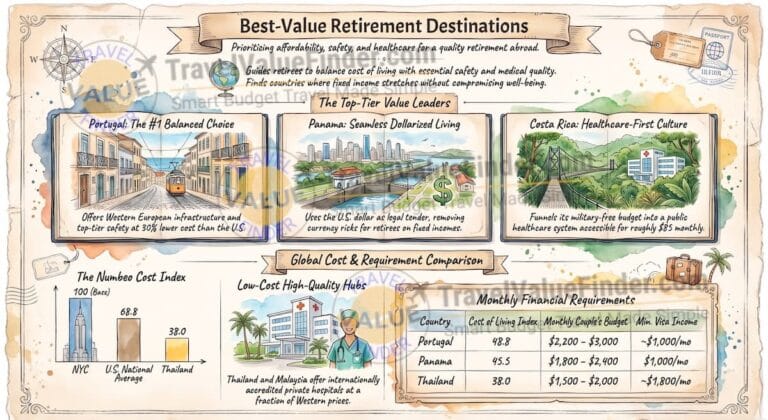
Travel in retirement in 2026 is more accessible, more affordable, and more rewarding than ever before. With flexible scheduling, senior discounts, and smart booking strategies, retirees can explore the world – from Portugal to Southeast Asia – on budgets that fit every income level. This guide covers everything you need: budgeting, destinations, health precautions, packing, and how to stretch your dollars further.
Leslie Nics, TravelValueFinder.com | Last updated: May 2026 | Last Reviewed: May 26 2026
If you’ve been dreaming about travel in retirement , you’re in good company. According to the AARP 2026 Travel Trends Survey , a remarkable 86% of adults 50+ ranked travel as their number-one discretionary spending priority
for 2026 – beating out dining, entertainment, and everything else. Once you retire, every week is a long weekend. That time advantage is your single biggest travel superpower, and this guide is here to help you use it well.
I’m Leslie Nics – a retiree who has spent years exploring the world on a budget and built TravelValueFinder.com to share what I’ve learned with fellow retirees. Everything in this guide is based on real-world travel experience, independent research, and a deep commitment to helping you get the most value from every trip you take.
1. Why Retirement Is the Best Time to Travel in 2026
Here’s something most retirement travel guides won’t tell you: retirement doesn’t just give you the freedom to travel – it gives you a structural advantage that working travelers simply cannot replicate.
- You can fly mid-week (cheapest seats) every single time.
- You can book shoulder-season trips to avoid crowds and peak pricing.
- You can stay longer in one place, unlocking weekly rental discounts.
- You can wait for last-minute deals without the risk of losing vacation days.
- You can skip lines by visiting popular attractions at off-peak hours.
Despite challenges or barriers, older adults are adapting how they travel, not whether they travel. It’s always going to be at the top of their list – and they’re becoming savvier and more strategic. – AARP 2026 Travel Trends Survey
The research backs this up. Nearly two-thirds of adults 50+ plan to travel in 2026, and older travelers are increasingly choosing international destinations, with cruise bookings among adults 70+ nearly double that of those in their 50s. Retirement travel is not slowing down – it’s evolving into something smarter, slower, and far more satisfying. Explore more Travel Tips for Retirees: 20 Ways to Travel Better After 60.
2. How Much Does Travel in Retirement Cost? (2026 Budget Breakdown)
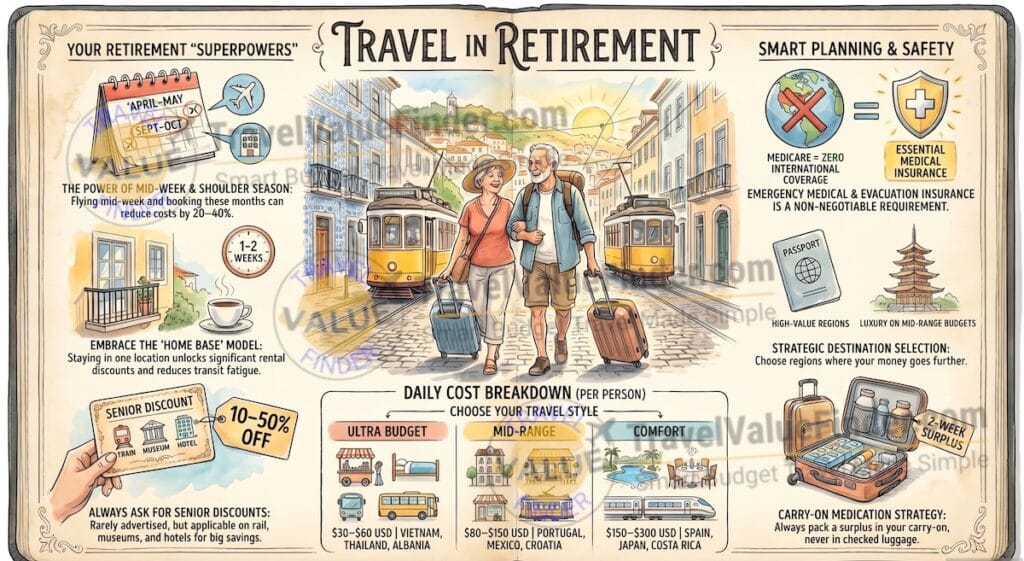
One of the biggest misconceptions about retirement travel is that it has to be expensive. It doesn’t. Your costs depend almost entirely on your destination and travel style. Here’s a realistic 2026 breakdown:
| Travel Style | Daily Budget (USD) | Sample Destination | Accommodation | Best For |
|---|---|---|---|---|
| Ultra Budget | $30–$60 / day | Vietnam, Thailand, Albania | Guesthouses, hostels | Adventure retirees |
| Mid-Range | $80–$150 / day | Portugal, Mexico, Croatia | 3-star hotels, Airbnb | Most retirees |
| Comfort | $150–$300 / day | Spain, Japan, Costa Rica | 4-star hotels, b&bs | Comfort-first travelers |
| Luxury | $300+ / day | Italy, New Zealand, France | 5-star resorts, suites | Splurge trips |
Pro Tip: The biggest lever in your travel budget isn’t the hotel category – it’s destination selection. Choosing Vietnam over Italy at a mid-range style can save you $1,000 or more per week, with no sacrifice in experience quality. See our full guide on budget travel tips for 30 strategies that work.
Hidden Costs Retirees Often Forget to Budget
- Travel insurance (average $307 for a 15-day trip in 2026 – never skip this)
- Medications and any required vaccinations
- Airport transportation at both ends
- Checked baggage fees if you’re flying budget carriers
- International data plan or local SIM card
- Tipping customs vary wildly – budget $5–15/day in tipping cultures
3. The Best Destinations for Retirement Travel in 2026
The best retirement travel destinations share four qualities: they’re affordable, accessible, safe, and genuinely enjoyable at a slower pace. Here are the standouts for 2026, based on value, retiree-friendliness, and real traveler feedback:
The best destination isn’t just about geography – it’s about how you want to travel. Leslie Nics, TravelValueFinder.com
| Destination | Daily Budget | Best For | Why Retirees Love It | Climate | TravelValueFinder Rating |
|---|---|---|---|---|---|
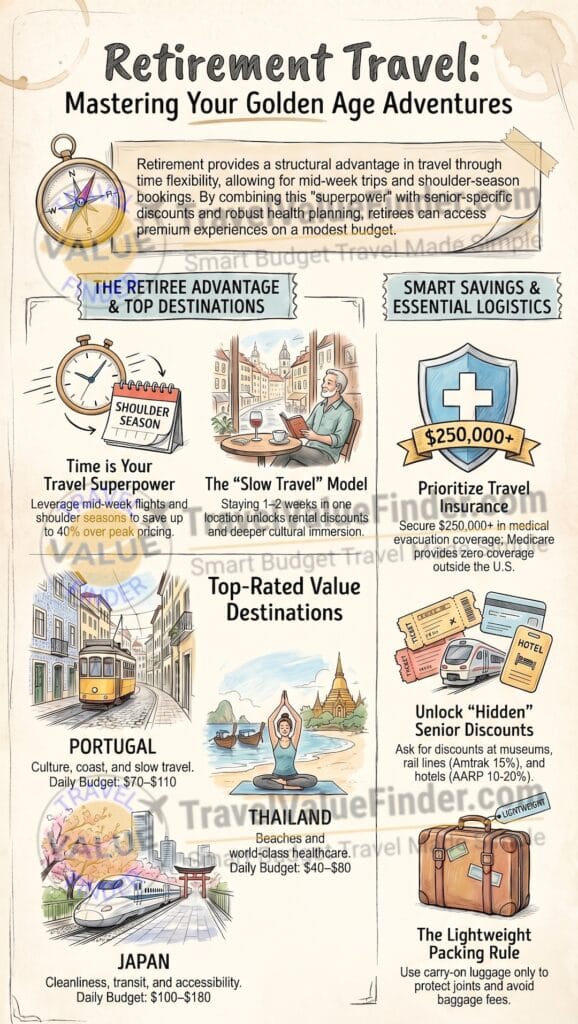
| Portugal | $70–$110 | Culture, coast, slow travel | Walkable cities, mild climate, affordable wine | Mild year-round | ⭐⭐⭐⭐⭐ |
| Thailand | $40–$80 | Beach, culture, food | World-class healthcare, very affordable | Tropical (avoid May–Oct rains) | ⭐⭐⭐⭐⭐ |
| Japan | $100–$180 | Culture, history, cuisine | Safe, clean, excellent transit, accessible | Four distinct seasons | ⭐⭐⭐⭐⭐ |
| Mexico (Oaxaca/Merida) | $50–$100 | Food, art, retirement communities | Large expat community, direct US flights | Warm, dry highlands | ⭐⭐⭐⭐ |
| Croatia | $80–$140 | Adriatic coast, islands | Stunning scenery, less crowded than Italy | Mediterranean | ⭐⭐⭐⭐ |
| Costa Rica | $80–$130 | Nature, wellness, adventure | World-class biodiversity, Pura Vida lifestyle | Tropical (two seasons) | ⭐⭐⭐⭐ |
| Alaska (USA) | $150–$250 | Wildlife, scenery, cruises | No international health insurance needed | Summer May–Sep | ⭐⭐⭐⭐ |
Looking for the full breakdown? Our best cheap travel destinations guide dives deep into costs, neighborhoods, and what’s worth splurging on in each country. Explore How to Afford Travel in Retirement on a Fixed Income.
4. How to Book Flights, Hotels & Tours at the Best Prices for Retirement Travel
Flights: The Retiree Advantage
You can fly when prices are lowest – and that changes everything. Tuesday and Wednesday departures consistently offer the cheapest fares. Shoulder season (April–May and September–October for Europe; February–March for Southeast Asia) cuts flight prices by 20–40% vs. peak season.
- Set price alerts on Google Flights 3–4 months before your target travel window.
- Check departure city flexibility – flying out of a hub rather than a regional airport often saves $200+.
- Consider one-way bookings on different airlines for better routing and pricing.
- Senior fares: American Airlines, United, and Delta offer senior discounts on select routes – always check.
Hotels: Where Retirees Get the Best Value
For retirement travel, hotel location matters more than almost any other factor. A well-located 3-star is often far better value than a cheap 4-star on the outskirts. When booking, compare across multiple platforms – prices vary by 15–25% for the same room.
Our trusted booking partners – Booking.com, Agoda, and TripAdvisor – each show different inventory and pricing. I recommend checking all three before booking any hotel. You’ll often be surprised at the differences.
| Platform | Best For | Retiree Perks | Link |
|---|---|---|---|
| Booking.com | Broadest global inventory | Free cancellation filters, Genius discounts | Search Booking.com |
| Agoda | Asia & Pacific best rates | Early bird deals, loyalty rewards | Search Agoda |
| TripAdvisor | Reviews + booking in one place | Price comparison, verified reviews | Search TripAdvisor |
We also have a detailed comparison in our best hotel booking sites guide – including how I personally compare three sources before every booking to consistently save 15–30%.
5. Travel Insurance for Retirees: What You Absolutely Must Know in 2026
This is not optional. If you are traveling internationally in retirement, travel insurance is one of the most important purchases you will make. Here’s why:
Medicare provides zero coverage outside the 50 U.S. states and Washington D.C. An air ambulance evacuation from Europe or Asia can cost over $100,000 out of pocket. – GoGoGrandparent / U.S. News 2026
What Your Retirement Travel Insurance Must Cover
- Emergency medical coverage: minimum $100,000; ideally $250,000+
- Medical evacuation: minimum $250,000 – non-negotiable for international travel
- Trip cancellation and interruption: protects your non-refundable deposits
- Pre-existing conditions waiver: purchase within 14–21 days of your first trip deposit to qualify
- Travel delay coverage: essential if your itinerary involves connections
| Coverage Type | Minimum Recommended | Why It Matters for Retirees | 2026 Average Cost |
|---|---|---|---|
| Emergency Medical | $100,000–$250,000 | Medicare won’t cover you abroad | Included in most plans |
| Medical Evacuation | $250,000+ | Air ambulance: $50,000–$100,000+ | Included in most plans |
| Trip Cancellation | 100% of trip cost | Health surprises can cancel plans | Approx. $307 avg (15 days) |
| Pre-existing Condition Waiver | Essential if you have conditions | Ensures your health history is covered | Buy within 14–21 days of deposit |
| Cancel for Any Reason (CFAR) | Optional but valuable | Maximum flexibility for retirees | +40–50% premium add-on |
Recommended resources: SquareMouth.com and U.S. News Best Travel Insurance for Seniors 2026 are two of the most reliable independent comparison tools for senior travel insurance in 2026.
6. Senior Discounts That Can Save Retirees Thousands in 2026
This is one of the most underutilized advantages of retirement travel. Senior discounts exist across flights, hotels, car rentals, national parks, museums, and more – and most retirees never ask for them.
| Category | Discount Source | Savings Potential | How to Access |
|---|---|---|---|
| Flights | American, United, Delta (65+) | Varies by route | Select “Senior” in passenger dropdown |
| International Flights | AARP + British Airways | $65–$200 per round trip | AARP Travel Center membership |
| Car Rentals | Avis, Budget (AARP members) | Up to 30% off base rate | Book via AARP Travel Center |
| US National Parks | America the Beautiful (Senior Pass) | $80 lifetime / free entry for 80+ | Purchase at nps.gov or any park gate |
| Amtrak Rail | Amtrak (62+) | 15% off most fares | Select “Senior” when booking |
| Hotel Chains | Marriott, IHG, Hilton (AARP) | 10–20% off rack rates | AARP membership + member rate code |
| Museums / Attractions | Most major museums globally | Often 25–50% off | Always ask – rarely advertised |
| Cruises | Most major cruise lines | Early booking + AARP savings | Book 6–12 months ahead for best rates |
Always ask. Senior discounts are rarely advertised – but they exist almost everywhere. One simple question at check-in, ticketing, or booking can save $20 to $200 in a single transaction. – Leslie Nics, TravelValueFinder.com
7. Health, Mobility & Accessibility Tips for Retiree Travelers in 2026
Traveling well in retirement means traveling smart about your health. This is not about limitations – it’s about planning ahead so nothing interrupts the experience.
Before You Go: Medical Preparation Checklist
- Schedule a pre-travel health checkup 6–8 weeks before departure.
- Confirm all vaccinations are current (including destination-specific requirements).
- Carry a written medication list with generic names – brand names differ by country.
- Pack at least a 2-week medication surplus in your carry-on, never checked luggage.
- Bring a brief medical summary from your doctor, translated if traveling to non-English-speaking countries.
- Register with the U.S. Embassy via the STEP program at step.state.gov for emergency alerts.
Navigating Airports and Airports with Ease
- Request wheelchair assistance when booking – it’s free and gets you through security faster.
- Use TSA Cares (855-787-2227, call 72 hours before your flight) if you have medical implants, portable oxygen, or mobility challenges.
- Travel with a collapsible cane or walker that meets airline carry-on dimensions.
- Ask about priority boarding – most airlines offer it with no formal documentation required.
Managing Medications Across Time Zones
Crossing multiple time zones can disrupt medication schedules. Work with your doctor to create a schedule-transition plan before departure, particularly for medications like blood pressure drugs, insulin, and blood thinners where timing is critical.
8. How to Pack Smart for Retirement Travel: The 2026 Retiree Packing List
The golden rule for retirement travel packing: less is almost always more. Nobody wants to schlep heavy bags around cobblestone streets in Lisbon or up train station stairs in Japan. Mobility issues make this doubly important.
Packing Principles for Retirees
- Carry-on only whenever possible – saves fees, saves time, protects joints.
- Use packing cubes to organize medications, documents, and clothes separately.
- Choose lightweight, wrinkle-resistant fabrics in neutral colors you can mix and match.
- Bring compression socks for long-haul flights – essential for circulation.
- Pack a small first-aid kit with band-aids, blister patches, antidiarrheal, and pain relief.
- Bring your medications in original prescription bottles to avoid customs issues.
- A lightweight foldable day bag for excursions saves enormously vs. carrying your main luggage.
| Category | Must-Pack Items | Retiree-Specific Notes |
|---|---|---|
| Documents | Passport, insurance card, STEP registration, emergency contacts | Keep digital copies in Google Drive or email |
| Medical | Medications + 2-week surplus, prescriptions, doctor summary, first aid | Carry-on only – never check medications |
| Tech | Unlocked phone, universal adapter, portable charger, noise-canceling earbuds | Larger text/display settings before departure |
| Comfort | Compression socks, neck pillow, eye mask, earplugs | Compression socks: non-negotiable for flights over 4 hours |
| Clothing | 5–7 days neutral mix-and-match; layering pieces for temperature changes | Plan laundry every 5–7 days rather than overpacking |
9. Slow Travel vs. Fast Travel in Retirement: Which Style Is Right for You?
This is the question I get asked most often from fellow retirees. And my answer is almost always the same: slow travel is almost always better in retirement – not just physically, but financially and experientially.
The Case for Slow Travel in Retirement
- Staying 1–2 weeks in one location unlocks weekly rental discounts of 20–40%.
- You absorb culture at a deeper level when you’re not moving every 2 days.
- Less transit means less fatigue, fewer logistical headaches, and more actual enjoyment.
- You can find local grocery stores, markets, and restaurants that tourists rush past.
- It’s more comfortable if you have any mobility considerations.
- Consider The Best River Cruises for Retirees in 2026 (Value & Comfort Compared)
When you travel for this long, it’s a good idea to take an occasional vacation from your vacation. Every day is a Saturday when you’re retired – so take your time. – Leslie Nics, TravelValueFinder.com
When Fast Travel Makes Sense
Fast travel – moving through multiple cities or countries on a single trip – still has its place in retirement. It works well for bucket-list itineraries (a European rail journey, a Southeast Asia circuit), for accompanied tours where logistics are handled for you, and for retirees who are energetic and want to see maximum new territory. Just build in rest days every 3–4 days.
Ready to compare cities now?
- Use our Free Retirement Cost of Living Calculator — get your personalized report in 30 seconds – Free PDF download.
- How to Use a Retirement Cost of Living Calculator – to Compare Cities Worldwide
The Best of Both: The “Home Base” Model
My personal favorite approach for retirement travel: pick one home base (Lisbon, Chiang Mai, Oaxaca) for 2–4 weeks, then take day trips and overnight excursions from there. You get variety without constant packing and unpacking. Your accommodation often gets cheaper the longer you stay. And you start to actually know a place rather than just passing through it. Explore the Best Destinations for Retirees in 2026: Where to Go This Year and Discover the Travel After 60: Everything You Need to Know Guide or the Senior-Friendly Cities in Europe: Best Places to Visit Over 60
About the Author
Leslie Nics is the founder and lead writer of TravelValueFinder.com. As a retiree who has personally traveled to 40+ countries on a fixed income, Leslie combines real-world travel experience with independent research to help fellow retirees find the best value in destinations, hotels, and travel strategies. All guides on TravelValueFinder.com are based on independent research, real-world cost data, transparent editorial standards, and a conflict-of-interest disclosure policy. Hotel links and booking recommendations may include affiliate commissions – disclosed clearly and at no extra cost to readers. Leslie’s work has been cited across the travel community for its data-driven, retiree-first approach to travel planning.
Sources used in this article: AARP 2026 Travel Trends Survey | Kiplinger Retiree Travel Guide 2026 | SquareMouth Senior Travel Insurance 2026 | U.S. News Best Senior Travel Insurance | GoGoGrandparent Senior Travel Guide 2026