Travel Value Finder

Yes, you can afford travel in retirement on a fixed income – with the right strategy. The formula is simple: build a dedicated travel fund, choose high-value destinations, time your trips for shoulder season, and stack senior discounts and travel rewards. This guide breaks down exactly how to budget for retirement travel, fund it without touching your core savings, and stretch every dollar further.
Leslie Nics, TravelValueFinder.com | Last updated: May 2026 | Last Reviewed: May 28 2026
One of the most common questions I hear from fellow retirees is this: “Can I really afford travel in retirement on what I’m bringing in?” The honest answer is yes – but only if you stop treating travel as an afterthought and start treating it as a line item in your retirement budget.
The average monthly Social Security benefit in 2026 is $2,071, or about $24,852 per year. The median retirement household income sits around $58,680. For millions of retirees, that’s the entire budget – housing, food, healthcare, and yes, travel. According to financial professionals, allocating 5–10% of your annual retirement spending to travel is a realistic and sustainable target for most fixed-income retirees. On a $58,000 income, that’s $2,900–$5,800 per year – enough for meaningful travel if you apply the strategies in this guide.
I’m Leslie Nics, founder of TravelValueFinder.com. I’ve traveled to 40+ countries on a fixed income by applying these exact strategies. Everything in this budget retirement travel guide is based on real-world experience and independent research – not theory.
The Honest Reality of Traveling on a Fixed Income in 2026
Before strategy, let’s address the elephant in the room: yes, traveling on a fixed income requires more planning than traveling on a working salary. But it doesn’t require more money. In fact, retirees have structural advantages that working travelers can’t replicate.
What Retirees Have That Working Travelers Don’t
- Time flexibility: You can fly Tuesday, avoid peak season, and stay 3 weeks instead of 10 days – unlocking the best prices every time.
- No penalty for last-minute changes: No vacation days to lose. You can pivot on deals when they appear.
- Senior discounts: Across airlines, hotels, national parks, museums, trains, and car rentals – working travelers rarely qualify.
- Travel rewards accumulation: Everyday spending on groceries, gas, and prescriptions can translate into free flights and hotel stays.
- Experience over quantity: Slow travel – one place, longer stay – is both cheaper and more fulfilling than rushing between destinations.
Retirement opens doors to travel that working years often restrict. Fixed incomes from Social Security, pensions, or savings require careful strategies – but many retirees successfully fund adventures by cutting costs while maximizing value. – Retirement.media, 2026
Important: One critical reality: 45% of older adult households cannot cover basic costs of living (National Council on Aging). Travel must be planned – not impulsive. This guide assumes your core living expenses are covered first.
Step 1: Build a Dedicated Travel Fund Before You Go
The single most effective thing you can do to afford travel in retirement is to stop treating it as a discretionary expense that competes with other spending – and start treating it as a fixed savings goal with its own account.
The Travel Fund Formula
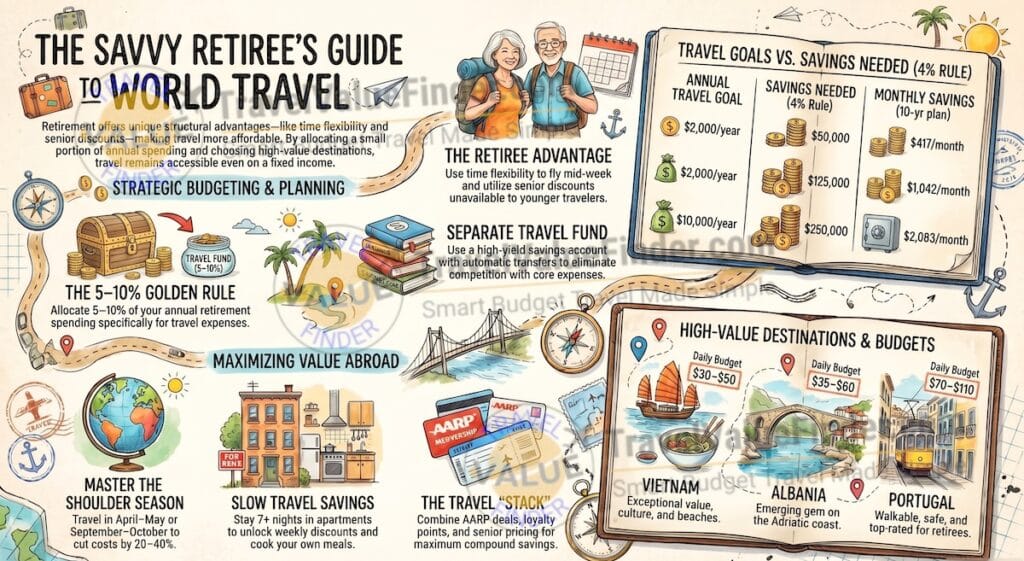
Financial planner Jay Zigmont (Childfree Wealth) offers a clear benchmark: “If you want to spend $10,000 per year traveling, you’ll need an extra $250,000 saved before you retire.” This is based on the 4% safe withdrawal rate. For smaller travel budgets, scale accordingly:
| Annual Travel Goal | Savings Needed (4% Rule) | Monthly Savings (10 yrs) | Monthly Savings (20 yrs) |
|---|---|---|---|
| $2,000/year | $50,000 | $417/month | $208/month |
| $5,000/year | $125,000 | $1,042/month | $521/month |
| $10,000/year | $250,000 | $2,083/month | $1,042/month |
| $15,000/year | $375,000 | $3,125/month | $1,563/month |
Already retired? You can still build a travel fund from your existing income. Financial advisor Trevor Houston recommends: “Creating a separate travel fund with small monthly deposits allows you to establish a budget that eliminates travel expenses from your core spending.”
How to Fund Your Travel Account Without Touching Core Savings
- Open a dedicated high-yield savings account labeled “Travel Fund” (psychologically powerful).
- Set an automatic monthly transfer – even $50–$200/month compounds meaningfully.
- Redirect windfalls: tax refunds, gift money, any one-time income goes straight to travel.
- Reduce one recurring expense (a subscription, a dining habit) and redirect it to travel savings.
- Use travel rewards credit cards for everyday spending – points replace cash spending on flights and hotels.
Travel Savings Rule of Thumb: Financial professionals suggest 5–10% of your annual retirement spending for travel. On a $58,000 retirement income, that’s $2,900–$5,800/year – enough for 1–2 meaningful trips if you apply the strategies below.
Step 2: Know Your Real Numbers – 2026 Budget Retirement Travel Breakdown
One of the biggest barriers to travel on a fixed income is vague fear rather than actual unaffordability. Here are real, research-backed cost examples for different types of retirement travel in 2026:
| Trip Type | Destination | Duration | Daily Budget | Total Cost (2) | Notes |
|---|---|---|---|---|---|
| Ultra-budget | Vietnam / Albania | 14 days | $40–60/day | ~$1,120–1,680 | Guesthouses, local food |
| Mid-range domestic | Portugal / Mexico | 10 days | $80–110/day | ~$1,600–2,200 | 3-star hotels, mix of dining |
| Slow travel (apt.) | Lisbon / Oaxaca | 21 days | $60–80/day | ~$2,520–3,360 | Apartment rental, cook meals |
| Comfort mid-range | Spain / Costa Rica | 12 days | $120–160/day | ~$2,880–3,840 | 4-star hotels, guided tours |
| U.S. road trip | Southwest / Pacific NW | 14 days | $90–130/day | ~$2,520–3,640 | Motels + America the Beautiful Pass |
| Repositioning cruise | Transatlantic | 14 nights | ~$180/day (all-in) | ~$2,519/person | Meals + lodging + entertainment included |
Cruise tip: Repositioning cruises – ships moving between seasons – are often 50–60% cheaper than loop cruises. A 14-night transatlantic crossing was priced at $2,519/person vs. $6,799/person for a 10-night Caribbean loop on the same ship class (AARP, 2026).
Step 3: Choose Destinations That Make Your Budget Go Further
Destination selection is the single biggest lever in budget retirement travel. Choosing Vietnam over Italy at the same travel style can save $1,000+ per week – with no reduction in experience quality. Here are the best-value destinations for retirees in 2026:
| Destination | Daily Budget | Monthly Cost (1 person) | Dollar Strength | Retiree Appeal | Best Season |
|---|---|---|---|---|---|
| Vietnam | $30–50 | ~$900–1,500 | Very strong ⭐⭐⭐⭐⭐ | Culture, cuisine, beaches | Nov–Apr |
| Portugal | $70–110 | ~$2,100–3,300 | Strong ⭐⭐⭐⭐⭐ | #1 for retirees (walkable, safe) | Apr–Jun, Sep–Oct |
| Mexico (Oaxaca) | $50–80 | ~$1,500–2,400 | Strong ⭐⭐⭐⭐ | Large expat community, direct US flights | Oct–Apr |
| Thailand | $40–70 | ~$1,200–2,100 | Very strong ⭐⭐⭐⭐⭐ | World-class healthcare, beaches | Nov–Mar |
| Albania | $35–60 | ~$1,050–1,800 | Exceptional ⭐⭐⭐⭐⭐ | Adriatic coast, emerging gem | May–Oct |
| Colombia (Medellin) | $40–70 | ~$1,200–2,100 | Very strong ⭐⭐⭐⭐ | Eternal spring climate, expat community | Year-round |
| U.S. road trip | $80–120 | ~$2,400–3,600 | N/A (domestic) | No international health gap, flexibility | Spring/Fall |
Portugal stands out especially for American retirees in 2026. Travel advisor Kara Simmons estimates a week in Portugal for two costs $4,200–$4,800 including flights – and traveling in April or May cuts that by 20–30% vs. summer. For context, Portugal offers excellent healthcare, English-speaking locals in most cities, mild year-round weather, and walkable, flat city centers ideal for older travelers.
For internal comparison, see our full retirement travel destinations guide which breaks down costs, neighborhoods, and splurge-or-save decisions for each country. Explore How to Travel Europe by Rail as a Retiree: Passes, Tips & Routes
Step 4: Time Your Trips to Cut Costs by 20–40%
Timing is where the retiree advantage is most powerful. You can always travel when prices are lowest – something working travelers simply cannot do consistently.
The Three Tiers of Travel Timing
| Timing | When | Price vs. Peak | Crowds | Best For |
|---|---|---|---|---|
| Peak season | Jun–Aug (Europe); Dec–Jan (Caribbean) | Full price | Maximum | Avoid unless visiting family |
| Shoulder season | Apr–May, Sep–Oct (Europe); Feb–Mar (SE Asia) | 20–40% cheaper | Low to moderate | Best overall value for retirees |
| Off-season | Nov–Mar (Europe); May–Oct (SE Asia monsoon) | 40–60% cheaper | Very low | Budget-first; check weather carefully |
| Mid-week flights | Tue/Wed departures all year | 20–30% cheaper | Lighter airports | Applies to every trip – always book this |
| Last-minute deals | 30–14 days before departure | Varies; can be 30–50% off | N/A | Retirees with no fixed commitments |
Flexibility in timing and destinations stands as the biggest advantage for retirees. Avoiding peak seasons and embracing shoulder periods slashes expenses on flights, lodging, and activities. – Retirement.media, 2026
Step 5: Book Smart – Hotel Comparison Strategy for Budget Retirement Travel
The same hotel room can vary in price by 15–25% depending on which booking platform you use. Before confirming any accommodation, compare prices across at least three sources. Our three trusted partners – each with unique inventory and pricing – are the ones I use on every trip:
| Platform | Best For | Money-Saving Feature | Book Now |
|---|---|---|---|
| Booking.com | Widest global inventory | Free cancellation + Genius member discounts | Search Booking.com |
| Agoda | Asia & Pacific best rates | Early bird deals up to 30% off | Search Agoda |
| TripAdvisor | Reviews + price comparison | Side-by-side rate comparison across sites | Search TripAdvisor |
Full comparison breakdown in our best hotel booking sites for retirees guide. The 5-minute comparison habit consistently saves 15–30% – on a $1,200 hotel budget, that’s $180–$360 back in your pocket.
Booking Tip: Always filter for “Free Cancellation” on Booking.com. Locking in a cancellable rate at today’s price protects you if prices drop further – or if health or plans change.
Step 6: Free and Near-Free Accommodation Strategies
Accommodation is typically the largest cost in any trip – which means it’s also where the biggest savings are available. Beyond standard hotel discounts, retirees have access to strategies that can reduce or eliminate accommodation costs entirely.
House-Sitting: Free Accommodation in Exchange for Home Care
TrustedHousesitters connects homeowners with vetted sitters who care for their home (and often pets) while they’re away. In exchange: free accommodation, often in desirable locations. This model works particularly well for retirees who are flexible with dates, comfortable with pets, and want extended stays in one location.
- Listings available in 130+ countries, including Portugal, Italy, France, Thailand, Australia.
- Annual membership costs ~$150–$250 – offset by the first night of free accommodation.
- Ideal for 1–4 week stays. Often includes beautiful homes in residential (non-tourist) areas.
Home Exchange: Swap Your Home for Theirs
Home exchange programs (HomeExchange.com, Love Home Swap) let you swap your home with another member’s home for free. Both parties get free accommodation. Works best for retirees who own their home and want to travel for 1–3 weeks.
Long-Stay Apartment Rentals: Weekly Discounts of 20–40%
Booking an Airbnb or VRBO apartment for 7+ nights unlocks automatic weekly discounts of 20–40% vs. the nightly rate. Staying for a full month often cuts nightly costs by 50%+. Add the ability to cook meals (eliminating restaurant costs for breakfast and lunch) and a 3-week apartment rental often beats 3 weeks of hotels at total trip cost.
Repositioning Cruises: All-Inclusive at Budget Prices
When cruise ships reposition between their summer and winter routes, they offer dramatically reduced fares to fill cabins on one-way crossings. These transatlantic and trans-Pacific sailings include all meals, entertainment, and your cabin – making them one of the best all-in-one value options in retirement travel.
Cruise Value: A 14-night transatlantic repositioning cruise was priced at $2,519/person in early 2026 – about $180/day all-in for accommodation, meals, and entertainment. Compare that to $180+/night for a standard European hotel.
Step 7: Stack Your Savings – Senior Discounts + Points + Memberships
The retirees who travel most affordably aren’t just using one strategy – they’re stacking multiple savings sources simultaneously. Here’s how the stack works:
| Savings Source | Typical Savings | How to Access | Best Use Case |
|---|---|---|---|
| AARP Membership ($16/yr) | 10–30% on hotels, car rentals | aarp.org + member code at booking | Hotels (IHG, Marriott), Avis, Budget |
| America the Beautiful Pass | $80 lifetime (free 80+) | nps.gov or any park entrance | All U.S. National Parks – unlimited entry |
| Travel credit card points | $600–1,500 in first-year sign-up bonus | Meet minimum spend in first 3 months | Free or heavily discounted flights |
| No-FX-fee credit card | 2–3% per purchase abroad | Chase Sapphire, Citi Strata Premier | All international purchases |
| AAA Membership ($60–70/yr) | Varies by partner | AAA app + member ID | Hotels, restaurants, attractions |
| Bank of America Museums on Us | Free museum entry | Show BofA card at 225+ museums | First full weekend of every month |
| Senior / Off-peak pricing | 15–50% on attractions + trains | Always ask at ticketing/check-in | Museums, transit, guided tours |
| Amtrak Senior Discount (62+) | 15% off most rail fares | Select Senior when booking | U.S. domestic train trave |
Never pay for something a membership already covers. Senior discounts, AARP deals, and travel card perks are available on almost everything – but you have to ask. Most are never displayed. – Leslie Nics, TravelValueFinder.com
Step 8: Cut Costs on the Big Three – Flights, Food & Activities
Flights: The 5 Strategies That Work
- Find Cheap Flights: Fly Tuesday or Wednesday – consistently 20–30% cheaper than weekend flights.
- Book 6–12 weeks out for domestic, 3–6 months for international (for best fares, not earliest possible).
- Use Google Flights’ “Flexible Dates” grid to see the full month’s pricing at once.
- Consider alternate airports – flying from a major hub vs. a regional airport often saves $100–$300.
- Set price alerts at your target fare and book when it hits – don’t rush.
Food: Eating Well for Less
- Eat your main meal at lunch, not dinner – lunch menus (prix fixe) in Europe are often 40–50% cheaper than dinner for the same food.
- Shop at local markets for breakfast and snacks – a day’s worth of breakfast costs $2–4 at a local market vs. $12–18 at a hotel.
- Stay in apartments with kitchens for longer trips – cooking half your meals can cut food costs by $20–30/day per person.
- Avoid tourist-zone restaurants – walk two blocks from major attractions and prices drop 30–50%.
Activities: Seeing Everything for Less
- Free walking tours exist in almost every major city globally – tip-based, excellent quality.
- Many world-class museums have free or reduced-admission days – research before you go.
- City tourist cards (Paris Museum Pass, Rome’s Omnia Card) often pay for themselves in 2–3 attractions.
- National parks, public gardens, coastal walks, and historic town centers are free.
Step 9: Don’t Skip Travel Insurance – Here’s How to Afford It
Important: Medicare provides zero coverage outside the 50 U.S. states. A medical evacuation from Europe or Asia can cost $50,000–$100,000+ out of pocket. Travel insurance is not optional for international retirement travel.
The average travel insurance cost for a 15-day trip in 2026 is around $307 – less than one restaurant dinner for two. Compare that to an uninsured emergency and it’s one of the best values in all of travel. Here’s how to keep insurance costs manageable:
- Compare plans at SquareMouth.com or InsureMyTrip.com – don’t buy the first policy you see.
- Annual multi-trip policies cover unlimited trips in a year for ~$300–$500 – far cheaper than buying per-trip insurance if you travel 3+ times annually.
- Purchase within 14–21 days of your first trip deposit to qualify for the pre-existing conditions waiver.
- Cancel For Any Reason (CFAR) coverage adds ~40–50% to premium but gives full flexibility – valuable for retirees whose health can change.
- Your travel credit card may include trip cancellation and interruption insurance – check benefits before buying separately.
See our companion guide: Travel Tips for Retirees: 20 Ways to Travel Better After 60 for the full insurance coverage checklist.
Real Annual Travel Budget Examples for Retirees in 2026
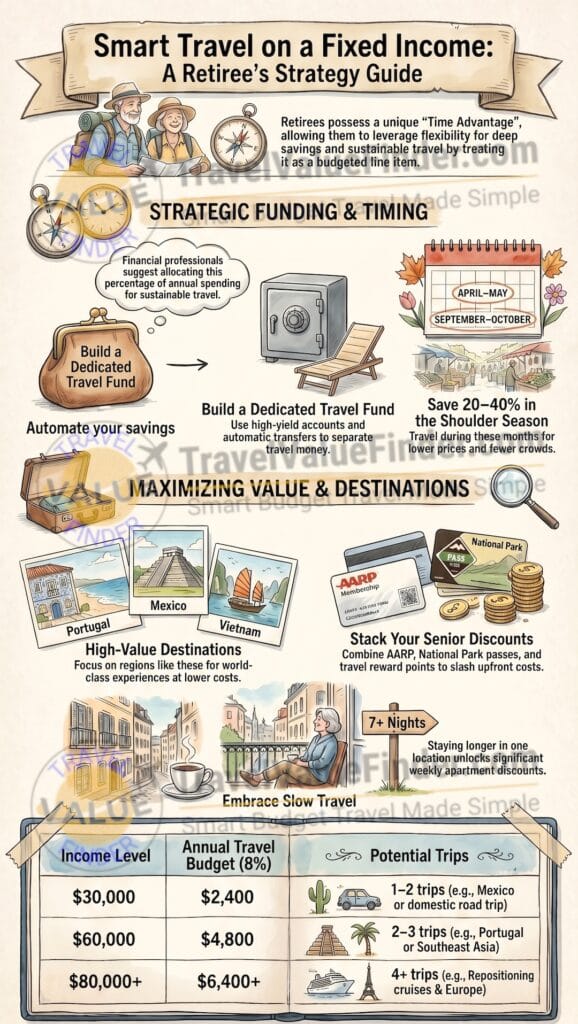
To make this concrete, here are three sample annual travel budgets for retirees at different income levels, based on real 2026 destination and pricing data:
| Budget Tier | Annual Income | Travel Budget (8%) | Trips Possible | Sample Itinerary | Strategies Used |
| Essential | $24,000–30,000 | $1,920–2,400 | 1–2 short trips | Road trip + 1 Airbnb week in Mexico | AmTrak, NPS pass, Airbnb weekly rate |
| Comfortable | $45,000–60,000 | $3,600–4,800 | 2–3 trips | Portugal 10 days + 2 domestic trips | Shoulder season, AARP deals, points |
| Enriched | $60,000–80,000 | $4,800–6,400 | 3–4 trips | SE Asia 2 wks + Europe + 2 US trips | House-sit, travel card points, mid-week |
| Abundant | $80,000+ | $6,400+ | 4–5+ trips | Transatlantic cruise + Japan + 3 short | Repositioning cruises, business class pts |
Key insight: Even on a $24,000 Social Security-only income, a $1,920 annual travel budget (8%) is achievable – and enough for 1–2 real trips using the strategies in this guide. The difference between retirees who travel and those who don’t isn’t usually income. It’s planning.
The Go-Go Years: Why Traveling Sooner Matters
Financial planners call early retirement the “go-go years” – the window when health, energy, and desire to travel are all high simultaneously. Research and financial advisors consistently note that travel ability typically peaks in the early 60s and declines through the 70s and 80s.
It’s easier to travel in your 60s than your 70s and 80s. Check off some bucket list items if you have sufficient savings – don’t wait. – Motley Fool, 2026
The practical implication: if you’re in your early-to-mid 60s and able to travel, the cost of not traveling – in missed experiences – is real. Build your travel fund, apply the strategies in this guide, and start with one meaningful trip this year. The strategies work. The memories are irreplaceable. Explore the Best Destinations for Retirees in 2026: Where to Go This Year and Discover the Travel After 60: Everything You Need to Know Guide. Find more about The Retirement Travel Bucket List: 50 Experiences to Have After 60 for you to enjoy your travel retirement. Find out How Much Money Do You Need to Retire Abroad? (2026 Country-by-Country Guide)
Ready to compare cities now?
- Use our Free Retirement Cost of Living Calculator – get your personalized report in 30 seconds – Free PDF download.
- How to Use a Retirement Cost of Living Calculator – to Compare Cities Worldwide
Frequently Asked Questions: Afford Travel in Retirement
How much should a retiree budget for travel per year?
Financial professionals suggest 5–10% of your annual retirement spending for travel. On a $58,000 median retirement income, that’s $2,900–$5,800/year – enough for 1–3 meaningful trips using the strategies in this guide. Your travel budget will likely be highest during your “go-go years” (early 60s) and naturally reduce as health changes.
Can you travel on Social Security alone?
Yes, with careful planning. The average Social Security benefit in 2026 is $2,071/month. Allocating 8% to travel = $1,984/year. With shoulder season timing, senior discounts, and mid-week flights, that’s enough for a meaningful domestic trip plus 1–2 shorter getaways, or a 10–14 day trip to a low-cost destination like Mexico or Albania.
What is the cheapest way to travel in retirement?
The combination that produces the lowest cost per trip: (1) low-cost destination (Vietnam, Albania, Mexico), (2) shoulder season travel, (3) mid-week flights, (4) weekly apartment rental with kitchen access, (5) travel rewards points for flights, (6) senior discounts for activities. Stack all five and $2,000–$3,000 covers a 2-week international trip for one.
Is travel worth it on a fixed income?
Overwhelmingly yes, according to research. 52% of seniors aged 50+ rank travel as their #1 priority for discretionary income – above dining, entertainment, and everything else. Travel has documented benefits for cognitive health, emotional wellbeing, social connection, and life satisfaction. The key is making it sustainable through planning, not sacrificing it because it feels unaffordable.
How can I save for retirement travel without affecting my core savings?
Open a separate high-yield savings account labeled “Travel Fund”. Set an automatic monthly transfer of whatever amount is comfortable – even $50 builds meaningful savings over time. Redirect tax refunds, gift money, and any irregular income into this account. Use travel rewards credit cards for everyday spending so your grocery and gas spending generates flight and hotel value.
About the Author
Leslie Nics is the founder and lead writer of TravelValueFinder.com. A retiree with personal experience traveling to 40+ countries on a fixed income, Leslie writes specifically for fellow retirees seeking honest, value-driven travel guidance. All content is based on independent research, real-world cost data, and a transparent editorial policy. Affiliate hotel booking links (Booking.com, Agoda, TripAdvisor via Stay22) are clearly disclosed and earn a small commission at no extra cost to readers. Leslie’s approach: every strategy in this guide is one she has personally used or independently verified.
Sources: AARP 2026 Travel Trends Survey | Kiplinger: Money-Saving Travel Tips 2026 | Stage Ready Financial Planning: Travel in Retirement | National Council on Aging: Older Adult Financial Security | Randall Wealth: Average Retirement Income 2026 | GOBankingRates: Can You Afford to Travel Every Year? | Retirement.media: Budget Travel Strategies | SquareMouth: Senior Travel Insurance 2026