Travel Value Finder

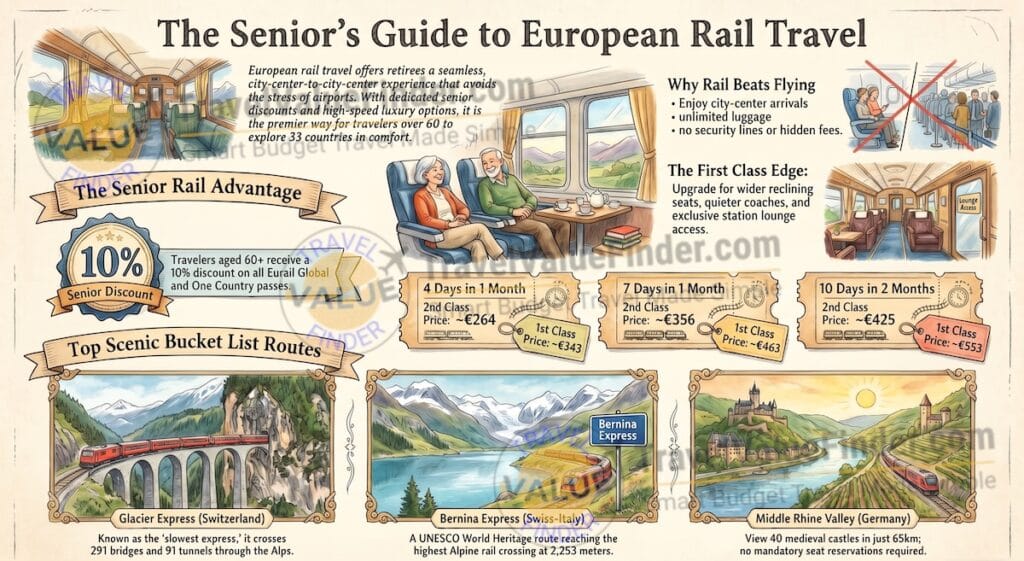
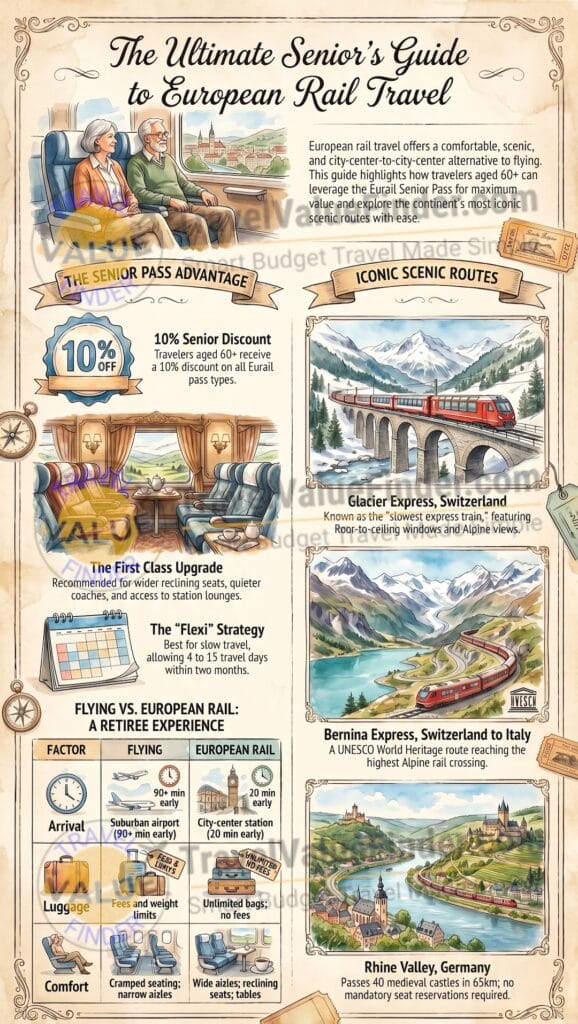
European rail travel for retirees in 2026 is one of the most comfortable, scenic, and affordable ways to explore the continent. The Eurail Global Senior Pass gives travelers 60+ a 10% discount on already-flexible rail passes covering 33 countries.
Seniors should choose First Class for comfort, and book mandatory seat reservations early (especially on French TGV, Italian Frecciarossa, and night trains).
You should use the Rail Planner App to manage your journey. The pass is best value for travelers crossing 4+ countries or riding overnight trains.
Point-to-point advance tickets often beat the pass for 1–2 country trips.
Top scenic routes include:
- Glacier Express (Zermatt–St. Moritz),
- Bernina Express (UNESCO),
- Flåm Railway (Norwegian fjords),
- Bergen Railway, and
- the Venice Simplon-Orient-Express.
Disclaimer: This article is for general informational purposes only and does not constitute financial, investment, tax, legal, immigration, or other professional advice. Costs and other figures are estimates and can change. Always verify current information and consult a qualified professional before making significant financial, travel, or retirement decisions.
Leslie Nics, TravelValueFinder.com | Last updated: June 2026 | Last Reviewed: September 08 2026
I’m Leslie Nics, founder of TravelValueFinder.com, and a retiree who has taken European trains from Oslo to Athens, from Lisbon to Istanbul.
Everything in this guide is grounded in 2026 research from Eurail.com, Tictivity’s April 2026 Eurail Pass Guide, Seat61.com, and my own experience on European rails.
Let’s start with the decision that matters most.
Table of Contents
Why European Rail Travel Is the Perfect Fit for Retirees
European trains arrive in city centers (not distant airports).
Furthermore, it allow unlimited luggage without fees, offer First Class with wider seats and quieter coaches, and include some of the world’s most scenic routes as standard services.
Retirees benefit disproportionately from rail travel’s flexibility, comfort, and city-center access when compared to flying. Here’s the comparison;
| Factor | Flying | European Train (Retiree View) |
|---|---|---|
| Departure | Suburban airport; 90+ min early arrival | City-center station; 20–30 min early |
| Security | Full TSA/EU screening; remove shoes, laptops | No security screening on most routes |
| Luggage | Checked fees + weight limits + overhead hassle | No fees; unlimited bags in luggage rack |
| Arrival | Suburban airport; 30–60 min transit to center | City-center station; walk or metro to hotel |
| Seating comfort | Economy: cramped; Business: expensive | First Class: wide, reclining, quiet, table |
| Scenery | Clouds (or seat map of the plane floor) | Alps, fjords, vineyards, coastlines |
| Mobility | Narrow aisles; overhead bins; tight seats | Wide aisles; level boarding in most stations; wheelchair spaces |
| Cancellation risk | High; rebooking can cost $100–$300 | Most advance tickets: refundable or exchangeable |
| CO₂ footprint | High. European flights produce 90x rail emissions | Low. European rail is largely electric and renewable |
For retirees specifically, the city-center to city-center advantage is the single most compelling argument for rail.
European train stations are typically in the heart of their cities. Paris Gare du Nord, Vienna Hauptbahnhof, Amsterdam Centraal, Rome Termini are surrounded by hotels, restaurants, and transit connections.
No taxi or transit ride from a distant airport. No navigating unfamiliar bus routes with luggage. You step off the train and you’re already there.
The Eurail Senior Pass Explained: Everything Retirees Need to Know in 2026
The Eurail Global Senior Pass gives travelers 60+ a 10% discount on all Eurail Global, Regional, and One Country passes.
- Americans buy Eurail (not Interrail, which is for European residents).
- The pass is mobile-only in 2026, managed via the Rail Planner App.
- Travelers 60+ on the date their trip starts qualify for senior pricing.
- Children 4–11 travel free (up to 2 per senior).
- The pass covers 33 countries. First Class is recommended for retirees.
Eurail vs. Interrail: Which One Can You Buy?
This is the first question most American travelers get wrong. Americans, Canadians, Australians, and all non-European residents buy a Eurail Pass. Europeans (including UK residents) buy an Interrail Pass.
Both are issued by the same company (Eurail B.V.) and look identical inside the Rail Planner App once activated.
The only difference is residency eligibility. If you live in the U.S., you buy Eurail, full stop.
Who Qualifies for the Senior Discount?
You must be 60 years or older on the date you choose to start your trip, not the date of purchase.
The 10% senior discount applies automatically when you select your age at checkout.
It applies to all Eurail pass types: Global, Regional, and One Country.
Children aged 4–11 travel free when accompanied by a senior pass holder (up to 2 children per senior).
2026 Eurail Global Pass: Prices and Options
Below are current 2026 adult second-class prices as a baseline (source: Tictivity Eurail Pass Guide, April 2026).
Senior pricing is approximately 10% below these figures. First Class adds approximately 30%.
Prices are in euros at current official Eurail.com pricing:
| Pass Type | Adult 2nd Class (base) | Senior 2nd Class (~10% off) | Senior 1st Class (~30% more) | Best For |
|---|---|---|---|---|
| 4 days in 1 month (Flexi) | €293 | ~€264 | ~€343 | Short multi-city trip; 2–3 countries |
| 5 days in 1 month (Flexi) | €335 | ~€302 | ~€393 | Standard 2-week itinerary |
| 7 days in 1 month (Flexi) | €396 | ~€356 | ~€463 | Most popular; 3–4 countries in 1 month |
| 10 days in 2 months (Flexi) | €472 | ~€425 | ~€553 | Slow travel; extended European trip |
| 15 days in 2 months (Flexi) | €583 | ~€525 | ~€683 | Major multi-country itinerary |
| 15 days continuous | €487 | ~€438 | ~€570 | Daily rail travel; intensive tour |
| 1 month continuous | €703 | ~€633 | ~€823 | Extended slow travel trip |
| 3 months continuous | €1,054 | ~€949 | ~€1,234 | Long-haul retiree rail adventure |
First Class Recommendation:
For retirees, First Class is strongly recommended.
- You get wider reclining seats,
- quieter coaches,
- a proper table for meals and reading,
- less crowding, and
- in many countries access to lounge seating at stations.
The comfort upgrade is worth the ~30% premium over a long rail trip
How the Flexi Pass Travel Day Works
A travel day runs from 00:00 to 23:59 in the country where you board.
You can take as many trains as you like within that calendar day and it counts as one travel day.
Night trains departing after 19:00 (7pm) typically count as a single travel day even if you arrive the next morning. This means you can use a night train as both transportation and overnight accommodation while spending just one pass day.
Where to Buy Your Eurail Pass
Purchase directly at Eurail.com or through approved resellers, RailEurope.com and Trainline.
All sell the same passes at the same prices.
Eurail.com is recommended as the most reliable source for changes, refunds, and direct customer support.
Note: passes must be activated within 11 months of purchase and are refundable (85% back) before activation.
Eurail Senior Pass vs. Point-to-Point Tickets: The Honest 2026 Decision Guide
The Eurail pass beats point-to-point tickets when crossing 4+ countries using night trains, or wanting flexibility to change plans.
Point-to-point advance tickets win for 1–2 country trips with a fixed itinerary.
The key variable: European train fares are dynamic like airline fares. Advance tickets can be dramatically cheaper than pass + reservation fees.
Always price both options before deciding.
This is the section most guides skip because the honest answer isn’t simple.
A Eurail Senior Pass is not automatically the best choice, and for some itineraries, it’s significantly more expensive than buying advance point-to-point tickets.
Here’s the framework for making the right decision:
| Your Situation | Best Choice | Why |
|---|---|---|
| 1–2 countries, fixed dates, booking 4–8 weeks ahead | Point-to-point advance tickets | Advance fares often far below pass + reservation fees |
| 4+ countries, flexible itinerary | Eurail Senior Pass (Flexi) | Flexibility value + senior discount + no advance booking required |
| Traveling with a travel partner | Eurail Pass (Saver option saves additional 10%) | Group Saver discount stacks with senior discount |
| Multiple overnight trains | Eurail Senior Pass | Night trains count as one travel day; saves hotel costs |
| Germany, Netherlands, Austria, Belgium | Pass often wins | High point-to-point fares; no mandatory reservations |
| France, Italy (fixed dates) | Point-to-point advance tickets | French SNCF and Trenitalia offer cheap advance fares; TGV/Frecciarossa reservations expensive on pass |
| Switzerland scenic trains | Swiss Travel Pass or pay reservation fee | Glacier/Bernina Express: seat reservation ~CHF54 mandatory regardless of pass |
| Short trip: 3–5 days, 2 countries | Point-to-point advance tickets | Pass cost too high; advance tickets usually cheaper for few journeys |
Seat Reservations with a Eurail Pass: Country-by-Country Guide (2026)
Not all European trains require seat reservations with a Eurail pass.
- Germany, Austria, Netherlands, Belgium, and most regional trains do not.
- France (every TGV), Italy (Frecciarossa/Frecciargento), and Eurostar require mandatory paid reservations (€10–30).
- Switzerland’s scenic trains (Glacier/Bernina Express) require CHF54 mandatory reservation.
- Night trains always require advance reservation for couchette or sleeper berths.
| Country / Route | Reservation Required? | Reservation Cost | Book Via | Notes for Retirees |
|---|---|---|---|---|
| France (TGV) | Yes – mandatory on ALL TGV trains | €10–30 | SNCF Connect or Eurail.com | Book as early as possible; TGV fares and reservations sell out |
| Italy (Frecciarossa/Frecciargento) | Yes – mandatory | €10–13 | Trenitalia or Eurail.com | Italo (private operator) has limited pass quota – book early or take regional trains |
| Spain (AVE high-speed) | Yes – mandatory | €10–23 | Renfe.com or Eurail.com | Spain’s AVE is superb; reservations essential for popular Madrid-Barcelona route |
| Eurostar (London–Paris/Brussels) | Yes – mandatory | €30–40+ | Eurostar.com (limited pass quota) | Pass quota sells out fast; book as soon as dates are set |
| Germany (ICE/IC) | No – optional (€4.90) | Optional only | DB Navigator app | Most flexible country for pass travel; hop on any ICE anytime |
| Austria (Railjet) | No – optional | Optional only | ÖBB.at | ÖBB Railjets are comfortable; seat optional but recommended in peak season |
| Netherlands (Intercity) | No | None | NS.nl | Very flexible; trains every 15–30 minutes on most routes |
| Belgium (Intercity) | No | None | SNCB.be | Small country; frequent trains; no reservation needed |
| Switzerland (Glacier Express) | Yes – mandatory | CHF54 (~€58) | RhB.ch | Book months ahead; panorama car seats sell out in spring/summer |
| Switzerland (Bernina Express) | Yes – mandatory | CHF36 (~€39) | RhB.ch | UNESCO route; reservation includes panorama car |
| Norway (Flåm Railway) | Yes – mandatory | Included in ticket | Visitflam.com | Not covered by Eurail; separate ticket required (from NOK310) |
| Night Trains (all routes) | Yes – couchette or sleeper berth | €20–80+ depending on berth type | Via operator or Eurail.com | Book early; berths fill fast. Always book upper berth for easier access over 60 |
2026 Tip:
- Use the free Eurail Rail Planner App to plan your route.
- Check reservation requirements by train, and generate QR code tickets.
- The app works offline once activated, download before your departure date.
- Avoid booking Eurostar separately without first checking the pass quota at Eurail.com.
Best European Train Routes for Retirees in 2026: Scenic, Comfortable & Accessible
The 8 best European train routes for retirees in 2026 by scenic impact and comfort:
- Glacier Express (Zermatt–St. Moritz, CHF54 reservation),
- Bernina Express (Chur–Tirano, UNESCO World Heritage),
- Flåm Railway (Norwegian fjords, separate ticket),
- Bergen Railway (Bergen–Oslo, Eurail covered),
- Venice Simplon-Orient-Express (luxury, not pass-valid),
- Cinque Terre coastal train,
- Eurostar (London–Paris), and
- the classic Rhineland route (Cologne–Mainz).
This is where European rail travel earns its reputation.
These are not just transportation routes. They are experiences in their own right.
For retirees who want the scenery to be as memorable as the destination, these eight routes deliver.
1. Glacier Express. Zermatt to St. Moritz, Switzerland
The world’s most famous scenic railway | UNESCO World Heritage | ‘Slowest express train in the world’
| Journey Time | Distance / Countries | Reservation Required |
|---|---|---|
| 7–8 hours (full route) | 291km | Switzerland | CHF54 (~€58) mandatory reservation; Eurail valid for fare |
The Glacier Express is perhaps the most celebrated train journey in the world, and it lives up to every photograph.
Connecting the Matterhorn at Zermatt with the Alps glamour of St. Moritz, the route crosses 291 bridges, passes through 91 tunnels.
It reaches its highest point at the Oberalp Pass (2,033 meters) before descending through the dramatic Rhine Gorge, known as Switzerland’s Grand Canyon.
The panorama carriages have floor-to-ceiling windows that slope overhead, giving unobstructed views of the Alpine scenery in every direction.
For retirees, the seated, unhurried nature of the Glacier Express is ideal:
- no hiking,
- no exertion,
- a restaurant car serving Swiss cuisine, and
- 7–8 hours to absorb some of the world’s finest mountain scenery.
The Excellence Class adds a premium all-inclusive dining experience with a rotating menu of seasonal Swiss dishes paired with regional wines. This is a genuinely memorable retiree splurge at ~CHF195 supplement above the standard reservation.
- Panorama cars: Sloping floor-to-ceiling windows; commentary in multiple languages via in-seat audio.
- Excellence Class: Dedicated dining car; 4-course menu with wine pairing; hosted service. Book direct via RhB.ch.
- Wheelchair accessibility: The Glacier Express has wheelchair spaces available; book accessibility assistance via RhB.ch when making your reservation.
- Season: Runs year-round. Spring (May–June) and Autumn (September–October) for fewer crowds and lower prices. Summer is spectacular but very busy.
Retiree Rail Tip:
- Book the CHF54 reservation at RhB.ch as soon as your dates are confirmed.
- Panorama car seats sell out months in advance in summer.
- Request window seats on the right side (southbound) for the best Matterhorn views near Zermatt.
- The 3-hour partial trip from Chur to St. Moritz on the UNESCO Albula Line is a superb shorter option.
2. Bernina Express. Chur to Tirano, Switzerland to Italy
UNESCO World Heritage railway | Highest point 2,253m | Brusio Circular Viaduct
| Journey Time | Distance / Countries | Reservation Required |
|---|---|---|
| 4 hours | 144km | Switzerland + Italy | CHF36 (~€39) mandatory reservation; Eurail valid for fare |
The Bernina Express is a UNESCO World Heritage-listed route connecting Chur, Switzerland to Tirano, Italy.
It crosses the Bernina Pass at 2,253m (the highest Alpine rail crossing), includes the iconic Brusio Circular Viaduct and Landwasser Viaduct, and offers views of the Morteratsch Glacier.
Panorama cars run year-round. The journey can be done as part of a Zurich-to-Milan scenic routing via Tirano, making it an alternative to the standard high-speed train.
If the Glacier Express is the Alps’ greatest hits album, the Bernina Express is its hidden masterpiece.
The Bernina Express carries UNESCO World Heritage status. One of very few railways in the world to receive this designation for its extraordinary combination of engineering ingenuity and Alpine beauty.
The route includes the Brusio Circular Viaduct (a circular stone viaduct that literally loops the train around itself to descend a steep gradient) and the Landwasser Viaduct (a 65-meter-high curved stone bridge that emerges from a tunnel and immediately crosses a ravine on a six-arch span).
The route’s high point at Ospizio Bernina (2,253 meters) is the highest railway crossing in the Alps. It offers views of the Morteratsch Glacier and the three Alpine lakes (Lej Nair, Lago Bianco, and Palu).
The descent into Tirano, Italy passes through tiny Italian border villages that feel completely removed from tourist Europe.
This is the most scenic 4 hours available on European rails, and it can be used as the scenic alternative leg on a Zurich-to-Milan journey.
- Zurich to Milan via Bernina: Zurich – Chur (ICE, 1hr) – Chur – Tirano (Bernina Express, 4hrs) – Tirano – Milan (bus, 2.5hrs). Slower than the 3-hour direct train but incomparably more scenic.
- Panorama cars: Available on all Bernina Express departures. Sloping windows; audio guide in multiple languages.
- Morteratsch Glacier viewpoint: A short walk from Morteratsch station; the glacier is visible from the train but a 30-minute stop rewards with up-close views.
- Accessibility: Panorama cars have designated wheelchair spaces. Notify RhB.ch when booking.
Retiree Rail Tip:
- Book the panorama car directly via RhB.ch.
- The departure from Chur (rather than St. Moritz) starts at a lower elevation, making the climb to the Bernina Pass even more dramatic.
- For the full experience, combine Glacier Express + Bernina Express as a 2-day Swiss Alpine rail circuit.
3. Flåm Railway. Flåm to Myrdal, Norway
One of the world’s steepest standard-gauge railways | Norwegian fjords | 80% gradient | Waterfalls
| Journey Time | Distance / Countrie | Reservation Required |
|---|---|---|
| 1 hour each way | 20km | Norway | NOT covered by Eurail pass – separate ticket from NOK 390/€35 |
The Flåm Railway (Flåmsbana) is one of the world’s steepest standard-gauge railways, climbing 863 meters in 20km from the Aurlandsfjord at Flåm to the mountain station at Myrdal.
It is one of Norway’s most visited tourist attractions.
The train is NOT included in the Eurail pass.
A separate tickets cost from NOK 390 (€35) one way.
At Myrdal, passengers can connect to the Bergen Railway for fjord-to-coast travel.
The famous Kjósfossen waterfall stop is a highlight, and the train pauses for photos.
- Norway in a Nutshell: The classic tourist circuit combines the Flåm Railway with a fjord cruise on the Nærøyfjord (UNESCO) and the Bergen Railway. A one-day circuit from Bergen or Oslo that covers the essential Norwegian fjord experience.
- Bergen Railway connection: At Myrdal station, connect to the Bergen Railway (covered by Eurail) for the full fjord-to-Bergen route through snow-capped mountains and moorland.
- Wheelchair accessibility: Flåm Railway trains have wheelchair spaces and accessible boarding. The Kjósfossen stop involves standing on a platform, and manageable for most mobility levels.
- Best time: June–September for full waterfalls and green mountains. October–May for snow-covered landscapes and far fewer tourists.
Retiree Rail Tip:
- Book the Flåm Railway at visitflam.com well in advance for summer travel, it fills completely in July–August.
- The return trip (uphill from Flåm to Myrdal) is equally scenic, worth doing both directions if you can spare the day.
- The fjord cruise on Nærøyfjord added to this route makes for one of Europe’s finest single travel days.
4. Bergen Railway. Bergen to Oslo, Norway
Norway’s greatest rail journey | Fjords, waterfalls, high mountain plateau | 7 hours of Nordic beauty
| Journey Time | Distance / Countries | Reservation Required |
|---|---|---|
| 6.5–7 hours | 491km | Norway | Covered by Eurail; seat reservation optional (~NOK 50) |
The Bergen Railway is the kind of train journey that makes you genuinely grateful to be alive.
The seven-hour route between Bergen – Norway’s colorful harbor city on the western fjords, and Oslo crosses the Hardangervidda, Europe’s largest mountain plateau, at over 1,200 meters elevation.
In winter and early spring, the plateau is covered in deep snow and you feel you’re crossing the roof of Europe.
In summer, it’s carpeted in wildflowers and populated by grazing reindeer.
The station at Finse (1,222 meters), Norway’s highest railway station, sits in a landscape that looks like the Arctic even in July.
The descent from the plateau toward Bergen passes through the Flåm Valley junction at Myrdal, where passengers can detrain for the famous Flåm Railway before rejoining the main route.
The final approach to Bergen through the Fløyen mountains and into the harbor is one of the most satisfying railway arrivals in Europe.
- Covered by Eurail: Unlike the Flåm Railway, the Bergen Railway is included in all Eurail Global Passes. Optional seat reservation ~NOK 50.
- Best direction: Oslo to Bergen in the morning (east to west) gives you light on your right side for the best plateau and descent photos.
- Finse stop: Consider stopping for one or two nights at Finse, a car-free mountain village with a glacial lake and some of Norway’s finest walking. Book the Finse 1222 hotel well ahead.
- Combined itinerary: Oslo – Bergen (Bergen Railway) – Flåm (Flåm Railway) – fjord cruise. Bergen is the ideal 2-3 day Norwegian rail circuit for retirees.
Retiree Rail Tip:
- Book a window seat on the right side for the Oslo–Bergen direction (left side for Bergen–Oslo) to maximize fjord and plateau views.
- The dining car on most Bergen Railway trains serves excellent Norwegian smoked salmon and open sandwiches.
- Bring layers because Finse can be genuinely cold even in June.
5. Rhine Valley Rail. Cologne to Mainz, Germany
UNESCO Rhine Gorge | 40 castles in 65km | Wine villages & medieval history | No reservation required
| Journey Time | Distance / Countries | Reservation Required |
|---|---|---|
| 1.5–2 hours | 180km | Germany | No reservation required; hop on any train; covered by all Eurail passes |
The Rhine Valley route between Cologne and Mainz, specifically the Middle Rhine Gorge UNESCO World Heritage stretch between Koblenz and Bingen, is the easiest and most accessible scenic route in Germany,
It is one of the most historically rich in all of Europe. In 65 kilometers of river, 40 medieval castles perch on forested hillsides above the Rhine, with wine villages, ancient tollhouses, and the legendary Loreley rock outcrop below.
For retirees, this route has a specific advantage:
- no seat reservation is required on German trains,
- which means you can simply arrive at Cologne Hauptbahnhof,
- step on the next train to Mainz, and
- take any window seat that’s available.
The scenic section takes about 90 minutes.
Consider breaking the journey at Bacharach or Rüdesheim. Both are flat, charming Rhine wine villages with excellent local Riesling and manageable walking routes along the river.
- Right bank vs. left bank: The right bank (eastern shore) train line offers slightly better castle views. Cologne to Koblenz on the left bank; Koblenz to Mainz switch to the right bank train.
- River cruise alternative: KD Rhine Cruises (Eurail pass gives 20–50% discount on Rhine cruises) runs between Cologne and Mainz with multiple stops. A slower, seated option with excellent views.
- Bacharach stop: A perfectly preserved 14th-century walled town above the Rhine. Almost entirely flat in the main walking zone. Excellent Riesling tastings at the local wine cooperative.
- No reservation needed: Germany is the most pass-friendly country in Europe for spontaneous travel. Any Eurail pass gives you unlimited hop-on access to ICE, IC, and regional trains.
Retiree Rail Tip:
- Travel mid-week in spring (April–May) or autumn (September–October) for uncrowded trains.
- The Rhine Valley at its most photogenic with spring blossom on the vineyard terraces, autumn gold and red foliage on the castle hillsides.
- Pair with a night or two in Koblenz or Rüdesheim for the full Rhineland experience.
6. Cinque Terre Coastal Train. La Spezia to Levanto, Italy
Mediterranean coastline | Five UNESCO villages | Train + boat access | No car needed
| Journey Time | Distance / Countries | Reservation Required |
|---|---|---|
| 15–30 minutes between each village | 18km | Italy | Covered by Eurail; local trains do NOT require reservation; Frecciarossa to La Spezia requires €13 reservation |
The Cinque Terre (Five Lands) are five colorful fishing villages perched on the Ligurian cliff coast between La Spezia and Levanto.
This is one of Italy’s most accessible destination combinations with no cars, no steep cobblestone navigation required for the train route between villages.
Each of the five villages has distinct character.
Monterosso (the flattest, with the longest beach) is the most senior-friendly for extended stays.
Vernazza is the most photogenic.
Manarola has the iconic harbor photo.
The Cinque Terre Card (€18.50 per day) covers unlimited local trains between all five villages plus boat services and trail access. An exceptional value for a full day of village-hopping.
- Cinque Terre Card: €18.50/day covers unlimited local trains between all 5 villages, boats, and trail access. Buy at La Spezia Centrale or online.
- Monterosso for seniors: The flattest of the five villages with the longest sandy beach, a flat main promenade, and the most hotel options. Best base for retirees.
- Boat alternative: Boats run between the villages March–October, offering a maritime perspective on the colorful cliff-face villages. Covered by the Cinque Terre Card.
- Getting there: Frecciarossa from Florence or Genoa to La Spezia Centrale (requires €13 reservation on pass); then local Cinque Terre trains have no reservation requirement.
Retiree Rail Tip:
- Visit April–May or September–October for Cinque Terre without the July–August crush.
- July and August in the villages is genuinely overcrowded. The narrow village alleys become dangerous to navigate, and the local trains are standing-room only.
- Spring and autumn deliver the same scenery with a fraction of the people.
7. Eurostar. London to Paris (or Brussels/Amsterdam)
Under the English Channel | London St. Pancras to Paris Gare du Nord in 2hr 16min | City center to city center
| Journey Time | Distance / Countries | Reservation Required |
|---|---|---|
| 2hr 16min (London–Paris); 3hr 52min (London–Amsterdam) | 494km | UK + France (+ Belgium/Netherlands) | Mandatory reservation ~€30–40; limited pass quota on Eurail; book early |
The Eurostar is not just a train. It is one of the great engineering achievements of the 20th century, and riding it for the first time remains genuinely exciting even decades after its opening.
The 50.5km Channel Tunnel crossing takes about 20 minutes at 160km/h, and you emerge on the French side in the green fields of Nord-Pas-de-Calais.
The entire journey from London St. Pancras International to Paris Gare du Nord takes 2 hours 16 minutes; door-to-door, often faster than flying when airport transit time is included.
For retirees, the Eurostar offers a compelling argument against flying between London and Paris:
- check-in requires just 30 minutes before departure (vs. 90+ minutes at Heathrow or CDG),
- no checked bag fees or weight limits,
- no body scanner queues, and
- arrival at the heart of both cities.
Standard Premier (Eurostar’s business class) includes a 3-course meal, wider seats, and a quieter coach. Highly recommended for the 2-hour journey at a modest premium.
- Pass quota: Eurail pass holders must reserve through Eurail.com with a €30–40 fee. The Eurostar Eurail quota is limited and sells out fast. Book the moment your dates are confirmed.
- Standard Premier: 3-course meal service, wider seats, priority boarding. Book at Eurostar.com. A genuine comfort upgrade for a 2-hour journey.
- London to Amsterdam direct: The direct Eurostar service to Amsterdam (3hr 52min) is now established. Check passport control requirements at St. Pancras.
- Accessibility: Wheelchair spaces available in both Standard and Standard Premier. Book accessibility assistance at Eurostar.com when purchasing.
Retiree Rail Tip:
- Book Eurostar the moment your dates are set.
- Both the Eurail pass quota and the best Standard Premier seats sell out weeks in advance for popular Friday/Sunday departures.
- Traveling Tuesday–Thursday secures the most availability and sometimes lower Standard Premier prices.
8. Venice Simplon-Orient-Express. London/Paris to Venice (and beyond)
The world’s most legendary luxury train | 1920s Art Deco carriages | Not covered by Eurail | Bucket-list experience
| Journey Time | Distance / Countries | Reservation Required |
|---|---|---|
| 2 nights (London to Venice) | Paris–Venice via Swiss Alps | Multiple routes | NOT covered by any rail pass; private luxury train; all-inclusive pricing |
The Venice Simplon-Orient-Express sits in a category entirely its own.
This is not a transportation option – it is a time machine.
The 1920s Art Deco and Edwardian carriages roll through the Swiss Alps, over the Brenner Pass, and into Venice on routes that feel like a journey into the golden age of travel.
The dining car serves multi-course meals with crystal, silverware, and white tablecloths. The bar car hosts live piano performances after dinner.
For retirees, the VSOE represents the ultimate bucket-list European rail experience.
It is a genuine splurge. Prices start at approximately £3,900 (€4,600) per person for the Paris-to-Venice route in a standard cabin (all meals and drinks included).
Suites are significantly higher. Book direct at Belmond.com, ideally 6–12 months in advance for preferred cabins and dates.
The 2025–26 season expanded to include additional routes through Southern France, Prague, and Istanbul.
- Routes in 2026: London/Paris to Venice; Paris to Istanbul; London to the Swiss Alps; seasonal routes through Andalusia, Prague, and Scotland.
- Cabin types: Cabin (twin single beds; shared shower); Suite (private bathroom); Grand Suite (most spacious; private facilities). All include meals and drinks.
- Accessibility: Limited by the 1920s carriages. Narrow corridors and steps between cars are genuinely challenging. Contact Belmond directly to discuss specific mobility needs before booking.
- Waiting list: The most popular routes (especially Paris–Venice in autumn) have waiting lists. Register interest on Belmond.com as soon as you begin planning.
Retiree Rail Tip:
If the full price is prohibitive, consider booking just one night on the VSOE for a shorter route (e.g., Paris to Innsbruck or London to Paris on certain routes).
This significantly reduces the per-person cost while still delivering the full experience of the carriages, dining, and bar car.
Check Belmond.com for current routing options.
Practical Rail Travel Tips for Retirees in Europe: The Complete Field Guide
Key practical tips for European rail travel over 60:
- choose First Class for comfort and quieter coaches,
- always buy a Flexi Pass (not continuous) for slow travel,
- book night train berths early and request upper berth,
- use the Rail Planner App offline,
- bring an eSIM for connectivity, and
- request station assistance in advance for step-free boarding at large stations.
Choosing First Class vs. Second Class
For retirees on a multi-week European rail trip, First Class is strongly recommended and is included in the First Class Eurail pass option (approximately 30% above second class pricing).
The practical differences in 2026:
- Wider reclining seats: First Class typically offers 2+1 seating vs. 2+2 in second class – meaningfully more personal space for longer journeys.
- Quieter coaches: First Class is almost universally quieter, with fewer children and generally more businesslike atmosphere.
- Reserved seat guarantee: On trains where reservation is mandatory, First Class seats fill after Second Class, and marginally easier to book at shorter notice.
- Lounge access: In some countries (Switzerland, Belgium, France), First Class pass holders access station lounges. A significant comfort advantage on long travel days.
- Valid in Second Class too: A First Class Eurail pass is valid in both First and Second Class coaches, and flexibility to switch to a livelier second-class car if preferred.
Night Train Strategy for Retirees
Night trains are one of the great unreported advantages of rail travel for retirees.
When you board a night train in Vienna at 8pm and wake up in Paris at 9am, you have used one Flexi pass travel day and eliminated one night of hotel costs.
The Nightjet (Austrian Federal Railways) network has expanded significantly in 2025–26, with routes connecting Vienna, Salzburg, and Zurich to Paris, Amsterdam, Brussels, Rome, Venice, and Hamburg.
- Book early: Night train berths sell out. Book as soon as you know your dates, especially for summer travel.
- Request upper berth: For travelers 60+, the upper berth (counterintuitively) is often easier. You climb up once and have a private horizontal space without anyone stepping over you. But if ladders are a concern, request the lower berth explicitly.
- Couchette vs. sleeper: Couchettes (6 per compartment, shared) are cheaper; sleepers (2–3 per compartment, with bedding) are more comfortable. For retirees, the sleeper compartment is strongly recommended for privacy and rest quality.
- Nightjet Pass2-Bed: The Nightjet Pass2-Bed product is specifically designed for two travelers sharing a 2-berth compartment, and an excellent value for couples.
Station Navigation Tips for Retirees
- Request mobility assistance: All major European stations offer free mobility assistance for passengers who request it in advance (typically 48–72 hours). This means a staff member meets you at the station entrance and escorts you to your platform, assists with luggage, and helps with boarding. Request via your train operator’s website.
- Large stations vs. small: Large stations (Paris Gare du Nord, Rome Termini, Frankfurt Hauptbahnhof) can be overwhelming. Use the luggage storage service (consigné), arrive 30–45 minutes early at big stations, and don’t hesitate to ask station staff for platform directions.
- Luggage forwarding: In Switzerland, Europabus operates a luggage forwarding service between major hotels and stations. Send your bags ahead and travel light. An extraordinary convenience for retirees traveling point-to-point.
- Platform gaps: Station platforms vary in their gap between the train and the platform edge. Germany and Austria have some of the smallest gaps in Europe (good for mobility aids). France and Italy can have significant drops – request boarding assistance if you use a cane or walker.
Sample Rail Itineraries for Retirees: From 7 Days to 3 Weeks
Three sample itineraries for retirees traveling Europe by rail in 2026:
7-Day Itinerary: Swiss Alpine Rail Circuit
| Day | Route | Key Experience | Pass Notes |
|---|---|---|---|
| 1 | Fly into Zurich | Arrive; settle in; Zurich Old Town walk | No travel day used |
| 2 | Zurich – Zermatt (via Visp) | 2.5hr; arrive and see Matterhorn views | Travel Day 1; no reservation on ICE Zurich–Visp; separate Matterhorn Gotthard Bahn Visp–Zermatt |
| 3 | Glacier Express: Zermatt – St. Moritz | 7 hours Alpine scenery; Oberalp Pass; Rhine Gorge | Travel Day 2; CHF54 reservation required; book months ahead |
| 4 | St. Moritz (rest day) | Gondola up Corvatsch; town stroll; Swiss cuisine | No travel day |
| 5 | Bernina Express: St. Moritz – Tirano – Milan | 4hr scenic UNESCO route; Morteratsch Glacier; Brusio Viaduct; bus Tirano–Milan | Travel Day 3; CHF36 + bus reservation |
| 6 | Milan (rest day) | Duomo; Pinacoteca di Brera; aperitivo culture | No travel day |
| 7 | Milan – Zurich (fly home) | ICE / Frecciarossa to Zurich or direct flight | Travel Day 4 |
Best Pass:
- 5-Day Flexi Senior Pass (1st Class) + CHF54 Glacier Express + CHF36 Bernina Express reservations.
- Total pass ~€463 (Senior 1st Class);
- reservations ~€100.
- Compare against point-to-point for this specific route to confirm best value.
10-Day Itinerary: Western Europe Classic
| Day | Route | Key Experience | Pass Notes |
|---|---|---|---|
| 1 | Fly to London; Eurostar to Paris | Eurostar: 2hr 16min; arrive Paris Gare du Nord | Travel Day 1; €30–40 Eurostar reservation |
| 2–3 | Paris (2 nights) | Louvre, Eiffel Tower, Marais; dinner on Seine | No travel day |
| 4 | Paris – Amsterdam (Thalys/Eurostar) | 2.5 hours; canals and museums | Travel Day 2; €15–20 Thalys reservation |
| 5 | Amsterdam (1 night) | Rijksmuseum; Van Gogh Museum; canal cruise | No travel day |
| 6 | Amsterdam – Cologne – Rhine Valley | Cologne Cathedral; Rhine Valley castle scenery | Travel Day 3; no reservation Germany |
| 7 | Rhine Valley – Frankfurt – Salzburg | Bacharach wine village; Salzburg arrival | Travel Day 4 |
| 8 | Salzburg (1 night) | Mozart’s birthplace; Hohensalzburg Fortress | No travel day |
| 9 | Salzburg – Vienna | 1.5 hour Railjet; Vienna arrival | Travel Day 5; no mandatory reservation |
| 10 | Vienna (fly home or night train) | Schönbrunn; Vienna State Opera; Viennese cafés | No travel day if resting; Travel Day 6 if night train home |
Best Pass:
- 7-Day Flexi Senior Pass (1st Class) gives 2 extra flex days for spontaneous additions.
- Total pass ~€463 (Senior 1st Class). Eurostar + Thalys
- reservations: ~€60.
- Compare against Eurostar + Thalys advance tickets for Paris section specifically.
How to Book Hotels for a European Rail Trip as a Retiree
For rail travel, always book hotels within 10–15 minutes’ walk of the main train station.
City-center location is disproportionately valuable for retirees traveling by train.
Compare rates across three platforms before confirming prices that could vary 15–25% for the same property.
Get the latest hotel prices on Booking.com, Hotels.com or Kayak.com
Hotel location strategy changes when you’re traveling by rail.
The priority is simple: book accommodation within easy walking distance of the main train station.
Every city on a European rail itinerary has a walkable zone around its main station with 3–5 star hotels;
- Vienna Hauptbahnhof,
- Paris Gare du Nord,
- Amsterdam Centraal,
- Cologne Hauptbahnhof, and
- Zürich Hauptbahnhof.
Staying here eliminates taxi or transit costs at both ends of every journey and means your luggage is never a problem.
Frequently Asked Questions: Europe Rail for Retirees
What is the Eurail Senior Pass discount in 2026?
Travelers 60 years or older on the date they start their trip receive approximately 10% off all Eurail pass types.
Is a Eurail Senior Pass worth it in 2026?
It depends on your itinerary. The Eurail Senior Pass is best value when: crossing 4+ countries, riding overnight trains (saves hotel costs), wanting flexibility to change plans without rebooking fees, or booking late (when advance point-to-point tickets are expensive).
Which is better for retirees: First Class or Second Class on European trains?
First Class is strongly recommended for retirees on European rail. The reasons: wider reclining seats, quieter coaches, less crowding, and in many countries access to station lounges and table seats guaranteed.
Do I need a Eurail Pass to travel Europe by train as an American?
No. Point-to-point advance tickets are often cheaper than a Eurail pass for itineraries covering 1–2 countries with fixed dates. Use Trainline.com or individual national rail websites to price individual journeys. A Eurail pass is most valuable when flexibility, multi-country travel, and overnight trains are priorities. Compare both options for your specific itinerary before deciding.
What European train routes are best for retirees?
The top 8 for scenic impact and comfort: Glacier Express (Zermatt–St. Moritz, Switzerland); Bernina Express (Chur–Tirano, UNESCO World Heritage); Flåm Railway (Norwegian fjords); Bergen Railway (Bergen–Oslo); Rhine Valley (Cologne–Mainz, Germany, no reservation); Cinque Terre coastal train (Italy); Eurostar (London–Paris); and the Venice Simplon-Orient-Express (luxury bucket list).
Are European trains accessible for seniors with mobility needs?
Yes, with planning. Most modern European trains have wheelchair spaces, step-free boarding (with assistance at most stations), and priority seating. Request mobility assistance 48–72 hours before departure through your train operator’s website.
What is the Nightjet and why does it matter for retirees?
Nightjet is the Austrian Federal Railways (ÖBB) overnight train network, greatly expanded in 2024–26 with routes connecting Vienna, Zürich, and Salzburg to Paris, Amsterdam, Brussels, Rome, Venice, and Hamburg.
Sources
- Eurail.com: Global Pass (Official)
- Tictivity Eurail Pass Guide, April 2026
- Seat61.com: Eurail Pass Guide
- RailEurope: Eurail Global Pass
- Eurail.com: Scenic Train Routes
- Seat61.com: Bernina Express Guide
- Eurail.com: Global Pass Official Booking
Affiliate Disclaimer: Some links in this article are affiliate links. We may earn a referral commission on qualifying bookings at no additional cost to you.