Travel Value Finder

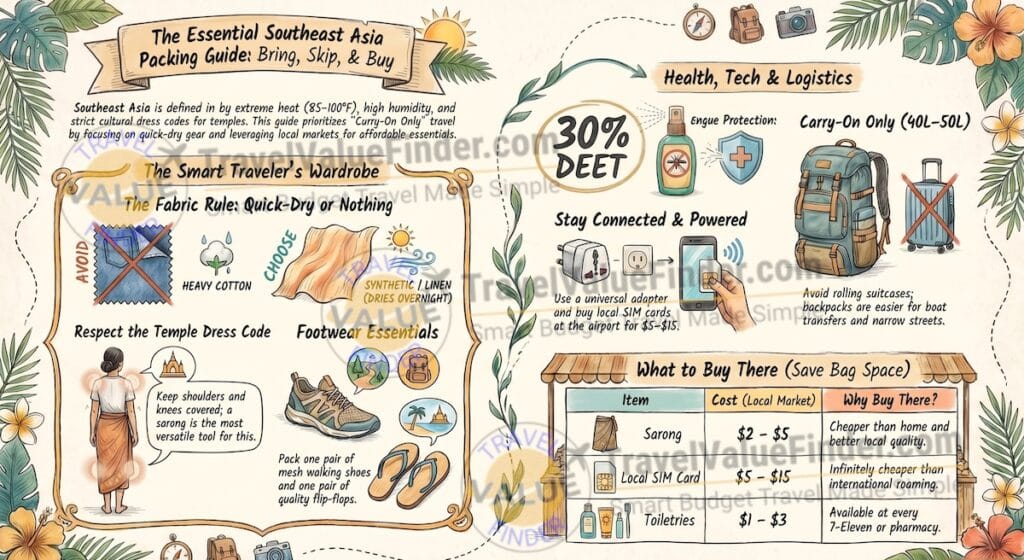
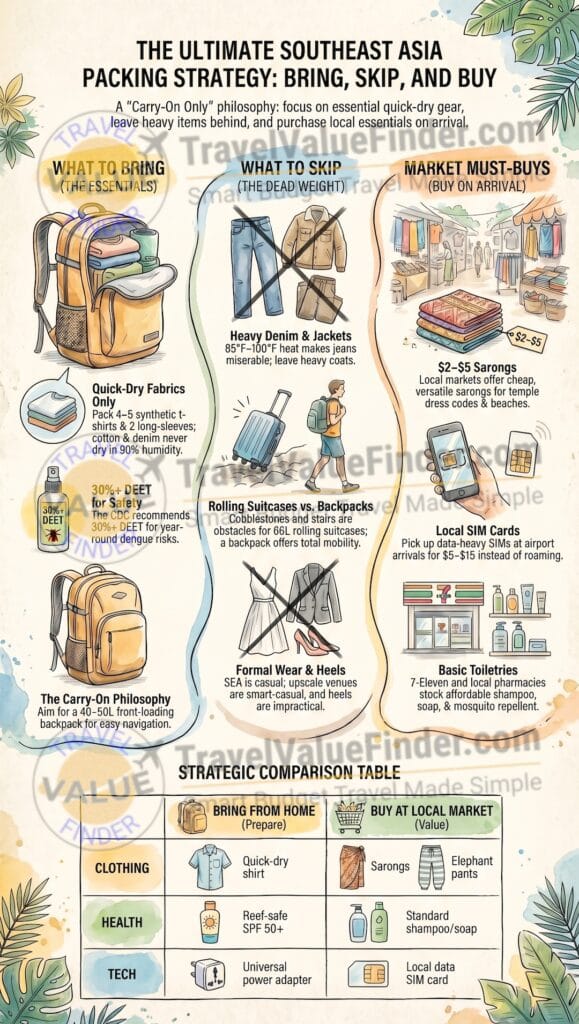
For a Southeast Asia packing list, the essentials are:
- Lightweight quick-dry clothing (4–5 t-shirts, 2 long-sleeves, 1 thin layer for A/C);
- Long pants or skirt for temple dress codes;
- Flip flops + one pair of mesh walking shoes;
- DEET 30%+ insect repellent (dengue is year-round in most of SEA per CDC);
- Reef-safe sunscreen SPF 50+;
- Universal power adapter;
- Dry bag for island days;
- Oral rehydration salts;
- Traveler’s diarrhea kit;
- Packable rain jacket.
What to skip:
- heavy jeans,
- formal shoes,
- bulky towels,
- heavy coats, and
- oversized rolling suitcases.
What to buy there:
- sarongs ($2–$5 at any market),
- local SIM cards ($5–$15 at airport),
- toiletries, and
- flip flops.
Carry-on only is achievable and recommended for trips up to 3–4 weeks. Find out more about the Best Luggage Tracker for Travel: AirTag vs SmartTag2 vs Tile.
Leslie Nics, TravelValueFinder.com | Last updated: May 2026 | A practical, no-nonsense packing guide built on real SEA travel conditions. Covering what to bring from home, what to skip entirely, and what’s cheaper and better to buy once you land. No product pushing, no overpacking anxiety.
Table of Contents
The Southeast Asia Packing List That Actually Reflects Reality
Here’s what most Southeast Asia packing list articles won’t tell you: the biggest packing mistake isn’t forgetting something, it’s bringing too much.
Every experienced traveler who has humped a 70L backpack up a narrow guesthouse staircase in Bangkok at midnight will tell you the same thing.
The second-biggest mistake is buying expensive gear at home that you could pick up for a fraction of the price on Khao San Road or at the Chatuchak Weekend Market.
I’m Leslie Nics at Travel Value Finder, and this guide is different from most packing lists in two ways.
- First, I tell you not just what to bring, but what to skip and why, and that second list is just as important as the first.
- Second, everything here is grounded in actual conditions. The CDC’s health recommendations for the region, real climate data, the practical realities of moving between countries. The cultural rules that can get you turned away at temple gates.
Southeast Asia spans nine countries. These are Thailand, Vietnam, Cambodia, Laos, Myanmar, Malaysia, Singapore, Indonesia, and the Philippines.
While they share a broadly tropical climate, they differ enough in plug types, dress codes, monsoon timing, health risks, and entry requirements that a generic packing list often falls short.
This guide covers those differences so you pack for where you’re actually going.
The traveler with the 40L backpack moves through Southeast Asia. The traveler with the 70L backpack is moved by it. Pack light enough that your bag is something you carry, not something you manage. Leslie Nics, TravelValueFinder.com, Updated May 2026
Before You Pack Anything: Five Things to Know About SEA
These five facts shape everything about how you should pack. Skip them and you’ll overpack in some areas and be completely unprepared in others.
1. It Is Hot, Extremely Hot.
Southeast Asia’s year-round temperatures range from 85–100°F (30–38°C), with humidity averaging 70–90% depending on location and season, according to scientific research published in Nature Scientific Reports on SEA heat stress.
The practical implication; heavy fabrics, dark colors, and anything that doesn’t breathe will make you miserable within hours. Your entire clothing strategy should be built around light, loose, and quick-dry.
2. The Monsoon Is Real and Varies by Country
There is no single ‘monsoon season’ for Southeast Asia. It moves differently across the region and affects different countries at different times.
In 2026, a potential Super El Niño may bring hotter, drier conditions to parts of SEA from July onwards, according to Time Out Asia’s 2026 El Niño travel advisory.
Check the monsoon timing for your specific destinations before finalizing your packing. It determines whether you need a serious rain jacket or can get away with a light packable one.
3. Temple Dress Codes Are Strictly Enforced
Buddhism and Hinduism shape daily life across most of SEA, and temple dress codes are not suggestions, they are enforced.
Bare shoulders and knees will get you turned away at Angkor Wat, most Thai temples, Bali’s Tanah Lot, and hundreds of other sites.
Your packing list must account for this; at least one long-sleeve layer and one pair of long pants or a sarong.
4. The Markets Are Extraordinary and Cheap
Bangkok, Chiang Mai, Hội An, Ubud, Siem Reap, Hanoi; These cities have markets that sell excellent-quality clothing, sarongs, sunglasses, sandals, toiletries, and gear at prices that make home purchases look laughable.
A sarong you’d pay $25 for online costs $2–$5 at a Thai market.
This is relevant to your packing list because if it’s something you can buy there easily and cheaply, consider leaving it home and buying when you arrive.
5. You’ll Be Moving Constantly
Most SEA trips involve moving every 2–5 days – from city to island to highland to coast.
Every time you move, you carry your bag. Every kilogram you pack is a kilogram you carry up every hostel staircase, down every boat gangplank, and through every overnight bus terminal.
The best packing philosophy for SEA is if you’re uncertain, leave it out. If you need it, you can almost certainly buy it there.
The Complete Southeast Asia Packing List
Master Packing Table : Bring / Skip / Buy There
Key: Bring from home | Skip entirely | Situational : read the note
| Item | Bring? | How Many | Buy There? | Leslie’s Note |
| CLOTHING | ||||
| Lightweight quick-dry t-shirts | Yes | 4–5 | Yes (cheap) | Light colors only. Dark clothes absorb brutal SEA heat and show sweat instantly |
| Long-sleeve lightweight shirt | Yes | 2 | Yes | Essential for temple dress codes, sun protection, and freezing A/C on overnight buses |
| Shorts (loose, mid-thigh+) | Yes | 3 | Yes (very cheap) | Avoid anything above mid-thigh, you’ll be turned away from temples. Light linen or nylon. |
| Long pants / lightweight trousers | Yes | 1–2 | Yes | Mandatory for many temples; doubles as mosquito protection at dusk. Linen or nylon, nothing heavy. |
| Swimsuit / swim shorts | Yes | 1–2 | Yes | Bring 1 from home. Thai/Balinese swimsuit quality is fine but sizing for Western bodies can be tricky. |
| Sarong / lightweight scarf | Yes | 1 | Yes (markets) | The most versatile item in SEA. Temple cover-up, beach wrap, towel, picnic blanket, sun shade. Buy locally around $2–$5. |
| Lightweight fleece or layer | Yes | 1 | No | NOT for the heat. For overnight buses and planes with Arctic A/C. One thin layer is enough. |
| Heavy jeans or thick trousers | Skip | 0 | – | Denim in 90°F + 90% humidity is miserable. Leave them home. Lightweight cotton or nylon replaces them entirely. |
| Formal / dress-up clothes | Skip | 0 | – | SEA is casual. Even upscale restaurants are smart-casual at most. Pack clothes you can walk in, not impress in. |
| Heavy jacket or coat | Skip | 0 | – | Year-round temperatures of 85–100°F (30–38°C). A heavy jacket is dead weight from day one. |
| FOOTWEAR | ||||
| Flip flops / sandals | Yes | 1 pair | Yes (very cheap) | The default footwear of SEA. Easy on/off for temples. Buy Havaianas or similar at home. Local ones wear out faster. |
| Lightweight walking shoes | Yes | 1 pair | Limited | For city walking, trekking days, and any day requiring more than sandals. Mesh trainers are ideal, they dry fast. |
| Waterproof hiking boots | Maybe | 1 pair | No | Only if your itinerary has serious trekking (Sapa, Doi Inthanon, Borneo). Otherwise walking shoes handle 95% of SEA terrain. |
| Heels or dress shoes | Skip | 0 | – | Cobblestones, mud, street puddles, constant temple shoe removal. Heels are impractical in almost every scenario. |
| HEALTH, SAFETY & TOILETRIES | ||||
| DEET insect repellent 30–40% | Yes | 1 bottle | Yes but verify % | CDC recommends DEET 30%+ for dengue and malaria risk areas. Don’t rely on ‘natural’ repellents. They are ineffective against Aedes aegypti (dengue mosquito). |
| Reef-safe sunscreen SPF 50+ | Yes | 2 tubes | Bring from home | Bring reef-safe from home. Regular sunscreen with oxybenzone is banned in parts of Thailand and Philippines. Local brands often low SPF. |
| Oral rehydration salts (ORS) | Yes | 10–15 sachets | Yes (pharmacies) | The #1 overlooked essential. Heat + humidity = dehydration risk daily. Electrolytes beat plain water for rehydration after sweating. |
| Traveler’s diarrhea kit | Yes | 1 kit | Pharmacies OK | Pack: loperamide (Imodium), ORS, Pepto-Bismol tablets. Traveler’s diarrhea is one of the most common health issues in SEA per CDC Yellow Book. |
| Prescription medications | Yes | Full supply | Do not rely on | Bring your full trip supply + 5 days extra. Keep in original labeled containers for customs. Do not count on finding your specific medication locally. |
| Malaria prophylaxis | Consult MD | Prescription | No | Required for rural forested areas in Thailand, Cambodia, Vietnam, Myanmar, Laos (per CDC Yellow Book). Not needed for most tourist city itineraries. See your doctor 4–6 weeks before travel. |
| Basic first aid kit | Yes | Small kit | Partially | Antiseptic wipes, bandages, antibiotic cream (skin heals slowly in humid heat), blister plasters, tweezers. Don’t overdo it, keep it compact. |
| Toilet paper / tissues | Yes | Small pack | Yes | Many public restrooms and rural bathrooms provide no toilet paper. A travel pack in your daypack is not optional. |
| Hand sanitizer | Yes | 2 x small | Yes | Before street food, after tuk tuks, before touching your face. A small 50ml bottle in your daypack covers most situations. |
| Large perfume bottles / bulky cosmetics | Skip | 0 | – | Heavy, bulky, and unnecessary in the heat. Decant into travel sizes. Most local pharmacies stock toiletries cheaply anyway. |
| TECH, DOCUMENTS & MONEY | ||||
| Universal power adapter | Yes | 1 | Yes but limited | Plug types vary by country: Thailand/Vietnam use A/B/C, Philippines uses A/B, Singapore/Malaysia use G. A universal adapter covers all SEA countries in one. |
| Portable power bank (10,000+ mAh) | Yes | 1 | Yes | Essential for island hops, long bus rides, and temple days where charging isn’t available. 10,000 mAh charges most smartphones 2–3 times. |
| Unlocked smartphone | Yes | 1 | – | Buy a local SIM on arrival. Thailand, Vietnam, Singapore, and Malaysia all have $5–$15 data SIMs at every airport. Confirm your phone is unlocked before you leave. |
| Laptop | Maybe | 1 if needed | – | Digital nomads: yes. Pure vacation travelers: leave it home. A tablet handles most needs at half the weight. If you bring it, protect with a dry bag on boat days. |
| Passport + certified copies | Yes | 1 + 3 copies | – | Keep the original in your hotel safe when sightseeing. Carry a printed copy + a phone photo. Renew if less than 6 months validity. SEA countries routinely deny entry. |
| Travel insurance documents | Yes | 1 digital + 1 print | – | Save your policy number and emergency line in your phone AND on paper. Medical evacuation from a remote island can cost $50,000+ without insurance. |
| No-foreign-fee debit/credit card | Yes | 2 different banks | – | Charles Schwab (ATM fee reimbursement) + a backup Visa or Mastercard. Tell your bank before departure. Carry some USD cash for visa-on-arrival fees. |
| BAGS, GEAR & TRAVEL ACCESSORIES | ||||
| Main bag (40–50L backpack or carry-on) | Yes | 1 | No | 35–50L is the sweet spot. Above 60L and you’re carrying too much. Front-loading panel-access packs beat top-loaders for day-to-day access. |
| Small daypack (15–20L) | Yes | 1 | Yes | Your constant companion for temple days, markets, and island excursions. Lightweight and packable, not a second full bag. |
| Dry bag | Yes | 1 (5–10L) | Yes (beach towns) | Non-negotiable for island hopping and longtail boat transfers. Protects your phone, camera, and passport from spray and sudden rain. |
| Packing cubes | Yes | 3–4 | No | Compress clothing and keep your bag organized when moving between guesthouses every 2–3 days. Underrated game-changer for multi-destination trips. |
| Padlock (TSA-approved) | Yes | 1–2 | Yes | For hostel lockers, securing your bag on overnight trains, and locking accommodation doors that use padlocks (common in budget guesthouses). |
| Quick-dry travel towel | Yes | 1 | Yes | Many budget guesthouses don’t provide towels, or the provided ones are thin and mildewy. A compact microfiber towel dries in 30 minutes in SEA heat. |
| 60L rolling suitcase | Skip | 0 | – | Cobblestones in Hội An, narrow boat gangplanks in Thailand, steep hostel stairs in Hanoi. A rolling suitcase turns every street into an obstacle course. |
| MISCELLANEOUS ESSENTIALS | ||||
| Reusable water bottle + filter | Yes | 1 | Bottle yes, filter harder | Tap water is not safe to drink in most of SEA. A filtered bottle (LifeStraw or Grayl) saves money, reduces plastic waste, and ensures safe water anywhere. |
| Earplugs | Yes | Plenty | Yes | Roosters at 4am in Bali, motorbiikes in Hanoi, hostel dorm snorers everywhere. Earplugs are not optional if you want to sleep. |
| Eye mask for sleeping | Yes | 1 | Yes | Overnight buses and trains have no curtains. Islands have sunrise at 5:30am. An eye mask costs $3 and is worth ten times that. |
| Mosquito net | Maybe | 1 if rural | Yes | Most mid-range guesthouses provide them. Pack one only if your itinerary includes rural homestays, jungle lodges, or off-grid island stays. |
| Cash (USD, small bills) | Yes | $100–$200 | – | USD is accepted for visa-on-arrival fees in Cambodia, Myanmar, and some Indonesian checkpoints. Small bills ($1, $5, $10) are preferred. ATMs handle the rest. |
Clothing for Southeast Asia: The Real Strategy
Most packing guides give you a list of what to bring. This section gives you the reasoning behind it. Understanding why these choices matter helps you make better decisions when you’re standing in front of your open suitcase.
The Fabric Rule: Quick-Dry or Nothing
In 85°F heat with 85% humidity, cotton becomes your enemy after about 20 minutes. It absorbs moisture, stays wet, and takes all day to dry. The t-shirt you sweated through at 10am is still damp when you want to wear it tomorrow.
Quick-dry synthetic fabrics (polyester, nylon, merino wool blends) are the only sensible choice for SEA clothing. They dry overnight, wick sweat away from your skin, and hold their shape through repeated machine washing.
The same logic applies to towels. A quick-dry microfiber travel towel dries in 30 minutes hanging from a guesthouse balcony. A cotton towel in that humidity stays damp for 12 hours and starts smelling by day three.
The Temple Clothing Problem, and the Sarong Solution
Every first-time SEA traveler runs into this; you’re at Angkor Wat in shorts and a tank top, and you’re turned away at the gate.
Or you’re at Wat Pho in Bangkok and you have to pay $2 to rent a wrap from the souvenir stand.
The sarong is the most versatile solution to the temple clothing problem.
One lightweight sarong bought at any Thai or Balinese market for $2–$5 covers shoulders when worn as a shawl, and wraps around legs as a skirt.
It doubles as a beach mat, serves as a light blanket on cold bus rides, and functions as a towel in a pinch. It weighs next to nothing and packs flat. It is the single most useful item you can add to any SEA packing list that isn’t already there.
Women’s Packing: Extra Considerations
- Bra extenders and sports bras: Heat and activity make underwire uncomfortable quickly. Sports bras or bralettes are the practical choice.
- Lightweight dress: One versatile dress covers beaches, temples (with a sarong), restaurants, and nights out. Far more useful than a separate ‘nice’ outfit.
- Female hygiene products: Tampons in particular are difficult to find in rural areas and smaller towns across SEA. Bring an adequate supply or switch to a menstrual cup before the trip.
- Loose linen pants: One pair covers temple visits, beach cover-ups, and cool-enough evenings. Weigh almost nothing.
Men’s Packing: What Actually Suffices
- Board shorts double as swimwear and casual shorts: Two pairs of board shorts handle 90% of daily activities in beach-focused destinations.
- One collared shirt: Opens doors at slightly nicer restaurants, appropriate for business-casual situations, packs flat.
- Quick-dry boxer briefs: Cotton underwear in SEA humidity is genuinely uncomfortable. Synthetic quick-dry underwear is a significant quality-of-life upgrade.
Health and Medical Packing: What the CDC Actually Recommends
This is the section most packing lists treat superficially.
Given that health risks in SEA are real and specific, it deserves more than a bullet point. The following is based on guidance from the CDC Yellow Book for Southeast Asia and the CDC’s country-specific travelers’ health pages; the most authoritative source available for US travelers.
Vaccines: See Your Doctor 4–6 Weeks Before Departure
According to Passport Health’s CDC/WHO-based vaccination guide for Southeast Asia, the following vaccinations are recommended for most travelers to Southeast Asia:
- Hepatitis A: Spread through contaminated food and water. Relevant everywhere in SEA, especially when eating street food. Highly recommended.
- Hepatitis B: Spread through blood and body fluids. Recommended for all travelers.
- Typhoid: Transmitted through contaminated food and water. Particularly relevant for adventurous eaters and rural travel.
- Japanese Encephalitis: Recommended for travelers spending ≥1 month in rural SEA areas, or those with significant outdoor exposure during transmission season. A CDC-recommended vaccine per the Yellow Book.
- Rabies: Recommended for travelers with significant animal contact risk – relevant in countries with large stray dog populations (Cambodia, Thailand, Vietnam).
- Routine vaccines: Ensure MMR (measles, mumps, rubella), Tdap, and influenza are current. Measles cases are rising globally in 2025–2026 per CDC alert.
Malaria: It’s Country and Zone Specific – Not a Universal SEA Risk
The CDC Yellow Book is clear.
Malaria risk in most popular tourist itineraries is low. There is no known malaria transmission in Bangkok, Chiang Mai, Phuket, Ho Chi Minh City, Hanoi, Siem Reap city, or Bali.
Risk exists in rural, forested border areas of Thailand, Cambodia, Vietnam, Myanmar, and Laos.
If your itinerary includes jungle trekking in border zones, consult your doctor about prophylaxis (atovaquone-proguanil or doxycycline are CDC-recommended options). Do not start prophylaxis without medical guidance.
Dengue: The Real Mosquito Risk for Most SEA Travelers
While malaria gets more attention, dengue fever is by far the more common mosquito-borne risk for tourists in SEA, according to the CDC Yellow Book for Cambodia.
Dengue is endemic throughout the region and peaks during rainy seasons, but transmission occurs year-round.
The dengue mosquito (Aedes aegypti) bites during the day, unlike malaria mosquitoes which bite at dusk and dawn.
There is no vaccine currently recommended for adult travelers. Your primary protection: DEET 30%+ insect repellent applied consistently throughout the day.
Natural repellents; citronella, lemon eucalyptus are largely ineffective against Aedes aegypti.
This is not a minor preference issue. It’s a medical recommendation. Pack DEET from home. Verify the percentage on any locally purchased product.
Traveler’s Diarrhea: Pack Your Kit
Traveler’s diarrhea is the most common health issue affecting visitors to SEA, per the CDC Travelers’ Health overview.
Pack a kit that includes; loperamide (Imodium), oral rehydration salts, and Pepto-Bismol tablets.
The kit takes up minimal space and earns its weight many times over. In rural areas, local pharmacies may not stock your preferred brands.
Power Adapters and Tech: Country-by-Country Guide
This is the detail that most packing guides bury in a single bullet point. Plug types vary meaningfully across SEA. Bringing the wrong adapter means a dead phone at 6am before a long travel day.
Check out the Best Travel Adapter for International Travel: 3 Tested Picks That Actually Work.
Power Plug and Voltage Guide by Country
| Country | Plug Type | Voltage | US Adapter Needed? |
| Thailand | A, B, C | 220V (US uses 110V) | Yes. Universal adapter + check voltage |
| Vietnam | A, C, D | 220V | Yes. Universal adapter |
| Cambodia | A, C, G | 230V | Yes. Universal adapter |
| Indonesia / Bali | C, F | 230V | Yes. European-style adapter |
| Philippines | A, B | 220V | Often fits US plugs but check voltage |
| Malaysia / Singapore | G (UK-style) | 230V | Yes. UK-style adapter required |
| Myanmar | C, D, G | 230V | Yes. Universal adapter |
Important:
- Most modern smartphones, tablets, and laptop chargers are dual-voltage (100–240V) and handle the switch from US 110V to SEA 220–230V automatically.
- Check your device’s charging brick. If it says ‘100–240V,’ you only need a plug adapter, not a voltage converter.
- If it says ‘110V only,’ you need a voltage converter to avoid frying your device.
Local SIM Cards: Buy on Arrival, Not Before
Every major SEA airport arrivals hall has SIM card kiosks with data-heavy tourist packages for $5–$15.
Thailand’s DTAC and AIS 30-day tourist SIMs, Vietnam’s Viettel tourist SIM, and Singapore’s Singtel visitor SIM are all excellent value and infinitely easier than international roaming.
Confirm your phone is carrier-unlocked before departure. If unsure, call your US carrier. Most will unlock a phone that’s fully paid off.
Monsoon and Weather: Pack for Your Specific Destination
The single biggest variable in a SEA packing list is timing.
A trip to Thailand in February needs almost no rain gear.
A trip to the Philippines in August without good rain protection and flexible travel plans is asking for trouble.
SEA Monsoon and Dry Season Reference Table
| Country | Monsoon / Wet Season | Best Dry Season | Packing Implication |
| Thailand | Jun–Oct | Nov–Apr | Rain jacket + dry bag critical Jun–Oct; lighter packing Nov–Apr |
| Vietnam (North) | May–Sep | Oct–Apr | Pack a light layer for Hanoi winters (Dec–Feb can reach 60°F) |
| Vietnam (South) | May–Nov | Dec–Apr | Rain gear for Ho Chi Minh City wet season; otherwise tropical-standard pack |
| Cambodia | Jun–Oct | Nov–May | Angkor Wat in rainy season; fewer crowds + lush green + afternoon downpours. Rain jacket essential. |
| Indonesia / Bali | Nov–Mar (S.Bali) | Apr–Oct | Haze risk Aug–Oct from Sumatra fires. Pack N95 mask if traveling then. |
| Philippines | Jun–Nov | Dec–May | Typhoon season Jun–Nov. Flexible itinerary and travel insurance are not optional. |
| Singapore / Malaysia | Year-round rain | Feb–Apr (drier) | Compact rain jacket always; haze risk from Indonesia fires Aug–Oct |
Rain jacket vs. umbrella:
A compact packable rain jacket (not a heavy Gore-Tex shell) is the right answer for SEA. It packs into its own pocket, weighs under 300g, and handles sudden tropical downpours.
Umbrellas are impractical for active travel. They take up a hand, turn inside-out in gusty storms, and don’t keep you dry while on a motorbike or tuk tuk.
2026 El Niño Warning for SEA Travelers
- NOAA has flagged a 62% probability of El Niño emerging June–August 2026, with a potential very strong event by late 2026.
- For SEA travelers, this means hotter and drier-than-usual conditions in Thailand, Vietnam, Malaysia, and Indonesia. Plus increased haze risk from Indonesian forest fires affecting Singapore and Malaysia (August–October particularly).
- If traveling in Q3–Q4 2026, pack N95 masks and check air quality indices for your destinations before and during your trip.
- Air quality apps like IQAir and AirVisual are reliable for real-time SEA data.
Can You Do Southeast Asia Carry-On Only? Yes, Here’s How
This is one of the most common questions about SEA travel, and the answer for trips up to 3–4 weeks is: absolutely yes.
Carry-on only (typically a 40–45L bag within most airline size restrictions) is not only possible in SEA – it’s the preferred way to travel there. Here’s why it works:
- You can wash clothes every 2–3 days: Laundry services are cheap, fast, and available everywhere in SEA, typically $1–$2/kg, returned the same day. You only need 3–4 days of clothes.
- You can buy what you forget: Forgot sunscreen? 7-Eleven has it. Forgot a sarong? Every market in every city sells them. The supply chain for traveler necessities in SEA is extremely robust.
- You avoid checked baggage fees: Budget airlines dominate SEA domestic routes (AirAsia, Lion Air, Vietjet, Scoot). Checked baggage on these carriers adds $15–$40 per leg. On a 6-country trip with 4 domestic flights, carry-on only saves $120–$320.
- You move faster: No waiting at baggage claim. No anxiety about lost luggage on island hops. No wrestling a 20kg suitcase over the curb at 2am.
The Carry-On Only Clothing Formula (3–4 Week Trip)
- 5 quick-dry t-shirts
- 2 long-sleeve lightweight shirts
- 3 pairs of shorts
- 1 pair lightweight long pants
- 1 lightweight fleece or layer
- 1 swimsuit / board shorts
- 5–6 pairs quick-dry underwear
- 5–6 pairs lightweight socks
- 1 pair flip flops + 1 pair lightweight walking shoes
- 1 packable rain jacket
That’s everything you need for 3–4 weeks in Southeast Asia, assuming laundry every 3–4 days. It fits comfortably in a 40–45L bag alongside your toiletries, tech, and documents, with room to spare for market purchases.
People Also Ask: Southeast Asia Packing Questions Answered
What should I not bring to Southeast Asia?
Skip
- heavy jeans and denim (miserable in 90°F+ humidity),
- formal shoes or heels (impractical on cobblestones and at temples),
- heavy coats (year-round heat makes them dead weight),
- oversized rolling suitcases (impossible on narrow SEA streets and boat gangplanks), and
- most toiletries in full sizes (buy locally).
Also skip expensive jewelry and visible luxury items. Not for safety reasons primarily, but because they’re impractical and you’ll worry about them constantly.
Can you do Southeast Asia with just a carry-on?
Yes, and it’s the recommended approach for trips up to 3–4 weeks.
With 5 quick-dry t-shirts, 3 shorts, 1 pair of long pants, a swimsuit, a thin fleece, flip flops, and walking shoes, you have everything you need.
Laundry services in SEA cost $1–$2/kg and are available almost everywhere, so you only need 3–4 days of clothes at a time.
Budget airlines between SEA countries charge $15–$40 per checked bag leg. Carry-on only can save $100–$300 on a multi-country trip.
What clothes to pack for Southeast Asia?
Pack lightweight, quick-dry fabrics exclusively, no cotton or denim.
The core wardrobe:
- 4–5 quick-dry t-shirts in light colors,
- 2 long-sleeve lightweight shirts (for temples and A/C buses),
- 3 pairs of loose shorts (mid-thigh or longer for temple access),
- 1 pair of lightweight long pants (mandatory at many temples, doubles as mosquito protection),
- a swimsuit, a sarong (buy locally for $2–$5), and
- one thin layer for overnight buses.
- Avoid dark colors, they absorb heat and show sweat.
Do you need a rain jacket for Southeast Asia?
Yes. A packable one. Tropical downpours arrive with no warning and last 20–60 minutes. A compact packable rain jacket (not a heavy hiking shell) handles SEA rain effectively, weighs under 300g, and packs into its own pocket.
What health items should I pack for Southeast Asia?
Per CDC guidance:
- DEET 30%+ insect repellent (for dengue prevention, the primary mosquito risk for tourists),
- reef-safe sunscreen SPF 50+,
- oral rehydration salts,
- a traveler’s diarrhea kit (loperamide, ORS, Pepto-Bismol),
- your full supply of prescription medications in original labeled containers, and
- a basic first aid kit.
See your doctor 4–6 weeks before departure for recommended vaccines. Hepatitis A, Typhoid, and ensuring routine vaccines (MMR, Tdap) are current are the most commonly relevant for SEA travel.
What type of bag is best for Southeast Asia?
A front-loading or panel-access backpack of 35–50L is the optimal choice for most SEA travelers. It’s carry-on compliant, accessible in cramped guesthouses and vehicles, and manageable on the narrow streets and boat gangplanks that define SEA travel.
Top-loading backpacks are less practical because accessing anything from the bottom requires unpacking everything above it. Avoid rolling suitcases unless you’re staying in one city. They are genuinely impractical for multi-destination SEA travel.
Is it safe to drink tap water in Southeast Asia?
No. Tap water is not safe to drink in Thailand, Vietnam, Cambodia, Laos, Myanmar, Indonesia, or the Philippines.
Singapore is the only SEA country with reliably safe tap water. Use a filtered water bottle (LifeStraw or Grayl), buy sealed bottled water, or use water purification tablets.
Never use tap water for brushing teeth in countries where it’s unsafe. This is a common mistake.
Frequently Asked Questions (FAQs)
Q: How many days before my SEA trip should I see a doctor for vaccines?
The CDC recommends visiting a travel medicine specialist or your primary care physician at least 4–6 weeks before departure.
Some vaccines require multiple doses spread over time (Hepatitis B requires 3 doses over 6 months; Japanese Encephalitis also requires 2 doses).
If your trip is less than 4 weeks away, see a doctor anyway. Some vaccinations can still be given and provide partial protection.
Q: Do I need a visa for Southeast Asian countries?
US citizens can enter Thailand, Malaysia, Singapore, Indonesia, Vietnam, and the Philippines visa-free for 30–90 days.
Cambodia and Laos offer visa-on-arrival (bring $30–$40 in cash USD for Cambodia e-Visa or border visa;
Laos VoA is $30–$42). Myanmar requires an e-Visa obtained in advance online.
Requirements change. Verify current requirements at travel.state.gov for each country on your itinerary at least 2 weeks before departure.
Ensure your passport has at least 6 months of validity beyond your intended stay.
Q: How do I protect my electronics in Southeast Asia?
Primary threats: rain, humidity, and boat spray.
A dry bag (5–10L) is essential for island hops and boat transfers. Your phone, camera, and passport should be inside it every time you’re on a vessel or near water.
A ziplock bag in your daypack handles sudden rain for day-to-day protection. Use silica gel packets in your camera bag to absorb moisture overnight.
For laptops, a waterproof laptop sleeve adds meaningful protection during monsoon-season travel.
Q: What currency should I bring to Southeast Asia?
USD in small bills ($1, $5, $10, $20) is useful for visa-on-arrival fees (Cambodia, Laos) and occasional border situations.
Beyond that, withdraw local currency from bank ATMs on arrival. You’ll get the best exchange rate and avoid the airport currency exchange markup (typically 5–12% worse than the bank rate).
Bring two cards from two different banks as backup. Notify your bank of your travel dates for each country you’ll visit.
Most cities have widely available ATMs, but carry enough local currency for 2–3 days when visiting remote or rural areas.
Q: What should I wear to visit temples in Southeast Asia?
The universal temple dress code across SEA:
shoulders covered (no tank tops or sleeveless shirts),
knees covered (no shorts, no short skirts).
This applies at Buddhist temples in Thailand, Cambodia, Laos, Myanmar, Vietnam, and Malaysia, and at Hindu temples in Bali and parts of Malaysia.
The easiest solution: a lightweight long-sleeve shirt or sarong for shoulders, long pants or a sarong for knees.
Many major temples (Angkor Wat, Grand Palace Bangkok) provide wrap-arounds for rent at the gate, but it’s more convenient and cheaper to bring your own sarong.
Q: Is a money belt necessary in Southeast Asia?
A money belt (or similar hidden pouch) is a smart precaution for your passport, spare cash, and backup cards particularly on overnight buses, in crowded markets, and at major tourist sites where pickpocketing is more common.
It’s not something you need to wear all day every day, but having one for high-risk situations (Chatuchak market Bangkok, Ben Thanh market Ho Chi Minh City, Siem Reap night market) is sensible.
Keep only your spending cash for the day in an accessible wallet, nothing irreplaceable.
Sources & References
- CDC Yellow Book, Southeast Asia Country Health Profiles (Thailand, Vietnam, Cambodia)
- CDC Yellow Book, Thailand
- CDC Yellow Book, Vietnam
- CDC Yellow Book, Cambodia
- CDC Travelers’ Health, Vietnam Destination Page
- CDC, Yellow Fever Vaccine and Malaria Prevention by Country
- Passport Health USA, Travel Vaccines and Advice for East and Southeast Asia
- Nature Scientific Reports, Widespread Heat Stress in Southeast Asia (2025)
- Time Out Asia, Super El Niño in Southeast Asia: What Travellers Need to Know in 2026
- Eagle Creek, How to Pack for Southeast Asia: Climate and Gear Guidance
- US State Department, Traveler Information by Country (Visa Requirements)
- WHO, Food Safety Fact Sheet (referenced for water safety context)
Affiliate Disclaimer: Some links in this article are affiliate links. We may earn a referral commission on qualifying bookings at no additional cost to you