Travel Value Finder


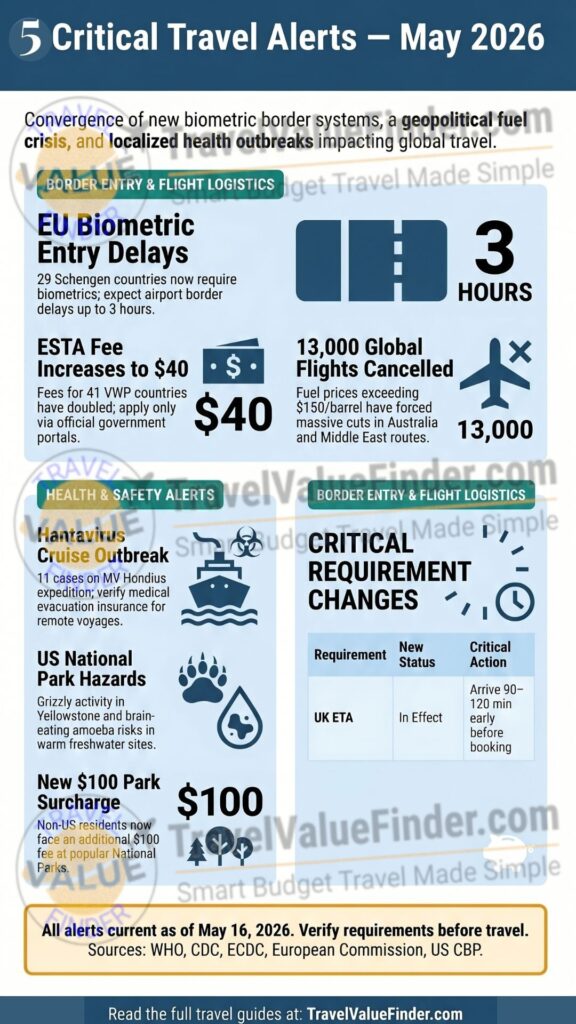
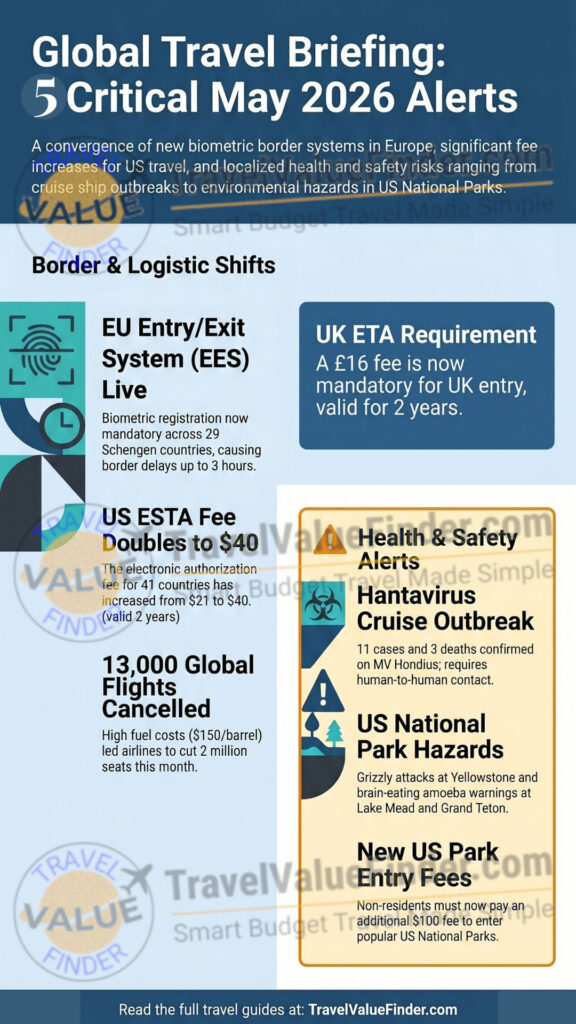
What are the most important travel alerts for May 2026? The five most critical travel alerts in May 2026 are: (1) the Andes hantavirus outbreak aboard cruise ship MV Hondius, with 11 confirmed cases and 3 deaths; (2) the EU Entry/Exit System (EES) now fully live, causing up to 3-hour border delays for non-EU travelers across 29 Schengen countries; (3) the ESTA fee doubling from $21 to $40 with proposed social media disclosure requirements; (4) global airlines cutting 13,000 flights and 2 million seats in May due to fuel costs above $150/barrel; and (5) US national park safety advisories including a grizzly bear attack and brain-eating amoeba warnings at Yellowstone, Grand Teton, and Lake Mead.
Leslie Nics | TravelValueFinder.com | Travel Alerts | May 9, 2026 | Last reviewed: May 9, 2026
If you have trips booked for summer 2026 – or are planning any international travel this year – these travel alerts for May 2026 cover everything reshaping international travel right now. The next few minutes of reading could save you thousands of dollars, hours of delays, and considerable stress. The global travel landscape has shifted dramatically in the past two weeks alone. A deadly disease outbreak aboard a luxury expedition cruise ship, a sweeping new EU border system causing multi-hour airport delays, doubled US visa fees, and a wave of flight cancellations driven by a geopolitical fuel crisis are all converging in May 2026.
This guide, updated weekly by TravelValueFinder.com’s Leslie Nics, compiles the top travel alerts from authoritative sources – WHO, CDC, ECDC, the European Commission, and US Customs & Border Protection – and translates them into practical, money-saving guidance for real travelers.
Travel Alerts May 2026 #1: Hantavirus Cruise Ship Outbreak – What Every Traveler Must Know
No premium price tag guarantees premium emergency infrastructure. When you’re three days from the nearest hospital, the fine print on your travel insurance becomes your most important document. Leslie Nics, TravelValueFinder.com – Updated May 2026
What Happened
On May 2, 2026, the World Health Organization received notification of a severe respiratory illness cluster aboard the MV Hondius, a Dutch-flagged expedition cruise ship that had departed Ushuaia, Argentina on April 1, 2026. The vessel carried 147 to 149 people from 23 nationalities – including passengers from nine EU member states – on a remote South Atlantic itinerary spanning Antarctica, South Georgia Island, Tristan da Cunha, Saint Helena, and Ascension Island.
As of May 15, 2026, the European Centre for Disease Prevention and Control (ECDC) confirmed 11 total cases – eight confirmed, two probable, and one inconclusive – including three deaths. No new cases or deaths have been reported since the previous update, and the outbreak appears to be stabilizing.
Virus identified: Andes hantavirus (ANDV) – the only hantavirus strain known to spread between humans, though only through close, prolonged contact.
| Metric | Figure | Source |
|---|---|---|
| Total Cases (as of May 15) | 11 (8 confirmed, 2 probable, 1 inconclusive) | ECDC |
| Deaths | 3 | WHO / CDC |
| Ship departed | April 1, 2026 – Ushuaia, Argentina | WHO |
| Nationalities on board | 23 countries, incl. 9 EU/EEA states | ECDC |
| Risk to general public | Very Low (WHO & ECDC assessment) | WHO / ECDC |
| US repatriation facility | Nebraska Biocontainment Unit & Emory University Hospital | CDC |
| Antarctica demand trend | Up 34% year-over-year (Jan–Apr 2026) | Squaremouth / CNBC |
Should You Cancel Your Cruise?
Travel risk experts and global health authorities are unanimous: the outbreak aboard MV Hondius is an outlier medical event, and the risk of widespread transmission is extremely low. Andes virus requires close, prolonged contact – not casual proximity. The WHO, CDC, and ECDC all assess the risk to the general population as very low.
However, the outbreak has surfaced important questions about expedition cruise preparedness that every traveler should ask before booking any remote voyage.
ACTION REQUIRED FOR EXPEDITION CRUISE TRAVELERS If you have an upcoming expedition cruise – particularly to Antarctica, South Georgia, or similar remote destinations – take these steps immediately: (1) Confirm your travel insurance covers medical evacuation from remote international waters. (2) Verify the ship’s onboard medical capabilities and evacuation protocols. (3) Purchase ‘Cancel for Any Reason’ (CFAR) coverage. Note: CFAR upgrades nearly doubled from 10% to 19% of buyers in the first four months of 2026, according to Squaremouth.
What Are the Symptoms of Hantavirus?
Symptoms of Andes hantavirus (hantavirus pulmonary syndrome) include: high fever, gastrointestinal symptoms (nausea, vomiting, diarrhea), rapid progression to pneumonia, acute respiratory distress, and shock. Onset in the MV Hondius cases occurred between 6 and 28 April 2026. The case fatality rate for hantavirus pulmonary syndrome is approximately 38% in severe cases. There is currently no approved antiviral treatment – care is supportive.
As more travelers book trips to remote destinations, we’re seeing a new category of risk emerge – not just health risk, but logistical risk. Getting evacuated from Antarctica is a different problem than getting evacuated from a European capital. Jason Margulies, Maritime Attorney, Lipcon Margulies & Winkleman (via CNBC)
Leslie Nics’ Expedition Cruise Checklist
- Contact your insurer now if you are currently booked on an expedition cruise departing in the next 90 days
- Read the ship’s medical capability statement before booking, not after
- Confirm evacuation insurance covers remote oceanic locations (many standard policies do not)
- Research the nearest hospital to every port on your itinerary
- Book CFAR (Cancel for Any Reason) coverage – standard policies won’t cover outbreak-related cancellations unless a formal government advisory is issued
Alert #2: Europe’s New Biometric Border System Is Causing Up to 3-Hour Delays
Planning a summer trip to Europe without accounting for EES delays is like planning a road trip without checking for construction – you might get through fine, or you might miss your flight. Add the buffer. It’s not worth the gamble. Leslie Nics, TravelValueFinder.com
What Is the EU Entry/Exit System (EES)?
As of April 10, 2026, the EU’s Entry/Exit System (EES) became fully operational across all 29 Schengen-area countries, replacing manual passport stamping with digital biometric records. If you are a non-EU traveler – including citizens of the United States, United Kingdom, Canada, Australia, and others – every time you cross a Schengen border, you must now submit fingerprints, a facial scan, and passport data. This information is stored for three years.
The system was phased in beginning October 12, 2025, and became mandatory for all 29 countries from April 10, 2026. Since launch, over 45 million border crossings have been registered, and more than 24,000 people have been refused entry (due to expired documents, insufficient justification for visits, or fraudulent paperwork). EES has also identified over 600 individuals posing security risks.
| Who Is Affected by EES? | Who Is EXEMPT from EES? |
|---|---|
| US, UK, Canadian, Australian citizens | EU/Schengen member state citizens |
| All non-EU nationals on short stays (up to 90 days in 180) | Non-EU nationals with long-term visas or residence permits |
| Visa-exempt travelers (tourism, business) | Family members of EU nationals with residence cards |
| Property owners without residence permit | Train/plane crew on international journeys |
| Note: Ireland and Cyprus are NOT participating in EES | Armed forces and families (Partnership for Peace/NATO) |
Real Impact: What’s Happening at Airports Right Now
The rollout has not been smooth. At the April 10 full implementation date, airports across the Schengen area – particularly in France, Spain, Italy, and Germany – reported border control queues stretching to three hours. Passengers missed flights, incurred thousands in re-booking costs, and were recorded as ‘no-shows’ by airlines who declined responsibility.
One documented incident involved a family departing Milan’s Linate Airport whose flight left without them because border officials had only two biometric machines operational, despite 16 being available. The EU’s aviation industry body, ACI EUROPE, warned that Europe’s reputation as an accessible tourist destination is now at stake.
Greece has partially suspended EES checks for UK visitors. France’s e-gates do not yet process UK or US passports. Implementation remains inconsistent across countries. The European Commission has confirmed member states may temporarily suspend EES checks for up to 90 days (plus a 60-day extension) during exceptional queue situations – meaning experience will vary by country and airport.
CRITICAL: ALLOW EXTRA TIME AT EUROPEAN BORDERS – SUMMER 2026 Official guidance from the European Commission, UK government, and aviation bodies: arrive 90 to 120 minutes earlier than usual for international departures from Schengen countries. If your Schengen border crossing is your first of a trip, you will go through full biometric registration. Subsequent crossings will only require one biometric check. Do NOT book tight connections on first-time Schengen arrivals. Use the EU ‘Travel to Europe’ app (Google Play / App Store) to pre-register biometrics 72 hours before arrival – available in Portugal and Sweden, expanding.
The Pre-Registration Option – And Its Limitations
The European Commission launched the ‘Travel to Europe’ mobile app to allow pre-registration of biometric photos and passport data up to 72 hours before arrival. However, pre-registration does not replace the required in-person border control interview. The app is currently only available in Portugal and Sweden, with an EU-wide rollout planned for summer 2026. Even travelers who have pre-registered may still face manual document checks if a border station’s systems are not fully integrated.
What Comes Next: ETIAS
EES is closely connected to – but separate from – the upcoming European Travel Information and Authorization System (ETIAS). ETIAS will require visa-exempt travelers (including US and UK citizens) to obtain pre-travel authorization before visiting most EU countries, similar to the US ESTA. ETIAS is expected to launch later in 2026. TravelValueFinder.com will cover this development in a dedicated alert as the launch date approaches.
ETIAS will be the next frontier. Get your EES registration sorted first, then watch for ETIAS. Two separate systems, two separate requirements – summer 2026 is just the beginning of Europe’s digital border transformation. Leslie Nics, TravelValueFinder.com
Alert #3: ESTA Fee Doubles to $40 – And Proposed Social Media Vetting Could Change Everything
The ESTA Fee Increase
The Electronic System for Travel Authorization (ESTA) fee for travelers entering the United States under the Visa Waiver Program (VWP) has increased from $21 to $40, effective in 2026. This affects travelers from 41 countries – including the UK, Australia, Japan, France, Germany, and all EU member states with VWP agreements – who plan to visit the US for tourism or business for up to 90 days.
The ESTA remains valid for two years (or until your passport expires) and allows multiple entries. For most applicants, approval is still instant (80% of cases) or within 72 hours. Apply at least 72 hours before departure via the official CBP ESTA site only – avoid third-party sites that charge additional fees.
| ESTA: Before 2026 | ESTA: Current 2026 |
|---|---|
| Application fee: $21 | Application fee: $40 |
| Social media: not required | Social media: proposed (5-year history) – not yet final |
| Processing: most under 72 hours | Processing: most instant–72 hours |
| Validity: 2 years / passport expiry | Validity: 2 years / passport expiry (unchanged) |
| Countries covered: 41 VWP nations | Countries covered: 41 VWP nations (unchanged) |
The Proposed Social Media Disclosure Requirement
In December 2025, US Customs and Border Protection (CBP) published a proposed rule that would require ESTA applicants to disclose all social media accounts used in the past five years, along with phone numbers (5-year history), email addresses (10-year history), and family member information. The proposal also includes expanded biometric data collection.
IMPORTANT: This Proposal Is NOT Yet Final Law As of May 2026, the social media disclosure requirement remains a CBP proposal under a 60-day public comment period – it has not been enacted as a mandatory ESTA requirement for routine travelers. Some enhanced social media vetting was introduced March 30, 2026 for certain nonimmigrant visa applicants, but standard ESTA travel is not yet affected. Always verify current requirements at the official ESTA website (esta.cbp.dhs.gov) before applying.
Privacy advocates and tourism bodies have warned that if finalized, the requirement could significantly deter international visitors – particularly during the 2026 FIFA World Cup in North America, where the US Travel Association estimates millions of international fans are expected.
Smart travelers apply for ESTA well before departure. With proposed changes in the pipeline, locking in your current authorization now – before any new requirements take effect – is a sound strategy.” Leslie Nics, TravelValueFinder.com
Alert #4: 13,000 Flights Cut Globally – What the Fuel Crisis Means for Your Summer Plans
The Scale of the Disruption
Global airlines have cut approximately 13,000 flights and nearly two million seats from May schedules in response to jet fuel prices remaining above $150 per barrel – a direct consequence of the closure of the Strait of Hormuz in late February 2026. The cuts are being felt most severely on Australia-Europe, Asia-North America, and trans-Tasman routes.
| Airline / Region | Disruption | Impact |
|---|---|---|
| Jetstar | 12% trans-Tasman capacity cut | Australia–New Zealand routes significantly reduced |
| Air New Zealand | 1,100+ flights removed through May | NZ domestic and international reduced |
| Virgin Australia | 46% national delay rate (April) | Major delays across Australian domestic network |
| Iraq/Middle East Airspace | Iraqi airspace reopened May 10 post-ceasefire | Qatar Airways resumed Baghdad, Basra, Erbil flights |
| Qantas / American Airlines | ACCC interim authorization Apr 4 | 54% of AU/NZ–North America seats under codeshare review |
| Alaska Airlines | New: Seattle–London Heathrow daily from May 21 | New route offsetting some Pacific capacity loss |
Positive Developments Amid the Turbulence
Not all news is grim. Alaska Airlines is launching daily nonstop flights between Seattle and London Heathrow beginning May 21 – its fifth intercontinental route. Finnair relaunched Toronto-Helsinki service on May 4 after an 11-year absence, operating three times weekly with A330 aircraft. Qatar Airways resumed flights to Baghdad, Basra, and Erbil from May 10 as Iraqi airspace gradually reopened following the April 8 ceasefire.
A new WestJet-Air India interline partnership enables seamless single-ticket bookings connecting India with 17 Canadian cities and 14 US cities – a significant connectivity boost for South Asian travelers.
Flight capacity volatility in 2026 rewards flexible travelers. Book changeable fares, monitor fuel surcharge policies, and always have a backup routing in mind. The routes that disappear fastest are often the ones travelers assumed were permanent. Leslie Nics, TravelValueFinder.com
Alert #5: US National Parks Safety Alerts – Yellowstone, Grand Teton, Lake Mead
Grizzly Bear Attack Near Old Faithful
On May 4, 2026, two hikers were attacked by a female grizzly bear with cubs near the Old Faithful area of Yellowstone National Park, both left in critical condition. The trail had previously been closed due to bear activity but had been reopened after rangers found no recent evidence of bears in the area. The incident is a reminder that wildlife in Yellowstone is dynamic – trail status can change rapidly.
Brain-Eating Amoeba (Naegleria fowleri) Advisory
The CDC has issued advisories after Naegleria fowleri – a rare but nearly always fatal brain-eating amoeba – was detected in waters at Yellowstone National Park, Grand Teton National Park, and Lake Mead National Recreation Area. The amoeba cannot infect humans through swallowed water, but if water enters the nose (during swimming, diving, water sports, or jumping into water), infection can occur.
CDC ADVISORY: Amoeba Risk at Three Major National Parks Naegleria fowleri infection has been detected at Yellowstone, Grand Teton, and Lake Mead. Infection is nearly always fatal. The CDC recommends: wearing a nose clip if swimming or engaging in water activities at affected parks. Avoid submerging your head in warm freshwater. Do NOT jump or dive into any warm freshwater at these locations. Risk is highest in warm, stagnant, or slow-moving water during hot weather.
Non-Resident National Park Fee Increase
Starting January 1, 2026, non-US residents must pay an additional $100 fee, or purchase a $250 annual pass, to visit the most popular US national parks under the administration’s ‘America-first pricing’ policy. International visitors planning US national park itineraries should factor this cost into their travel budgets.
People Also Ask: Your Top Travel Alert Questions Answered
Is hantavirus contagious between cruise ship passengers?
Andes hantavirus (ANDV) is the only hantavirus strain capable of human-to-human transmission, but spread requires close, prolonged contact – typically direct physical contact, prolonged time in enclosed spaces, or exposure to an infected person’s saliva or respiratory secretions. Casual contact (dining in the same room, walking past someone) does not pose a meaningful risk. WHO, CDC, and ECDC all assess the risk to the general public as very low.
Do I need to register biometrics every time I enter the EU?
No. Your first crossing into the Schengen Area registers your full biometric data (fingerprints and facial image), which is stored for three years. On subsequent crossings within that period, only one biometric check is required (either fingerprints or facial scan, not both). However, if your data has expired or if border systems have connectivity issues, you may need to re-register.
Is the EU ETIAS the same as EES?
No – they are separate systems. EES (Entry/Exit System) is already live and records when non-EU travelers enter and exit the Schengen Area. ETIAS (European Travel Information and Authorization System) is a forthcoming pre-travel authorization (similar to ESTA for the US), requiring visa-exempt travelers to apply online before visiting the EU. ETIAS is expected to launch later in 2026. Both systems work in tandem but serve different purposes.
How do I know if my ESTA is still valid?
Log in to the official ESTA application site at esta.cbp.dhs.gov with your application number and passport details. ESTA is valid for two years from the approval date, or until your passport expires, whichever comes first. If your passport details have changed, you must apply for a new ESTA – the old one becomes void even if it has not expired.
What does the US travel to the UK now require?
All visa-exempt nationals – including US citizens – must hold a valid UK Electronic Travel Authorization (ETA) before boarding any flight to the United Kingdom. The UK ETA costs £16, is valid for two years, and allows multiple visits. Applications take minutes online. If you renew or change your passport, you must update your UKVI account or you risk being denied boarding.
Which airlines are most at risk of bankruptcy in 2026?
Spirit Airlines ceased operations in 2026 after 34 years. Travel analysts, including Christopher Elliott, identify JetBlue as the carrier at greatest current risk, citing significant recent losses. Other carriers considered financially vulnerable include Avelo, Frontier, Allegiant, and Sun Country. Travelers booking with any budget carrier should strongly consider purchasing travel insurance that covers airline insolvency, as credit card chargebacks are not guaranteed.
2026 Travel Alerts at a Glance – Quick Reference
| Alert | Status | Who Is Affected | Action Required |
|---|---|---|---|
| Hantavirus – MV Hondius | ACTIVE | Expedition cruise passengers | Check evacuation insurance. Monitor CDC/WHO. |
| EU Entry/Exit System (EES) | LIVE APRIL 10 | All non-EU travelers to Schengen | Arrive 90–120 min early. Pre-register via app. |
| ESTA Fee $40 | IN EFFECT | VWP travelers to US (41 countries) | Apply early. Use official CBP site only. |
| UK ETA Required | IN EFFECT | All visa-exempt travelers to UK | Apply before booking flights to UK. |
| Flight Cuts (13,000 flights) | MAY 2026 | AU, NZ, ME, Asia-Pacific routes | Book flexible fares. Check capacity. |
| Yellowstone/Grand Teton/Lake Mead | ADVISORY | Visitors to US national parks | Avoid warm freshwater. Wear nose clip. |
| EU ETIAS | COMING LATE 2026 | Visa-exempt EU visitors | Monitor TravelValueFinder.com for updates. |
What to Do Right Now: Leslie Nics’ 7-Point Traveler Action Plan
- Audit your travel insurance. Confirm it covers medical evacuation, trip interruption, and airline insolvency – especially if traveling to remote destinations or booking with budget carriers.
- If traveling to Europe this summer, add 90–120 minutes to your border crossing time. Do not book tight connections on first-time Schengen arrivals.
- Renew your ESTA now if it expires within 6 months. Apply only at esta.cbp.dhs.gov – the fee is $40.
- Check your UK ETA status if you plan to visit the United Kingdom. If you renewed your passport, your old ETA is void.
- If booked on an expedition cruise to Antarctica or remote South Atlantic locations, contact your insurer to confirm evacuation coverage and speak with your cruise line about their medical capabilities.
- For US national park visits: do not swim, dive, or submerge your head in warm freshwater at Yellowstone, Grand Teton, or Lake Mead.
- Bookmark TravelValueFinder.com/travel-alerts for weekly updates. Subscribe to travel alerts to stay ahead of rule changes before they affect your trips.
Frequently Asked Questions (FAQs)
Q: Is the hantavirus outbreak on MV Hondius a risk for all cruises?
No. The outbreak was linked specifically to the MV Hondius expedition cruise, which traveled to extremely remote locations in the South Atlantic. Standard cruise ships on popular routes (Caribbean, Mediterranean, Alaska) operate in very different environments and are not affected. The Andes virus is primarily transmitted through contact with infected rodents in South American wilderness areas.
Q: Do I need to do anything special before flying to Europe in summer 2026?
Yes. As a non-EU traveler, you will now be required to submit biometric data (fingerprints and facial scan) at the Schengen border under the new Entry/Exit System. Pre-register via the ‘Travel to Europe’ EU app if available in your destination country, arrive significantly earlier than usual, and avoid booking tight connections after a first-time Schengen entry. If you are traveling from or through the UK, check GOV.UK for the latest EES-related border guidance.
Q: My ESTA is about to expire – can I renew it before any social media requirement kicks in?
Yes. The proposed social media disclosure requirement has not been enacted as of May 2026. Applying now means you are subject to current requirements (no social media disclosure). Always use the official CBP ESTA portal (esta.cbp.dhs.gov) and apply at least 72 hours before travel. Once approved, your new ESTA is valid for two years.
Q: How do I check if my national park fee applies to me as an international visitor?
From January 1, 2026, non-US residents must pay an additional $100 per entry fee, or purchase a $250 annual pass, for the most visited US national parks. Check the National Park Service website (nps.gov) for the specific parks and fee structures, as not every park in the US system requires this additional fee.
Q: Are there any good flight deals emerging from the airline capacity cuts?
Counterintuitively, yes. Airlines fighting for market share on remaining routes are sometimes offering promotional fares. Check TravelValueFinder.com’s deals section regularly. Additionally, points-based routes to Tahiti are currently available for as few as 25,000 Capital One miles each way – a significant value opportunity highlighted this week.
Q: What is the safest way to stay updated on travel alerts?
Bookmark official sources: CDC.gov, WHO.int, ECDC.europa.eu, and the travel advisories section of your government’s foreign affairs department. For curated, traveler-focused intelligence that translates official advisories into practical action, follow TravelValueFinder.com/travel-alerts/ for weekly updates by Leslie Nics.
Sources & Further Reading
This article was researched and written by Leslie Nics, founder of TravelValueFinder.com. All sources are primary, authoritative, and published within the past seven days.
- WHO: Disease Outbreak News – Hantavirus Cluster Linked to Cruise Ship (May 4, 2026) – who.int
- CDC: HAN Health Advisory #528 & Hantavirus Current Situation Summary – cdc.gov/hantavirus
- ECDC: Andes Hantavirus Outbreak – Cruise Ship MV Hondius (Updated May 15, 2026) – ecdc.europa.eu
- European Commission: Entry/Exit System Full Implementation – home-affairs.ec.europa.eu
- Euronews: EU Entry/Exit System: What Travellers Need to Know (April 10, 2026) – euronews.com
- US CBP / ESTA: ESTA Official Application Portal – esta.cbp.dhs.gov
- CNBC: MV Hondius Hantavirus Outbreak: Luxury Expedition Cruise Boom and Remote Travel Risks (May 9, 2026)
- U.S. Travel Association: U.S. Travel Forecast – $1.37 Trillion in 2026 – ustravel.org
- Squaremouth: Expedition Travel Insurance Trends (via CNBC, May 2026)
- National Geographic: What You Need to Know About Domestic and International Travel in 2026 – nationalgeographic.com
Stay Ahead of Travel Alerts – TravelValueFinder.com This Travel Alerts page is updated Monthly by Leslie Nics. Subscribe for free weekly travel alert emails and never be caught off guard by a border rule change, health advisory, or flight disruption again. Explore Related Guides on TravelValueFinder.com:
- Europe ETIAS 2026: The Only Checklist Every Traveler Needs Before Flying
- Your Mexico Hotel Just Got 1,000% More Expensive – Here’s the Only Way Around the FIFA World Cup 2026 Price Crisis
- Global Travel Alerts May 2026: The Complete Briefing Every International Traveler Needs Before Booking
- Travel Alerts May 2026: Ebola Crisis, Thailand-Cambodia Conflict & Summer Disruptions Every Traveler Must Act On Now
- Travel Alerts May 2026: 3 Urgent Disruptions Every Traveler Must Know This Week
- Best Hotel Booking Sites: Where to Find the Cheapest Deals
- Best Time to Book Flights to Get the Cheapest Prices
- TravelValueFinder.com/travel-insurance-guide
Ready to plan the trip? Use our Free AI Trip Planner to build a day-by-day focused itinerary for any destination, and browse our destination guides to find exactly where to stay for the best local food access.
About the Author
Leslie Nics is a veteran travel strategist, deals analyst, and founder of TravelValueFinder.com – a trusted resource helping budget-conscious and value-driven travelers make smarter booking decisions. With over a decade of experience tracking airline policies, health advisories, border rule changes, and emerging travel risks across six continents, Leslie delivers actionable intelligence that goes beyond headlines. This article is researched from primary sources including WHO, CDC, ECDC, the European Commission, and U.S. Customs and Border Protection.