Travel Value Finder

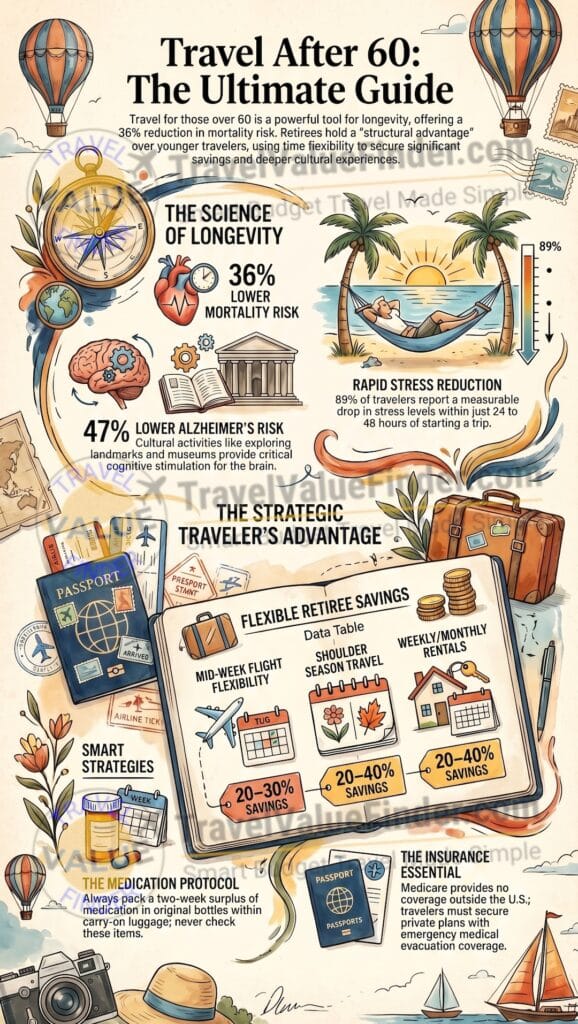
Travel after 60 in 2026 is safer, smarter, and more rewarding than at any point in history. Retirees hold a structural advantage over younger travelers:
- time flexibility to fly mid-week,
- travel in shoulder season, and
- embrace slow travel.
The key pillars are health preparation (pre-travel medical check, medication management), financial planning (travel fund, senior discounts, travel rewards), safety essentials (travel insurance is non-negotiable since Medicare doesn’t cover abroad), and destination selection.
Disclaimer: This article is for general informational purposes only and does not constitute financial, investment, tax, legal, immigration, or other professional advice. Costs and other figures are estimates and can change. Always verify current information and consult a qualified professional before making significant financial, travel, or retirement decisions.
Leslie Nics, TravelValueFinder.com | Last updated: May 2026
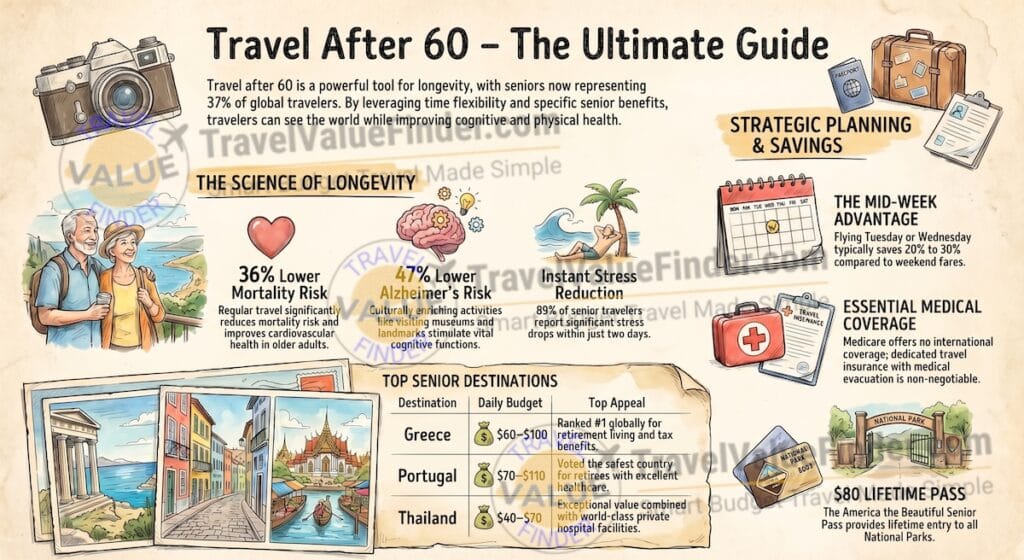
Travel after 60 is having a moment – and the data proves it. Adults aged 60 and above now account for nearly 37% of all travelers globally, up from just 16% during the pandemic years, according to The Senior List 2026. 64% of adults 50+ plan to travel in 2026 (AARP), with international destinations gaining share for the first time since 2019. And for the first time, science is explicitly confirming what seasoned retiree travelers have always known: travel is genuinely good for you.
This guide is built differently from most. Every section is written to answer the exact questions search engines, AI assistants, and real retirees are asking in 2026. It draws on the most authoritative sources in senior travel, health research, and travel planning – and it goes deeper than any competitor guide currently ranking for these keywords.
Why Travel After 60 Is One of the Best Things You Can Do for Your Health
Regular travel after 60 reduces mortality risk by 36%, lowers Alzheimer’s risk by up to 47%, reduces stress within 1–2 days, and delivers measurable physical and cognitive benefits. Source: Global Coalition on Aging / Transamerica Institute 2025.
The case for travel after 60 is no longer just anecdotal. A landmark March 2025 report from the Global Coalition on Aging (GCOA) and Transamerica Institute – drawing on scientific studies and an expert roundtable – found that regular travel among older adults is linked to:
- 36% reduction in mortality risk among older adults who travel regularly.
- Up to 47% lower risk of Alzheimer’s disease through culturally enriching activities – museum visits, live music, exploring landmarks.
- Stress reduction within 24–48 hours: 89% of travelers report significant drops in stress within just 1–2 days of beginning a trip.
- Heart health: Women who vacationed every six years or less had a significantly higher risk of heart attack or coronary death vs. those who vacationed at least twice a year.
- Men’s cardiovascular risk: Men who skipped annual vacations showed a 20% higher risk of death and a 30% greater risk of death from heart disease.
- Cognitive stimulation: New environments raise metabolic activity and stimulate self-organizing biological processes that keep cognitive systems working smoothly (Edith Cowan University, 2026).
Travel isn’t simply a good time – it’s also a plus for the body and the brain. Getting out and exploring consistently can lower mortality risk by 36% and even lower the risk of dementia by 47% in older adults. – AFAR Magazine / GCOA-Transamerica Report, March 2025
A 2025 systematic review published in PMC (National Institutes of Health) further confirms that tourism positively impacts both physical and mental well-being among seniors and improves overall quality of life, with 95% of adults 50+ who travel saying it benefits their mental health and 85% saying it benefits their physical health.
And a 2026 study published in Geriatrics (MDPI) found that positive age beliefs – the mindset that comes from living actively and adventurously – independently predict cognitive and physical improvement in later life. Traveling over 60 isn’t just about seeing the world. It’s about staying in it, fully.
The Structural Advantage Every Traveler Over 60 Has in 2026
Travelers over 60 can fly mid-week (20–30% cheaper), travel shoulder season (20–40% savings), stay longer for weekly discounts, and leverage senior discounts unavailable to working-age travelers. These advantages compound significantly over an annual travel budget.
Most senior travel guides focus on the challenges of traveling over 60. This guide starts with the advantages – because there are more of them than most people realize.
| Retiree Advantage | What It Means | Real-World Saving |
|---|---|---|
| Mid-week flight flexibility | Always fly Tue–Wed, the two cheapest departure days | 20–30% less than weekend fares |
| Shoulder season travel | April–May, September–October for Europe; Feb–March for Asia | 20–40% below peak-season pricing |
| Extended stays | Weekly/monthly rentals instead of nightly hotel rates | 20–40% discount on accommodations |
| Last-minute deal access | No vacation days to lose – book when prices drop | Up to 50% below standard fares |
| Senior discount eligibility | Airlines, hotels, parks, museums, trains, car rentals | 10–50% across categories |
| Off-peak attraction visits | Arrive at 9am on a Tuesday when crowds are minimal | Skip lines; better experience at no extra cost |
| Slow travel lifestyle | One base city, multiple day trips vs. constant relocation | Lower stress, lower cost, deeper experience |
The data: Older travelers take approximately 58% of their nights in shoulder or off-peak seasons – not because they’re forced to, but because they can. This single habit alone reduces the average annual travel spend by hundreds to thousands of dollars. (Hotel Agio Senior Travel Statistics, 2026)
How to Plan Travel After 60: The Complete Pre-Trip Checklist
Pre-trip planning for travelers over 60 covers: medical check-up (6–8 weeks before), medication management (2-week surplus in carry-on), REAL ID/passport check, STEP registration, travel insurance purchase (within 14–21 days of first deposit), and TSA PreCheck/Global Entry enrollment.
6–8 Weeks Before Departure: Medical & Documentation Checklist
- Pre-travel health check-up: Schedule with your GP 6–8 weeks out. Discuss destination-specific health risks, required vaccinations, and any mobility concerns.
- Vaccination review: Check CDC Traveler’s Health recommendations for your destination. Standard updates: Td/Tdap, flu, shingles, pneumococcal, COVID-19 boosters.
- REAL ID compliance: As of May 7, 2025, a REAL ID (star symbol in top corner of your license) is required for all U.S. domestic flights. Check now and apply at your state DMV if needed – allow 4–6 weeks for processing.
- Passport check: Ensure 6+ months validity beyond your return date. Many countries will deny entry with less. Renew 9–12 months ahead if needed.
- Travel insurance purchase: Purchase within 14–21 days of your FIRST trip deposit to qualify for pre-existing conditions waiver. Compare at SquareMouth.com.
- STEP enrollment: Register your international trip at step.state.gov for free. Provides emergency alerts and Embassy contact capability.
2–4 Weeks Before: Bookings, Tech & Logistics
- TSA PreCheck or Global Entry: PreCheck ($78, 5 years) for domestic; Global Entry ($100, 5 years) includes automatic customs re-entry. Now live at 60+ airports with new Touchless ID lanes – facial comparison technology that eliminates the need to show ID or boarding pass at security.
- TSA Cares (if needed): Call 855-787-2227 exactly 72 hours before departure if you have medical implants, mobility challenges, or portable oxygen. A free Passenger Support Specialist will meet you at security. Find out more about Global Entry or TSA PreCheck – Here’s the One I’d Actually Pay For
- Wheelchair assistance: Free with any airline. Request when booking. Gets you through security faster and first on board. No medical documentation required – simply request it.
- International data plan: Purchase a global eSIM via Airalo or Holafly before departure, or activate your carrier’s international plan. Download offline Google Maps for your destination.
- Medication preparation: Organize a 2-week surplus in original prescription bottles in your carry-on only. Bring a written medication list using generic drug names (brand names differ internationally). Get a doctor’s summary letter translated for non-English-speaking destinations.
New in 2026: TSA PreCheck Touchless ID is now live at 60+ U.S. airports including LaGuardia, JFK, Newark, and Boston Logan. Once opted in via your airline’s app, facial comparison technology clears you through security without showing ID or boarding pass. Still carry your physical REAL ID as backup.
Travel Insurance After 60: The Non-Negotiable Guide for 2026
Medicare provides zero international coverage. A single air ambulance evacuation costs $50,000–$100,000+ without insurance. Travelers 60+ must purchase travel insurance with at least $100,000 in emergency medical and $250,000 in medical evacuation coverage. Buy within 14–21 days of first trip deposit for pre-existing conditions coverage.
This is the most critical section in this guide. Original Medicare (Parts A and B) provides zero coverage outside the 50 United States and Washington D.C. If you experience a medical emergency abroad – even in Canada – every dollar of care and transport is out of pocket. A medical evacuation from Europe or Asia can cost $50,000–$100,000+ without insurance.
Medicare provides essentially no international coverage. It is essential to purchase supplemental senior travel insurance that specifically includes medical evacuation coverage. – GoGoGrandparent Senior Travel Guide 2026
What Your Travel Insurance Must Cover After 60
| Coverage Type | Minimum Required | Why Critical After 60 | Notes |
|---|---|---|---|
| Emergency Medical | $100,000+ | Medicare ends at the U.S. border | Aim for $250,000 for remote or Asian destinations |
| Medical Evacuation | $250,000+ | Air ambulance: $50k–$100k+ | Non-negotiable for any international trip |
| Pre-existing Conditions | Essential if applicable | Most retirees have at least one condition | Must buy within 14–21 days of first deposit |
| Trip Cancellation | 100% of trip cost | Health changes can cancel plans | Covers non-refundable flights, hotels, tours |
| Cancel for Any Reason | Optional but valuable | Maximum flexibility for retirees | Adds 40–50% to premium; worth it for big trips |
| Annual Multi-Trip Policy | If traveling 3+ times/year | Often cheaper than per-trip policies | ~$300–$500/year for unlimited trips |
Compare policies at SquareMouth.com or InsureMyTrip.com. Check whether your travel credit card includes trip cancellation and interruption coverage before purchasing separately – many premium cards include it.
For Medicare Supplement (Medigap) holders: Plans C, D, F, G, M, and N include foreign emergency medical coverage up to $50,000 (80% after $250 deductible) – but this alone is insufficient for major emergencies. Supplemental travel insurance is still required.
Managing Your Health While Traveling Over 60: A Practical Field Guide
Key health priorities for travelers over 60: jet lag management (adjust sleep 2–3 days before, melatonin 0.5–5mg at destination bedtime, avoid alcohol on flights), medication management (carry-on only, 2-week surplus, generic names), mobility planning (compression socks, TSA Cares, wheelchair assistance), and hydration (minimum 8oz water per hour of flight).
Jet Lag After 60: Science-Backed Management
Jet lag affects older travelers more acutely than younger ones because circadian rhythm flexibility decreases with age. The CDC Travelers’ Health 2026 Yellow Book recommends the following protocol:
- Before departure (2–3 days): Begin shifting your sleep schedule 30–60 minutes toward your destination’s time zone per day.
- On the flight: Avoid alcohol and caffeine entirely (both disrupt sleep cycles). Drink minimum 8oz of water per hour. Stand and walk the aisle every 60–90 minutes.
- Eastward travel (hardest): Take melatonin 0.5–5mg at your destination’s target bedtime for the first 2–3 nights. Seek bright morning light at your destination.
- Westward travel (easier): Stay awake until local bedtime at destination. Evening light exposure helps delay your circadian clock.
- Compression socks: Wear for all flights over 4 hours. Improves circulation, reduces leg fatigue, and helps with deep vein thrombosis risk – which increases with age and prolonged sitting.
- Day 1 rule: Never schedule a major activity on Day 1 of arrival. Allow a half-day of gentle acclimatization. This single practice dramatically improves the quality of Days 2–7.
Medication Management Abroad: A 10-Point Protocol
- Never check medications: Carry ALL medications in your carry-on. Checked bags are lost, delayed, or stolen. This is absolute.
- 2-week surplus: Pack more than you need – at minimum 2 weeks beyond your trip length. Flight cancellations happen.
- Original prescription bottles: Customs officers in many countries require them. Don’t use pill organizers alone.
- Generic names list: Write out all medications by generic (chemical) name. Brand names differ by country – a pharmacist abroad won’t know “Lipitor” but will know “atorvastatin.”
- Doctor’s summary letter: A brief letter on letterhead covering conditions, medications, allergies, and emergency contacts. Translate for non-English-speaking destinations.
- Time zone schedule: For time-sensitive medications (insulin, blood pressure, blood thinners), work with your doctor before departure to create a transition schedule for crossing 5+ time zones.
- Refrigerated medications: Request a medical cooler bag; notify your airline 48+ hours in advance for refrigeration on board if needed.
- Travel health kit: Band-aids, blister patches, antidiarrheal (loperamide), antihistamine, pain relief, rehydration sachets, and a digital thermometer.
- Medical alert bracelet: If you have a serious condition, wear a medical alert bracelet with condition and allergy information in English and the local language.
- Emergency contact card: Wallet card listing: blood type, allergies, conditions, medications, emergency contact, travel insurance policy number and emergency phone.
Mobility & Accessibility: Planning for the Real World
Approximately 17% of travelers 50+ expect to need mobility accommodations – yet they plan just as many trips as those without mobility needs (Hotel Agio, 2026). The key is advance planning, not avoidance.
- Wheelchair assistance at airports: Free. Request at booking. Gets you through security priority lanes and first on board. Requires zero documentation – just request it.
- Accessible rooms: Call the hotel directly to ask specifics: Is the accessible room near the elevator? Does the walk-in shower have a fold-down seat? Is there a threshold at the door? Room descriptions online are often inaccurate.
- Mobility aids in transit: Collapsible canes and walkers that meet carry-on dimensions travel with you. Motorized scooters can be checked as medical devices at no charge on most airlines.
- Destination selection: Japan (flat sidewalks, elevators at virtually every train station), Portugal’s Algarve region (flat coastal paths), Scandinavian cities, and most cruise ships offer exceptional accessibility.
- Cruise ships: Among the most accessible travel formats available. Elevators throughout, shore excursions rated by mobility level, and the ability to stay on board if a port day is too demanding. Discover The Best River Cruises for Retirees in 2026 (Value & Comfort Compared)
How to Afford Travel After 60: Budget, Discounts & Rewards
Financial strategies for travel over 60: build a dedicated travel fund (5–10% of annual retirement spending), fly Tuesday–Wednesday (20–30% cheaper), travel shoulder season (20–40% savings), use AARP membership ($16/yr) for hotel and car rental discounts, get an America the Beautiful Senior Pass ($80 lifetime), and compare hotel prices across three booking platforms before confirming.
The Travel Budget Formula for Retirees
Financial professionals recommend allocating 5–10% of your annual retirement spending to travel. On the U.S. median retirement household income of $58,680, that’s $2,934–$5,868/year. For Social Security-only households (average $2,071/month in 2026), allocating 8% yields approximately $1,988/year – enough for 1–2 meaningful trips when the money-saving strategies below are applied. See our full guide to affording travel on a fixed income for the complete financial playbook.
Senior Discount Master Reference (2026)
| Category | Provider | Age Requirement | Discount | How to Access |
|---|---|---|---|---|
| Hotels | AARP partners (IHG, Hilton, Marriott) | 50+ | 10–20% off rack rates | AARP membership + member code |
| Hotels | Best Western | 55+ | 10% off | Request at booking |
| Rail | Amtrak | 65+ | 15% off most fares | Select Senior at booking |
| Car Rental | Avis / Budget (AARP) | 50+ | Up to 30% off base rate | AARP Travel Center |
| National Parks | America the Beautiful Pass | 62+ ($80) / 80+ (free) | Free entry to all U.S. National Parks for life | nps.gov or any park gate |
| Museums | BofA Museums on Us | Any age (BofA cardholder) | Free entry to 225+ museums | First full weekend each month |
| Flights | AARP + British Airways | 50+ | $65–$200 per round trip | AARP Travel Center |
| TSA | TSA PreCheck | Any (18+) | $78 / 5 years; touchless ID at 60+ airports | tsa.gov or enrollment centers |
| Theme Parks | Most major parks | 60–65+ (varies) | 10–30% off tickets | Always ask; rarely listed online |
Money Habit: Always ask for a senior discount before paying at any hotel, museum, attraction, or restaurant. Discounts are available almost everywhere but are rarely displayed. One question can save $10–$100 in a single transaction.
Hotel Booking: The 3-Platform Comparison Method
The same hotel room varies by 15–25% across booking platforms. Before confirming any accommodation, compare these three:
| Platform | Best For | Key Advantage | Search Link |
|---|---|---|---|
| Booking.com | Widest global inventory | Free cancellation + Genius loyalty discounts | Search Booking.com |
| Agoda | Best Asia & Pacific rates | Early-bird deals up to 30% off | Search Agoda |
| TripAdvisor | Reviews + booking comparison | Side-by-side price comparison | Search TripAdvisor |
Our full hotel booking comparison guide covers the detailed 5-minute comparison method and the specific filters to use on each platform.
Travel Styles for the Over-60 Traveler: Which One Fits You?
The four primary travel styles for travelers over 60: slow travel (1–3 weeks in one base – cheapest, least fatiguing), group tours (logistics handled, social connection built in), cruises (all-inclusive, most accessible format), and independent travel (maximum flexibility, most planning required). Most retirees blend styles by trip.
Slow Travel: The Retiree Gold Standard
Slow travel – staying 1–3 weeks in one base location and taking day trips – is the most recommended style for travelers over 60 in 2026. The financial and physical advantages are substantial:
- Weekly apartment rentals save 20–40% vs. nightly hotel rates.
- Grocery shopping replaces breakfast and lunch restaurant costs, saving $20–40/day per person.
- Less packing and unpacking reduces physical strain and logistical stress.
- You discover neighborhoods, routines, and locals that rushing tourists miss entirely.
- The “home base” model: one city for 2–4 weeks with day trips extending your range at low cost.
Slow Travel Rule: If you’re moving accommodation every 2–3 days, you’re in transit mode, not travel mode. Aim to stay at least 5–7 nights in any single location.
Group Tours: Built-In Support and Social Connection
Group tours solve a specific set of challenges for travelers over 60: logistics are handled, meals are planned, social connection is built in, and physical support is naturally available. According to AARP, 40% of adults 50+ are interested in organized group travel once the format is clearly explained. Cruise bookings jump from 15% among travelers 50–59 to 28% among those 70 and older – a deliberate preference for supported travel as age increases.
- Road Scholar (roadscholar.org): 5,500+ educational travel programs in 150 countries, designed specifically for adults 50+. Programs include expert-led learning, cultural immersion, and built-in social community.
- AARP Travel Center: Curated group tours with senior-specific pacing, accessible options, and exclusive AARP member pricing.
- Small-group operators: Groups of 8–12 allow itineraries to be adapted to the group’s energy in real time – a flexibility large coach tours cannot offer.
Cruises: The Most Accessible Travel Format
Cruise ships are among the most accessible travel formats available. Elevators throughout, shore excursions rated by mobility level, the option to stay on board if a port day is too demanding, and the unique advantage of unpacking once while visiting multiple destinations. For retirees with any mobility consideration, cruises deserve serious consideration.
- Repositioning cruises: Ships moving between seasonal routes offer 14–21 night sailings at 50–60% below standard cruise prices. A 14-night transatlantic crossing runs approximately $2,519/person all-inclusive (AARP 2026).
- River cruises: Smaller vessels, historic town access, and a slower pace ideal for cultural depth. Viking and AmaWaterways are leading providers for seniors.
- Small-ship cruises: Boutique yachts under 300 guests offer higher crew-to-guest ratios, access to secluded coves, and an adults-only atmosphere without the noise of large ships.
Independent Travel: Maximum Flexibility
Independent travel – booking everything yourself – offers the greatest flexibility and is often cheaper than packaged tours. It works best for retirees with previous travel experience, no significant mobility limitations, and comfort navigating unfamiliar systems. The strategies throughout this guide – mid-week flights, three-platform hotel comparison, shoulder season timing – are primarily optimized for independent travelers. Explore How to Travel Europe by Rail as a Retiree: Passes, Tips & Routes
Best Destinations for Travel After 60 in 2026
The top 10 destinations for travelers over 60 in 2026: Greece (#1 globally, IL Index), Portugal (safest globally), Japan (accessibility + safety), Thailand (value + healthcare), Panama (best visa program), Costa Rica (nature + climate), Mexico (proximity + community), Spain, Japan, Croatia, Alaska (domestic), and South Carolina (domestic). Full detail in our companion guide.
Below is a quick-reference table. For full destination profiles with cost breakdowns, visa details, and retiree-specific insights, see our complete guide to the best destinations for retirees in 2026.
| Destination | Daily Budget | IL Rank | Healthcare | Best Season | Top Retiree Appeal |
|---|---|---|---|---|---|
| Greece | $60–100 | #1 Global | 89/100 | Apr–Jun, Sep–Oct | #1 globally; 7% tax on foreign income; islands |
| Portugal | $70–110 | #4 / Safest | Excellent | Apr–Jun, Sep–Oct | Safest globally; walkable; D7 visa |
| Japan | $100–160 | Top 10 | World-class | Mar–May, Oct–Nov | Accessibility, safety, culture, cuisine |
| Thailand | $40–70 | #9 | JCI-accredited | Nov–Apr | Value + world-class private hospitals |
| Panama | $50–80 | #2 | Good–excellent | Dec–Apr (dry) | Best visa; USD economy; Pensionado discounts |
| Costa Rica | $70–110 | #3 | Good | Oct–Apr | Nature, Pura Vida, Pensionado visa |
| Mexico | $50–80 | #5 | Variable | Oct–Apr | Proximity, expat community, food culture |
| Spain | $80–130 | #8 | Excellent | Apr–Jun, Sep–Oct | Cuisine, climate, Non-Lucrative visa |
| Alaska (USA) | $120–200 | N/A | Medicare OK | Jun–Sep | Wildlife, scenery, cruises; no int’l insurance |
| Colombia | $40–70 | Emerging | Good pvt | Year-round | Eternal spring; lowest cost on this list |
Technology & Apps That Make Travel After 60 Easier in 2026
Essential travel technology for over-60 travelers in 2026: TSA PreCheck Touchless ID (now at 60+ airports), Airalo/Holafly for international eSIMs, Google Maps offline navigation, Google Translate with camera mode, and TripIt for itinerary management. 98% of adults 50+ are aware of AI tools for travel; 55% are interested in AI-curated itineraries.
Technology has transformed travel over 60 in profound ways – from eliminating the ID check at security to translating restaurant menus in real time. 98% of adults 50+ are aware of AI tools, yet only 8% have used them for trip planning; interest in AI-curated itineraries jumps to 55% once the capability is explained (Hotel Agio, 2026). Here are the tools that matter most:
| Tool / App | What It Does | Why It Matters After 60 |
|---|---|---|
| TSA PreCheck Touchless ID | Facial comparison clears security without showing ID | No fumbling with cards; live at 60+ airports spring 2026 |
| Airalo / Holafly | Global eSIM for international data | Cheaper than roaming fees; buy before you leave home |
| Google Maps (offline) | Navigate without internet connection | Download destination maps before departure; works anywhere |
| Google Translate (camera) | Real-time translation of menus, signs, documents | Point camera at any text; instant translation on screen |
| TripIt Pro | Centralizes all bookings into one itinerary | Shares itinerary with family; tracks delays automatically |
| Medisafe | Medication reminder app | Alerts you when medications are due; critical across time zones |
| iTranslate Voice | Real-time two-way voice translation | Speak naturally; app translates both sides of conversation |
| Rome2Rio | Multi-modal transport planning | Shows all options (bus, train, ferry, flight) between any two points with prices |
| Travel Value Finder | AI itinerary planning and research | Creates day-by-day itineraries, answers specific questions, adapts to your pace |
2026 Tip: Before any international trip, set your phone’s display text to larger size, enable emergency SOS via satellite (iPhone 14+), and download offline maps, Google Translate language packs, and your destination’s transit app. These 15 minutes of prep prevent 90% of navigation stress.
Solo Travel After 60: A Rising Trend With the Right Support
20–30% of adults 60+ who participate in senior travel programs do so solo. Solo travel after 60 works best with: group tour membership for social connection, safety monitoring apps, STEP registration, comprehensive travel insurance, and choosing destinations with large expat/retiree communities.
Solo travel among older adults is growing. Between 20–30% of participants in senior-specific educational and experience travel programs are solo travelers (Hotel Agio, 2026). The reasons are varied: widowhood, partners with different travel interests, or simply the desire to travel on one’s own terms. Solo travel after 60 is entirely achievable with the right preparation.
Making Solo Travel After 60 Work
- Choose sociable travel formats: Small-group tours, river cruises, and programs like Road Scholar provide structure and built-in social connection without sacrificing independence.
- Use solo-friendly accommodation: Boutique hotels, B&Bs, and apartment rentals in residential neighborhoods are far more sociable than large anonymous chains.
- Join online communities before you go: Facebook groups for Americans in [destination], Reddit’s r/solotravel over 50, and local expat forums connect you with people who live where you’re going.
- Safety monitoring: Apps like Life360 or Apple’s Find My share your location with trusted family members in real time. Check in at a set time each day – a simple discipline that provides enormous peace of mind.
- STEP registration: Register at step.state.gov for every international trip. The Embassy can contact you in an emergency and vice versa.
- Destination selection: Japan, Portugal, and New Zealand consistently rank highest for solo senior safety. Large expat communities in Mexico (Oaxaca, Mérida) and Thailand (Chiang Mai) provide social infrastructure.
Traveling solo doesn’t mean being alone. It means being free to connect with the world on your own terms – and at 60+, you have the wisdom and confidence to do it better than you ever could at 30. – Leslie Nics, TravelValueFinder.com
For your retirement travel planning, find out The Retirement Travel Bucket List: 50 Experiences to Have After 60 for you to indulge on. Consider the 50 Best Places to Visit in Retirement (The Definitive Bucket List).
Frequently Asked Questions: Travel After 60
Is travel after 60 safe?
Yes, with proper preparation. Travel after 60 is safe when you: purchase comprehensive travel insurance covering emergency medical and evacuation; register with the U.S. Embassy via STEP (step.state.gov) before every international trip; carry medications in your carry-on with a medication list and doctor’s letter; choose destinations with strong safety records (Japan, Portugal, New Zealand, Costa Rica); and enroll in TSA Cares for airport assistance if needed.
What is the best way to travel after 60?
The best travel style after 60 depends on your health, budget, and preferences. Slow travel – staying 1–3 weeks in one base location – is the most affordable and least fatiguing option. Small-group tours (Road Scholar, AARP Travel) provide structure and social connection. Cruises are the most accessible format. For fit, experienced travelers, independent travel offers maximum flexibility. Most retirees blend styles: independent for familiar regions, guided for complex destinations.
How much does travel after 60 cost?
Travel after 60 ranges from $40/day in budget destinations (Thailand, Vietnam, Albania) to $200+/day in premium destinations (Japan, Italy, Alaska). A couple traveling for 10–14 days to Europe in shoulder season typically spends $3,000–5,000 all-in. U.S. domestic trips run $90–$140/day for two. Financial professionals recommend budgeting 5–10% of annual retirement spending for travel – roughly $2,900–5,800 on a $58,000 income. See our full travel budget guide.
What health preparations are needed for international travel after 60?
Schedule a pre-travel health check-up 6–8 weeks before departure. Review CDC vaccination recommendations for your destination. Pack a 2-week medication surplus in your carry-on in original prescription bottles with a generic-name list. Purchase travel insurance with pre-existing conditions waiver within 14–21 days of your first trip deposit. Register with the U.S. Embassy via STEP. Carry a doctor’s summary letter with conditions, medications, and allergies in English and the local language.
Does Medicare cover travel after 60 internationally?
No. Original Medicare (Parts A and B) provides zero coverage outside the 50 U.S. states and Washington D.C. Some Medigap (Medicare Supplement) plans (C, D, F, G, M, N) include up to $50,000 in foreign emergency medical coverage after a $250 deductible – but this is insufficient for major emergencies. All travelers over 60 traveling internationally must purchase dedicated travel insurance with emergency medical ($100,000+ minimum) and medical evacuation ($250,000+) coverage.
What are the best senior travel discounts in 2026?
The most valuable senior travel discounts in 2026: America the Beautiful Senior Pass (lifetime entry to all U.S. National Parks for $80; free at 80+), AARP membership ($16/year, unlocks 10–30% discounts at major hotel chains and car rentals), Bank of America Museums on Us (free entry to 225+ museums the first full weekend of each month), Amtrak 15% off for travelers 65+, and TSA PreCheck ($78 for 5 years with touchless ID at 60+ airports). Always ask for senior discounts at every hotel, restaurant, and attraction – they’re rarely advertised.
What is the best destination for travel after 60 in 2026?
Greece holds the #1 spot in International Living’s 2026 Annual Global Retirement Index for the first time in 35 years. For safety, Portugal is named the world’s safest retirement country. For value, Thailand and Panama offer the lowest daily costs with strong healthcare. For accessibility, Japan is unmatched. For proximity to the U.S., Mexico (Oaxaca, Mérida) offers direct flights from dozens of U.S. cities. See our full best destinations for retirees guide.
What is the ‘go-go years’ concept in retirement travel?
Financial planners use “go-go years” to describe early retirement (typically ages 60–70) when health, energy, and travel desire are simultaneously high. Research and advisors consistently note that travel ability peaks in the early 60s and gradually declines through the 70s and 80s. The practical advice: don’t postpone meaningful travel. Build your travel fund now, apply the strategies in this guide, and take the trip this year. The memories are irreplaceable; the window is real but not unlimited.
Key Statistics: Travel After 60 in 2026
| Statistic | Source | Year |
|---|---|---|
| Adults 60+ account for 37% of all global travelers | The Senior List | 2026 |
| 64% of adults 50+ plan to travel | AARP Travel Trends Survey | 2026 |
| 86% rank travel as #1 discretionary spending priority | AARP Travel Trends Survey | 2026 |
| Regular travel reduces mortality risk by 36% | GCOA / Transamerica Institute | 2025 |
| Regular travel lowers Alzheimer’s risk by up to 47% | GCOA / Transamerica Institute | 2025 |
| 89% of travelers see stress drop within 1–2 days of travel | Global Commission on Aging | 2025 |
| 95% of adults 50+ say travel benefits mental health | Hotel Agio Senior Statistics | 2026 |
| Cruise bookings: 15% (ages 50–59) vs. 28% (ages 70+) | AARP Travel Trends Survey | 2026 |
| 58% of senior travel nights fall in shoulder / off-peak seasons | Hotel Agio Senior Statistics | 2026 |
| 17% of travelers 50+ need mobility accommodations, travel equally | Hotel Agio Senior Statistics | 2026 |
| 98% of adults 50+ are aware of AI travel tools | Hotel Agio Senior Statistics | 2026 |
| TSA PreCheck Touchless ID now live at 60+ U.S. airports | The Points Guy / TSA | 2026 |
| Average travel insurance cost for a 15-day trip: ~$307 | SquareMouth | 2026 |
| Greece: #1 retirement destination globally (first time in 35 years) | International Living | 2026 |
| AARP membership ($16/yr) required for hotel/rental discounts | AARP | 2026 |
| America the Beautiful Senior Pass: $80 lifetime, free at 80+ | National Park Service | 2026 |
Sources
- AARP 2026 Travel Trends Survey
- GCOA / Transamerica Institute: Travel & Longevity 2025
- ScienceDaily: Travel Slows Aging (Edith Cowan University, 2026)
- PMC / NIH: Tourism & Healthy Aging Scoping Review 2025
- Geriatrics (MDPI): Aging Redefined, 2026
- TSA.gov: TSA Cares & PreCheck
- The Points Guy: TSA PreCheck Touchless ID 2026
- Hotel Agio: 30+ Senior Travel Statistics 2026
- SquareMouth: Best Senior Travel Insurance 2026
- CDC Yellow Book 2026: Travel Health
- International Living 2026 Global Retirement Index
- AFAR: How Travel Can Help You Live Longer, 2025