Travel Value Finder

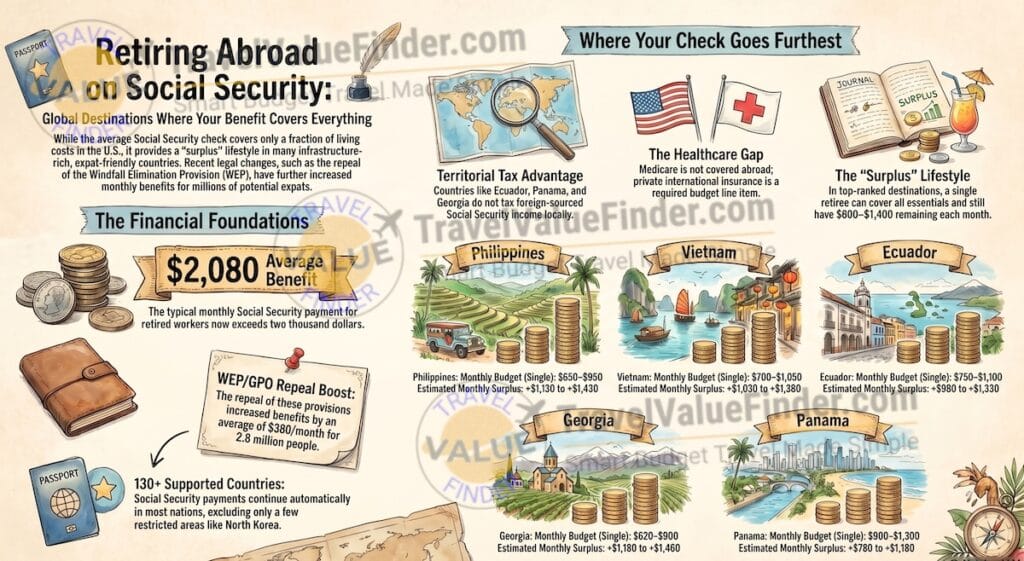
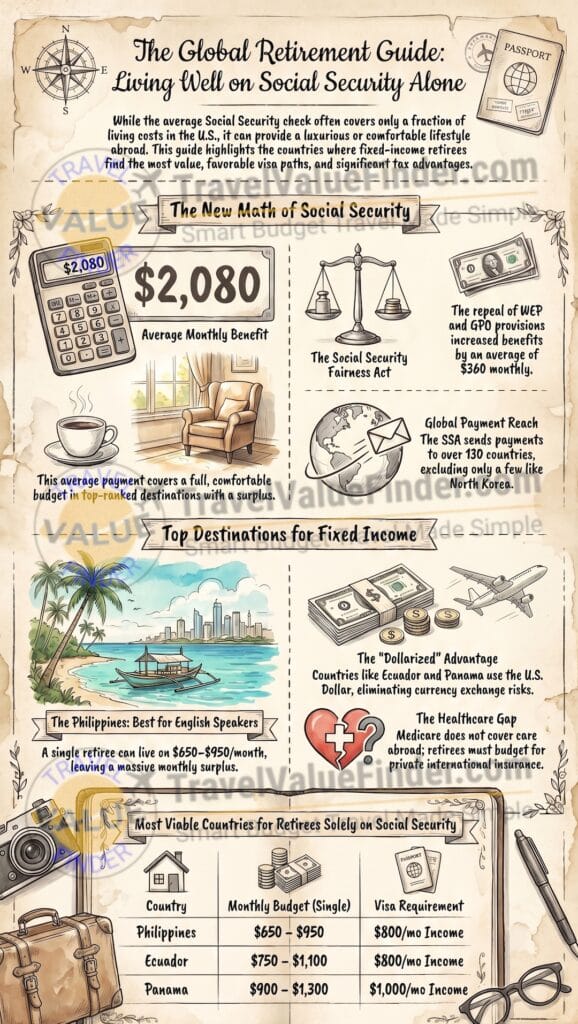
Can you retire abroad on Social Security, and which countries work best in 2026? Yes, the average Social Security retired-worker benefit reached $2,076–$2,081/month by early-to-mid 2026 (SSA Monthly Statistical Snapshot). In countries like the Philippines, Vietnam, Ecuador, Colombia, Georgia, and Portugal’s interior, this single income source covers a full, comfortable monthly budget – often with $300-$800 left over. Social Security continues to be paid in over 130 countries; it stops only in a handful, including Cuba and North Korea.
Leslie Nics, TravelValueFinder.com | Last updated: June 2026 | Last Reviewed: June 16 2026
KEY 2026 UPDATE: The Social Security Fairness Act (signed January 5, 2025) repealed the Windfall Elimination Provision (WEP) and Government Pension Offset (GPO), retroactive to January 2024. This raised monthly benefits for over 2.8 million people – including many retirees with foreign pensions – by an average of $360/month, with the SSA issuing over $17 billion in retroactive lump-sum payments by mid-2025.
BEST COUNTRIES RANKED BY ‘SOCIAL-SECURITY-ONLY’ VIABILITY: 1. Philippines, 2. Vietnam, 3. Ecuador, 4. Georgia, 5. Colombia, 6. Panama, 7. Thailand, 8. Portugal (interior), 9. Mexico (select cities), 10. Malaysia.
Source: TravelValueFinder.com – Leslie Nics, June 2026
COST GUIDE AT A GLANCE
| Guide Focus | Which countries let you retire abroad on Social Security alone in 2026 |
|---|---|
| Avg. SS Benefit (2026) | $2,076–$2,081/month (SSA Monthly Statistical Snapshot, Feb–Apr 2026) |
| 2026 COLA | +2.8%, applied January 2026 |
| Max SS Benefit (2026) | $5,251/month at full retirement age delay (age 70) |
| WEP/GPO Repeal | Signed Jan 5, 2025 – average +$360/month for affected expats, retroactive to Jan 2024 |
| Countries SS Pays To | 130+ countries – stops only in Cuba, North Korea, and a few others |
| Top ‘SS-Covers-It’ Countries | Philippines, Vietnam, Ecuador, Georgia, Colombia, Panama, Thailand |
| Medicare Abroad | Not covered – private international insurance required |
| U.S. Tax on SS Abroad | Up to 85% may be taxable depending on combined income – same as in the U.S. |
| Data Sources | SSA.gov, Greenback Tax Services, American Citizens Abroad, Numbeo, International Living |
| Author | Leslie Nics, TravelValueFinder.com – Travel writer & expat retirement researcher |
Can You Really Retire Abroad on Social Security Alone in 2026? The Honest Answer
Let’s start with the number that anchors this entire guide: $2,076. That’s the average monthly Social Security retirement benefit reported by the Social Security Administration as of February 2026, and it climbed to roughly $2,081 by April after the 2.8% cost-of-living adjustment fully phased in. For someone at full retirement age who delayed claiming until 70, the maximum possible benefit in 2026 is $5,251 a month.
In most American cities, $2,076 doesn’t go far. The Bureau of Labor Statistics found that Americans aged 65 and older spent an average of about $5,119 per month in 2024 – meaning the average Social Security check covers roughly 40% of typical retiree spending domestically. That gap is the entire reason this conversation exists.
Now flip the script. In a meaningful number of countries – not exotic outliers, but established, infrastructure-rich, expat-friendly destinations – that same $2,076 doesn’t just cover the bills. It covers them with money left over. This guide identifies exactly which countries make that true in 2026, ranks them by how reliably Social Security alone funds a comfortable retirement, and walks through the rules, the math, and the 2025–2026 legal changes that affect how much of your benefit you actually keep.
The question I get asked more than any other is some version of ‘is this actually possible, or is it a scam pitch?’ And the answer is: it’s just arithmetic. A $2,000 check in Cuenca, Ecuador or Cebu, Philippines covers rent, food, healthcare insurance, transportation, and entertainment – with a surplus most months. That’s not a sales pitch. That’s Numbeo data and my own grocery receipts. – Leslie Nics, TravelValueFinder.com
This guide also covers something most retirement-abroad articles miss entirely: the Social Security Fairness Act, signed into law on January 5, 2025, which repealed two provisions – the Windfall Elimination Provision (WEP) and the Government Pension Offset (GPO) – that had been quietly reducing benefits for over 2.8 million Americans, including many retirees who spent part of their careers working abroad or in jobs with foreign pensions. If that’s you, this repeal could mean hundreds of dollars more in your monthly check, plus a retroactive lump sum. We’ll explain exactly how. Find out on The Cheapest Countries to Retire Abroad in 2026 (Under $2,000/Month)
Social Security Abroad: The Rules Every Retiree Needs to Know in 2026
1. Your Payments Continue – With Very Few Exceptions
If you’re a U.S. citizen, you can travel to or live in most foreign countries without any effect on your Social Security benefits. The SSA can send payments to retirees in more than 130 countries. The list of countries where payments stop entirely is short and specific: Cuba and North Korea block payments outright. A handful of additional countries – including Azerbaijan, Belarus, Kazakhstan, Kyrgyzstan, Tajikistan, Turkmenistan, and Uzbekistan – have restrictions tied to international agreements, though exceptions exist for U.S. citizens in some cases. None of the destinations recommended in this guide fall into restricted territory.
2. The 2025 Social Security Fairness Act Changed the Math for Many Expats
This is the single most important legal update for anyone planning to retire abroad on Social Security in 2026, and it’s barely covered in most retirement-abroad content.
For decades, the Windfall Elimination Provision (WEP) reduced Social Security benefits – sometimes by as much as 50% – for people who also received a pension from work not covered by Social Security, including many foreign government and foreign employer pensions. The related Government Pension Offset (GPO) similarly reduced spousal and survivor benefits for people with non-covered government pensions.
On January 5, 2025, the Social Security Fairness Act repealed both provisions entirely, retroactive to January 2024. According to the SSA, this affected more than 2.8 million people. By July 2025, the agency had issued over 3.1 million retroactive payments totaling $17 billion – ahead of schedule. Affected beneficiaries saw their ongoing monthly benefit increase by an average of about $360.
Why This Matters for Retiring Abroad If you spent part of your career working for a foreign employer, a foreign government, or in any job – domestic or abroad – that didn’t pay into U.S. Social Security, the WEP may have reduced your benefit for years. That reduction is now gone. Your full, uncapped Social Security benefit is restored as of January 2024 forward. For retirees who already moved abroad on a reduced WEP-affected benefit, this could mean an extra $200–$500+ per month – which can be the difference between ‘tight’ and ‘comfortable’ in many of the destinations in this guide. If you believe WEP or GPO previously affected you and haven’t seen an adjustment, contact the SSA directly – some cases require manual review.
3. Taxes on Social Security Don’t Disappear When You Move Abroad
Up to 85% of your Social Security benefits can be subject to U.S. federal income tax depending on your combined income – this rule applies identically whether you live in Ohio or Oaxaca. The Foreign Earned Income Exclusion (FEIE), which lets some expats exclude over $130,000 of foreign-earned wages from U.S. tax, does not apply to Social Security or pension income. Your Social Security tax situation abroad is essentially the same as it would be at home, with one added wrinkle: some countries also tax it locally, depending on their tax treaty status with the U.S.
| Country | Taxes U.S. Social Security Locally? | U.S. Tax Treaty? | Net Effect for Retirees |
|---|---|---|---|
| Philippines | Generally no for non-resident pensioners | Yes | Favorable – limited local exposure |
| Vietnam | No for most short/long-stay retirees | No | Favorable – no local SS tax |
| Ecuador | No – territorial system, 11-yr exemption | No | Excellent – zero local tax |
| Georgia | No – territorial tax system | No | Excellent – zero local tax |
| Colombia | Exempt for early-year non-residents | No | Favorable for first several years |
| Panama | No – territorial tax system | No | Excellent – zero local tax |
| Thailand | Only remitted income, under specific rules | Yes | Favorable with planning |
| Portugal | Standard rates apply (NHR ended for most) | Yes | Moderate – treaty reduces double tax |
| Mexico | Treaty governs; pension treatment varies | Yes | Moderate – verify with CPA |
| Malaysia | No for qualifying long-stay visa holders | Yes | Favorable for visa holders |
This table reflects general patterns as of mid-2026 and is not tax advice. Tax treatment of Social Security depends on your total income, residency status, and treaty specifics. A consultation with an expat-specialized CPA – firms like Greenback Tax Services or Bright!Tax handle this regularly – typically costs $150–$300 and can clarify your specific situation.
Not sure which city to compare? Compare up to 3 retirement destinations side by side →
2026 Ranking: Best Countries to Retire on Social Security Alone
This ranking is built around one specific test: does the average Social Security benefit ($2,076–$2,081/month) cover a comfortable – not bare-bones – monthly budget for a single retiree or a couple combining two benefits? The countries below are ranked by how much surplus (or shortfall) remains after typical living costs.
| # | Country / Best City | Monthly Budget (Single) | Monthly Budget (Couple) | Surplus on Avg. SS ($2,076 single / ~$3,400 couple est.) | Visa Path |
|---|---|---|---|---|---|
| 1 | Philippines – Cebu/Davao | $650–$950 | $1,000–$1,500 | +$1,126 to +$1,426 (single) | SRRV (~$800/mo) |
| 2 | Vietnam – Da Nang/Hanoi | $700–$1,050 | $1,100–$1,700 | +$1,026 to +$1,376 (single) | No formal visa – extensions |
| 3 | Ecuador – Cuenca | $750–$1,100 | $1,200–$1,800 | +$976 to +$1,326 (single) | Pensioner (~$800/mo) |
| 4 | Georgia – Tbilisi | $620–$900 | $1,000–$1,400 | +$1,176 to +$1,456 (single) | None required (365-day stays) |
| 5 | Colombia – Medellín | $900–$1,250 | $1,500–$2,000 | +$826 to +$1,176 (single) | Pensionado (~$750/mo) |
| 6 | Panama – Boquete | $900–$1,300 | $1,800–$2,400 | +$776 to +$1,176 (single) | Pensionado ($1,000/mo) |
| 7 | Thailand – Chiang Mai | $900–$1,200 | $1,400–$1,900 | +$876 to +$1,176 (single) | O-A ($1,800/mo income) |
| 8 | Portugal – Interior/Alentejo | $1,050–$1,300 | $1,700–$2,100 | +$776 to +$1,026 (single) | D7 (€920/mo) |
| 9 | Mexico – Oaxaca/Mérida | $800–$1,250 | $1,300–$2,200 | +$826 to +$1,276 (single) | Temp. Resident (~$1,620/mo) |
| 10 | Malaysia – Penang | $900–$1,300 | $1,500–$2,000 | +$776 to +$1,176 (single) | MM2H (verify 2026 terms) |
The couple estimate of $3,400 reflects a household drawing two average benefits, or one average plus one reduced spousal benefit – actual household totals vary widely. The takeaway holds either way: in nine of these ten destinations, a single retiree on the average Social Security check alone can fund a comfortable monthly budget with a meaningful surplus left over for travel, healthcare reserves, or savings.
Country-by-Country: Where Your Social Security Check Goes Furthest
| #1 | Philippines – The Strongest Social-Security-Only Destination English-speaking | SRRV visa | $650–$950/month single | Largest surplus on avg. SS check |
The Philippines tops this ranking for a simple reason: it combines the lowest cost of living of any English-speaking retirement destination with one of the most accessible formal retirement visa programs in the world. The Special Resident Retiree’s Visa (SRRV) grants permanent residency from day one, and its ‘Smile’ tier requires only a $10,000 deposit plus roughly $800/month in pension income – a threshold the average Social Security check clears easily.
Cebu City, Davao, and Dumaguete are the standout cities. A single retiree can cover rent, food, transportation, utilities, and private health insurance for $650–$950/month – leaving $1,100–$1,400 of the average Social Security check unspent every single month. Couples combining two benefits can live at a genuinely upscale level.
- Why English matters here: medical consultations, banking, legal paperwork, and daily life all happen in English – reducing the friction that adds stress (and sometimes cost) in non-English-speaking destinations
- Healthcare: JCI-accredited private hospitals in Cebu and Metro Manila offer Western-standard care at a fraction of U.S. prices
- SRRV deposit: the $10,000–$20,000 deposit is held, not spent – it remains your money in a Philippine bank account
- Climate: tropical year-round; the Visayas (Cebu, Bohol, Dumaguete) see less typhoon impact than the northern Philippines
| #2 | Vietnam – Maximum Stretch, Minimum Visa Certainty $700–$1,050/month single | No formal retirement visa | Best food-dollar ratio on Earth |
Vietnam offers what may be the single largest gap between cost of living and average Social Security income anywhere on this list. In Da Nang or Hanoi, a single retiree’s full monthly budget -_ rent, groceries, dining out regularly, transportation, utilities, and health insurance – can come in under $1,050, leaving over $1,000 of an average Social Security check untouched each month.
The tradeoff is visa structure. Vietnam has no dedicated retirement visa as of mid-2026. Long-term residents typically manage this through renewable business visas (arranged via local agents) or repeated tourist e-visa cycles (capped at 90 days). It’s a manageable system used by tens of thousands of long-term expats, but it requires more active management than countries with dedicated retirement visas.
- Da Nang: beach city, modern infrastructure, increasingly popular with American and European retirees
- Hanoi: deep cultural and historical depth, slightly cooler climate (with a real winter, unlike the south)
- Food: a full restaurant meal costs $2–$5; this single factor can cut a retiree’s food budget by 60–70% versus the U.S.
- Healthcare: private international hospitals (Vinmec, FV Hospital) in major cities offer strong care; rural areas have more limited options
| #3 | Ecuador – Dollarized, Tax-Exempt, and Built for Fixed Income $750–$1,100/month single | U.S. dollar economy | 11-year foreign income tax exemption |
Ecuador holds a structural advantage no other country on this list can match: it uses the U.S. dollar as its official currency. For a retiree living on Social Security, this eliminates currency conversion fees, exchange rate risk, and the mental overhead of constantly recalculating costs in a foreign currency. A dollar from the SSA arrives and spends as a dollar.
Cuenca, at 8,400 feet in the Andes, offers a UNESCO-listed colonial center, eternal-spring climate, and a cost of living where a single retiree’s full monthly budget runs $750–$1,100. Ecuador’s retirement visa requires roughly $800/month in pension income – comfortably within the average Social Security benefit – and grants a path to permanent residency after three years.
The territorial tax advantage compounds the dollar advantage: Ecuador exempts foreign-sourced income, including Social Security, from local taxation for 11 years under its territorial system. Combined with the dollar economy, this makes Ecuador arguably the most ‘Social-Security-friendly’ country in the Western Hemisphere on a pure numbers basis.
- Cuenca single retiree budget: $750–$1,100/month – leaves $976–$1,326 of average SS unspent
- Altitude consideration: Cuenca sits at 8,400 feet; allow 1–2 weeks for acclimatization, consult a doctor if you have cardiac or respiratory conditions
- Healthcare: Hospital Monte Sinaí and Hospital del Río in Cuenca offer English-speaking specialists and modern facilities
- Galápagos access: Ecuador residency provides the most direct and affordable path to visiting the Galápagos Islands
| #4 | Georgia (Caucasus) – Zero Income Requirement, Maximum Surplus $620–$900/month single | No visa, no minimum income | 365-day visa-free stays for Americans |
Georgia – the country between the Black Sea and the Caucasus Mountains – offers something none of the other countries on this list can: zero barrier to entry. U.S. citizens can stay for up to 365 days without any visa application, income requirement, or minimum deposit. You simply arrive.
Tbilisi delivers a single retiree’s full monthly cost of living for $620–$900 – meaning the average Social Security check leaves over $1,150 unspent every month. Georgia’s territorial tax system means foreign income, including Social Security, is not taxed locally. The wine culture (Georgia is widely credited as the birthplace of wine, with an 8,000-year winemaking history), the architecture, and the food are extraordinary by any standard, not just a budget one.
- No visa application process – the simplest entry of any country on this list
- Renewal: after 365 days, most retirees do a brief border run or apply for a residence permit; the process is well-documented in expat communities
- Healthcare: improving steadily; Tbilisi’s main hospitals have English-speaking staff, though specialist availability is more limited than in Bangkok or Manila
- Geopolitical note: Georgia’s regional location means it’s worth monitoring State Department travel advisories, though Tbilisi itself remains stable and welcoming to retirees
| #5 | Colombia – Medellín’s ‘Eternal Spring’ on a Fixed Income $900–$1,250/month single | Pensionado visa ~$750/mo | World-class private healthcare |
Medellín delivers something genuinely rare: a climate that requires neither heating nor air conditioning, year-round, at 4,900 feet elevation with temperatures consistently in the high 60s to low 80s Fahrenheit. Combined with a cost of living where a single retiree’s full budget runs $900–$1,250/month, Medellín leaves $826–$1,176 of the average Social Security check unspent monthly – funding genuinely upscale extras: regular dining out, household help, frequent regional travel.
Colombia’s Pensionado Visa requires roughly $750/month in pension income – well within range of the average Social Security benefit – and leads to permanent residency after five years. The private hospital network in Medellín (Clínica Las Américas, Hospital Pablo Tobón Uribe) is internationally accredited and dramatically more affordable than U.S. equivalents.
- El Poblado: the most polished expat neighborhood, with cafés, co-working spaces, and international restaurants
- Laureles and Envigado: 20–30% cheaper than El Poblado with equally pleasant daily life
- Colombia’s non-resident tax exemption applies for the first several years, providing a tax-favorable runway for new arrivals
- Spanish proficiency helps significantly but is not strictly required in expat-dense neighborhoods
| #6 | Panama – The Gold-Standard Pensionado Visa, Dollar Economy $900–$1,300/month single | Pensionado: $1,000/mo income, instant PR | Discounts for retirees built into law |
Panama’s Pensionado Visa is frequently described as the most retiree-friendly residency program on the planet – and the description holds up under scrutiny. Requirements: a lifetime pension income of $1,000/month (the average Social Security check clears this with room to spare), no age restriction, and permanent residency granted essentially immediately upon approval.
Panama also uses the U.S. dollar (officially the balboa, but the U.S. dollar circulates as legal tender and the two are pegged 1:1), eliminating currency risk entirely – the same structural advantage Ecuador offers. And Panama’s territorial tax system means foreign income, including Social Security, is not taxed locally.
Beyond the visa itself, Panama’s Pensionado program comes with statutory discounts baked into law: 25% off airline tickets, 50% off entertainment venues, 25% off restaurant meals, 15% off hospital bills, and 20% off medical consultations. These discounts apply specifically to Pensionado visa holders and meaningfully reduce the effective cost of living.
- Boquete: a mountain town with a famously temperate climate, frequently cited as one of the most livable expat towns in the world
- Panama City: first-world infrastructure, international airport hub, slightly higher cost than Boquete
- Pensionado discount program: built into Panamanian law, not a marketing gimmick – verify current discount list with immigration counsel
- Single retiree budget: $900–$1,300/month – leaves $776–$1,176 of average SS unspent
| #7 | Thailand – The Established Classic, Slightly Higher Visa Bar $900–$1,200/month single | O-A visa requires $1,800/mo income | World-class healthcare in Bangkok |
Thailand has anchored budget retirement guides for two decades, and for good reason: the expat infrastructure in Chiang Mai is the most developed of any city in this guide, the food culture is extraordinary and cheap, and Bangkok’s private hospitals are genuinely world-class – many medical tourists fly there specifically for procedures.
The one place Thailand trails the leaders on this list is the visa income threshold. The Non-Immigrant O-A (retirement) visa requires either 65,000 THB/month (roughly $1,800) in income or 800,000 THB (roughly $22,000) held in a Thai bank account. The average Social Security check of $2,076 clears the income threshold – but with less margin than the Philippines, Vietnam, or Ecuador. For a single retiree relying solely on an average or below-average benefit, the bank-deposit option may be the more practical path.
- Chiang Mai single retiree budget: $900–$1,200/month, leaving $876–$1,176 of average SS unspent
- Visa renewal: annual, well-understood process with extensive support infrastructure (agents, expat forums, established procedures)
- Healthcare: Bumrungrad and Bangkok Hospital in Bangkok are internationally renowned; Chiang Mai has strong private hospital options as well
- Best for: retirees whose Social Security benefit is at or above the $1,800/month income threshold, or who have $22,000 available for the bank-deposit visa route
- Explore how to Retire in Thailand on $1,500 a Month: The Complete 2026 Guide
| #8 | Portugal (Interior) – The Only Western European Option That Fits $1,050–$1,300/month single | D7 Visa: €920/mo | EU healthcare access |
Portugal is the only Western European country where Social Security alone can realistically fund a comfortable retirement – and only if you look beyond Lisbon and the most popular Algarve towns. The D7 Passive Income Visa requires demonstrating roughly €920/month (about $1,000 USD) in stable income, a threshold the average Social Security check clears comfortably.
In the Alentejo region, the Silver Coast (Óbidos, Caldas da Rainha), and northern cities like Braga and Guimarães, a single retiree’s full monthly budget runs $1,050–$1,300 – leaving roughly $776–$1,026 of the average Social Security check unspent. That’s a tighter margin than the Southeast Asian or Latin American leaders, but it comes with a meaningful tradeoff: EU residency, Schengen Area travel access, and a path to EU citizenship (now extended to 10 years of residency for most nationalities under Portugal’s May 2026 nationality law amendment, but still a real path).
- D7 income requirement: €920/month single; €1,380/month for a couple – both within reach of average or combined Social Security benefits
- Public healthcare (SNS) is available to legal residents; many supplement with private insurance (~€400/year)
- Best interior cities: Braga, Guimarães, Évora, Castelo Branco – all dramatically cheaper than Lisbon while retaining Portugal’s quality of life
- EU access alone may justify the tighter budget margin for retirees who prioritize travel within Europe
| #9 | Mexico – Proximity Wins, But the Visa Bar Has Risen $800–$1,250/month single in select cities | Temp. Resident Visa: ~$1,620/mo income (2026) |
Mexico remains the most popular retirement destination for Americans by sheer numbers – over one million American expats call Mexico home. The proximity advantage is real: 2–3 hour flights to most U.S. cities, shared time zones in many regions, and an enormous, well-established expat infrastructure.
The challenge in 2026 is the rising income threshold for the Temporary Resident Visa, now around $1,620/month – a figure the average Social Security benefit ($2,076) clears, but with considerably less margin than the Pensionado-style programs in Panama, Colombia, or Ecuador. Some sources report even higher figures for certain consulates and for permanent residency applications, so verification with your specific consulate is essential.
Where Mexico still works well on Social Security alone: smaller, less touristy cities like Oaxaca, Mérida, and inland colonial towns, where a single retiree’s full budget can run $800–$1,250/month – leaving a real surplus even after the visa threshold is met.
- Oaxaca City: extraordinary food and art culture, comfortable elevation, $800–$1,250/month single budget
- Mérida: among the safest large cities in Mexico, growing retiree community, proximity to Caribbean beaches
- Verify current visa thresholds directly with your nearest Mexican consulate – requirements have changed multiple times in recent years
- Healthcare: major cities have excellent private hospital networks; Mérida and Oaxaca both have solid private care options
| #10 | Malaysia – Penang’s Food Capital Status at a Fixed-Income Price $900–$1,300/month single | MM2H program in flux – verify current terms | Best healthcare value in SE Asia |
Penang consistently ranks among the most livable cities in Southeast Asia for retirees – UNESCO heritage architecture, what many consider the best street food culture in the region, internationally accredited private hospitals, and strong English proficiency throughout the population.
The caveat: Malaysia’s My Second Home (MM2H) program has been revised multiple times since 2021, with periods of suspension and relaunch under new (often higher) financial requirements. As of 2026, retirees should verify current MM2H terms directly with Malaysian immigration or a licensed agent before assuming eligibility – the program may not be accessible to retirees relying solely on an average Social Security benefit under its current structure. Penang’s state-level P-MM2H program is sometimes more accessible and worth investigating separately.
- Penang single retiree budget: $900–$1,300/month – leaves $776–$1,176 of average SS unspent if visa requirements are met
- Healthcare: Penang Adventist Hospital and Gleneagles Penang are top-tier, English-speaking, and significantly cheaper than U.S. equivalents
- No capital gains tax, no inheritance tax in Malaysia – relevant for retirees with investment income alongside Social Security
- Action item: confirm 2026 MM2H requirements before planning around this destination – it’s the one entry on this list with genuine visa uncertainty
Real Scenarios: What Different Social Security Amounts Actually Buy Abroad
Not every retiree receives the average benefit. Some receive less – particularly those who claimed early at 62, or those with shorter work histories. Others, especially those who delayed to 70, receive significantly more, up to the 2026 maximum of $5,251/month. Here’s how different benefit levels map to destinations.
| Monthly SS Benefit | Best-Fit Destinations | Lifestyle Level Achievable | Notes |
|---|---|---|---|
| $1,400–$1,600 (early claim, age 62) | Vietnam, Georgia, Philippines, Ecuador | Comfortable, modest surplus | Avoid Thailand O-A visa (income threshold too tight) unless using bank-deposit route |
| $1,900–$2,200 (near-average) | Philippines, Vietnam, Ecuador, Georgia, Colombia, Panama | Comfortable with healthy surplus | Most flexible benefit range – opens nearly every destination on this list |
| $2,500–$3,000 (above average) | Any destination on this list, including Portugal interior and Mexico | Comfortable to upscale | Surplus large enough to fund regular international travel |
| $3,500–$5,251 (delayed claim to 70, or dual-income couple) | Any destination, including Lisbon, Algarve coast, Spain’s Valencia/Alicante | Upscale to premium | Opens Western European coastal destinations previously out of reach |
Healthcare on a Social Security Budget: The Line Item That Makes or Breaks the Plan
Medicare – the program most retirees count on for healthcare – generally does not cover care received outside the United States. This is the single most common blind spot in Social-Security-abroad planning. Every budget in this guide already includes private international health insurance, but it’s worth understanding what that line item actually buys.
| Country | Couple Health Ins. (Age 60–65)/Month | Routine Doctor Visit (Cash) | Private Hospital Day Rate |
|---|---|---|---|
| Philippines | $250–$400 | $20–$50 | $100–$200 |
| Vietnam | $220–$380 | $15–$40 | $80–$200 |
| Ecuador | $250–$420 | $25–$50 | $100–$200 |
| Georgia | $250–$450 | $15–$40 | $150–$300 |
| Colombia | $280–$450 | $25–$60 | $120–$250 |
| Panama | $280–$480 | $30–$60 | $130–$280 |
| Thailand | $220–$380 | $20–$50 | $80–$200 |
| Portugal | $200–$380 | $15–$70 | $200–$400 |
| Mexico | $280–$500 | $30–$70 | $150–$350 |
| Malaysia | $250–$400 | $20–$50 | $100–$200 |
The Pre-65 Healthcare Gap on Social Security If you claim Social Security before age 65, you’re not yet Medicare-eligible – meaning you need full private international health insurance regardless of where you live, and premiums at ages 60–64 run higher than at 55–59. Some retirees in this situation choose to delay claiming Social Security specifically to bridge to Medicare eligibility at 65, then claim a larger benefit and use Medicare (where applicable) plus supplemental local coverage. Others claim early, accept the smaller benefit, and budget the higher pre-65 insurance premium into their abroad budget from day one – which the figures throughout this guide already do. Either approach can work. The mistake is not accounting for it at all.
14 Tips for Making Social Security Stretch Furthest Abroad
- Check whether the WEP/GPO repeal applies to you. If you worked any portion of your career for a foreign employer, a foreign government, or in U.S. employment not covered by Social Security (some teachers, police, firefighters, federal CSRS employees), the Social Security Fairness Act may have increased your benefit retroactively to January 2024. If you haven’t seen an adjustment, contact the SSA – some cases require manual review and haven’t been processed automatically.
- Get your Social Security deposited directly to a U.S. bank account, then transfer internationally. Direct international deposit is available in some countries but often comes with unfavorable exchange rates and fees. Most expats keep a U.S. account as the landing point and use Wise or a similar service to transfer funds at the mid-market rate.
- Use a Schwab International checking account for ATM access abroad. It reimburses ATM fees worldwide and uses real exchange rates – meaningful savings when you’re drawing from a fixed monthly benefit.
- Time your claiming decision around your destination, not just U.S. norms. If your target country’s visa requires $800–$1,000/month in income (Ecuador, Colombia, Panama) and you’re considering claiming at 62 versus 67, claiming earlier may get you to your destination sooner without sacrificing visa eligibility – run the numbers for your specific situation.
- Understand that ‘average’ isn’t ‘guaranteed.’ The $2,076–$2,081 figures in this guide are averages. Your personal benefit depends on your 35 highest-earning years, claiming age, and marital status. Get your specific estimate from your My Social Security account at ssa.gov before planning around any destination.
- Build a 3-to-6-month cash buffer in USD before you go. Even in the most Social-Security-friendly destinations, unexpected costs happen – a medical event, a visa hiccup, a lease that falls through. A buffer prevents a temporary problem from becoming a financial crisis.
- If you’re not yet 65, budget the higher pre-Medicare insurance premium explicitly. The country comparisons in this guide already include this, but double-check quotes for your specific age and any pre-existing conditions before committing to a destination.
- File your taxes every year, regardless of how little local tax you owe. The U.S. taxes citizens on worldwide income. Even in a zero-local-tax country like Ecuador, Georgia, or Panama, you still file a U.S. return – and up to 85% of your Social Security may be federally taxable depending on your total income.
- File an FBAR if your foreign accounts exceed $10,000 combined. This is separate from your tax return (FinCEN Form 114) and the penalties for not filing are severe. If you open a local bank account abroad – which most retirees do – track this threshold.
- Choose a country with a territorial tax system if minimizing total tax burden is a priority. Ecuador, Georgia, and Panama all exempt foreign-sourced income – including Social Security – from local taxation. This doesn’t eliminate U.S. federal tax obligations, but it removes a second layer that exists in residency-based tax countries.
- Don’t skip the trial visit. Every destination in this guide looks compelling on a spreadsheet. Spend 60–90 days in your top choice before signing a lease or starting a visa application. The numbers are real, but so is the lifestyle adjustment, and the only way to know if it fits is to live it temporarily first.
- Join destination-specific expat groups before you commit. Facebook groups, Reddit’s r/expats, and destination forums contain current, ground-level information about rental markets, healthcare providers, and visa processing times that official sources often lag behind.
- Keep Medicare Part B if you’re already 65, even if you don’t plan to use it immediately. Dropping it triggers a permanent late-enrollment penalty (10% per 12-month period without coverage) if you ever re-enroll. For retirees who might eventually split time between countries or return to the U.S., this is a costly mistake to avoid.
- Revisit your country choice every few years, not just once. Visa requirements change (Mexico’s threshold has risen multiple times; Malaysia’s MM2H has been revised repeatedly). A destination that was the best fit in 2024 may shift in 2027. Build periodic review into your plan rather than treating the initial decision as permanent.
Quick Answers: FAQs
Can you live abroad on Social Security alone in 2026?
Yes, in many countries. The average Social Security retired-worker benefit reached $2,076–$2,081/month in early-to-mid 2026. In the Philippines, Vietnam, Ecuador, Georgia, Colombia, and Panama, a single retiree’s full monthly budget – including rent, food, transportation, utilities, and private health insurance – typically runs $620–$1,300/month, leaving $800–$1,450 of the average check unspent every month.
What is the average Social Security check in 2026?
The average monthly Social Security benefit for retired workers was approximately $2,076 in February 2026 and rose to about $2,081 by April 2026, following the 2.8% cost-of-living adjustment applied in January 2026. The maximum possible benefit for someone who delayed claiming until age 70 in 2026 is $5,251/month.
Does Social Security continue if I move abroad?
Yes, for U.S. citizens, Social Security payments continue in more than 130 countries with no effect on eligibility from simply living abroad. Payments stop in a small number of countries, primarily Cuba and North Korea, along with some additional restrictions involving certain other countries – though exceptions apply for U.S. citizens in some cases. None of the destinations recommended in this guide are affected.
What is the Social Security Fairness Act and how does it affect retiring abroad?
The Social Security Fairness Act, signed into law on January 5, 2025, repealed the Windfall Elimination Provision (WEP) and the Government Pension Offset (GPO), retroactive to January 2024. These provisions had reduced Social Security benefits – sometimes by up to 50% – for over 2.8 million people who also received pensions from work not covered by Social Security, including many with foreign pensions. The repeal increased monthly benefits by an average of about $360 for affected individuals and triggered over $17 billion in retroactive payments by mid-2025. For retirees abroad with foreign pension income, this can substantially improve the math of retiring on Social Security.
Will I pay U.S. taxes on Social Security if I retire abroad?
Yes, the same federal tax rules apply whether you live in the U.S. or abroad. Up to 85% of your Social Security benefits may be subject to U.S. federal income tax depending on your combined income. The Foreign Earned Income Exclusion does not apply to Social Security or pension income. Some countries also tax Social Security locally depending on their tax treaty status with the U.S. – countries with territorial tax systems (Ecuador, Georgia, Panama) generally do not tax foreign-sourced Social Security income locally.
Which country is best for retiring on Social Security alone?
Based on 2026 cost-of-living and visa data, the Philippines, Vietnam, Ecuador, and Georgia offer the largest surplus when living on the average Social Security benefit ($2,076–$2,081/month). The Philippines combines the lowest English-speaking cost of living with an accessible retirement visa (SRRV). Ecuador and Panama add the advantage of dollarized economies with no currency risk. Georgia requires no visa or income minimum at all for the first year.
Bottom Line: Social Security Can Fund a Real Retirement Abroad in 2026
The average Social Security check – $2,076 to $2,081 a month as of 2026 – is not enough to live comfortably in most of the United States. That’s a documented, widely reported fact, and it’s the source of real anxiety for millions of retirees. But that same number, in the right country, isn’t a constraint. It’s a comfortable monthly budget with room to spare.
The Philippines, Vietnam, Ecuador, Georgia, Colombia, and Panama each let a single retiree live well on Social Security alone, with hundreds of dollars in surplus most months. Thailand, Portugal’s interior, Mexico’s smaller cities, and Malaysia work too, with tighter but still workable margins. And for the over 2.8 million Americans affected by the 2025 repeal of WEP and GPO, the math may be even better than it was a year ago – sometimes by hundreds of dollars a month, plus a retroactive payment that can fund a meaningful chunk of relocation costs.
None of this requires a large nest egg, a six-figure pension, or extraordinary circumstances. It requires choosing the right country, understanding the visa requirements, budgeting honestly for healthcare, and being willing to live differently than you would in the U.S. – often better, by most measures that matter. Find out How Much Money Do You Need to Retire Abroad? (2026 Country-by-Country Guide) for more information.
I’ve watched retirees talk themselves out of this for years because they assumed Social Security alone was ‘not enough’ – full stop, no further analysis. It’s not enough for a lot of America. It’s plenty for a life in Cuenca, or Cebu, or Tbilisi. The number doesn’t change. Where you spend it does. – Leslie Nics, TravelValueFinder.com
About the Author
Leslie Nics Travel Writer & Retirement Abroad Researcher | TravelValueFinder.com. Leslie Nics is the lead travel writer and budget cost researcher at TravelValueFinder.com, where he specializes in numbers-driven guides for retirees, digital nomads, and long-term travelers exploring affordable life abroad. His research draws on extended firsthand stays across Southeast Asia, Latin America, and Eastern Europe – including time in the Philippines, Vietnam, Ecuador, Colombia, and Georgia – combined with continuous tracking of Social Security Administration data, expat tax rule changes, and country-specific visa requirements. His Social Security and retirement abroad coverage is referenced across expat Facebook communities, Reddit’s r/expats, and international relocation forums. He cross-checks every figure in this guide against SSA.gov’s Monthly Statistical Snapshot, Numbeo’s live cost-of-living database, International Living’s Annual Global Retirement Index, and verified expat-reported budgets.
Core Expertise: Social Security strategy for expats | Retirement visa research | Tax treaty analysis for retirees abroad | SE Asia, Latin America & Eastern Europe cost-of-living analysis
This guide is for informational purposes only and is not intended to provide legal, financial, medical, or health advice.
Sources & References (June 2026)
- Social Security Administration – Monthly Statistical Snapshot, February & April 2026 (SSA.gov)
- SSA – Social Security Fairness Act: WEP and GPO Update (SSA.gov, 2025)
- SSA Publication EN-05-10035 – Retirement Benefits 2026 (international payment rules)
- Greenback Tax Services – Social Security Fairness Act for Expats Explained, 2026
- Greenback Tax Services – Do Expats Get Social Security? Eligibility, Payments, and Tax Rules, April 2026
- American Citizens Abroad (americansabroad.org) – Social Security and WEP repeal coverage
- Kiplinger – Average Monthly Social Security Check, April 2026
- Bright!Tax – Windfall Elimination Provision: What It Was and What Changed After Repeal, 2026
- Numbeo Cost of Living Database – May–June 2026
- International Living – 2026 Annual Global Retirement Index
- U.S. Bureau of Labor Statistics – Consumer Expenditure data, retirees 65+
- Global Citizen Solutions – Best Countries for Americans to Retire Abroad, 2026