Travel Value Finder

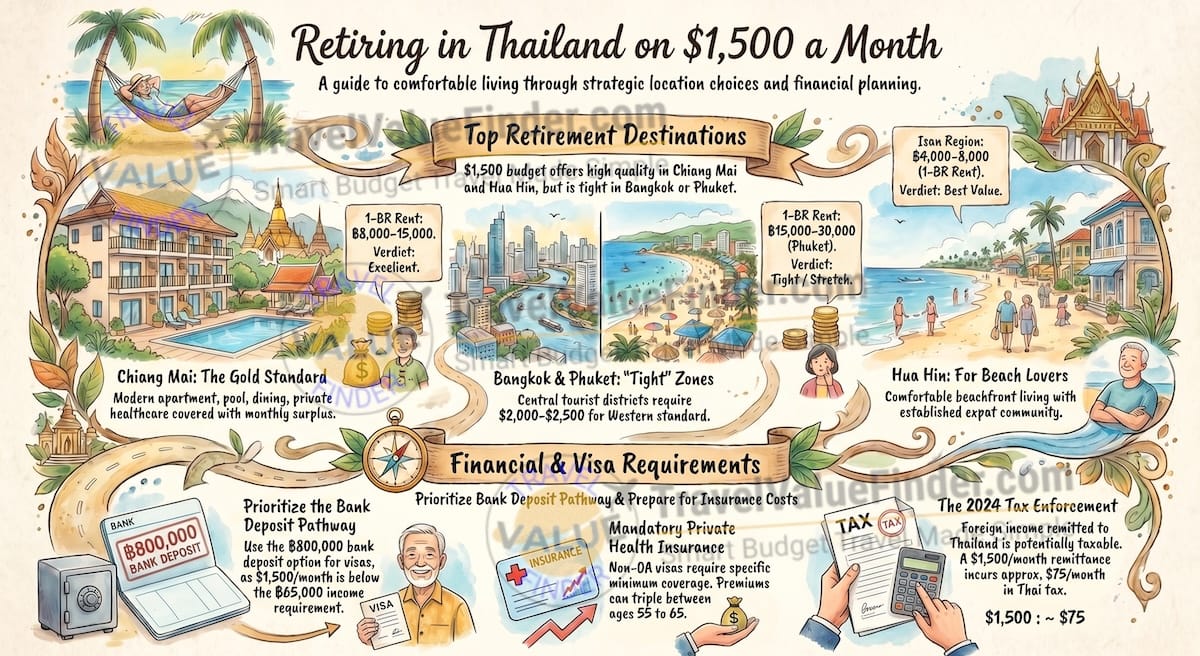
Can you retire in Thailand on $1,500 a month in 2026? Yes, in Chiang Mai, Hua Hin, Isan region, and most provincial cities. No, not comfortably in central Bangkok or Phuket’s tourist zones, where $2,000–$2,500 is more realistic. The Thai Retirement Visa (Non-OA) requires age 50+ and either ฿ 800,000 (~$23,500) in a Thai bank account OR ฿65,000/month (~$1,910 at January 2026 rates of $1 ≈ ฿ 34) income – above $1,500. Strategy: use the 800,000 baht bank deposit option rather than income proof. Private health insurance is mandatory for Non-OA (฿40,000 OPD +฿400,000 IPD minimum coverage). Thailand’s 2024 tax rule is now fully enforced: all foreign income remitted to Thailand from 2024 onward is potentially taxable. Medicare provides zero international coverage. Exchange rate used: $1 =฿34 (January 2026 per Baan Thai Solutions). Find out more on Retiring in Thailand: What 28 Days in Chiang Mai Taught Me (The Test Nobody Takes)
Leslie Nics, TravelValueFinder.com | Last updated: June 2026 | Last Reviewed: June 10 2026
Let’s answer the retire Thailand 1500 month question the way it deserves to be answered: not with a yes or no, but with the specific cities, lifestyle choices, and financial decisions that determine whether $1,500 is generous, tight, or insufficient for your retirement in Thailand.
Here’s the truth that most articles dancing around: $1,500 a month is absolutely workable for a comfortable retirement in the right parts of Thailand – and this is not a budget poverty-lifestyle statement. In Chiang Mai’s Nimman neighborhood, you can live in a modern serviced apartment with a pool, eat remarkably well (a mixture of Thai street food and Western restaurants), have access to world-class private hospitals, and still have money left for weekend trips within Southeast Asia. That’s $1,500.
But Bangkok’s Sukhumvit district or Phuket’s Patong area on $1,500? That’s a fundamentally different conversation. Here, $1,500 requires real trade-offs: smaller apartment, fewer Western meals, more cautious healthcare spending. These are trade-offs some retirees happily make and others find frustrating. Knowing which category you’re in before you buy the plane ticket is the point of this guide.
One more critical number: the Thai Retirement Visa income requirement is ฿65,000/month (~$1,910) – more than $1,500. This means if your income is $1,500, you’ll need to use the ฿800,000 bank deposit pathway for your visa instead of income proof. This is entirely manageable, but it’s a planning requirement most $1,500-a-month articles skip. I’m Leslie Nics of TravelValueFinder.com. Let’s get into the real 2026 numbers.
The Honest Verdict: Where $1,500 a Month Works in Thailand in 2026
$1,500/month (฿51,000 at $1=฿34) is sufficient for a comfortable single-person retirement in Chiang Mai, Hua Hin, Isan region, Pai, Kanchanaburi, and most provincial Thai cities. It is tight in Bangkok and insufficient for a Western-standard lifestyle in Phuket or Koh Samui. Chiang Mai is the gold standard: $1,500 covers modern apartment, private healthcare, dining out regularly, and SEA travel. Bangkok requires $2,000–$2,500 for equivalent comfort. Sources: Asia Lifestyle Magazine Jan 2026, Superagent May 2026, Rumavi Apr 2026, Pacific Prime Jan 2026.
| Location | 1-BR Rent | Monthly Total | $1.5K Verdict | What $1,500 Delivers |
|---|---|---|---|---|
| Chiang Mai | ฿8,000–15,000 | ~$1,000–1,400 | Excellent | Modern apartment + pool; private healthcare; great food; SEA travel surplus |
| Hua Hin | ฿8,000–20,000 | ~$900–1,450 | Very good | Beach lifestyle; large expat community; golf; comfortable with surplus |
| Isan region (Korat, Khon Kaen) | ฿4,000–8,000 | ~$600–1,000 | Excellent value | Lowest costs in Thailand; authentic local life; limited expat infrastructure |
| Pattaya | ฿8,000–18,000 | ~$900–1,400 | Works (lifestyle note) | Works financially; Pattaya’s entertainment focus suits specific retirees |
| Bangkok (Sukhumvit / Silom) | ฿15,000–30,000 | ~$1,500–2,200 | Tight | Possible with compromises; studio or outer neighborhood; limited dining out |
| Bangkok (outer areas: Lat Phrao, On Nut) | ฿8,000–15,000 | ~$1,100–1,600 | Workable | BTS/MRT access; modern apartments; trade-off: 30+ min from city center |
| Phuket (Patong/Kata tourist zones) | ฿15,000–30,000 | ~$1,400–2,000 | Tight–stretch | Premium for island lifestyle; $1,500 requires strict discipline; $2,000 comfortable |
| Koh Samui | ฿12,000–25,000 | ~$1,300–1,900 | Tight | Beautiful island; $1,500 works in low season; high season costs spike |
| Pai / Kanchanaburi | ฿4,000–10,000 | ~$500–900 | Best value | Mountain/rural lifestyle; very low cost; limited infrastructure; peaceful |
Exchange rate: $1 ≈ ฿34 (January 2026, Baan Thai Solutions). Always verify current THB/USD rates – the baht has strengthened since 2024, reducing the purchasing power of U.S. dollars in Thailand.
The $1,500 Verdict: $1,500/month in Chiang Mai = comfortable lifestyle with modern apartment, private healthcare access, restaurant meals regularly, and surplus for travel. $1,500 in Bangkok Sukhumvit = compromised lifestyle in a studio apartment. $1,500 in Phuket Patong = genuinely tight. The city you choose matters more than the number.
The Complete 2026 Thailand Retirement Cost Breakdown
Monthly costs for a single retiree in Thailand in 2026: Housing: ฿8,000–30,000 ($235–882) depending on location and standard; Groceries: ฿4,000–8,000 ($118–235); Dining out: ฿6,000–15,000 ($176–441); Private health insurance: ฿2,500–10,000/month ($74–294); Utilities: ฿1,500–4,000 ($44–118); Transport: ฿2,000–6,000 ($59–176); Entertainment: ฿3,000–8,000 ($88–235). Total comfortable single lifestyle: ฿35,000–45,000 ($1,029–1,324) in Chiang Mai; ฿50,000–80,000 ($1,471–2,353) in Bangkok.
Sources: Pacific Prime Jan 2026, Baan Thai Solutions Feb 2026, Varsovia Estate June 2026.
Housing: Thailand’s Biggest Budget Variable
Housing in Thailand is dramatically different from Western expectations in terms of value. A ฿10,000–15,000/month ($294–441) apartment in Chiang Mai’s Nimman neighborhood – often with pool, gym, 24-hour security, and cleaning service included – is the norm rather than the exception. The same money in Bangkok’s Sukhumvit rents a small studio. Here are 2026 real rents across Thailand’s main retirement destinations:
| City | 1-BR Budget | 1-BR Modern | 2-BR (couple) | Notes |
|---|---|---|---|---|
| Chiang Mai | ฿6,000–8,000 | ฿10,000–15,000 | ฿14,000–22,000 | Nimman: modern; Old City: charming; Hang Dong: expat community |
| Bangkok (Sukhumvit) | ฿12,000–18,000 | ฿18,000–30,000 | ฿25,000–45,000 | On Nut + BTS: most affordable near transit; Asok + Thonglor: premium |
| Bangkok (Lat Phrao/Bearing) | ฿7,000–12,000 | ฿10,000–18,000 | ฿15,000–25,000 | 30 min from center by MRT; good local amenities; local market access |
| Hua Hin | ฿6,000–12,000 | ฿10,000–20,000 | ฿14,000–28,000 | Houses with gardens available at ฿12,000–20,000; more space per baht than Bangkok |
| Phuket (non-tourist zones) | ฿8,000–15,000 | ฿15,000–25,000 | ฿20,000–35,000 | Chalong/Rawai: quieter, cheaper; Patong/Kata: tourist premium |
| Isan (Korat/Khon Kaen) | ฿3,000–6,000 | ฿5,000–9,000 | ฿7,000–13,000 | Lowest rents in Thailand; limited Western amenities; very local |
| Koh Samui | ฿10,000‗20,000 | ฿15,000–30,000 | ฿22,000–40,000 | Higher than mainland; villa-style common; island premium |
Important: Thailand’s property laws prohibit foreigners from owning land freehold. You can own a condominium unit in your own name (provided the building’s foreign ownership quota – typically 49% – is not exceeded). Renting is simpler and usually the best approach for the first 1–2 years. Never sign a long lease without independent legal advice. Find where to stay in Bangkok for a trial stay before committing.
Food: Thailand’s Greatest Retirement Advantage
Thai food culture is one of the world’s great economic advantages for retirees. Eating well in Thailand is not just cheap – it’s transcendently cheap. A plate of pad thai or khao man gai (Hainanese chicken rice) from a street food stall: ฿50–80 ($1.50–2.35). A full meal at a local Thai restaurant: ฿80–150 ($2.35–4.41). Three full Thai street food meals per day costs roughly ฿3,000–4,500/month ($88–132) – a figure that astonishes most new arrivals.
- Street food and local restaurants: ฿50–150/meal ($1.50–4.41). The backbone of budget retirement in Thailand – delicious, hygienic (choose busy stalls), and extraordinarily varied.
- Western restaurants: ฿200–600/meal ($5.88–17.65). A burger and fries at a Western-style café in Chiang Mai’s Nimman: ฿180–250. A pizza in Phuket: ฿350–550. Budget retirees mix Thai street food (5x/week) with occasional Western meals (2x/week).
- Grocery shopping: Makro, Tops Market, Lotus’s (formerly Tesco Lotus), and Big C cover all Western needs. A month of groceries for a single person who cooks half their meals: ฿4,000–8,000 ($118–235). Local fresh markets (talat sot) offer extraordinary value for fruit, vegetables, and protein.
- Alcohol: Thailand has relatively high alcohol taxes. A large bottle of Chang or Singha: ฿55–70 ($1.62–2.06) from 7-Eleven; ฿80–120 at a bar. Wine is significantly more expensive than in Europe; spirits are moderately priced.
Healthcare: The Critical Variable for $1,500 Retirees
Thailand’s private hospital system is world-class at Southeast Asian prices – Bangkok Hospital, Bumrungrad International, Samitivej, and Chiang Mai Ram are internationally accredited and English-speaking, with costs 40–80% below equivalent U.S. care. But the health insurance calculation is one of the most important in the $1,500 Thailand retirement budget, and most articles understate it:
- Non-OA visa mandatory insurance: Requires minimum ฿40,000 OPD / ฿400,000 IPD coverage. This translates to approximately ฿2,500–5,000/month ($74–147) for retirees aged 55–65. Premiums roughly triple between ages 55 and 65 as noted by Rumavi’s 2026 Thailand visa analysis – a critical planning consideration.
- Comprehensive private insurance (recommended): Most retirees opt for more coverage than the visa minimum. A comprehensive policy covering major medical with a $1 million limit runs ฿5,000–10,000+/month ($147–294) for ages 65–70. Pacific Prime is Thailand’s leading insurance broker for expat retirees.
- Pay-as-you-go (No-OA holders): Some retirees (Non-O visa holders, not Non-OA) skip insurance and pay out of pocket for routine care, maintaining savings for major events. A GP consultation at a private hospital: ฿500–1,500 ($15–44). Annual full check-up at Bumrungrad: ฿5,000–20,000 ($147–588).
- Medicare: ZERO coverage in Thailand or any other country outside the United States. This is not negotiable.
| Healthcare Service | Private Hospital Thailand | Government Hospital Thailand | vs. U.S. Cost (uninsured) |
|---|---|---|---|
| GP / outpatient consultation | ฿500–1,500 ($15–44) | ฿100–300 ($3–9) | $150–350 |
| Specialist consultation | ฿1,500–3,000 ($44–88) | ฿300–800 ($9–24) | $250–500 |
| Emergency room visit | ฿2,000–5,000 ($59–147) | ฿500–1,500 ($15–44) | $1,000–3,000+ |
| Dental cleaning | ฿500–1,200 ($15–35) | ฿200–600 ($6–18) | $150–300 |
| Annual comprehensive check-up | ฿5,000–18,000 ($147–529) | ฿1,000–3,000 ($29–88) | $500–1,500 |
| Private insurance (age 60–65) | ฿4,000–7,000/month ($118–206) | N/A | $1,000–1,500+/month |
| Minimum Non-OA insurance | ฿2,500–5,000/month ($74–147) | N/A | (Required for Non-OA visa holders) |
Source: Pacific Prime Thailand 2026 cost guide, Baan Thai Solutions Feb 2026, Rumavi Thailand retirement visa 2026.
Full Sample Monthly Budgets: $1,500 in Three Thai Cities
Three complete monthly budgets for a single American retiree in Thailand in 2026 ($1=฿34): Chiang Mai: total ฿33,200–44,500 ($976–1,309) – $1,500 leaves $191–524 surplus; Bangkok outer areas: total ฿43,000–57,000 ($1,265–1,676) – $1,500 works tightly–comfortably; Hua Hin: total ฿30,500–44,000 ($897–1,294) – $1,500 excellent with surplus. Sources: Expat Den Mar 2026, New Asia Living Jan 2026, Varsovia Estate Jun 2026.
Budget A: Chiang Mai – Where $1,500 Works Best
Chiang Mai is consistently ranked as Thailand’s top retirement city for budget-conscious retirees in 2026. The combination of 30–40% lower housing costs than Bangkok, a well-established English-speaking expat community (thousands of American, British, Australian, and European retirees), a world-class private hospital (Chiang Mai Ram), and a culture-rich highland city that rewards slow exploration makes it the gold standard for retiring in Thailand on $1,500 a month.
| Category | Budget (฿) | Mid (฿) | Comfortable (฿) | Notes |
|---|---|---|---|---|
| Housing (1-BR, Nimman/Santitham area) | ฿8,000 | ฿11,000 | ฿15,000 | Nimman: best expat area; Santitham: quieter, cheaper; pool common at mid tier |
| Groceries (Makro + Talat fresh market) | ฿4,000 | ฿5,500 | ฿7,500 | Local markets dramatically cheaper; Makro for Western brands |
| Dining out (mix Thai + occasional Western) | ฿4,500 | ฿7,000 | ฿10,000 | Thai street food ฿60–120/meal; Western café ฿180–300 |
| Health insurance (Non-OA minimum, age 60–65) | ฿2,500 | ฿4,000 | ฿7,000 | Minimum Non-OA; mid = better policy; comfortable = comprehensive |
| Utilities (electric, water, internet, mobile) | ฿2,200 | ฿3,000 | ฿4,000 | True Move or AIS mobile: ฿300–500/month; fiber internet ฿500–800 |
| Transport (songthaew + Grab + occasional taxi) | ฿2,000 | ฿3,000 | ฿4,500 | Chiang Mai has no sky train; Grab (Thai Uber) + red songthaews |
| Entertainment, day trips, cultural activities | ฿3,000 | ฿5,000 | ฿8,000 | Temple visits (free); Doi Inthanon day trip ฿2,000–3,000 all-in |
| Visa + immigration costs (annual, averaged monthly) | ฿1,000 | ฿1,000 | ฿1,500 | Non-OA annual extension: ฿1,900; TM30 reporting; annual check |
| Personal + miscellaneous | ฿1,500 | ฿2,500 | ฿3,500 | Haircut ฿100–200; massage ฿200–350/hr; laundry service |
| TOTAL (฿/month) | ฿28,700 | ฿42,000 | ฿61,000 | Source: Expat Den 2026, Pacific Prime 2026 |
| TOTAL (USD/month at $1=฿34) | $844 | $1,235 | $1,794 | $1,500 covers mid-comfortable Chiang Mai lifestyle |
Chiang Mai Verdict: $1,500/month in Chiang Mai delivers a mid-to-comfortable retirement: modern apartment with pool in the Nimman area, private health insurance, restaurant meals daily (mix of Thai and occasional Western), and enough left over for day trips and budget travel within Southeast Asia. This is genuinely comfortable, not austerity.
Budget B: Hua Hin – Beach Lifestyle at $1,500
Hua Hin sits 2.5 hours south of Bangkok on the Gulf of Thailand and is Thailand’s most established retirement resort town. The royal family’s summer palace is here; the town has been receiving Western visitors since the 1920s; and the combination of beachfront living, good golf courses, a relaxed pace, and significantly lower costs than Phuket or Koh Samui makes it the beach option for retirees on $1,500.
- Monthly total (single): ฿30,500–44,000 ($897–1,294)
- Housing: Varsovia Estate’s June 2026 cost guide cites a house with a small garden for ฿12,000–20,000/month in Hua Hin – extraordinary value for beach-adjacent living. 1-BR apartments: ฿8,000–15,000.
- Healthcare: Hua Hin Hospital (private) and Bandon International Hospital provide good quality care. Bangkok Hospital Hua Hin branch: more expensive but top tier. Most serious medical issues warrant a trip to Bangkok (2.5 hours).
- Expat community: Large, organized, and active. English-speaking services, Western restaurants, international supermarkets (Hua Hin has a Makro and Villa Market), and social clubs well-established.
- Golf: Hua Hin has 9 championship golf courses. A weekday round starts at ฿1,200 ($35). Monthly golf budget of ฿5,000–8,000 ($147–235) is realistic for enthusiastic players.
Budget C: Bangkok (Outer Areas) – City Life on $1,500 with Trade-Offs
Living in Bangkok on $1,500 a month is entirely possible in the outer districts – Lat Phrao, Bearing, Minburi, or the areas just beyond the BTS/MRT extension lines. Here, 1-BR apartments run ฿7,000–12,000/month with good quality and modern facilities. The trade-off is a 30–45 minute commute by train to central Bangkok rather than walking distance. For retirees who don’t need daily central access, this is entirely manageable.
The more important consideration: Bangkok on $1,500 requires choosing between lifestyle and location. You can have the city-center experience (Sukhumvit Sois 11–23, Thonglor) at $2,000–$2,500. You can have the outer-Bangkok experience (excellent transit access but 30+ min to center) at $1,500. You can’t have the full central Bangkok lifestyle at $1,500 – and understanding this before arrival saves considerable frustration.
- Monthly total (outer Bangkok, single): ฿43,000–57,000 ($1,265–1,676)
- Best outer neighborhoods: On Nut (BTS access, expat-friendly), Lat Phrao (MRT, local feel), Bearing (BTS, quieter), Ram Inthra (cheaper, local)
- Bangkok advantages over Chiang Mai: World’s best international airport connectivity; Bumrungrad International Hospital (among Asia’s top 5); more international dining; better English fluency; Skytrain/MRT covers much of the city
- Find the best budget hotels in Bangkok while visiting before you decide on which city to live in Thailand
The Thailand Retirement Visa in 2026: The Complete Guide
Thailand Retirement Visa (Non-OA): age 50+; either ฿800,000 (~$23,529) in a Thai bank account OR ฿65,000/month (~$1,912) income. Income requirement EXCEEDS $1,500 – use bank deposit option if income is $1,500. Non-OA requires health insurance (฿40,000 OPD + ฿400,000 IPD minimum). Annual extension with 90-day reporting. Thailand Privilege Visa: ฿650,000+ upfront (฿900,000 for 20-year Elite Privilege); eliminates bank deposit; annual reporting. 2024 tax rule: foreign income remitted to Thailand from 2024 onward potentially taxable. Sources: Thai Consulate LA, Siam Legal 2026, Rumavi May 2026, Bright Tax Mar 2026.
Thailand’s retirement visa system has two main pathways – plus the Thailand Privilege (Elite) Visa for those who prefer paying upfront. The most important thing to understand for retirees on $1,500/month: the Non-OA income threshold of ฿65,000/month (~$1,912) is more than $1,500. This does not prevent you from retiring in Thailand – it means you use the ฿800,000 bank deposit pathway rather than income documentation.
Option 1: Non-Immigrant O-A Visa (Standard Retirement Visa)
The most common pathway for American retirees. Issued before arrival by a Thai Consulate outside Thailand.
| Requirement | Specification | 2026 Notes for $1,500 Budget Retirees |
|---|---|---|
| Age | 50 years or older on application date | No exceptions; verify passport birth date matches |
| Financial option 1: Bank deposit | ฿800,000 (~$23,529) in a Thai bank account | Must be in Thai bank at least 2 months before application. Best for retirees on $1,500/month income. Kiwibank, Bangkok Bank, Kasikorn Bank commonly used |
| Financial option 2: Monthly income | ฿65,000/month (~$1,912) from pension/income | EXCEEDS $1,500. Use bank deposit option if monthly income is below ฿65,000 |
| Financial option 3: Combination | Deposit + income totaling ฿800,000/year | E.g., ฿400,000 deposit + ฿33,333/month income. Proportional combination acceptable |
| Health insurance (Non-OA mandatory) | ฿40,000 OPD + ฿400,000 IPD minimum per year | Required from application. Must cover Thailand; domestic or foreign insurer acceptable. Verify with Thai Consulate your specific state |
| Police clearance | Clean criminal record from U.S. | FBI federal check + state-level check. Apostille required. Allow 4–6 weeks |
| Medical certificate | No prohibited diseases (TB, elephantiasis, 3rd-stage syphilis, drug addiction, type 3 leprosy) | From U.S. licensed physician; must be recent |
| Validity + extension | 1 year each stay; annual extension in Thailand | Extend at local Immigration Office 30 days before expiry. Annual 90-day reporting (now mostly digital via IMMO-Online portal) |
| Employment | Strictly prohibited | Any work (including freelance) requires a work permit |
| Visa cost | ฿1,900 ($56) for annual extension in Thailand | Initial Non-OA: $80 at Thai Consulate in U.S. |
Option 2: Non-Immigrant O Visa (In-Country Conversion)
A simpler pathway for retirees already in Thailand on a tourist visa or other status. Apply in Thailand at an Immigration office. The financial requirements are the same as Non-OA (฿800,000 deposit or ฿65,000 income), but health insurance is not mandatory for Non-O (unlike Non-OA). This makes it a popular choice for retirees who want to keep insurance costs truly minimal, though maintaining some private insurance is strongly recommended given Thai hospital billing practices without coverage
Option 3: Thailand Privilege Visa (Elite Visa)
A premium long-stay visa program for those who prefer upfront payment over annual deposit and reporting. Cost: ฿650,000 ($19,118) for a 5-year Elite Flexible One membership; ฿900,000 ($26,471) for a 20-year Elite Privilege Entry (as of January 2026). Benefits include VIP airport handling, no bank deposit requirement, no annual income proof, and simplified 90-day reporting.
- Thailand Privilege 10-year economics: Rumavi’s 2026 visa analysis notes that the Thailand Privilege Visa eliminates the ฿800,000 locked deposit opportunity cost. At 0.5% annual savings rate on ฿800,000, you lose approximately ฿4,000/year in interest on the Non-OA. Over 10 years, the Privilege Visa at ฿900,000 may be cost-competitive if you factor in the deposit opportunity cost and annual reporting compliance burden.
- Best for: Retirees who find annual bank reporting burdensome, want VIP airport service, or don’t have ฿800,000 to keep locked in a Thai bank.
The 2024 Thai Tax Rule: The Most Important Change for 2026 Retirees
Important: CRITICAL: As of January 1, 2024, Thailand’s Revenue Department changed its interpretation of foreign income taxation. All foreign-sourced income (pensions, Social Security, dividends, rental income) remitted to Thailand from 2024 onward is potentially subject to Thai income tax if you are a Thai tax resident (180+ days in Thailand per year). This rule is now in full enforcement in 2026. The U.S. and Thailand do NOT have a comprehensive tax treaty, though there is a limited tax convention. Thai income tax rates range from 0–35% on progressive brackets. Get advice from a Thailand tax specialist before moving.
The practical impact: a retiree remitting $1,500/month ($18,000/year) to Thailand faces potential Thai income tax
- Thai income tax brackets (2026): 0–฿150,000/year: 0%; ฿150,001–300,000: 5%; ฿300,001–500,000: 10%; ฿500,001–750,000: 15%; ฿750,001–1,000,000: 20%; above ฿1,000,000: 25–35%.
- $1,500/month in Thai baht: At $1=฿34, $18,000/year = ฿612,000. After personal deduction (฿60,000) and expense deduction (40%, max ฿100,000), taxable income: approximately ฿452,000. Thai income tax: approximately ฿30,700/year ($903), or roughly $75/month.
- U.S. Social Security: There is no U.S.–Thailand tax treaty covering Social Security. Unlike France, where SS is treaty-protected, in Thailand your SS may be taxable as remitted foreign income if you are a Thai tax resident and send it to Thailand. Verify with a Thailand tax specialist.
- Tax minimization strategies: Keep prior-year savings (earned before Jan 1, 2024) in a separate account to remit as non-taxable savings. Limit remittances to Thailand. Use a Thai credit/debit card linked to a U.S. account to avoid formal ‘remittance’ classification (legal gray area – get advice).
The 5 Best Thai Cities for Retiring on $1,500 a Month in 2026
Top 5 cities for retiring in Thailand on $1,500/month: (1) Chiang Mai – best overall; modern, expat community, Chiang Mai Ram hospital, 30–40% cheaper than Bangkok; (2) Hua Hin – beach lifestyle, established expat scene, golf, relaxed pace; (3) Pattaya – works financially, large expat community, specific entertainment focus; (4) Isan region cities (Korat/Khon Kaen) – lowest cost in Thailand, most authentic, least expat infrastructure; (5) Chiang Rai – underrated northern city, lower cost than Chiang Mai, beautiful scenery.
1. Chiang Mai: The Gold Standard for $1,500 Retirement in Thailand
Chiang Mai has been the benchmark for budget-conscious retirement in Thailand for two decades, and in 2026 it still holds that position. The city strikes an unusual balance: it has all the infrastructure of a major international city (international airport, JCI-accredited hospital, fast fiber internet, international supermarkets, thousands of English-speaking expats) while maintaining housing costs 30–40% below Bangkok.
- Monthly total: ฿28,700–61,000 ($844–1,794) depending on lifestyle tier
- Best neighborhoods: Nimman (most expat-friendly, best coffee shops and restaurants, walkable); Santitham (quieter, more local, cheaper); Old City (cultural heart, guesthouses + small apartments); Hang Dong (South, more space, popular with long-term expats)
- Healthcare: Chiang Mai Ram Hospital is internationally accredited with English-speaking staff. Maharaj Nakhon Chiang Mai (government): excellent quality at a fraction of private costs. Bangkok Hospital Chiang Mai: private, premium
- Day trips: Doi Inthanon National Park (Thailand’s highest peak); Doi Suthep temple; Mae Rim elephant sanctuaries; Lamphun ancient temples; Pai mountain town
- Expat resources: Chiang Mai Expats Club (longest-running expat organization in northern Thailand); CMCC (Chiang Mai Commercial Club); multiple Facebook groups with tens of thousands of members
2. Hua Hin: Best Beach Retirement on $1,500
Hua Hin delivers the Thai beach lifestyle at a price point that works on $1,500 – making it the only major coastal resort where $1,500 is genuinely comfortable (Phuket and Koh Samui require more). The royal connection – the Thai royal family’s Klai Kangwon palace is located here – means the city is exceptionally well-maintained and culturally dignified compared to other Thai resort towns.
- Best areas: Town center (walkable, market access, flat); Khao Takiab (south end, quieter beach); Hua Hin Hills (further south, more residential, cheaper)
- Golf: 9 championship courses. A round at Black Mountain Golf Club (one of Asia’s best) costs ฿2,500–4,000 ($74–118) on weekdays. Monthly golf budget: ฿5,000–8,000 ($147–235)
- Healthcare: Bangkok Hospital Hua Hin provides good quality care. Serious medical issues handled in Bangkok (2.5 hours by road or train)
3. Isan Region (Korat/Khon Kaen/Ubon): Best Value, Most Authentic
The Isan region of northeastern Thailand offers the lowest cost of living in the country and the most authentically Thai living experience. For retirees who genuinely want to integrate into Thai culture rather than an expat bubble, Isan is remarkable: friendly, genuine, and dramatically affordable. A comfortable single retirement here costs $600–1,000/month – leaving $500–900 of surplus on $1,500.
- Honest trade-off: English fluency in Isan is significantly lower than in Chiang Mai, Bangkok, or Hua Hin. International food and Western amenities are limited. Visa extension offices and immigration services are less efficient. This is Thailand for retirees who have learned some Thai and want the genuine country experience.
- Best cities: Nakhon Ratchasima (Korat) – largest and most developed; Khon Kaen – university city with good hospital; Ubon Ratchathani – near Lao border, beautiful Mekong surroundings
4. Pattaya: Works Financially, Specific Lifestyle
Pattaya works on $1,500 a month and has genuine advantages – world-class hospitals (Bangkok Pattaya Hospital is one of Thailand’s finest), close proximity to Bangkok (90 minutes), a large established expat community, and housing costs comparable to Hua Hin. The honest note: Pattaya’s entertainment district has a specific character that suits some retirees and genuinely doesn’t suit others. Its beach is not Thailand’s finest. But retirees who want easy Bangkok access, good healthcare, established expat infrastructure, and international food options at Chiang Mai prices will find Pattaya financially appropriate.
5. Chiang Rai: Underrated Northern Gem
Chiang Rai is the northern city that Chiang Mai was 20 years ago: quieter, more affordable, less developed for expats, but genuinely beautiful and increasingly popular with retirees who find Chiang Mai too busy. Home to the White Temple (Wat Rong Khun) – one of Thailand’s most extraordinary modern temples – and surrounded by the Golden Triangle hill country, Chiang Rai offers a distinctly different pace. Monthly total: ฿25,000–40,000 ($735–1,176) for a single person, leaving substantial surplus on $1,500.
Retiring in Thailand: The Honest Pros and Cons for Americans in 2026
Pros: Extraordinary value for money; world-class private healthcare at fraction of U.S. costs; warm tropical climate; welcoming culture; extensive expat communities; easy visa pathway (฿800,000 bank deposit option); Thailand Privilege Visa option for upfront payment.
Cons: 2024 tax rule (all remitted foreign income potentially taxable); No U.S.–Thailand tax treaty; Non-OA insurance premiums triple by age 65; ฿65,000/month income threshold exceeds $1,500 (use bank deposit instead); land ownership prohibited for foreigners; 90-day reporting compliance required.
| Pros: Why Thailand Works for American Retirees | Cons: What Most Guides Don’t Tell You |
|---|---|
| Extraordinary cost of living: $1,000–1,500/month comfortable in right cities | 2024 Thai tax rule: all foreign income remitted to Thailand now potentially taxable |
| World-class private hospitals (Bumrungrad, Bangkok, Samitivej) at 40–80% below U.S. cost | No U.S.–Thailand comprehensive tax treaty; Social Security not treaty-protected |
| Thai street food: extraordinary quality for ฿50–150/meal | Non-OA income threshold (฿65,000/month) exceeds $1,500 – use bank deposit option instead |
| Warm tropical climate year-round; proximity to beaches | Health insurance premiums roughly triple between ages 55 and 65 (Rumavi 2026) |
| Welcoming culture; Thai hospitality is genuine and warm | 90-day check-in reporting required (now mostly digital, still a compliance burden) |
| Large, well-established expat communities in Chiang Mai, Hua Hin, Bangkok, Pattaya | Foreign land ownership prohibited; condo ownership possible but complex |
| Easy Non-OA visa pathway via ฿800,000 bank deposit option | ฿800,000 locked at near-zero Thai interest rate (2–3%) – real opportunity cost |
| Thailand Privilege Visa option: upfront payment, no annual deposit hassle | Baht strengthening since 2024 reduces U.S. dollar purchasing power in Thailand |
| Medicare doesn’t cover Thailand – but private hospital costs are so low it matters less | Rural areas: limited English; limited Western amenities; car essential |
| Southeast Asia travel hub: flights to Bali, Vietnam, Japan from ฿3,000–8,000 ($88–235) | Property rights for foreigners are complex; rental scams exist; use reputable agents |
How to Retire in Thailand on $1,500 a Month: A Practical 10-Step Plan
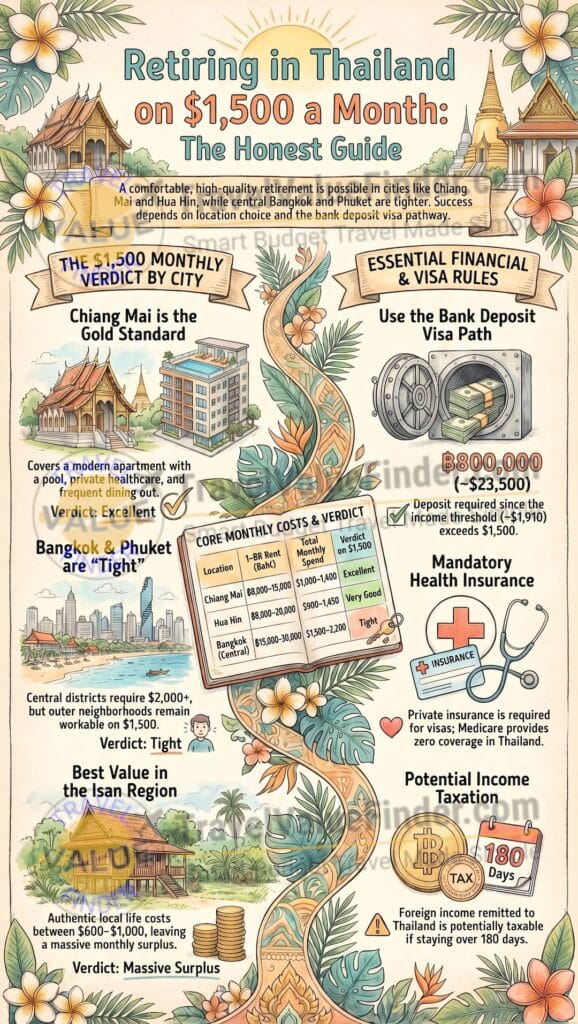
10 steps to retire in Thailand on $1,500/month: (1) Confirm $1,500 income vs. ฿65,000 threshold (use bank deposit option); (2) Open Thai bank account (฿800,000 required); (3) Visit target city for 30+ days; (4) Secure health insurance meeting Non-OA minimum; (5) Get FBI background check; (6) Medical certificate from U.S. physician; (7) Apply for Non-OA at Thai Consulate in U.S.; (8) Arrive in Thailand; (9) Report to immigration (TM30); (10) Extend annually + maintain 90-day check-in. Timeline: 3–6 months.
- Check the income vs. deposit decision: $1,500/month = approximately ฿51,000 at $1=฿34. The Non-OA income threshold is ฿65,000. You need either (a) ฿800,000 in a Thai bank account at least 2 months before application, or (b) income of ฿65,000+, or (c) a combination totaling ฿800,000/year. If your income is $1,500, use the bank deposit option.
- Open a Thai bank account: Bangkok Bank and Kasikorn Bank (KBank) are the most foreigner-friendly for opening accounts in Thailand. You will typically need to open an account in Thailand in person. Bring passport, Non-OA visa (or current visa), and proof of address. Some branches are more flexible than others – tourist area branches of Bangkok Bank often accept foreign visitors.
- Visit Thailand for 30+ days first: Before committing, spend at least 30 days (ideally 60–90) in your target city. Stay in a monthly rental apartment, not a hotel. Eat locally, navigate the transport, visit hospitals, attend expat meetups. The gap between imagined Thailand and lived Thailand is smaller if you’ve already tested it.
- Select and purchase Non-OA health insurance: Must provide minimum ฿40,000 OPD / ฿400,000 IPD coverage. Pacific Prime Thailand, AXA Thailand, Allianz Ayudhya, and BUPA Thailand are the most commonly used by expat retirees. Get a certificate of insurance for your consulate application.
- Obtain FBI criminal background check: FBI.gov Identity History Summary. Apostille required (U.S. Department of State). Allow 4–6 weeks. Some Thai consulates also accept state-level background checks.
- Get a medical certificate: From a U.S. licensed physician certifying absence of the 7 prohibited conditions. Must be recent (within 3 months of application). Bring it to your Thai Consulate appointment with a signed translation if your physician uses non-standard terminology.
- Apply for Non-OA at Thai Consulate in your U.S. state: Make an appointment at the Thai Consulate nearest to you (Los Angeles, Chicago, New York, Houston are the main options). Submit all documents. Processing: typically 3–7 business days. Visa is stamped in your passport and allows 1 year from entry, not from issuance.
- Arrive in Thailand and complete TM30 reporting: Your landlord is technically required to file a TM30 (Notification of Alien Staying) within 24 hours of your arrival. In practice, you may need to file it yourself at immigration if your landlord doesn’t. Non-compliance can complicate annual extensions.
- Begin 90-day check-in reporting: Required every 90 days. Now mostly done online via the IMMO-Online portal or through an immigration agent (฿500–800/$15–23 for agent service). Calendar alerts prevent the easy-to-forget penalties.
- Plan your annual extension: Extend your permission to stay at a local Immigration Office 30 days before your current extension expires. You’ll need: ฿800,000 still in your Thai bank account, or income documentation (฿65,000/month), or the combination; health insurance renewal certificate; passport photos; filled TM86 form; ฿1,900 fee.
Timeline: 3–6 months from decision to arrival. Thai Consulate processing is relatively fast (1–2 weeks at most). The longest delays are: accumulating ฿800,000 in a Thai bank account (can take time to transfer internationally) and getting the FBI background check (4–6 weeks). Start these first.
Planning Your Thailand Exploratory Trip: Hotel Booking Strategy
Before committing to a Thai city, spend 30+ days testing it in a monthly apartment rental. Compare hotel rates across three platforms for initial arrival nights. Agoda has particularly strong Thailand coverage (Thai-origin company). Always compare Booking.com, Agoda, and TripAdvisor before confirming – prices vary 15–25% for the same property in Thailand.
Before locking in a Thai city and visa application, spend at least 30 days living in your target location in a monthly apartment rental (not a hotel). This is the single most valuable pre-move investment you can make. Find out How Much Does Thailand Cost? A Realistic 2026 Budget Guide for visiting Thailand before moving there. For your initial arrival nights and exploratory accommodation, compare rates across our three preferred platforms:
| Platform | Best For | Thailand Advantage | Search Now |
|---|---|---|---|
| Booking.com | Widest inventory + free cancellation | Strong Thailand coverage; long-stay filter; free cancellation essential in Thailand (plans change) | Search Booking.com |
| Agoda | Best Thailand rates (Thai-owned platform) | Often 15–25% cheaper than Booking.com for Thai properties; largest Thailand inventory | Search Agoda |
| TripAdvisor | Reviews + price comparison | Read expat long-stay reviews for monthly rental quality and neighborhood character | Search TripAdvisor |
Honest destination guides and hotel comparisons to help you travel smarter – at the best value.
Hotel listings powered by Stay22 and Booking.com. We may earn a commission at no extra cost to you.
Ready to compare cities now?
- Use our Free Retirement Cost of Living Calculator – get your personalized report in 30 seconds – Free PDF download.
- How to Use a Retirement Cost of Living Calculator – to Compare Cities Worldwide
For the full Southeast Asia retirement context, see our best destinations for retirees guide. For European comparisons: retire in Portugal on $2,000, retire in Spain on $2,500, retire in France on $3,000. Thailand’s value advantage is real – but so are its unique compliance requirements in 2026. Find out Where to Stay in Bangkok: Best Areas, Hotels & Neighborhoods for Every Budget for your trial stay in Bangkok.
Find out How Much Money Do You Need to Retire Abroad? (2026 Country-by-Country Guide) and The Cheapest Countries to Retire Abroad in 2026 (Under $2,000/Month)
Frequently Asked Questions: Retire in Thailand on $1,500 a Month
Can you retire in Thailand on $1,500 a month in 2026?
Yes, in Chiang Mai, Hua Hin, Isan region, and most provincial cities. In Chiang Mai, $1,500 covers a mid-to-comfortable lifestyle: modern 1-BR apartment with pool (฿11,000/month), private health insurance, daily dining out (mix of Thai and Western), and surplus for travel. In Bangkok’s central tourist areas or Phuket, $1,500 requires trade-offs. The crucial planning note: the Thai Retirement Visa income threshold (฿65,000/month ≈ $1,912) exceeds $1,500 – use the ฿800,000 bank deposit pathway instead.
What is the Thai Retirement Visa income requirement and how does it affect $1,500 retirees?
The Non-OA Retirement Visa requires either ฿65,000/month (~$1,912) in income OR ฿800,000 (~$23,529) deposited in a Thai bank account. Since ฿65,000/month exceeds $1,500, retirees on $1,500/month typically use the bank deposit option. The ฿800,000 must be in a Thai bank account at least 2 months before your application. Bangkok Bank and Kasikorn Bank are the most foreigner-friendly options for opening this account. The deposit must remain throughout the year.
What is the 2024 Thai tax rule and does it affect $1,500-a-month retirees?
As of January 1, 2024 (now fully enforced in 2026), all foreign income remitted to Thailand is potentially subject to Thai income tax if you are a Thai tax resident (180+ days/year in Thailand). The U.S. and Thailand have no comprehensive tax treaty protecting Social Security or other income from Thai taxation. A retiree remitting $1,500/month ($18,000/year = approximately ฿612,000) would face Thai income tax of approximately ฿30,700/year ($903), or about $75/month, after standard deductions. This is a meaningful but not devastating addition to costs. Tax minimization strategies exist – get professional advice from a Thailand tax specialist before moving.
Is healthcare in Thailand good enough for American retirees?
Yes, Thailand’s private hospital system is genuinely world-class at prices 40–80% below equivalent U.S. care. Bumrungrad International Hospital in Bangkok is consistently ranked among Asia’s top 5 hospitals with more JCI accreditations than any other hospital in Southeast Asia. Bangkok Hospital (multiple locations), Samitivej, and Chiang Mai Ram are also internationally accredited and English-speaking. Medicare provides zero coverage in Thailand. Health insurance is mandatory for Non-OA visa holders (minimum ฿40,000 OPD + ฿400,000 IPD). Premiums roughly triple between ages 55 and 65.
What are the biggest financial mistakes American retirees make in Thailand?
The five most common: (1) Ignoring the 2024 tax rule – remitting income to Thailand without a tax plan; (2) Underestimating health insurance costs – which triple by age 65; (3) Choosing Bangkok on a Chiang Mai budget – Bangkok requires $2,000–$2,500 for equivalent comfort; (4) Leaving ฿800,000 in a low-interest Thai bank account without optimizing the rest of their portfolio; (5) Failing to account for the strengthening baht – which has reduced U.S. dollar purchasing power in Thailand since 2024. Budget at $1=฿33–34 and verify current rates monthly.
Can you own property in Thailand as an American retiree?
Foreigners cannot own land freehold in Thailand. Condominium ownership in your own name is possible if the building’s foreign ownership quota (typically 49% of units) has not been reached. Renting is simpler and generally better for the first 1–2 years. Lease arrangements (30-year leases on land) exist but require careful legal structuring. Never purchase Thai property without independent legal advice from a licensed Thai attorney (not a real estate agent).
Key Statistics: Retiring in Thailand on $1,500 a Month in 2026
| Data Point | Source | Year |
|---|---|---|
| $1,500–$2,500/month for a single retiree in Thailand (comfortable range) | Pacific Prime / ExpatDen | 2026 |
| Chiang Mai reduces core living costs by 30–40% vs. central Bangkok | New Asia Living | Jan 2026 |
| Non-OA income threshold: ฿65,000/month (~$1,912 at $1=฿34) | Thai Consulate LA / ExpatDen | 2026 |
| Non-OA bank deposit alternative: ฿800,000 (~$23,529) in a Thai bank | Thai Royal Consulate (official) | 2026 |
| Non-OA health insurance minimum: ฿40,000 OPD + ฿400,000 IPD per year | ThaiEmbassy.com / PacificCross | 2026 |
| Health insurance premiums roughly triple between ages 55 and 65 | Rumavi Thailand Visa Analysis | 2026 |
| 2024 Thai tax rule: all foreign income remitted to Thailand potentially taxable | Bright Tax / Thai Revenue Dept | 2026 |
| Thailand income tax brackets: 0–35% progressive; 0% on first ฿150,000 | Thai Revenue Department | 2026 |
| Thailand Privilege Visa cost: ฿650,000 (5-year) to ฿900,000 (20-year) | Thailand Privilege Program | 2026 |
| Chiang Mai 1-BR modern apartment with pool: ฿10,000–15,000/month ($294–441) | Expat Den / Varsovia Estate | 2026 |
| Hua Hin monthly budget (comfortable single): ฿35,000–50,000 ($1,029–1,471) | Varsovia Estate | Jun 2026 |
| Bangkok Sukhumvit monthly budget (single): ฿50,000–80,000 ($1,471–2,353) | Superagent / New Asia Living | 2026 |
| Bumrungrad International: GP visit ~฿1,500 ($44); most specialist ~฿2,000–3,000 | Baan Thai Solutions | Feb 2026 |
| Thai street food meal: ฿50–150 ($1.47–4.41) | Asia Lifestyle Magazine | Jan 2026 |
| 90-day check-in: required; digital via IMMO-Online portal | Thai Immigration Bureau | 2026 |
| Annual Non-OA extension fee: ฿1,900 ($56) | Thai Immigration Bureau | 2026 |
| Exchange rate January 2026: $1 ≈ ฿34 | Baan Thai Solutions / Numbeo | 2026 |
| Foreign condo ownership: allowed up to 49% of units in a building | Thai Condominium Act | current |
| Average U.S. Social Security benefit 2026: $2,071/month | Social Security Administration | 2026 |
| Medicare: zero coverage outside the United States | U.S. CMS | 2026 |
About the Author
Leslie Nics is the founder and lead writer of TravelValueFinder.com. This article draws on 2026 data from Pacific Prime Thailand (January 2026), Expat Den (March 2026), New Asia Living (January 2026), Baan Thai Solutions (February 2026), Superagent (May 2026), Rumavi (April & May 2026), Asia Lifestyle Magazine (January 2026), Varsovia Estate (June 2026), Bright Tax (March 2026), the Thai Royal Consulate Los Angeles, ThaiEmbassy.com, Siam Legal, and official Thai Immigration Bureau sources. No competitor articles were used as external links. All THB/USD figures use $1=฿34 (January 2026). Tax guidance is educational – consult a Thailand tax specialist before relocating.
Sources: Pacific Prime: Cost to Retire in Thailand 2026 | ExpatDen: Cost of Retiring in Thailand 2026 | New Asia Living: Thailand Retirement Cost Calculator 2026 | Baan Thai Solutions: How Much to Retire in Thailand 2026 | Superagent: Retiring in Thailand Full Cost Breakdown 2026 | Rumavi: Retiring in Thailand 2026 | Rumavi: Thailand Retirement Visa 2026 | Bright Tax: Retire in Thailand Tax Guide 2026 | Asia Lifestyle Magazine: Live in Thailand on $1,500 2026 | Varsovia Estate: Cost of Living Thailand 2026 | ThaiEmbassy.com: Health Insurance Thailand Retirees | Siam Legal: Thailand Retirement Visa 2026 | Thai Consulate Los Angeles: Non-Immigrant O Retirement