Travel Value Finder

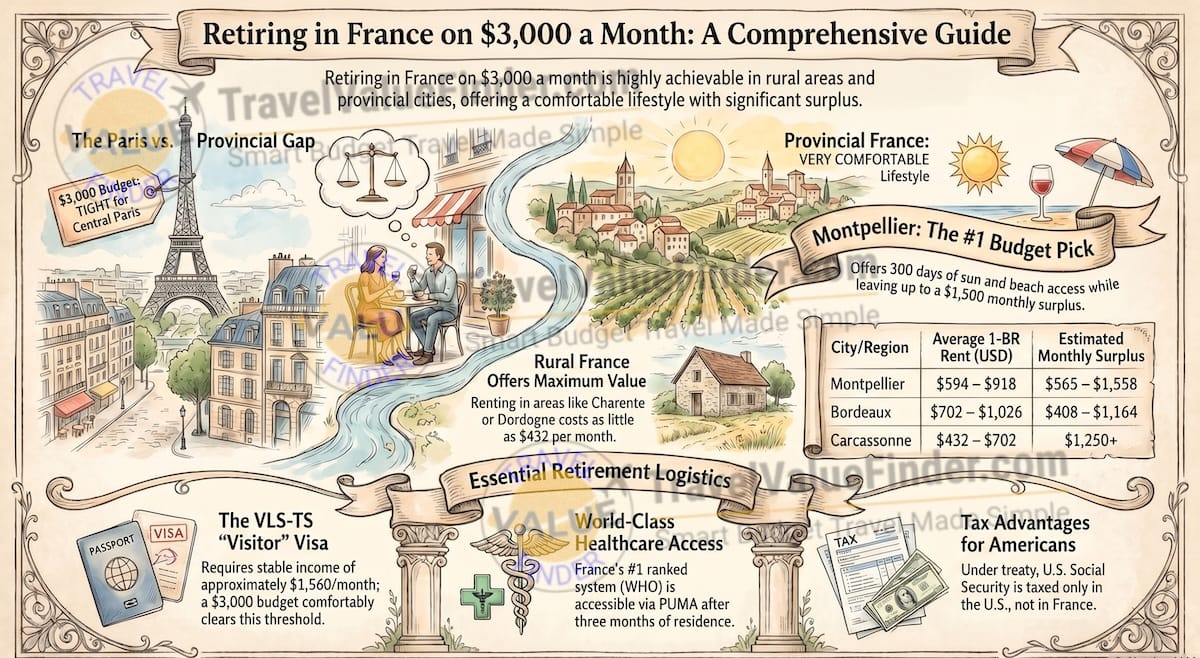
Can you retire in France on $3,000 a month in 2026? The honest answer depends entirely on where in France you live. In rural Charente, the Dordogne, the Lot, or smaller provincial cities (Carcassonne, Limoges, Perpignan), $3,000 covers a comfortable retirement with surplus. In Montpellier, Bordeaux, Lyon, or Nice, $3,000 is workable but tight. In Paris, $3,000 is insufficient for a comfortable lifestyle. France’s Long-Stay Visitor Visa (VLS-TS Visiteur) income threshold in 2026 is approximately €1,443/month (~$1,560 at €1=$1.08), well below $3,000. France’s healthcare system is ranked #1 in the world (WHO). After 3 months of stable residence, retirees can join PUMA, France’s universal healthcare system. The French government estimates a single person needs €1,800/month to live comfortably. Medicare provides zero international coverage. Exchange rate used: €1 = $1.08 USD (May 2026).
Leslie Nics, TravelValueFinder.com | Last updated: June 2026 | Last Reviewed: June 08 2026
Let’s start with what most ‘retire in France on $3,000 a month’ articles won’t admit: $3,000 a month is enough to retire comfortably in France – but not everywhere, and not in the way most Americans imagine France. If your mental picture is a terrace apartment overlooking Parisian rooftops and weekend train trips to the Riviera, $3,000 will fall short. If your picture is a stone farmhouse in the Dordogne, a riverfront apartment in Bordeaux’s quieter neighborhoods, or a sunlit flat in Montpellier two blocks from the tram, $3,000 gets you there and more.
The other thing most articles understate: France is more complex than Portugal or Spain for American retirees. The visa pathway is more bureaucratic, the language barrier is real (and important), the tax situation requires careful planning, and healthcare access has a 3-month gap at the start. None of these are dealbreakers – but they require honest accounting before you book a one-way ticket.
I’m Leslie Nics, founder of TravelValueFinder.com. This guide draws on verified 2026 data from RetireFinder’s France Guide (March 2026), Libertymundo’s Retire in France Guide (May 2026), LifeInRuralFrance.com (May 2026), Finarmour France cost analysis (April 2026), and the France-fi.com visa guide. No aspirational estimates. Just real numbers.
The Honest Answer: $3,000 a Month in France – Where It Works
$3,000/month (€2,778 at €1=$1.08) comfortably covers retirement in rural France (Charente, Dordogne, Lot) and smaller cities (Carcassonne, Limoges, Perpignan). In Montpellier, Bordeaux, and Lyon, $3,000 is workable. In Paris, $3,000 is tight. The French government’s own estimate for comfortable single-person living is €1,800/month ($1,944). RetireFinder March 2026: comfortable single retirement outside Paris costs €1,700–2,500/month ($1,836–2,700). Couples: €2,100–2,800/month ($2,268–3,024).
Sources: Libertymundo May 2026, RetireFinder March 2026, Finarmour April 2026.
| Location | 1-BR Rent | Monthly Total | $3K Verdict | What $3,000 Delivers |
|---|---|---|---|---|
| Paris (central) | €1,200–1,700 | ~$2,700–3,800 | Tight / stretch | Affordable in outer arrondissements (18–20th); insufficient in Le Marais or Saint-Germain |
| Paris (outer arrondissements) | €900–1,200 | ~$2,200–3,000 | Works (just) | Small apartment; limited dining out; Montmartre or Belleville neighborhoods |
| Nice / Côte d’Azur | €750–1,100 | ~$1,900–2,800 | Comfortable | Mediterranean lifestyle; large expat community; beach access; significant surplus |
| Lyon | €700–1,000 | ~$1,800–2,600 | Comfortable | France’s food capital; superb healthcare (CHU Lyon); excellent transit |
| Bordeaux | €650–950 | ~$1,700–2,500 | Very comfortable | Wine country; Atlantic coast; world-class food; UNESCO riverfront; $500+ surplus |
| Montpellier | €550–850 | ~$1,600–2,300 | Excellent value | 300 days sunshine; beach 10km; #1 budget pick in south France; large expat community |
| Toulouse | €550–850 | ~$1,500–2,200 | Very comfortable | Rose city; vibrant cultural life; excellent healthcare; 20% cheaper than Bordeaux |
| Carcassonne | €400–650 | ~$1,200–1,750 | Excellent value | UNESCO walled city; wine country; under €1,351/month possible; $1,250+ surplus on $3K |
| Rural (Charente/Dordogne/Lot) | €400–700 (own property ideal) | ~$1,600–2,300 (if renting) | Excellent value | Authentic French countryside; slower pace; car essential; expat communities established |
Exchange rate: All USD figures use €1 = $1.08 (May 2026 rate from Finarmour/Numbeo). Always check current EUR/USD rates and build a 10–15% buffer into budget projections.
The $3,000 Sweet Spot: $3,000/month puts you comfortably above the French government’s own estimate of €1,800/month for comfortable single-person living. You’re above the Visiteur visa income threshold (€1,443/month). In most of France outside Paris and the Riviera’s most expensive pockets, $3,000 delivers a genuinely comfortable lifestyle with surplus. The question isn’t whether you can afford France on $3,000 – it’s whether France’s language, bureaucracy, and complexity match your patience and interests.
The Complete 2026 France Retirement Cost Breakdown
2026 monthly costs for a single retiree in France: Housing (1-BR, varies widely): €400–1,700; Groceries: €300–450; Dining out: €200–350; Healthcare (PUMA + mutuelle after 3 months): €100–250; Private insurance (first 3 months): €40–80/month; Utilities: €120–200; Transport: €50–80 (city) or €200–280 (car); Entertainment: €100–200. Total range outside Paris: €1,400–2,400 ($1,512–2,592). Rural France (owning home): €1,300–2,000 for a couple.
Sources: LifeInRuralFrance May 2026, RetireFinder March 2026, Libertymundo May 2026. Cost of living in France, Travel Value Finder.
Housing: The Defining Variable in France
France’s housing costs vary more dramatically by location than almost any other European country. The same money that rents a small studio in Le Marais (Paris 3rd) rents a spacious 2-bedroom with period features in Bordeaux, Toulouse, or Montpellier. In rural France, the same budget buys or rents a stone farmhouse with garden. Here are real 2026 rents across France’s major retirement destinations:
| City/Region | 1-BR Central | 1-BR Residential | 2-BR (couple) | USD Equivalent (1-BR central, @$1.08) |
|---|---|---|---|---|
| Paris (central) | €1,200–1,700 | €900–1,200 | €1,600–2,200 | $1,296–1,836 |
| Nice | €750–1,100 | €600–900 | €1,000–1,400 | $810–1,188 |
| Lyon | €700–1,000 | €560–800 | €950–1,300 | $756–1,080 |
| Bordeaux | €650–950 | €520–760 | €880–1,250 | $702–1,026 |
| Montpellier | €550–850 | €440–680 | €750–1,100 | $594–918 |
| Toulouse | €550–800 | €440–640 | €750–1,050 | $594–864 |
| Strasbourg | €550–800 | €440–640 | €750–1,050 | $594–864 |
| Carcassonne | €400–650 | €320–520 | €550–850 | $432–702 |
| Rural Charente/Dordogne | €400–700 (rent) | Buy: €80,000–200,000 | €550–900 (rent) | $432–756 if renting |
| Normandy coast | €450–700 | €360–560 | €600–900 | $486–756 |
| Source | Lexidy Feb 2026 | Finarmour Apr 2026 | Libertymundo May 2026 | At €1=$1.08 USD |
Rural France Note: Most American retirees in rural France eventually buy property rather than rent – house prices in Charente, Dordogne, Lot, and Creuse are among the lowest in Western Europe. A 3-bedroom stone farmhouse in the Dordogne can be purchased for €100,000–180,000. Owning your home eliminates the largest cost category and dramatically changes the $3,000/month arithmetic. Find out if you should rent or buy property in France.
Food: Where France Earns Its Reputation (and Budget)
France’s food costs are higher than Portugal, Spain, or Thailand – but the quality-to-cost ratio is extraordinary when you shop like a local. The French supermarket revolution means that Lidl, Aldi, and Leader Price now compete in every French town, offering remarkably good-value shopping. But the real food advantage is the marché culture: covered markets operating 2–3 days per week in every French town and city where local producers sell fruit, vegetables, cheese, charcuterie, and bread at prices that beat supermarkets for quality and often for cost.
- Monthly groceries (single person): €300–450. A couple: €500–600 (LifeInRuralFrance, May 2026)
- Restaurant meals: A plat du jour (daily special) at a local brasserie: €12–18 for a hearty main course. The two-course formule déjeuner (lunch menu): €15–25. Dinner for two at a mid-range restaurant: €50–80. Michelin-starred: budget accordingly.
- Wine: French wine at exceptional quality starts at €4–9/bottle at a supermarket. Regional wines at a local cave (wine shop) offer extraordinary value – a serious Bordeaux for €8–15, a fine Burgundy for €15–30.
- Bread: A freshly baked baguette from a boulangerie: €1.10–1.50 (regulated price in most regions). The French bake twice daily; fresh bread is a ritual and a genuine lifestyle pleasure that costs almost nothing.
- Markets (marchés): Every town in France has a weekly outdoor market. In the Dordogne and Provence, these markets are among the finest food experiences available – fresh duck confit from the farmer’s own ducks, walnut oil pressed the same week, goat cheese made that morning.
Healthcare: France’s World #1 System for American Retirees
France’s healthcare system is ranked #1 in the world by the World Health Organization – the highest possible ranking, and a classification it has held consistently. For American retirees, this means:
- First 3 months: Private health insurance required (for your visa and for coverage). Must provide at least €30,000 coverage and medical repatriation to the U.S. Cost: €40–80/month for most retirees under 70. PUMA healthcare access is not automatic on a Visitor visa in the first 3 months – do not arrive without private insurance.
- After 3 months: Enroll in PUMA (Protection Universelle Maladie), France’s universal public health system. Sécurité Sociale reimburses approximately 70% of standard medical costs. Most retirees purchase a mutuelle (complementary insurance) to cover the remaining 30%. Cost: €100–250/month depending on age and coverage.
- GP visit: Base rate €26.50 (regulated); Sécurité Sociale reimburses €21.20; you pay €5.30 (often further covered by mutuelle).
- Hospital: Fully covered by Sécurité Sociale + mutuelle for most treatments. Daily hospital fee of €20 applies; mutuelle typically covers this.
- Dental: Partially covered by Sécurité Sociale and mutuelle. Dental coverage in France is significantly more comprehensive than in Spain or Portugal through the complementaire santé system.
- Medicare: ZERO coverage outside the United States. Non-negotiable for any American living in France.
- Find out more about the healthcare in France – a complete guide.
Utilities, Transport & Digital
| Category | Paris / Major Cities | Provincial / Rural | Notes |
|---|---|---|---|
| Electricity + gas (EDF/Engie) | €100–200/month | €80–160/month | Rural wood heating can be cheaper in winter |
| Water | €20–40/month | €15–30/month | Very low; included in charges in many apartments |
| Internet (fiber, Orange/SFR/Free) | €30―50/month | €25–45/month | Fiber in towns; ADSL in rural (slower) |
| Mobile phone | €10–30/month | €10–25/month | Free Mobile: €8/month excellent plan |
| Monthly transport pass | €55–90/month | €30–60/month | Paris Navigo (all zones): €86.40/month |
| Car (rural – essential) | N/A (use transit) | €200–280/month | Fuel + insurance + maintenance; rural requires a car |
| Property tax (taxe foncière, averaged) | €80–200/month (Paris) | €50–110/month (rural) | Annual charge averaged monthly; owners pay; renters exempt |
| Home insurance (assurance habitation) | €20–45/month | €15–35/month | Legally required for tenants and owners |
| Bank fees (frais bancaires) | €5–20/month | €5–20/month | Use BoursoBank, Fortuneo or N26 to avoid fees |
Bank Fees Warning: French traditional banks (BNP Paribas, Société Générale, Crédit Agricole) charge significantly higher fees than online banks. Basic account maintenance can run €24–65/year, plus fees for wire transfers, direct debits, and basic services. Use BoursoBank (France’s best-rated online bank) or Fortuneo to avoid these – but note you may need a French address before opening.
Full Sample Monthly Budgets: $3,000 in Three Very Different Locations
Three complete monthly budgets for a single American retiree in France in 2026 (€1=$1.08 USD): Montpellier: total €1,550–2,100 ($1,674–2,268) -$3,000 leaves $732–1,326 surplus; Bordeaux: total €1,700–2,400 ($1,836–2,592) – $3,000 leaves $408–1,164 surplus; Rural Charente (renting): total €1,600–2,200 ($1,728–2,376) – $3,000 leaves $624–1,272 surplus. Sources: LifeInRuralFrance May 2026, Libertymundo May 2026, RetireFinder March 2026.
Budget A: Montpellier – $3,000’s Best Urban Value in France
Montpellier is the standout city for retiring in France on $3,000 a month in 2026. It offers 300 days of sunshine per year, the sea 10km away, one of France’s best teaching hospitals (CHU Montpellier), a world-class tram system, a young and vibrant cultural atmosphere from its 70,000-student university, and housing costs 40–50% below Paris. RetireFinder rates Montpellier as the #1 budget pick for southern France retirement: a single expat needs $1,800–2,500/month here, well within the $3,000 range.
| Category | Low (€) | Mid (€) | High (€) | Notes |
|---|---|---|---|---|
| Housing (1-BR, Écusson or Antigone area) | €550 | €700 | €850 | Écusson: historic center; Antigone: modern, flat, near tram |
| Groceries (Lidl + Grand Marché des Arceaux) | €240 | €310 | €390 | Les Arceaux Saturday market: finest in southern France |
| Dining out (brasseries + local restaurants) | €150 | €220 | €290 | Plat du jour €12–15; formule déjeuner €16–22 |
| Healthcare (PUMA + mutuelle after 3 months) | €100 | €160 | €220 | Mutuelle varies by age; €120–180 typical for 65–75 |
| Utilities (electric, water, internet, mobile) | €120 | €155 | €185 | Mediterranean climate: lower heating costs than Paris |
| Transport (Montpellier tram/bus monthly) | €55 | €55 | €70 | Exceptional 6-line tram network covers the whole city |
| Entertainment, culture, beach day trips | €80 | €130 | €180 | Beaches 10km away; Spain 2hrs; Camargue 45 min |
| Assurance habitation + phone + bank | €40 | €55 | €70 | Home insurance required; use BoursoBank or Free Mobile |
| TOTAL (€/month) | €1,335 | €1,785 | €2,255 | Source: RetireFinder 2026, LifeInRuralFrance 2026 |
| TOTAL (USD/month at $1.08) | $1,442 | $1,928 | $2,435 | $3,000 leaves $565–1,558 monthly surplus |
Montpellier Verdict: $3,000/month in Montpellier delivers a genuinely comfortable retirement: Mediterranean sunshine, beach access, excellent healthcare, vibrant city life, and $565–1,558 monthly surplus for European travel, savings, or a better apartment. This is the strongest value proposition in France for American retirees on a $3,000 budget.
Budget B: Bordeaux – Wine Country, UNESCO Riverfront, $408–$1,164 Surplus
Bordeaux is France’s most beautiful mid-size city by most measures and one of its most rewarding for retirees. The UNESCO-listed historic waterfront (Port de la Lune), the extraordinary wine country beginning literally at the city’s edge, the direct TGV to Paris in 2 hours, and a food culture rivaling Lyon – all at housing costs 35–40% below Paris. Libertymundo’s May 2026 guide puts a comfortable single retirement in Bordeaux at €1,700–2,400/month ($1,836–2,592), leaving a comfortable surplus on $3,000.
- Best neighborhoods: Chartrons (antiques, wine merchants, flat), Victoire (student quarter, vibrant), Saint-Michel (local, authentic, cheaper), Capéran (quiet, residential).
- Monthly total (single): €1,700–2,400 ($1,836–2,592). $3,000 leaves $408–1,164 surplus.
- Healthcare: CHU Bordeaux is one of France’s finest teaching hospitals. Multiple English-speaking doctors available in the expat community.
- Wine: Bordeaux wine country begins at the city limits. Medoc châteaux are 30 minutes north; Saint-Émilion 40 minutes east. A case of quality Château Mouthes le Bihan from the Sunday morning market costs €40–60.
- Day trips: Atlantic coast (Arcachon, the Grand Dune du Pilat) 45 minutes; Basque Country (Biarritz, Bayonne) 90 minutes; Spanish border 2 hours; Dordogne 90 minutes.
Budget C: Rural France (Charente/Dordogne/Lot) – $3,000 with Authentic French Country Life
Rural France is where the numbers work most elegantly on $3,000 a month – but where the France realities are most concentrated. A car is absolutely essential. French is genuinely necessary for daily life (English penetration is very low in rural communities). And the authentic French countryside life that draws retirees to the Charente, Dordogne, and Lot is only accessible if you’re willing to integrate, learn the language, and participate in village life. But for retirees who meet those criteria, rural France offers something extraordinary: a genuinely different way of living for approximately $1,600–2,200/month (renting) or dramatically less if you own your home.
The couple budget from LifeInRuralFrance.com (May 2026, written by someone who has lived in rural Charente since 2016) provides the most honest real-world data available: groceries and household €500–600; utilities €350–450; healthcare €380–460; car €200–280; home insurance €35–55; property tax €70–110; dining out €200–400. Total couple budget: €1,735–2,355/month ($1,874–2,543) – leaving a couple with $457–1,126 surplus on $3,000 combined.
- Buying vs. renting: The rural France calculation changes dramatically if you own your home. A 3-bedroom stone farmhouse in the Charente or Lot costs €100,000–200,000. Owning eliminates the largest cost line item and allows a couple to retire comfortably on combined Social Security of $3,000–3,500/month.
- Property taxes: Taxe foncière (property tax) is the main annual charge for homeowners in France. In rural departments, annual property tax on a modest home runs €600–1,200 (€50–100/month averaged).
- The French language requirement: In rural France, not speaking French is genuinely limiting in a way it isn’t in Paris, Nice, or Bordeaux. Healthcare appointments, local services, market interactions, and community life all require basic to intermediate French. Plan for language classes (€80–200/month) in your first year budget.
The Long-Stay Visitor Visa (VLS-TS Visiteur): How Americans Retire in France in 2026
France’s retirement pathway is the Long-Stay Visitor Visa (VLS-TS Visiteur) – not a dedicated retirement visa. Income threshold: approximately €1,443/month (€17,300/year), based on the SMIC. Well below $3,000. Private health insurance (€30,000+ coverage, medical repatriation) required for the application. After 3 months stable residence: PUMA healthcare access (though not automatic for Visitor visa holders – verify with your prefecture). After 5 years: 10-year carte de résident. After 5 years with B2 French + civic exam (reformed January 2026): French citizenship. Sources: France-fi.com, EasyFranceNow, Libertymundo May 2026.
France doesn’t issue a visa labeled “retirement visa.” American retirees apply through the Visa de Long Séjour valant Titre de Séjour, category ‘Visiteur’ (VLS-TS Visiteur) – a one-year renewable residency permit for people who can financially support themselves without working in France. As the EasyStart VLS-TS guide notes: “‘Visitor’ does not mean tourist. It means you are not here to work.” Find out more about the France VLS-TS Visa.
VLS-TS Income Requirements: What 2026 Consulates Actually Expect
The formal income threshold for the VLS-TS Visiteur in 2026 is approximately €1,443/month (€17,300/year) – based on France’s SMIC (minimum wage). This is the figure most consulates use as a reference point, according to France-fi.com’s visa guide. At the May 2026 rate of €1 = $1.08, this is approximately $1,558/month – significantly below $3,000. Your $3,000 income comfortably clears this threshold.
However, some consulates set expectations above the formal SMIC threshold. Libertymundo’s France guide notes that the real expectation at application review is closer to €1,400/month – while the RetireFinder France guide puts the effective expectation at €1,500–2,000/month at most U.S. consulates. For a single applicant with $3,000/month in documented income, you comfortably exceed any consulate’s income expectations for the VLS-TS.
The VLS-TS Requirements Checklist 2026
| Requirement | What It Means | 2026 Details |
|---|---|---|
| Proof of financial resources | Stable recurring income or accessible savings | €1,443+/month threshold (SMIC). $3,000/month SS + pension comfortably exceeds this. Show 3–6 months of bank statements + income source documents |
| Valid U.S. passport | At least 3 months past intended departure | Most consulates recommend 1+ year of remaining validity. Renew at passportappointment.state.gov |
| Private health insurance | Min €30,000 coverage + medical repatriation to U.S. | Required for full visa period (1 year). Must specifically cover France; low or zero deductible preferred. Cigna Global, Allianz Care, AXA International; cost €40–80/month for most retirees under 70 |
| Proof of accommodation | Address in France for duration of stay | Long-term lease or property deed. 3-month Airbnb sometimes accepted for initial arrival by some consulates |
| Criminal background check | Clean record from U.S. authorities | FBI check + state-level check at some consulates. Apostille required. Allow 4–6 weeks |
| Completed application forms | French government forms + supporting letter | Apply at france-visas.gouv.fr. Include a cover letter in French (or English with translation) describing your ‘project’ in France |
| Application fee | Consular and OFII fees | €99 (~$107) visa fee; €225 (~$243) OFII tax due upon arrival in France |
| OFII validation (after arrival) | Office Français de l’Immigration et de l’Intégration | Must validate your VLS-TS online within 3 months of arrival at ofii.fr. You then receive your residence permit (sticker in passport) |
| Annual renewal (in France) | Renew at local prefecture 2 months before expiry | Must show 183+ days in France. Same income and insurance documentation as original application. Process done at prefecture – no need to return to U.S. |
| Citizenship path | French citizenship after 5 years | 5 years continuous residence + B2 French + civic exam (reformed January 2026 to be more rigorous) + integration proof. French passport: visa-free to 192 countries |
Important: The VLS-TS Visiteur is technically a non-working visa. If you generate any income in France (freelance work, local employment, French-source investments), you need a different visa category. Social Security, U.S. pensions, and foreign-source investments are passive income and do not violate the non-working requirement.
Healthcare Transition: The 3-Month Gap and PUMA Access
The single most commonly misunderstood aspect of retiring in France for Americans is the healthcare transition. You are NOT automatically enrolled in PUMA on day 1. The process:
- Months 1–3: Private health insurance only. Your visa-required private insurance (€40–80/month) covers everything during this period. Do not arrive in France without it.
- After 3 months stable residence: You may apply for PUMA at your local CPAM (Caisse Primaire d’Assurance Maladie). Note: PUMA access is not automatic for Visitor visa holders – it depends on your prefecture and individual circumstances. As Hiliv’s VLS-TS guide explicitly states, “A visitor visa holder who does not work in France may not automatically qualify.”
- PUMA + mutuelle: Once enrolled in PUMA (Sécurité Sociale), you’ll want to add a mutuelle (complementary insurance) covering the 30% not reimbursed by the state. Cost: €100–250/month depending on age and coverage level.
- PUMA contribution for retirees: Retirees without French-source income may pay a PUMA cotisation (contribution) based on their foreign income if it exceeds a threshold. As of 2026, foreign income above approximately €5,000/year is subject to PUMA cotisation of 6.5%. Budget for this as a healthcare cost – the LifeInRuralFrance couple budget accounts for €380–460/month for healthcare including this cost.
French Taxes for American Retirees: What You Must Know in 2026
U.S.-France tax treaty (Article 18): U.S. Social Security is taxed only in the U.S., not in France. U.S. private pensions are taxable in France as a resident. French income tax is progressive (0–45%). U.S. citizens must file both French and U.S. tax returns annually. PUMA cotisation: 6.5% on foreign income above €5,000/year (if no PUMA contributions made by an employer). Form 720 equivalent: FICOBA declaration for foreign bank accounts. Wealth tax: abolished (ISF) for most residents since 2018. Professional tax advice is essential before relocating.
France’s tax system is genuinely complex and has a different structure from Spain or Portugal for American retirees. The headline numbers are manageable for most retirees on Social Security and pension income – but the bureaucratic requirements are real and should not be underestimated:
- U.S. Social Security: Under the U.S.–France Tax Treaty (Article 18), U.S. Social Security benefits are taxable only in the U.S. – not in France. France uses this income to calculate your ‘effective rate’ for French-source income, but you are not taxed on it directly in France.
- U.S. private pensions and IRA distributions: These are generally taxable in France as a resident, with credit given for U.S. taxes paid. France’s income tax on this income: 0% on the first €11,294; 11% on €11,295–28,797; 30% on €28,798–82,341. Most retirees with modest income fall in the 11–30% bracket.
- PUMA healthcare contribution: If you are not paying into France’s social system through work, you may owe a 6.5% PUMA cotisation on your foreign income above €5,000/year. This is in addition to income tax. The LifeInRuralFrance.com budget accounts for this as a significant cost (€380–460/month for a couple covers PUMA contributions + mutuelle).
- French tax returns: As a French tax resident (183+ days/year), you must file an annual French income declaration (Déclaration de revenus) by late May each year. This includes all worldwide income.
- U.S. tax obligations: Moving to France does not end your U.S. tax filing obligations. File both an annual Form 1040 and FBAR (FinCEN 114) for foreign bank accounts above $10,000. The Foreign Earned Income Exclusion (FEIE) does not apply to pension or Social Security income.
Important: Get professional advice from a tax advisor or accountant experienced in both U.S. and French tax law before relocating. The combination of PUMA cotisation, French income tax on pensions, and continued U.S. filing requirements can significantly affect your net retirement income in France. Find out more about Taxes in France for Retirees.
The 6 Best French Cities and Regions to Retire on $3,000 a Month in 2026
Top picks for retiring in France on $3,000/month: Montpellier (#1 value, 300 days sun, 10km from beach, CHU hospital, $565–1,558 monthly surplus); Bordeaux (UNESCO riverfront, wine country, $408–1,164 surplus); Toulouse (rose city, 20% cheaper than Bordeaux, excellent healthcare); Rural Charente/Dordogne (stone farmhouses, authentic French life, car essential, French required); Nice/Côte d’Azur (Mediterranean luxury lifestyle, large expat community, beach); Carcassonne/Occitanie (UNESCO medieval city, under €1,351/month possible, largest $3K surplus). Find out more about the best places to live in France after 55.
1. Montpellier: Best Overall for Budget-Conscious Retirees
Montpellier is France’s most compelling city for American retirees on $3,000 a month in 2026. 300 days of sunshine per year. The Mediterranean Sea at Sète or Palavas-les-Flots, 10km away. One of France’s finest teaching hospitals. A world-class tram and bus network. A UNESCO heritage old town (Écusson) and a network of outdoor markets including the celebrated Saturday Les Arceaux market. And housing costs that leave $500–1,500 monthly surplus on a $3,000 budget.
- Monthly total (single): €1,335–2,255 ($1,442–2,435)
- Best neighborhoods: Écusson (historic center), Antigone (modern, flat, near tram), Port Marianne (newest, near Lez river), Les Arceaux (market district, lively)
- Healthcare: CHU Montpellier is one of France’s top 5 teaching hospitals. English-speaking doctors available through the expat network and private clinics
- Day trips: Spain 2 hours; Nîmes Roman amphitheater 30 minutes; Carcassonne 1 hour; Camargue flamingoes 45 minutes; Avignon 45 minutes
2. Bordeaux: Best City for Wine Lovers and Urbanites
Bordeaux’s rehabilitation from industrial port to Europe’s most liveable city (a title it held multiple years running) has made it one of France’s most desirable retirement destinations. TGV to Paris in 2 hours. The Garonne riverfront (UNESCO) is one of Europe’s finest urban promenades. The wine country is not a day trip from Bordeaux – it’s a Tuesday afternoon.
- Monthly total (single): €1,700–2,400 ($1,836–2,592)
- Saint-Émilion day trip: 40 minutes from the city center; one of France’s most beautiful wine villages; €15–25 for a world-class château tasting
- Expat community: Substantial and well-organized English-speaking community, particularly around the Chartrons neighborhood and in Bordeaux’s historic wine merchant district
3. Toulouse: Best Value in Southwest France
Toulouse – France’s ‘rose city’ for its distinctive pink brick architecture – is 20% cheaper than Bordeaux for housing with a comparable quality of life. Canal du Midi (UNESCO) runs through the city. The Airbus headquarters brings a large international community. And the Pyrénées mountains are 90 minutes away for winter skiing or summer hiking.
- Monthly total (single): €1,500–2,200 ($1,620–2,376)
- Healthcare: CHU Toulouse-Purpan is one of France’s largest and most advanced teaching hospitals
- Day trips: Carcassonne 1 hour; Andorra 2.5 hours; Spanish border 1.5 hours; Atlantic Coast 2 hours
4. Nice and the Côte d’Azur: Best Mediterranean Luxury on $3,000
Nice gives you the French Riviera at $3,000 a month – but you’ll need to choose your lifestyle carefully. The city itself (outside Cannes, Antibes, and Menton) is more affordable than its glamorous reputation suggests, particularly in the residential neighborhoods above the Bay of Angels. The Nice-Ville’s Old Town, weekly market at Cours Saleya, and access to Monaco (20 minutes by train) make it one of France’s most cosmopolitan retirement locations.
- Monthly total (single): €1,700–2,500 ($1,836–2,700)
- Large international community: Thousands of British, American, and Australian retirees in Nice and the surrounding Cote d’Azur. English-speaking services, medical practices, and legal services well-developed
- Climate: Nice averages 300 days of sunshine; temperature rarely drops below 10°C in winter; snow is virtually unknown in the city. One of Europe’s most consistently mild climates
5. Carcassonne: Best Value Medieval City
Carcassonne’s UNESCO-listed medieval walled city is one of Europe’s most extraordinary living monuments – not a museum but a functioning community where people live and work within 13th-century ramparts. Monthly budget as low as €1,251 ($1,351) in Carcassonne for a single person, according to RetireFinder France Guide, making it the largest-surplus city on this list at $3,000/month ($1,649+ monthly surplus).
- Monthly total (single): €1,000–1,500 ($1,080–1,620)
- Wines of the Languedoc: Carcassonne sits in the heart of one of France’s most exciting wine regions – Corbières, Minervois, and Roussillon wines at €4–12/bottle offer extraordinary value
- Access: Carcassonne Airport has direct UK and European flights. Toulouse 45 minutes; Montpellier 1 hour; Barcelona 2.5 hours
6. Rural France (Charente, Dordogne, Lot): Authentic Countryside Living
Rural France is for retirees who want the experience that inspired decades of ‘A Year in Provence’-style memoirs – and who are genuinely prepared to live it rather than just visit it. The Charente, Dordogne, and Lot departments in southwest France have established English-speaking expat communities (particularly around Périgueux, Sarlat, Bergerac, and Cahors), but the fundamental experience is one of integration into French village life rather than expat enclave living.
- Property prices: €80,000–200,000 for a 3-bedroom stone farmhouse (100+ square meters). Stone property purchase eliminates rent costs and transforms the $3,000 budget into genuine surplus living
- Car essential: A reliable car is as essential as a roof – rural France has no meaningful public transportation. Budget €200–280/month for fuel, insurance, and maintenance
- French language: Genuinely required for quality of life in rural France. Plan for language classes in year one (€80–200/month). Rural communities will welcome you warmly if you make the effort; the experience will be limited if you don’t
Retiring in France: The Honest Pros and Cons for Americans in 2026
Pros: WHO #1 healthcare; extraordinary food culture; rich history and landscape; lower cost than U.S. for healthcare and many goods; strong expat communities in major cities and rural areas; path to EU citizenship; U.S. Social Security taxable only in U.S. (not France). Cons: Language barrier is genuinely important (unlike Spain/Portugal); complex bureaucracy; PUMA cotisation adds healthcare cost; tax situation requires professional advice; car essential outside major cities; Paris is above $3,000 budget; citizenship exam reformed January 2026 to be more rigorous.
| Pros: Why France Works for American Retirees | Cons: What Most Guides Don’t Tell You |
|---|---|
| WHO #1 healthcare system globally – the best in the world | Language barrier is real: French is necessary for daily life outside Paris/tourist zones |
| PUMA universal healthcare after 3 months (Sécurité Sociale reimburses 70%) | PUMA cotisation: 6.5% on foreign income above €5,000/year if not contributing through work |
| Extraordinary food culture: markets, boulangeries, wine, fromageries | Tax system is complex: professional advisor required for U.S.+French filing compliance |
| U.S. Social Security taxable only in U.S. under U.S.–France Treaty | VLS-TS Visiteur is non-working: any French-source income requires a different visa |
| Rich history, landscape, and cultural depth in every region | Car essential outside major cities; public transit in rural France is minimal |
| Lower cost than U.S. for healthcare, food, housing outside major cities | Paris is genuinely above $3,000/month budget; not in scope for this guide |
| Path to French (EU) citizenship after 5 years; passport covers 192 countries | Citizenship exam reformed January 2026 to be more rigorous: B2 French now required |
| Strong expat communities in Bordeaux, Nice, Montpellier, and rural southwest | French bureaucracy is legendarily slow and paper-heavy; patience is essential |
| $3,000/month exceeds the VLS-TS Visiteur income threshold (€1,443/month) | 3-month healthcare gap on arrival: private insurance required from day 1 |
| Property prices in rural France among lowest in Western Europe | Annual Form 3916 (French FBAR equivalent): must declare foreign bank accounts |

How to Start Your France Retirement: A Practical 10-Step Plan
10 steps to retire in France as an American: (1) Decide on region/city based on budget analysis; (2) Take a 2-3 week exploratory visit; (3) Begin French language study; (4) Gather income documentation (6 months bank statements); (5) Get FBI criminal check (apostilled); (6) Purchase private health insurance (30,000€+ Schengen); (7) Secure accommodation in France; (8) Apply at French Consulate in your U.S. state; (9) Arrive in France; validate VLS-TS online at OFII within 3 months; (10) Register at prefecture, enroll in PUMA, file tax registrations. Timeline: 9–12 months from decision to departure.
- Choose your region: Use this guide to narrow your target. Paris: above $3,000 budget. Montpellier or Toulouse: best value. Bordeaux: lifestyle + wine. Rural: property purchase recommended for maximum budget efficiency.
- Visit for 2–3 weeks first: Stay in a long-term rental (not a hotel). Visit in shoulder season (April–May or September–October). Shop at the local marché. Take a French class. Talk to local expats. Your mental picture of France and the reality will be different – and that’s fine, but better to discover how before committing.
- Begin French language study: This is not optional for rural France and genuinely important everywhere else. Duolingo gets you started; Alliance Française, Rosetta Stone, and iTalki provide structured learning. Aim for A2 before moving; A2–B1 will transform your daily life. Budget €80–200/month for classes in your first year in France.
- Gather income documentation: 6 months of U.S. bank statements showing regular income; SSA-1099 Benefit Verification Letter; IRS Tax Transcripts for the most recent 2 years; brokerage statements if using investments to supplement. Convert all figures to euros with the exchange rate and conversion date noted clearly.
- Get FBI criminal background check: Request from FBI.gov. Apostille required (U.S. Department of State). Allow 4–6 weeks. Some French consulates also request state-level criminal records.
- Purchase private health insurance: Must cover France (Schengen area) with minimum €30,000 coverage and include medical repatriation to the U.S. Cigna Global, Allianz Care, AXA Global, and IMG are the most commonly accepted providers. Cost: €40–80/month under 70.
- Secure accommodation in France: A signed long-term lease or property deed is required for your application. Platforms: Seloger.com (rentals), LeBonCoin.fr (rentals and sales), PAP.fr (owner-direct, no agency fees). Consider a furnished short-stay apartment for the first 2–3 months while you find a long-term rental.
- Apply for the VLS-TS Visiteur at the French Consulate in your U.S. state: Apply at france-visas.gouv.fr. Schedule consulate appointment. Processing: typically 3–6 weeks at most U.S. consulates. The Washington D.C. and Los Angeles consulates tend to have the longest wait times; Miami and Houston are generally faster.
- Arrive in France and validate your VLS-TS within 3 months: Validate at ofii.fr within 90 days of first entry. This validation confirms your legal residence status. Schedule an OFII medical appointment if required (varies by nationality and age).
- Complete administrative registration: Register at your local prefecture (or online via ANEF portal) to convert your VLS-TS to a titre de séjour for annual renewal. Register with the local CPAM to begin PUMA healthcare access (after 3 months stable residence). Get a French bank account (BoursoBank or Fortuneo recommended to avoid fees). File tax registration with your local Direction des Finances Publiques.
Timeline: Allow 9–12 months from decision to departure: language study (ongoing), document gathering (2–3 months), consulate scheduling and processing (2–3 months), accommodation search (1–2 months). The French system rewards thorough preparation and punishes rushing. Download the France Retirement Checklist for Retirees, and the France Retirement Scorecard for Retirees for your retirement planning.
Planning Your France Exploratory Trip: How to Book Accommodation
Before committing to any French city or region, visit for 2–3 weeks in shoulder season (April–June or September–October). Stay in a central apartment rather than a hotel. Compare hotel and apartment rates across three platforms – prices vary 15–25% for the same property. Prioritize walking access to a local marché, flat terrain (Paris’ arrondissements vary; Bordeaux is flat; Montpellier’s center is manageable).
Before committing to a location, take a 2–3 week exploratory stay in your target French city in shoulder season. For your hotel or apartment nights, compare rates across our three preferred platforms – prices vary 15–25% for the same property:
| Platform | Best For | France Advantage | Search Now |
|---|---|---|---|
| Booking.com | Widest French inventory | Free cancellation; long-stay filter; widest Bordeaux/Montpellier/Lyon coverage | Search Booking.com |
| Agoda | Strong France rates | Often 10–20% cheaper for French city center apartments | Search Agoda |
| TripAdvisor | Reviews + price comparison | Read long-stay guest notes on noise levels, walkability, market proximity | Search TripAdvisor |
Honest destination guides and hotel comparisons to help you travel smarter – at the best value.
Hotel listings powered by Stay22 and Booking.com. We may earn a commission at no extra cost to you.
For the complete European retirement guide context, see our best destinations for retirees 2026 and our country-specific guides: retire Portugal on $2,000 a month and retire Spain on $2,500 a month. Our slow travel retirement guide covers the extended-stay approach that works best for exploratory trips before committing to a permanent base. It is certainly a good idea to try seasonal living in France before committing to a city.
You may also be interested to learn more about how to Retire in Thailand on $1,500 a Month: The Honest 2026 Guide.
Ready to compare cities now?
- Use our Free Retirement Cost of Living Calculator – get your personalized report in 30 seconds – Free PDF download.
- How to Use a Retirement Cost of Living Calculator – to Compare Cities Worldwide
Frequently Asked Questions: Retiring in France on $3,000 a Month
Can you retire in France on $3,000 a month in 2026?
Yes – in most of France outside Paris. The French government estimates a single person needs €1,800/month ($1,944) to live comfortably. RetireFinder’s 2026 data puts a comfortable single retirement outside Paris at €1,700–2,500/month ($1,836–2,700). $3,000 comfortably exceeds both thresholds in Montpellier, Bordeaux, Toulouse, Nice, Carcassonne, and rural France. The VLS-TS Visiteur income threshold (€1,443/month) is well below $3,000, meaning your visa application is strongly positioned. Paris requires $3,500–4,500 for a comfortable lifestyle.
What is France’s retirement visa and income requirement?
France does not have a dedicated retirement visa. American retirees apply for the VLS-TS Visiteur (Long-Stay Visitor Visa) – a one-year renewable residency permit for financially self-sufficient non-working residents. The 2026 income threshold is approximately €1,443/month ($1,558) based on the French SMIC (minimum wage). This is the informal reference point most U.S. consulates apply. Qualifying income: U.S. Social Security, pensions, IRA distributions, investment income, and documented savings. $3,000/month comfortably exceeds this requirement.
How does healthcare work for American retirees in France?
In three stages: (1) First 3 months: private health insurance only (required for visa, costs €40–80/month). (2) After 3 months stable residence: PUMA enrollment – Sécurité Sociale reimburses 70% of standard medical costs. Note: PUMA access for Visitor visa holders is not automatic – verify with your local CPAM. (3) Most retirees add a mutuelle (€100–250/month) for the remaining 30% and dental coverage. France’s healthcare system is ranked #1 globally by the WHO. Medicare provides zero coverage in France.
Do you need to speak French to retire in France?
In major cities (Paris, Nice, Bordeaux, Montpellier): English is spoken in expat communities and tourist-oriented businesses. You can function in English with effort, but French significantly improves your quality of life. In rural France: French is genuinely essential. Rural French communities have minimal English penetration and daily life – healthcare, administrative tasks, market shopping, community participation – requires functional French. Budget for language classes (€80–200/month) in your first year.
What are the taxes on Social Security in France?
Under the U.S.–France Tax Treaty (Article 18), U.S. Social Security benefits are taxable only in the United States – not in France. France uses your Social Security income to calculate an effective tax rate on any French-source income, but does not directly tax it. U.S. private pensions and IRA distributions are generally taxable in France as a resident (with credit for U.S. taxes paid). You must file both a French income declaration and a U.S. Form 1040 annually as a French tax resident. PUMA cotisation (6.5% on foreign income above €5,000/year) is a healthcare-related contribution, not income tax, but adds to your effective cost. Get professional advice from a U.S.–France tax specialist before relocating.
What is the difference between retiring in France vs. Portugal vs. Spain?
The key differences for American retirees in 2026: France offers the world’s #1 healthcare but more language complexity, higher bureaucracy, and more nuanced tax implications. Portugal is cheaper (Porto from $1,561/month), has a dedicated D7 visa with a €920/month threshold, and requires significantly less French-equivalent language effort. Spain has the world’s #7 healthcare, a Non-Lucrative Visa threshold of €2,400/month, and warm Mediterranean cities from $1,800–2,200/month. For budget and simplicity, Portugal edges France; for culture, food, and healthcare quality, France is the gold standard. See our companion guides: Retire Portugal – $2,000/month and Retire Spain – $2,500/month.
Key Statistics: Retiring in France on $3,000 a Month in 2026
| Data Point | Source | Year |
|---|---|---|
| France healthcare ranked #1 in the world (World Health Organization) | WHO World Health Report (consistently) | WHO |
| Comfortable single-person retirement outside Paris: €1,700–2,500/month ($1,836–2,700) | Libertymundo France Guide | May 2026 |
| Comfortable couple retirement outside Paris: €2,100–2,800/month ($2,268–3,024) | Libertymundo France Guide | May 2026 |
| French government estimate for comfortable single-person living: €1,800/month | Finarmour / French SMIC data | 2026 |
| VLS-TS Visiteur income threshold: €1,443/month (€17,300/year), based on SMIC | France-fi.com / EasyFranceNow | 2026 |
| VLS-TS visa fee: €99; OFII tax on arrival: €225 | RetireFinder France / France-visas.gouv.fr | 2026 |
| PUMA: Sécurité Sociale reimburses approximately 70% of standard medical costs | French Government / RetireFinder | 2026 |
| Mutuelle (complementary insurance) cost: €100–250/month for retirees | RetireFinder / LifeInRuralFrance | 2026 |
| PUMA healthcare access: available after 3 months stable residence (not automatic for Visitor visa holders) | Hiliv VLS-TS Guide / France-fi.com | 2026 |
| PUMA cotisation: 6.5% on foreign income above €5,000/year (for non-working residents) | French Tax Authority (Direction Fiscale) | 2026 |
| Paris 1-BR central: €1,200–1,700/month | Lexidy France Cost Guide | Feb 2026 |
| Montpellier 1-BR: €550–850/month; 300 days sunshine; 10km from sea | RetireFinder / GlobalCitizen | 2026 |
| Bordeaux 1-BR: €650–950/month; TGV to Paris 2 hours | Lexidy / Finarmour | 2026 |
| Carcassonne monthly budget: as low as €1,251/month single person | RetireFinder France | 2026 |
| Rural France couple budget (owning home): €1,735–2,355/month including car | LifeInRuralFrance.com | May 2026 |
| Rural France stone farmhouse: €80,000–200,000 purchase price in Charente/Dordogne | LifeInRuralFrance / PAP.fr | 2026 |
| French citizenship path: 5 years + B2 French + civic exam (reformed January 2026) | Libertymundo / RetireFinder | 2026 |
| U.S. Social Security: taxable only in U.S. (not France) under U.S.–France Treaty Art. 18 | France-fi.com / Migaku.com | 2026 |
| French income tax on IRA/pension income: 0% on first €11,294; 11% on €11,295–28,797 | French Tax Administration | 2026 |
| Exchange rate used in this guide: €1 = $1.08 USD | Finarmour / Numbeo | May 2026 |
| Average U.S. Social Security benefit: $2,071/month | Social Security Administration | 2026 |
| BoursoBank (online): cheapest French bank; no monthly fee | BoursoBank / Finarmour | 2026 |
| Baguette price (regulated): €1.10–1.50 from boulangerie | French Price Observatory | 2026 |
| Private health insurance (Schengen, min €30,000): €40–80/month under 70 | RetireFinder / France-fi.com | 2026 |
About the Author
Leslie Nics is the founder and lead writer of TravelValueFinder.com. This article draws on 2026 data from LifeInRuralFrance.com (a writer who has lived in rural Charente since 2016), RetireFinder France (March 2026), Libertymundo Retire in France Guide (May 2026), Finarmour cost analysis (April 2026), EasyFranceNow visa guide, France-fi.com, Lexidy France cost guide (February 2026), EasyStart VLS-TS guide (March 2026), Hiliv VLS-TS guide, Migaku retirement guide, and RetireFinder France. No competitor articles were used as external links. Exchange rate: €1=$1.08 (May 2026). Tax and visa information is educational only – consult a licensed French/U.S. tax advisor and immigration attorney before relocating.
Sources: LifeInRuralFrance: Cost to Retire Rural France 2026 | RetireFinder: France Retirement Guide 2026 | Libertymundo: Retire in France 2026 | Finarmour: France Cost of Living 2026 | France-fi.com: Retire to France from the US | EasyFranceNow: Long-Stay Visa Income Requirements | Lexidy: Cost of Living France 2026 | Hiliv: Long-Stay Visitor Visa France 2026 | EasyStart: VLS-TS Application Guide 2026 | Migaku: Retiring to France Long-Stay Visitor Route | French Legal Experts: Retirement Visa France 2026