Travel Value Finder


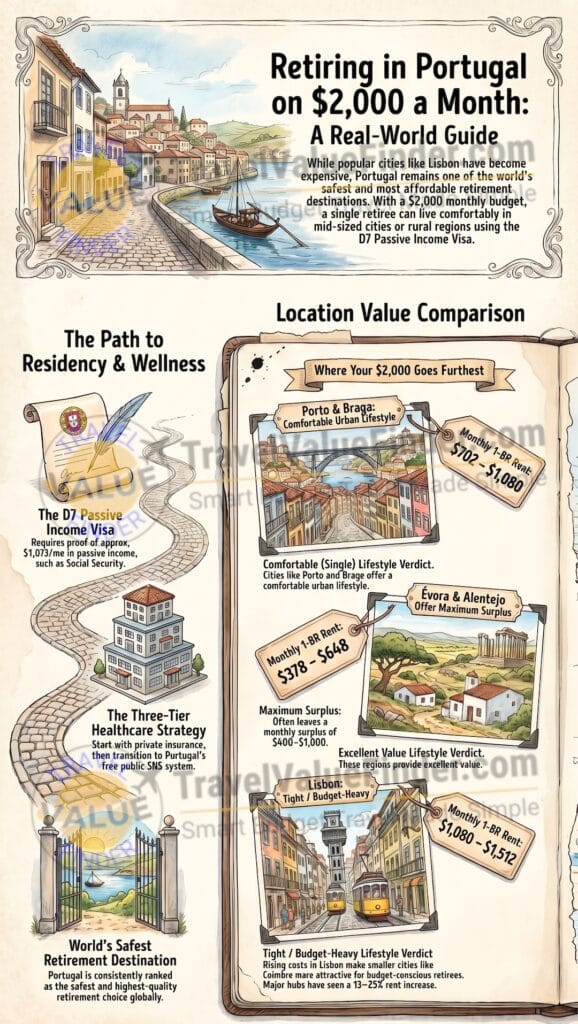
Absolutely, you can retire in Portugal on $2,000 a month in 2026 – but only in specific locations and with honest budgeting. In smaller towns (Centro region, Alentejo, interior Algarve), $2,000 covers rent, food, utilities, healthcare, and entertainment comfortably. In Porto, $2,000 works tightly for a single retiree. In Lisbon, $2,000 is a stretch. The D7 Passive Income Visa (minimum €920/month ≈ $1,073) is the main pathway for American retirees. Healthcare costs $50–200/month for private insurance, transitioning to free SNS public healthcare after residency. Portugal was named the world’s safest retirement country and #1 overall retirement destination by International Living in 2026. Exchange rate used: €1 = $1.08 USD (early 2026).
Leslie Nics, TravelValueFinder.com | Last updated: June 2026 | Last Reviewed: June 07 2026
Let’s start with the direct answer to the question everyone is actually asking: Yes, $2,000 a month is enough to retire in Portugal in 2026 – but where you live in Portugal matters enormously. In Lisbon, $2,000 will feel tight. In Porto, it’s workable for a single retiree. In the Centro region, the Alentejo, or the interior Algarve, $2,000 delivers a genuinely comfortable retirement lifestyle – one that includes your own apartment, restaurant meals, day trips, healthcare coverage, and enough left over for cultural activities and travel within Europe.
Portugal was named the world’s best retirement destination and the world’s safest country for retirement by International Living in 2026 – the first time Greece has taken the #1 spot in 35 years of rankings (Greece is #1 overall; Portugal dropped to #4 but retained the safety crown). More than 10,723 American retirees already receive Social Security payments in Portugal (SSA 2023 data), and that number has grown significantly since the D7 Visa became mainstream.
I’m Leslie Nics, founder of TravelValueFinder.com. I have spent extended time in Lisbon, Porto, and the Alentejo, and this guide is built on real 2026 data from Numbeo, Idealista, RetireFinder, and GetFastVisa’s May 2026 cost analysis. Let’s get into the real numbers.
The Honest Answer: $2,000 a Month in Portugal – Where It Works and Where It Doesn’t
$2,000/month ($1,850 USD equivalent at €1=$1.08) is sufficient for comfortable retirement in smaller Portuguese cities and towns. In Porto, it works tightly for a single person. In Lisbon, it requires careful budgeting. In the Alentejo, Centro region, and interior Algarve, $2,000 covers rent, food, utilities, healthcare, transport, and entertainment with money to spare. A couple needs $2,800–3,500 for a comfortable lifestyle in mid-size cities. Sources: Idealista 2026, GetFastVisa May 2026, RetireFinder March 2026.
Here is the location-by-location assessment of what $2,000/month actually delivers in Portugal in 2026:
| Location | 1-BR Rent | Monthly Total | $2K Verdict | What $2K Delivers |
|---|---|---|---|---|
| Lisbon (central) | €1,000–1,400 | ~$2,079–3,024 | Tight / stretch | Bare essentials; better with roommate or shared housing |
| Porto | €650–1,000 | ~$1,561–2,419 | Works (single) | Comfortable in residential neighborhoods; tight if dining out often |
| Algarve coastal towns | €550–850 | ~$1,469–2,376 | Works well | Comfortable; need car (€150–280/mo transport); beach lifestyle |
| Braga | €500–750 | ~$1,300–2,000 | Comfortable | Quality of life rivals Porto at 20–30% lower cost; university city energy |
| Coimbra | €450–700 | ~$1,200–1,900 | Very comfortable | Historic university city; excellent public hospital; manageable hills |
| Évora / Alentejo | €350–600 | ~$1,000–1,600 | Excellent value | Rural tranquility; UNESCO city; authentic Portuguese pace; wine country |
| Interior Algarve (Silves, Monchique) | €400–650 | ~$1,100–1,800 | Best value in mild climate | Hill towns with mild climate; car needed; 30 min from coast; quiet |
| Viana do Castelo / Aveiro | €400–650 | ~$1,100–1,700 | Excellent value | Underrated coastal cities; smaller scale; genuine local life; flat in parts |
Exchange rate note: All USD figures in this guide use the €1 = $1.08 rate from early 2026 (Numbeo / GetFastVisa May 2026). The actual rate fluctuates. When planning, always check the current EUR/USD rate and factor in a 5–10% buffer for currency movement.
Verdict on $2,000/month: $2,000 is sufficient for a comfortable single-person retirement in Porto, the Algarve, Braga, Coimbra, or any smaller Portuguese city or town. In Lisbon, $2,000 is tight but possible with careful housing choices. For couples, add 40–60% to the single-person budget for the most significant shared costs (accommodation, utilities, transport). See Cost of Living in Portugal for detailed information.
The Full 2026 Portugal Retirement Cost Breakdown: Every Category
2026 monthly cost breakdown for a single retiree in Portugal: Rent (1-BR): €450–1,400 depending on location; Utilities: €100–170; Groceries: €180–280; Dining out: €150–300; Healthcare (private insurance): €35–100/month; Transport: €35–60 (city) or €150–280 (car-dependent); Entertainment: €80–180; Internet + phone: €35–50; Miscellaneous: €80–140. Total range: €1,200–2,600 ($1,296–2,808). Sources: Numbeo May 2026, Idealista 2026, RetireFinder March 2026.
Housing: The Biggest Variable
Housing is the single biggest determinant of whether $2,000 works in Portugal. Rents have risen significantly in 2024–2026, particularly in Lisbon and coastal Algarve, but smaller cities remain highly affordable by Western standards.
| City/Region | 1-BR Central | 1-BR Residential | 2-BR (couple) | USD Equivalent (1-BR central) |
|---|---|---|---|---|
| Lisbon | €1,000–1,400 | €800–1,100 | €1,400–1,900 | $1,080–1,512 |
| Porto | €650–1,000 | €550–750 | €900–1,300 | $702–1,080 |
| Algarve (Lagos, Tavira) | €550–850 | €450–700 | €750–1,100 | $594–918 |
| Braga | €500–750 | €400–600 | €700–1,000 | $540–810 |
| Coimbra | €450–700 | €380–580 | €600–900 | $486–756 |
| Évora / Alentejo | €350–600 | €300–500 | €500–800 | $378–648 |
| Source | INE Portugal Q1 2026 | INE / Numbeo | RetireFinder 2026 | At €1=$1.08 USD |
Important: Housing costs in Portugal have risen 15–25% in Lisbon since 2023. The figures above reflect Q1 2026 data. Always verify current rents via Idealista.pt and Uniplaces.com before planning your budget. Costs outside Lisbon have risen more slowly – this is the primary reason smaller cities are now recommended for budget-conscious retirees. Find out about renting vs buying a property in Portugal.
Food: Groceries and Dining Out
Portugal remains significantly cheaper than most of Western Europe for food. Idealista’s 2026 cost guide reports that a single person typically spends €180–280/month on groceries in 2026. Dining out has edged up: a basic meal at an inexpensive restaurant is €11–14/person; a three-course dinner for two at a mid-range restaurant is €45–70.
- Grocery brands to use: Pingo Doce and Lidl are the most affordable major supermarkets. Continente and Jumbo are mid-range. Local mercados (markets) are cheapest for fresh fruit, vegetables, fish, and bread.
- Menu do dia: Portugal’s ‘menu of the day’ at lunch (three courses + wine + coffee for €8–12) is one of Europe’s great dining values and a cultural institution. Budget retirees should build their main meal around this daily.
- Fresh fish: Bacalhau (salt cod), sardines, and fresh fish at Portuguese prices represent extraordinary value – a whole grilled sea bass for two at a local tasca costs €15–20 including bread and salad.
- Wine: Portuguese wine is world-class and extraordinarily affordable. A bottle of excellent Douro or Alentejo red wine costs €3–7 at a supermarket. A glass of house wine at a restaurant: €1.50–3.
Healthcare: From Private Insurance to Free SNS Access
Healthcare is one of Portugal’s strongest advantages for American retirees. After becoming a legal resident, retirees can access the SNS (Serviço Nacional de Saúde – Portugal’s universal healthcare system) for free or at minimal co-pays. Before SNS access, private health insurance costs €35–100/month for most retirees under 70 (according to imin-portugal.com’s D7 visa cost analysis), rising to €100–200+ for older retirees. Find more about healthcare in Portugal.
- D7 Visa requirement: Private health insurance valid in Portugal (minimum €30,000 coverage) is required for the first year of your D7 Visa application. This transitions to SNS enrollment once residency is established.
- SNS public healthcare: Free for legal residents. User fees (taxas moderadoras) of €4–8 apply to some services (GP visits, emergency room, specialist referrals). Many services are completely free (children, pregnant women, low-income residents).
- Private supplement: Many retirees maintain low-cost private insurance (€50–8/month) even after SNS access for: shorter waiting times for specialist appointments, English-speaking doctors, dental care (not covered by SNS), and access to private hospitals in Lisbon and Porto.
- Dental care: Not covered by SNS. Budget €50–150/month for routine dental maintenance or €100–300/treatment. Portugal’s dental costs are 40–60% lower than U.S. prices.
Utilities, Transport, Internet
| Category | Lisbon/Porto | Smaller Cities/Towns | Notes |
|---|---|---|---|
| Electricity + gas | €80–130/month | €60–100/month | Summer AC adds; winter heating costs |
| Water | €15–30/month | €10–20/month | Very low cost in Portugal |
| Internet (fiber) | €30–50/month | €25–40/month | NOS, MEO, Vodafone are main providers |
| Mobile phone | €10–25/month | €10–20/month | Cheap plans from €10/month (NOS, Nowo) |
| Public transport (monthly pass) | €30–40/month | €25–35/month | Lisbon’s Navegante pass: €40/month all zones |
| Car (fuel + insurance + maintenance) | €150–250/month | €120–200/month | Only needed outside main cities |
| Total utilities + transport (no car) | ~€165–245/month | ~€120–195/month | Source: Numbeo May 2026, Idealista |
Entertainment, Culture & Leisure
Portugal’s culture is rich and largely free or very inexpensive to experience:
- Museum entry: Many state museums are free on the first Sunday of the month; the Calouste Gulbenkian Museum (Lisbon’s finest) has a senior discount at 65+. Annual cultural pass options are available.
- Cinema: €7–9 per ticket; senior discounts often available.
- Fado evenings: €50–150 for a traditional fado dinner; free fado in some Alfama/Mouraria bars.
- Day trips: Sintra from Lisbon: €4.40 return by train. Obidos, Évora, Coimbra all accessible by regional trains for €5–15 return.
- Monthly entertainment budget: €80–180/month covers cinema, occasional dinners, day trips, cultural events, and a bottle of wine with dinner most nights.
Full Sample Monthly Budgets: What $2,000 Actually Looks Like in 3 Portuguese Cities
Three complete monthly budgets for a single American retiree in Portugal in 2026 (at €1=$1.08 USD): Porto: total $1,561–2,419 (€1,445–2,240) – $2,000 works comfortably; Évora/Alentejo: total $1,000–1,600 (€930–1,480) – $2,000 leaves $400–1,000 surplus; Lisbon: total $2,079–3,024 (€1,925–2,800) – $2,000 works in a residential neighborhood, tight in the center. All data sourced from RetireFinder March 2026, Numbeo May 2026, and Idealista 2026.
Budget A: Porto – $2,000 Works Comfortably for a Single Retiree
| Category | Low (€) | Mid (€) | High (€) | Notes |
|---|---|---|---|---|
| Housing (1-BR, Cedofeita/Bonfim) | €600 | €750 | €950 | Residential neighborhood; short walk to center |
| Groceries (Pingo Doce, local market) | €160 | €210 | €260 | Cook at home 70% of meals |
| Dining out (menu do dia + occasional dinner) | €100 | €150 | €220 | 4–5 restaurant meals/week + menu do dia daily |
| Healthcare (private insurance, age 65–70) | €45 | €65 | €85 | Transitions to SNS after residency; keep supplement |
| Utilities (electricity, water, internet) | €100 | €130 | €160 | Fiber internet €30–40/month |
| Transport (monthly bus/metro pass) | €30 | €35 | €45 | Porto’s public transit is excellent |
| Entertainment, culture, day trips | €80 | €120 | €160 | Cinema, day trips to Douro Valley, museums |
| Personal, phone, miscellaneous | €80 | €100 | €130 | Haircuts, clothing, subscriptions |
| TOTAL (€/month) | €1,195 | €1,560 | €2,010 | Source: RetireFinder 2026, Numbeo May 2026 |
| TOTAL (USD/month at $1.08) | $1,291 | $1,685 | $2,171 | $2,000 covers mid-to-high Porto lifestyle |
Porto Verdict: $2,000/month delivers a comfortable, active retirement in Porto – including restaurant meals most days, day trips to the Douro Valley, private health insurance, and a 1-bedroom apartment in a residential neighborhood. You’ll live like a local, not like a tourist.
Budget B: Évora / Alentejo – $2,000 Delivers Surplus
In Évora – a UNESCO-listed Roman city in the heart of the Alentejo region – $2,000 provides a genuinely comfortable retirement with $400–$800 monthly surplus for savings, travel within Europe, or additional comforts:
| Category | Low (€) | High (€) | Notes |
|---|---|---|---|
| Housing (1-BR, central) | €350 | €550 | Well below national average; many properties available |
| Groceries + market | €140 | €200 | Alentejo markets: exceptional olive oil, cheeses, cured meats |
| Dining out | €80 | €140 | Tasca meals €8–12; Alentejo cuisine is extraordinary |
| Healthcare (private supplement) | €40 | €70 | Évora General Hospital is one of Portugal’s best regional hospitals |
| Utilities | €90 | €130 | Lower electricity costs; warmer climate reduces heating |
| Transport (car recommended) | €100 | €170 | Small car essential; Évora to Lisbon is 1.5 hrs by road |
| Entertainment + day trips | €50 | €100 | Megalithic sites, vineyards, cork oak forests |
| Miscellaneous | €70 | €110 | |
| TOTAL (€/month) | €920 | €1,470 | Source: RetireFinder 2026, local market research |
| TOTAL (USD/month) | $993 | $1,588 | $2,000 leaves $412–1,007 monthly surplus |
Budget C: Lisbon – $2,000 Is Tight (But Possible)
Here is the honest assessment of Lisbon on $2,000 for a single retiree in 2026. GetFastVisa’s May 2026 analysis puts a single American expat’s Lisbon spending at $1,400–2,400/month, and that’s before accounting for higher-quality lifestyle choices. On $2,000, you can live in Lisbon – but you’ll need to prioritize carefully:
- Housing strategy: Choose Mouraria, Mouraria, Intendente, or Marvila (up-and-coming, cheaper than Príncipe Real or Chiado). A 1-BR in these neighborhoods runs €850–1,100 vs. €1,200–1,400 in the classic expat zones.
- Dining strategy: Rely heavily on the menu do dia (€9–12 for three courses) rather than evening restaurant dinners. Lisbon’s pastelarias serve extraordinary breakfasts for €2–3.
- Entertainment: Take advantage of Lisbon’s free or near-free cultural offerings: the Belém riverside promenade, the free-entry-first-Sunday at national museums, and the free concerts in summer at the Jardim do Torel.
- Transport: Lisbon’s Navegante all-zone transport pass costs €40/month and eliminates all need for taxis or ride-shares within the city.
RetireFinder’s March 2026 data puts a single retiree’s full Lisbon budget at €1,925–2,800/month ($2,079–3,024). At $2,000, you’re at the lower end of that range. It requires discipline – but it is possible, and Lisbon on $2,000 still delivers a better quality of life than most American cities on the same income.
The D7 Visa: How American Retirees Get Legal Residency in Portugal in 2026
The Portugal D7 Passive Income Visa (also called the Passive Income Visa or Retirement Visa) is the primary pathway for American retirees in 2026. Minimum income: €920/month ($1,073 at current rates) for a single applicant – the Portuguese minimum wage. Requirements: passive income proof, Portugal bank account, accommodation proof, private health insurance (€30,000+ coverage), clean criminal record. Processing: typically 60–90 days. After 5 years of temporary residency, permanent residency is available; citizenship after 10 years (D7) with access to Portuguese passport (visa-free to 187 countries).
The D7 Passive Income Visa – officially the Visto D7 or Visado Rendimento Passivo – is Portugal’s purpose-designed residency pathway for retirees and anyone with sufficient passive income to support themselves without working in Portugal. For Americans, it is the primary route to legal long-term residence, and in 2026, it has become one of the most attractive retirement visa programs in the world.
D7 Visa Requirements: The Complete 2026 Checklist
| Requirement | What It Means | 2026 Details |
|---|---|---|
| Minimum passive income | Proof of regular income from outside Portugal | €920/month single; +50% for spouse (€1,380); +30% per child (€1,196 total with 1 child) |
| Acceptable income sources | Pension, Social Security, IRA/401k withdrawals, dividends, rental income | Consistent monthly bank statements showing income. U.S. Social Security qualifies directly |
| Portuguese bank account | Open before application | Novo Banco, Caixa Geral, Millennium BCP accept non-resident account opening |
| Proof of accommodation | Long-term rental contract or property ownership | Minimum 12-month lease contract typically required |
| Private health insurance | Valid in Portugal; min €30,000 coverage | Required for first year; costs €400–1,000/year depending on age and coverage |
| Clean criminal record | FBI background check (federal) + state-level | Request from FBI.gov; allow 4–6 weeks; must be apostilled |
| NIF (Tax Number) | Portuguese taxpayer identification number | Obtain at a Portuguese Consulate or in Portugal at a Finanças office |
| Application process | Apply at Portuguese Consulate in your U.S. state | Appointment required; typically 60–90 days for decision; enter Portugal within 4 months of approval |
| After approval | Attend immigration appointment in Portugal | Biometric data (fingerprints + photo); residence card issued; register for SNS healthcare |
| Residency path | Temporary residency – permanent – citizenship | 5 years temporary – permanent residency; 10 years – citizenship (Portuguese passport: visa-free to 187 countries) |
D7 Application Tip: Allow 6–12 months for the full D7 process from decision to departure: FBI background check (4–6 weeks), Portuguese bank account opening, securing accommodation, consulate appointment scheduling, and processing. Start the process at least 6 months before your intended move date.
Social Security in Portugal: Does It Qualify for the D7?
Yes. U.S. Social Security payments directly qualify as passive income for the D7 Visa. The average monthly Social Security benefit in 2026 is $2,071 – nearly double the €920 ($1,073) minimum required for a single applicant. A couple with combined Social Security income of $3,000–$4,000/month exceeds the D7 threshold comfortably even with the spouse supplement requirement (single €920 + 50% for spouse = €1,380 minimum for a couple).
The U.S.–Portugal Tax Treaty prevents double taxation on Social Security and other U.S. income, though the tax implications of the NHR regime (discussed below) should be reviewed with a Portuguese tax attorney before relocation.
The NHR Tax Regime 2.0 (IFICI): What Retirees Need to Know in 2026
Portugal replaced its original NHR (Non-Habitual Resident) tax regime in 2024 with the IFICI (Tax Incentive for Scientific Research and Innovation), also known as NHR 2.0. For retirees, this represents an important change: the original NHR 2.0’s broad income exemptions no longer automatically apply to retirees on foreign pension income. Instead:
- Standard Portuguese income tax: Foreign pension income is subject to standard Portuguese IRS rates (up to 48% on higher incomes, but typically 14.5–23% for most retirees given the lower income levels involved).
- U.S.–Portugal Tax Treaty: The treaty prevents double taxation. Income taxed in the U.S. is typically credited against Portuguese tax liability.
- Professional advice is essential: Tax implications vary significantly based on income type, level, and individual circumstances. Consult a Portuguese tax attorney before relocating. The Portugal D7 visa guide is a good starting resource; professional advice is the required next step.
Important: The tax situation for foreign retirees in Portugal has changed significantly since 2024 with NHR 2.0. Do not rely on articles written before 2025 for tax guidance. Consult a licensed Portuguese tax advisor (advogado fiscal) before making financial decisions based on Portuguese tax planning.
Healthcare in Portugal for American Retirees: The Full 2026 Picture
Portugal’s SNS (Serviço Nacional de Saúde) provides universal healthcare to legal residents, including foreign retirees. After D7 residency, retirees register with the SNS and access care free or at minimal co-pays (€4–8 per visit). Medicare does NOT cover internationally. Private insurance required for D7 application (€400–1,000/year). Most retirees maintain private supplemental insurance (€50–100/month) for faster specialist access, English-speaking doctors, and dental coverage.
Healthcare is one of the most important considerations in the retire Portugal 2000 month question, and it is one of Portugal’s strongest advantages for American retirees:
Medicare in Portugal: The Critical Reality
Important: Medicare (Parts A and B) provides ZERO coverage in Portugal or any other country outside the United States. If you live in Portugal full-time, you will need alternative healthcare coverage from day one. This is not optional.
The good news: Portugal’s healthcare alternatives are both excellent and affordable compared to U.S. healthcare costs.
The Three-Tier Healthcare Strategy for American Retirees
- Year 1 (D7 application phase): Private international health insurance required for your D7 application. This must be valid in Portugal with minimum €30,000 coverage. Annual cost: €400–1,000 depending on age, coverage, and provider. This fully replaces Medicare during this period.
- After residency (years 1–5): Register with the SNS at your local Centro de Saúde (health center). This gives you free access to GP care, hospital treatment, most specialist referrals, and emergency care. Small user fees (taxas moderadoras) of €4–8 apply to some visits. Most services are free.
- Supplemental private insurance (ongoing): Most American retirees maintain a low-cost private supplement (€50–100/month) for: English-speaking consultants, shorter waiting times for specialist appointments, private hospital access, dental care (not SNS-covered), and prescription speed.
| Healthcare Service | SNS Cost | Private Cost | vs. U.S. Cost (approximate) |
|---|---|---|---|
| GP visit | Free / €5 | €40–70 | $150–350 (uninsured U.S.) |
| Specialist consultation | €7–15 | €60–120 | $200–500 (U.S.) |
| Emergency room | €20–40 | €80–200 | $500–3,000+ (U.S.) |
| Hip replacement (total) | Free (SNS, with wait) | €7,000–12,000 | $30,000–50,000 (U.S.) |
| Dental cleaning | Not covered | €40–70 | $150–300 (U.S.) |
| Monthly private insurance (65–70) | N/A | €50–100/month | $600–1,200+/month (U.S. supplemental) |
| Prescription drugs | €2–15 co-pay | Varies | Often $50–500+ (U.S.) |
Sources: International Insurance 2026 Portugal guide, RetireFinder 2026, Numbeo May 2026
The 5 Best Portuguese Cities to Retire on $2,000/Month in 2026
Best cities for retiring in Portugal on $2,000/month in 2026: (1) Porto – best urban balance; (2) Évora – best value with surplus; (3) Braga – fastest-growing, most affordable northern city; (4) Tavira (Algarve) – quietest coastal option; (5) Coimbra – university city with excellent hospital. All are below the $2,000 budget for a single retiree with room for a comfortable lifestyle.
1. Porto: Best Urban Retirement on $2,000
Porto is the single best value city for retiring on $2,000/month in Portugal in 2026. It’s 25–35% cheaper than Lisbon while offering virtually the same quality of urban lifestyle: a world-class food scene, remarkable architecture, excellent public transit, the Douro River at its feet, and some of Portugal’s finest wine country an hour away. GetFastVisa puts a single American expat’s monthly total at $1,000–1,800/month in Porto (May 2026), meaning $2,000 leaves a comfortable cushion.
- Best neighborhoods for budget retirees: Cedofeita, Bonfim (residential, local restaurants, flat in parts), and Campanhã (up-and-coming, cheapest).
- Healthcare: Centro Hospitalar Universitário de São João is one of Portugal’s top hospitals. English-speaking specialists available at Lusíadas Porto private hospital (€70–120/consultation).
- Day trips: Douro Valley (1 hour), Viana do Castelo (1 hour north), Guimarães and Braga (45 minutes), beaches of Vila do Conde (30 minutes).
2. Évora: Best Value in All of Portugal
Évora is a UNESCO World Heritage city of extraordinary beauty and historical depth – Roman temple, Gothic cathedral, medieval streets, and bone chapel – at some of Portugal’s lowest living costs. On $2,000, you’ll live comfortably with significant surplus. The pace of life is deliberately slow, the food and wine are exceptional (this is Alentejo wine country), and the expat community, while small, is tight-knit.
- Monthly cost range: $993–1,588 all-in for a single person. $2,000 leaves $412–1,007 monthly surplus – ideal for supplemental savings or European travel.
- Healthcare: Hospital do Espírito Santo de Évora is the regional hospital. Private clinic Centro Clínico de Évora has English-speaking staff.
- Lifestyle: Weekly markets, weekend quintas (wine estate) visits, hiking among megalithic stone circles older than Stonehenge, and some of Portugal’s finest pork and olive oil.
3. Braga: Best Value Northern City
Braga is Portugal’s third-largest city and one of its most dynamic – a university city with a young population, extraordinary Baroque architecture, and one of the country’s fastest-improving food scenes. It’s 30–40% cheaper than Porto for housing while offering a similar northern Portuguese lifestyle. The famous Bom Jesus do Monte sanctuary (a UNESCO-listed staircase pilgrimage church) is free to visit and provides one of Portugal’s great hill walks.
- Monthly cost: $1,000–1,600 for a single person. $2,000 provides excellent lifestyle surplus.
- Healthcare: Hospital de Braga is a modern, high-quality hospital. University hospital affiliation means strong specialist availability.
- Day trips: Guimarães (birthplace of the Portuguese nation, 20 minutes), Viana do Castelo coast (1 hour), Gerês National Park (45 minutes).
4. Tavira: Best Coastal Algarve Value
Tavira is the most authentically Portuguese of the Algarve’s coastal towns – an ancient Moorish-Roman bridge city on the Gilão River, with whitewashed houses, orange orchards, and a quieter, more local feel than Faro, Lagos, or Albufeira. A car is necessary (Tavira’s public transit to the beach islands is seasonal and limited), but the lifestyle reward is a genuinely beautiful, undiscovered corner of southern Portugal.
- Monthly cost: $1,100–1,700 including a small car. $2,000 is very comfortable.
- Healthcare: Centro de Saúde de Tavira (SNS); private clinic in Faro (40 minutes) for specialists.
- Beach access: Ilha de Tavira is one of the finest barrier island beaches in Portugal – free ferry crossing (€1.50) to pristine Atlantic sand.
5. Coimbra: Best University City
Coimbra is Portugal’s ancient university city – home to one of Europe’s oldest universities (founded 1290), a UNESCO-listed library, and a steep-hilltop old town with Romanesque cathedral. It sits between Lisbon and Porto on the A1 motorway, making it arguably Portugal’s most strategically placed mid-size city. The Centro Hospitalar e Universitário de Coimbra (CHUC) is one of Portugal’s finest hospitals and a major academic medical center.
- Monthly cost: $1,200–1,900 for a single person. $2,000 is very comfortable.
- Healthcare advantage: One of Portugal’s top 3 hospitals is here. Exceptional for retirees with complex medical histories.
- Lifestyle: Coimbra fado (the original, academic version, distinct from Lisbon fado), weekly markets, the Mondego River promenade, and easy day trips to the coast (Figueira da Foz, 45 minutes).
Retiring in Portugal: The Honest Pros and Cons for Americans
Pros: #1 retirement destination globally (International Living 2026); safest country for retirement; mild year-round climate; affordable cost of living (30–40% below U.S. and UK); excellent free SNS healthcare after residency; strong expat community; D7 visa accessible on Social Security. Cons: Housing costs risen significantly in Lisbon; Medicare doesn’t travel; NHR 2.0 tax regime less favorable for retirees than original NHR; language barrier (Portuguese is not Spanish); slower bureaucratic processes; homesickness and distance from family are real considerations.
| Pros: Why Portugal Works for American Retirees | Cons: What No One Tells You |
|---|---|
| #1 retirement destination globally (International Living 2026) | Lisbon housing costs up 15–25% since 2023 – $2,000 is tight in the capital |
| World’s safest retirement country (#7 Global Peace Index) | Medicare provides zero international coverage – private insurance required |
| Cost of living 30–40% below U.S. and UK (excluding rent) | NHR 2.0 (IFICI) is less favorable for retirees than original NHR – get tax advice first |
| Excellent SNS universal healthcare free after residency | Portuguese bureaucracy is slow; D7 process takes 6–12 months |
| D7 Visa accessible on Social Security (€920/month minimum) | Language barrier: Portuguese is not Spanish – distinct language with different sounds |
| Mild year-round Atlantic climate (Lisbon averages 17°C/63°F annually) | Distance from family: 7–9 hour flight from most U.S. cities – homesickness is real |
| English widely spoken (especially in cities and by younger Portuguese) | Driving on right-hand side but road infrastructure varies significantly outside cities |
| Path to EU citizenship and Portuguese passport after 10 years | Rental market in Lisbon and Porto is competitive – find accommodation before arrival |
| Strong, established American expat community in Lisbon, Porto, and Algarve | Banking as a non-resident can be slow and requires persistence |
| EU access: Travel visa-free across all Schengen zone countries | Quality of internet and healthcare varies significantly outside main cities |
How to Start Your Portugal Retirement: A Practical Step-by-Step Plan
10 practical steps to retire in Portugal as an American: (1) Get FBI background check; (2) Open Portuguese bank account; (3) Obtain NIF (tax number); (4) Find accommodation (12-month lease); (5) Get private health insurance; (6) Apply for D7 Visa at Portuguese Consulate; (7) Enter Portugal within 4 months of approval; (8) Attend AIMA immigration appointment; (9) Register for SNS healthcare; (10) File for Portuguese tax residency. Total timeline from decision to arrival: 6–12 months.
- Decide on your city: Use this guide to narrow your target city. Then visit for 1–2 weeks in shoulder season (April–May or September–October) to validate your choice before committing to a lease.
- Obtain your FBI background check: Request from FBI.gov (Identity History Summary). Requires fingerprinting and 4–6 weeks for processing. Must be apostilled for use in Portugal. State-level background checks may also be required.
- Get your NIF (Número de Identificação Fiscal): Obtain from the Portuguese Consulate in your U.S. state or in person at a Finanças office in Portugal. The NIF is required to open a bank account, sign a lease, and apply for the D7.
- Open a Portuguese bank account: Novo Banco, Caixa Geral de Depósitos, and Millennium BCP all accept non-resident account openings, often remotely or at branches in the U.S. You’ll need NIF, passport, and proof of address.
- Secure accommodation: Find and sign a 12-month lease in Portugal before your D7 application. Idealista.pt and Uniplaces are the primary rental platforms. Consider a short-term Airbnb stay for the first month while you apartment hunt in person.
- Purchase private health insurance: Must be valid in Portugal with minimum €30,000 coverage. International providers: Cigna Global, Allianz Care, AXA Global. Cost: €400–1,000/year for a retiree under 70.
- Apply for the D7 Visa at your regional Portuguese Consulate: Schedule an appointment (allow several weeks for availability). Submit all documents. Processing time: typically 60–90 days. Decision communicated by email.
- Enter Portugal within 4 months of D7 approval: Once approved, you must enter Portugal and schedule an AIMA (immigration) appointment within 4 months of your visa issue date.
- Attend your AIMA appointment in Portugal: Biometric data collected (fingerprints, photo). Residence card issued. This is the step that formally establishes your legal residency.
- Register with the SNS healthcare system: Registration at your local Centro de Saúde using your residence permit and NIF. From this point, you access healthcare as a Portuguese resident. Tax residency registration follows at your local Finanças office.
- To simplify your planning, download the Portugal Retirement Checklist, and Portugal Retirement Scorecard.
Finding Accommodation Before Your Move: Booking Your Portugal Exploratory Trip
Before committing to a city, visit for 10–14 days in shoulder season. Compare hotel rates across three platforms (prices vary 15–25%). Book centrally for your first visit, then use day trips to assess different neighborhoods. Use Airbnb for longer stays (7+ nights) to experience the apartment lifestyle. Idealista.pt and Uniplaces for rental market research.
The single best move before committing to a Portugal retirement location: visit for 10–14 days and live like a resident, not a tourist (see Seasonal living in Portugal). Stay in a central apartment (not a hotel), shop at the local market, eat at tascas, walk the neighborhoods you’re considering. For hotel nights during your exploratory trip, compare rates across these three platforms – prices vary 15–25% for the same property:
| Platform | Best For | Portugal Advantage | Search Now |
|---|---|---|---|
| Booking.com | Widest European inventory | Free cancellation + long-stay filter; widest Lisbon/Porto inventory | Search Booking.com |
| Agoda | Strong Europe rates | Often cheaper for Porto specifically | Search Agoda |
| TripAdvisor | Reviews + price comparison | Read long-stay guest reviews for accessibility and neighborhood info | Search TripAdvisor |
Honest destination guides and hotel comparisons to help you travel smarter – at the best value.
Hotel listings powered by Booking.com. We may earn a commission at no extra cost to you.
For the complete hotel comparison method, see our best hotel booking sites guide. For the full travel planning framework, our complete guide to travel in retirement and slow travel retirement guide cover everything you need for an extended exploratory visit to Portugal. Find out How Much Money Do You Need to Retire Abroad? (2026 Country-by-Country Guide) and on The Cheapest Countries to Retire Abroad in 2026 (Under $2,000/Month)
Ready to compare cities now?
- Use our Free Retirement Cost of Living Calculator – get your personalized report in 30 seconds – Free PDF download.
- How to Use a Retirement Cost of Living Calculator – to Compare Cities Worldwide
Frequently Asked Questions: Retiring in Portugal on $2,000 a Month
Can you really retire in Portugal on $2,000 a month in 2026?
Yes – in specific locations and with honest budgeting. In Porto, Braga, Coimbra, Évora, interior Algarve towns (Tavira, Silves), and smaller cities throughout the Centro region, $2,000 provides a genuinely comfortable single-person retirement lifestyle including a one-bedroom apartment, daily dining (often with restaurant lunches), healthcare coverage, entertainment, and transport. In Lisbon, $2,000 is possible but requires careful housing choices and modest lifestyle. For a couple, budget $2,800–3,500 for comfort outside Lisbon.
What is the minimum income for the Portugal D7 Visa?
The minimum passive income for the D7 Visa in 2026 is €920/month for a single applicant – tied to Portugal’s minimum wage. For a couple applying together, add 50% (€460) for the spouse, totaling €1,380/month minimum. U.S. Social Security payments directly qualify. The average U.S. Social Security benefit in 2026 is $2,071/month – exceeding the €920 ($1,073) threshold comfortably for a single retiree.
What does $2,000 cover in Portugal?
In Porto or a smaller Portuguese city, $2,000/month covers: a one-bedroom apartment in a residential neighborhood (€600–900), groceries and cooking at home (€180–250), restaurant meals 4–5 times per week including menu do dia lunches (€120–200), private health insurance or SNS supplement (€50–100), all utilities including fast fiber internet (€130–180), monthly public transit pass (€30–40), entertainment and day trips (€80–150), and personal/miscellaneous (€80–120). Total: €1,270–1,840 ($1,372–1,987), leaving a small surplus or emergency buffer.
Does Medicare work in Portugal?
No. Medicare (Parts A and B) provides zero coverage in Portugal or anywhere outside the United States. American retirees in Portugal must have alternative healthcare coverage. The D7 Visa application requires private health insurance with minimum €30,000 coverage for the first year. After establishing residency, retirees register with the Portuguese SNS (universal public healthcare system) for free or minimal-cost care, and many maintain a low-cost private supplement (€50–100/month) for faster specialist access and English-speaking doctors.
Is Portugal safe for American retirees?
Portugal is the world’s safest country for retirement in 2026 according to International Living – ranked #7 on the Global Peace Index and #4 overall in the Global Retirement Index. Crime rates are low throughout the country, even in Lisbon and Porto city centers. Healthcare quality is high. The U.S. State Department categorizes Portugal as Level 1: Exercise Normal Precautions – the lowest possible risk category.
How long does it take to get the Portugal D7 Visa?
The full timeline from deciding to retire in Portugal to physically arriving: 6–12 months. This includes: obtaining an FBI background check (4–6 weeks), opening a Portuguese bank account, getting a NIF tax number, securing accommodation in Portugal, purchasing private health insurance, scheduling and attending a consulate appointment, and waiting for processing (typically 60–90 days). After approval, you must enter Portugal within 4 months of your visa issue date and attend an AIMA appointment for your residency card.
Key Statistics: Retiring in Portugal in 2026
| Data Point | Source | Year |
|---|---|---|
| Portugal named #1 safest country for retirement globally | International Living 2026 | 2026 |
| Portugal ranked #4 overall on International Living Global Retirement Index 2026 | International Living 2026 | 2026 |
| 10,723 Americans receive Social Security payments in Portugal (latest data) | U.S. Social Security Administration | 2023 |
| D7 Visa minimum passive income: €920/month (single applicant, tied to minimum wage) | Portuguese Government / Global Citizen Solutions | 2026 |
| D7 Visa couple minimum: €920 + 50% = €1,380/month (approximately $1,490) | Portugalist / Immigrant Invest | 2026 |
| Average U.S. Social Security benefit in 2026: $2,071/month | Social Security Administration | 2026 |
| Portugal cost of living: ~40% lower than UK (excluding rent) | Numbeo / Idealista | 2026 |
| Portugal cost of living: ~5.6% lower than Spain (with rent); 6.1% higher rent than Spain | Numbeo May 2026 | 2026 |
| Single retiree comfortable monthly budget in Porto: €1,445–2,240 ($1,561–2,419) | RetireFinder March 2026 | 2026 |
| Single retiree comfortable monthly budget in Lisbon: €1,925–2,800 ($2,079–3,024) | RetireFinder March 2026 | 2026 |
| Single retiree comfortable monthly budget in Algarve (Lagos/Tavira): €1,360–2,200 ($1,469–2,376) | RetireFinder March 2026 | 2026 |
| Lisbon 1-BR central apartment rent: €1,000–1,400/month | INE Portugal Q1 2026 / Idealista | 2026 |
| Porto 1-BR apartment rent: €650–1,000/month | INE Portugal Q1 2026 | 2026 |
| Évora / Alentejo 1-BR apartment rent: €350–600/month | RetireFinder / local market data | 2026 |
| Monthly groceries (single person): €180–280 | Idealista 2026 / Numbeo | 2026 |
| Inexpensive restaurant meal: €11–14/person | Numbeo May 2026 / Idealista | 2026 |
| Three-course dinner for 2 (mid-range): €45–70 | Idealista 2026 | 2026 |
| Private health insurance (D7 requirement): €400–1,000/year depending on age | Imin-portugal.com / Immigrantinvest | 2026 |
| SNS GP visit co-pay: €4–8 | Portuguese SNS official fees 2026 | 2026 |
| D7 Visa processing time: typically 60–90 days after consulate appointment | Citizen Remote / Global Citizen Solutions | 2026 |
| Portugal D7 path: 5 years – permanent residency; 10 years – citizenship (visa-free to 187 countries) | Immigration Advice Service / Portugalist | 2026 |
| Exchange rate used in this guide: €1 = $1.08 USD (early 2026) | GetFastVisa / Numbeo May 2026 | 2026 |
About the Author
Leslie Nics is the founder and lead writer of TravelValueFinder.com and a retiree who has spent extended time in Lisbon, Porto, and the Alentejo. This article draws on 2026 data from Numbeo (May 2026 city-level data), INE Portugal Q1 2026 rent index, Idealista (January 2026 cost guide), RetireFinder (March 2026 budget breakdown), GetFastVisa (May 2026 cost analysis), Global Citizen Solutions (D7 visa guide), Portugalist (D7 requirements), International Insurance (healthcare guide), and Immigrantinvest. No competitor travel sites were used as external links. All cost figures use €1=$1.08 USD (early 2026) and should be verified with current exchange rates before planning. Tax and visa guidance should be verified with a licensed Portuguese attorney.
Sources: Idealista: Cost of Retiring in Portugal 2026 | Idealista: Cost of Living Portugal 2026 | RetireFinder: Cost of Living Portugal 2026 | GetFastVisa: Portugal Cost of Living May 2026 | Numbeo: Portugal Cost of Living | Global Citizen Solutions: Portugal D7 Visa 2026 | Portugalist: D7 Visa Requirements | International Insurance: Retiring in Portugal 2026 | Immigrantinvest: Portugal D7 Visa Income Requirements | Imin-Portugal: D7 Visa Complete Guide | Get Golden Visa: Retiring in Portugal Guide 2026