Solo Travel for Women Over 60: The Complete Safety & Destination Guide

Is solo travel safe and practical for women over 60, and where should they go? Yes, solo travel for women over 60 is not only safe in the right destinations, it’s one of the fastest-growing travel segments. The number of women over 60 traveling solo has roughly doubled over the past five years, and women aged 45+ are now among the highest-spending solo traveler segments, averaging around $18,000 per trip in 2026. The best destinations combine low crime, strong infrastructure, walkability, and accessible healthcare: Japan, Portugal, Costa Rica, New Zealand, Iceland, Taiwan, and Denmark consistently top safety-focused rankings for 2026.

Leslie Nics | TravelValueFinder.com | Travel Alert | June, 2026 | Last reviewed: June 17, 2026

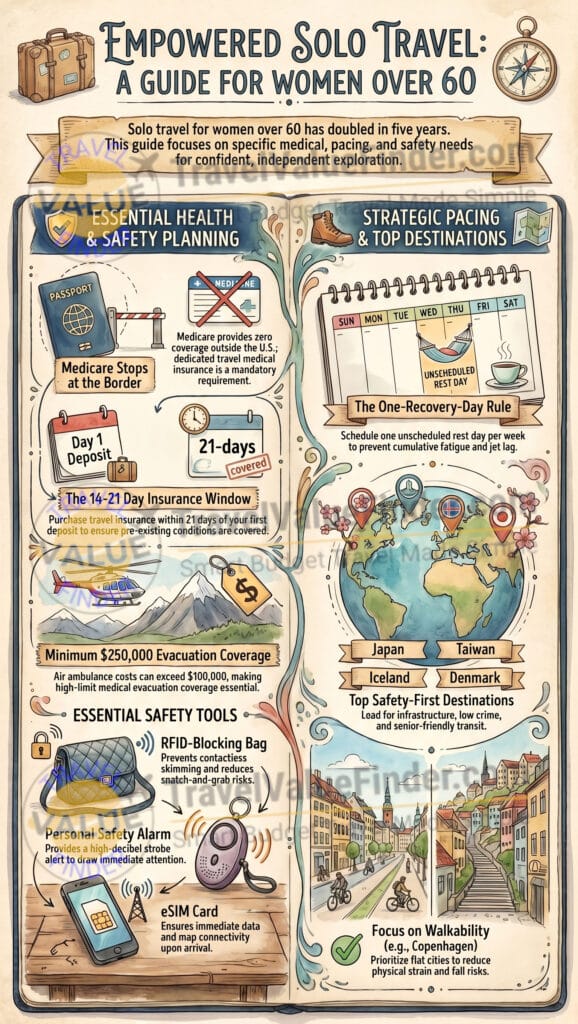
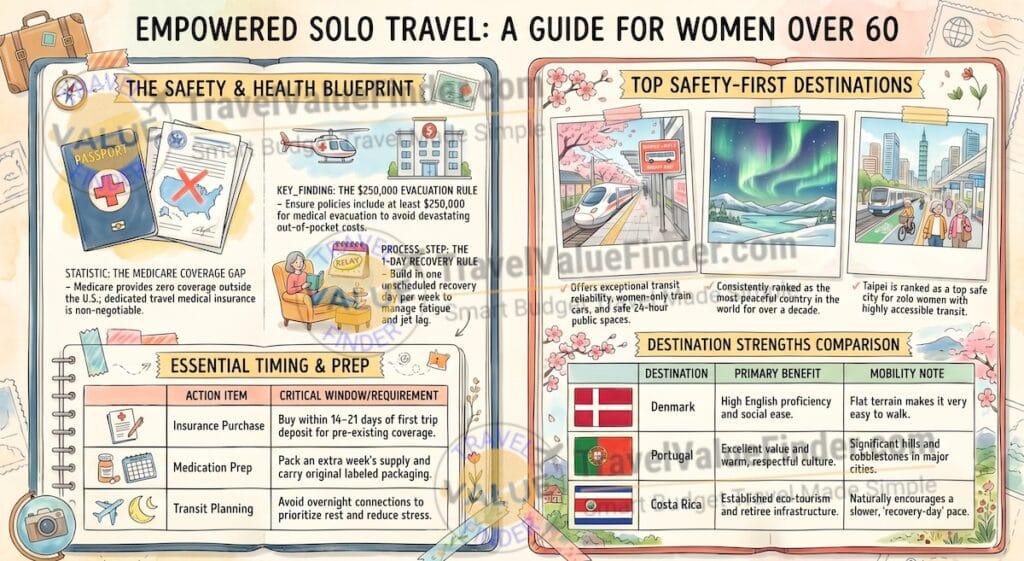
KEY DIFFERENCE FROM GENERAL SOLO FEMALE TRAVEL ADVICE: Women over 60 face distinct planning needs that generic ‘solo female travel’ guides don’t address – Medicare provides zero coverage outside the U.S., so dedicated travel medical insurance with medical evacuation coverage (minimum $250,000) is essential and should be purchased within 14-21 days of the first trip deposit if pre-existing conditions are involved. Pacing matters more: build in at least one unscheduled recovery day per week of travel, and avoid overnight transit connections.

TOP SAFETY TOOLS FOR 2026: RFID-blocking crossbody bags, personal safety alarms (e.g., She’s Birdie), eSIMs for reliable connectivity, and hotel-safe usage for documents.

GUIDE AT A GLANCE

Guide FocusSafety, planning, insurance, and destination guide for women over 60 traveling solo
Growth TrendNumber of women over 60 traveling solo has roughly doubled in the past 5 years
Highest-Spending SegmentSolo travelers 45+ average ~$18,000/trip in 2026 – among the top-spending cohorts
Top Safety-First DestinationsJapan, Taiwan, Iceland, Denmark, Portugal, New Zealand, Costa Rica
Medicare AbroadZero coverage outside the U.S. – dedicated travel medical insurance is essential
Medical Evacuation Minimum$250,000 coverage recommended; air ambulance can exceed $100,000 uninsured
Pre-Existing Condition WindowBuy travel insurance within 14–21 days of first trip deposit for coverage eligibility
Pacing Rule1 unscheduled recovery day per week of travel; avoid overnight transit connections
Essential Safety GearRFID-blocking crossbody bag, personal alarm, eSIM, hotel safe for documents
Solo Supplement TipHostels/guesthouses price by room not occupancy – often the lowest ‘solo tax’
Data SourcesInsureMyTrip/Numbeo 2026, Global Peace Index, World Economic Forum Gender Gap Report, JourneyWoman, GoGoGrandparent
AuthorLeslie Nics, TravelValueFinder.com – Travel writer & solo travel safety researcher

Solo Travel After 60 Isn’t a Compromise – It’s a Different (Often Better) Trip

Here’s a statistic that should reframe this entire conversation: the number of women over 60 traveling solo has roughly doubled over the past five years. This isn’t a fringe trend or a niche corner of the travel industry – it’s one of the fastest-growing segments in travel, period. And it’s not just growing in volume. Solo travelers aged 45 and over are now spending an average of around $18,000 per trip in 2026, making them one of the highest-spending traveler cohorts tracked by the industry.

If you’ve spent any time researching this topic, you’ve probably noticed something: most ‘solo female travel’ content is written for and about women in their 20s and 30s. The safety advice, the packing lists, the destination picks – they’re not wrong, exactly, but they’re answering a slightly different question. A 28-year-old backpacker and a 65-year-old retired teacher have overlapping but genuinely different needs when it comes to insurance, pacing, mobility, accommodation style, and even what ‘safety’ means day to day.

This guide is built specifically for women over 60. Not as an afterthought bolted onto a younger-skewing guide, but as the primary audience from the first paragraph. That means real attention to things that rarely get more than a sentence elsewhere: what happens to your healthcare coverage the moment you leave the country (the answer, for Medicare, is genuinely nothing – zero coverage), how to think about pacing a multi-week trip so jet lag and fatigue don’t derail it, and which destinations combine the safety profile you’re looking for with the walkability and infrastructure that make daily life abroad genuinely manageable, not just survivable.

The question I hear most isn’t ‘is it safe?’ – most women over 60 who are seriously considering this have already done their homework on crime statistics. The question is ‘will it work for me, specifically, at this stage of my life?’ And that’s a much better question, because the honest answer is: yes, with some planning adjustments that nobody bothers to write down for you. – Leslie Nics, TravelValueFinder.com

We’ll also tackle something that deserves to be said plainly: solo travel after 60 – whether you’re newly retired, recently widowed, or simply finally prioritizing your own adventures after decades of prioritizing everyone else’s – is not just achievable. For many women, it turns out to be the best travel of their lives. The independence, the pace, the depth of experience that comes from not negotiating an itinerary with anyone else – these aren’t consolation prizes. They’re the actual point.

The Safety Reality Check: What the Data Actually Shows

Let’s address the elephant in the room directly, because it deserves a direct answer: is it actually safe for a woman over 60 to travel alone? The honest, data-backed answer is yes – and in some ways, more so than for younger solo travelers. Multiple industry analyses note that women over 40 worry less about safety than younger cohorts, partly because they’ve often traveled before, and partly because they tend to choose destinations based on cultural depth and infrastructure rather than nightlife or budget-backpacker circuits – which themselves tend to be lower-risk environments.

That said, ‘safe’ isn’t a single number – it’s a combination of factors that matter differently depending on your priorities. The table below breaks down what actually drives a strong safety profile for solo women over 60, beyond the generic ‘low crime rate’ headline.

Safety FactorWhy It Matters More After 60What to Look For
Walkability & flat terrainCobblestones, steep hills, and long unavoidable walks compound fatigue and fall risk over a multi-day tripCities with efficient, accessible public transit (metro, trams) and manageable elevation changes
24-hour accessible spacesA nearby, well-lit, always-open space (convenience store, hotel lobby, train station) matters more if you’re navigating an unfamiliar area after dark or feeling unwellDestinations where 24-hour convenience stores or staffed transit hubs are common – Japan and Taiwan are global leaders here
Quality and proximity of healthcareAccess to a reliable clinic or hospital – and how that access works for a foreign visitor – is a bigger factor than for a 25-year-old in good health on a short tripCountries with strong public or private healthcare infrastructure and English-speaking medical staff in major cities
Predictable, reliable transitMissed connections and transit confusion are more stressful (and sometimes more physically taxing) when navigating solo without a backup planCountries known for transit punctuality and clear signage in English or pictograms
Cultural attitudes toward solo older womenSome cultures treat an older woman traveling alone with curiosity or unwanted attention; others treat it as entirely unremarkableRead recent first-person reports from women 60+ specifically – not just general solo female travel reviews
Gender equality infrastructureCorrelates with broader respect for personal space, harassment response, and general social comfort for women traveling without a companionWorld Economic Forum Gender Gap Report rankings as a proxy – Nordic countries consistently lead

The Stat Nobody Mentions: Age Often Works in Your Favor A consistent, under-discussed finding across solo female travel research: women over 60 report significantly lower rates of unwanted attention and harassment than younger solo female travelers in the same destinations. This doesn’t mean destination choice doesn’t matter – it absolutely does. But it does mean that some of the anxiety directed at ‘is it safe for a woman alone’ content, which is overwhelmingly written with younger travelers in mind, may not map directly onto your actual experience. The flip side: this can mean less built-in ‘social safety net’ in hostel or backpacker-style settings that cater to younger travelers, which is part of why this guide leans toward accommodation and destination types suited to a slightly different travel style.

Health Insurance and Medical Planning: The Section Most Guides Get Wrong

This is, without exaggeration, the single most important section in this guide – and it’s the one most ‘solo female travel’ content either skips entirely or covers with a throwaway line about ‘getting travel insurance.’ For women over 60, the stakes and the specifics are different enough that they deserve their own deep dive.

The Medicare Reality: Zero Coverage, No Exceptions

If you’re a U.S. resident on Medicare, here is the single most important fact in this entire guide: Medicare provides essentially no coverage outside the United States. Not reduced coverage. Not emergency-only coverage. Generally, zero. If you experience a medical emergency in Italy, Portugal, Japan, or anywhere else outside the 50 states and D.C., Medicare will not pay for it, and you will be expected to pay out of pocket at the point of care – which, in many countries, means before treatment continues.

This single fact is the foundation for everything else in this section, and it’s why dedicated travel medical insurance isn’t an optional add-on for women over 60 – it’s the single most important piece of trip planning, arguably more important than the destination itself.

Medical Evacuation: The Coverage Category That Actually Matters Most

Within travel insurance, the category that deserves the most attention is medical evacuation – and the number to know is this: an air ambulance evacuation back to the U.S. can cost over $100,000. This is not a worst-case exaggeration; it’s a documented real-world cost for serious medical evacuations from abroad. A policy that doesn’t include at least $250,000 in medical evacuation coverage is leaving a meaningful gap, regardless of how comprehensive the rest of the policy looks.

Insurance ComponentWhy It MattersWhat to Look For in a Policy
Emergency medical treatmentCovers hospitalization, physician visits, and emergency care abroad – the baseline Medicare doesn’t provideCoverage limit of at least $100,000–$250,000 depending on destination healthcare costs
Medical evacuationCovers transport to adequate care or repatriation – can exceed $100,000 for air ambulance aloneMinimum $250,000; ideally unlimited or near-unlimited for evacuation specifically
Pre-existing condition coverageMany policies exclude flare-ups of existing conditions (heart disease, diabetes, etc.) unless purchased within a specific windowBuy within 14–21 days of your first trip deposit – this window is the difference between covered and excluded for many insurers
Repatriation of remainsA difficult but practical consideration – covers the cost of returning remains to your home country in a worst-case scenarioTypically $25,000 per policy period in comprehensive senior plans
Trip interruption/cancellationCovers non-medical disruptions – useful but secondary to the medical categories above for this age groupMatch coverage to your actual non-refundable trip costs

The 14-to-21-Day Window You Cannot Miss If you have any pre-existing health condition – heart disease, diabetes, a previous cancer diagnosis, anything you currently manage with medication or monitoring – most insurers require you to purchase your travel insurance policy within 14 to 21 days of your first trip deposit (the first payment you make toward the trip, even a small deposit) in order for that condition to be covered if it flares up during travel. Miss this window, and you can still buy travel insurance – but any claim related to a pre-existing condition may be denied, even if the policy otherwise looks comprehensive. Action item: the moment you put down a deposit on flights, a tour, or accommodation, that’s your insurance shopping deadline – not ‘sometime before the trip.’

Practical Medication Management

  • Carry medications in original, labeled packaging – not pill organizers – for international travel, especially through customs
  • Bring a doctor’s note listing all medications by generic name (not just brand name), dosages, and the medical reason for each – useful for customs, pharmacies, and any medical situation abroad
  • Pack at least one extra week’s supply of every medication beyond your planned trip length, in case of travel delays
  • Split medications between your carry-on and a secondary bag (not checked luggage only) – never let all of your medication risk being in lost luggage
  • Research whether your specific medications are legal and available in your destination country – some common medications in the U.S. are restricted or require special documentation elsewhere

Pacing, Jet Lag, and Mobility: Designing a Trip That Works at 60+

This is the second section that generic solo travel guides almost never address adequately – and it’s often the difference between a trip that feels exhilarating and one that feels exhausting. The good news: the fixes are simple, they just require building them into the plan from the start rather than as an afterthought.

The One-Recovery-Day-Per-Week Rule

Build at least one unscheduled recovery day into every week of travel. Not a ‘light sightseeing day’ – an actual day with no plans, where the only goal is rest, laundry, a slow breakfast, and whatever spontaneous half-day activity might emerge if you feel like it. This single planning habit does more to prevent the cumulative fatigue that derails longer trips than almost anything else.

Avoid Overnight Transit Connections

A red-eye flight followed by an immediate train connection might have been a badge of honor at 25. At 60+, the combination of disrupted sleep, dehydration, and immediate onward travel compounds in ways that can cost you the first two or three days of a trip to recovery – which, on a two-week trip, is a meaningful percentage of your total time. When booking, prioritize arrival times that allow for a full night’s sleep before any onward connection, even if it means a slightly less efficient routing.

Jet Lag: Don’t Underestimate It

Jet lag affects everyone, but recovery time tends to increase with age, and the temptation to ‘push through’ on day one of a long-awaited trip is real. Build your itinerary so that the first 24-48 hours in a new time zone are deliberately light – even if that feels like ‘wasting’ precious vacation time. The payoff is a more enjoyable rest of the trip, not a lost day.

Choosing Accommodation for Mobility

  • Prioritize accommodations within walking distance of public transit, pharmacies, and at least one grocery option – reduces daily logistics friction significantly
  • If a destination is known for hills or cobblestones (Lisbon, Porto, parts of Rome, much of the Mediterranean), check specifically whether your accommodation requires navigating these on arrival with luggage
  • Ground-floor or elevator-accessible rooms aren’t just a ‘nice to have’ for multi-week stays – request this specifically when booking, as it’s not always indicated clearly in listings
  • For longer stays (a week or more in one place), an apartment-style rental with a washing machine reduces the need to pack heavy and the logistics of finding laundry services

The Best Destinations for Solo Women Over 60 in 2026

These destinations are selected specifically through the lens this guide has built so far: safety, walkability, healthcare access, transit reliability, and cultural comfort for older solo women – not just generic ‘low crime’ rankings. Each profile includes what makes it work specifically for this traveler, not just solo travelers in general.

#1Japan – The Gold Standard for Solo Women Over 60 9th on Global Peace Index | Trains run to the second | Women-only train cars | 24-hour safe spaces everywhere

Japan ranks 9th on the Global Peace Index for 2026 and is cited in virtually every solo female travel survey as one of the most welcoming destinations for women traveling alone – but for women over 60 specifically, several features make it stand out even further. The transit system is famously precise (trains run to the second), which removes a major source of solo-travel stress: uncertainty about connections. Major commuter lines offer women-only train carriages, a safety feature that’s genuinely unique on a global scale. And the culture of courtesy and respect for personal space means solo female travelers – including older women – report virtually zero incidents of harassment.

Beyond safety, Japan’s 24-hour convenience store culture (konbini on nearly every block in cities) means a safe, well-lit, staffed public space is rarely more than a minute or two away, at any hour – a meaningful peace-of-mind factor if you’re out later than planned or need to regroup.

  • Budget: $80–$130/day mid-range in major cities; $60–$100/day in less-touristed regions like Tohoku or Shikoku
  • Healthcare: excellent infrastructure in all major cities, though English-speaking staff is more concentrated in Tokyo, Osaka, and Kyoto
  • Mobility note: Japan’s major cities are extremely walkable and transit-accessible, though some older train stations have limited elevator access – research specific stations if mobility is a significant concern
  • Cultural fit: solo dining is completely normalized in Japan, including counter seating designed for one – a genuine quality-of-life factor for solo travelers
#2Taiwan (Taipei) – The Most Underrated Pick on This List Ranked #1 safest city for solo female travelers in 2026 | Happiest place in Asia | MRT runs past midnight

Taipei has been ranked the number one safest city for solo female travelers in 2026 in safety-index analyses, and Taiwan was separately named the happiest place in Asia in the 2026 Gallup World Happiness Report – a combination that makes it one of the most compelling and underrated picks for solo women over 60 looking for an Asia-based trip with a gentler learning curve than some other regional options.

The MRT (metro) system runs reliably until after midnight, stations are well-lit and monitored, and – like Japan – the convenience store culture (7-Eleven and FamilyMart on nearly every block, open 24 hours) means a safe public space is essentially always within reach. Taiwan is also notably affordable relative to Japan, making it a strong option for longer stays.

  • Budget: $45–$80/day mid-range, all-in – among the most affordable safety-leader destinations on this list
  • Full night market meal: $3–$7 – Taiwan’s night market culture is a genuine highlight and very solo-friendly
  • Solo supplement: very low – hostels and guesthouses commonly price by room, not occupancy
  • Healthcare: strong infrastructure in Taipei, with increasing English-language medical resources for visitors
#3Iceland – 11 Consecutive Years at the Top of the Global Peace Index Most peaceful country in the world for over a decade | English widely spoken | Easy to navigate independently

Iceland has led the Global Peace Index for 11 consecutive years – a level of sustained safety leadership that no other country can claim. For solo women over 60, Iceland offers a particular kind of appeal: a small population, widespread English fluency, and an outdoor-oriented culture where independent exploration (whether that’s a self-driven Ring Road segment, geothermal spa visits, or Reykjavik’s compact, walkable city center) feels genuinely accessible without requiring extreme physical exertion.

  • Reykjavik is frequently cited as an ideal launching point for first-time solo travelers – easy to navigate, very safe, with straightforward access to nature experiences
  • Mobility consideration: outside Reykjavik, distances between towns are significant and public transit options are more limited – small-group tours or organized day trips can bridge this gap well for solo travelers without a rental car
  • Geothermal spas (the Blue Lagoon and many lesser-known alternatives) are genuinely solo-friendly and a highlight for older travelers seeking relaxation alongside sightseeing
  • Healthcare: excellent, with English-speaking staff standard in Reykjavik’s medical facilities
#4Denmark (Copenhagen) – Flat, Bikeable, and Effortlessly Easy Top-10 Global Peace Index | Among the most walkable/bikeable cities in Europe | High English proficiency

Copenhagen consistently appears among the easiest European cities to navigate solo – it’s flat (a genuine advantage over hillier European capitals), highly walkable and bikeable, and English proficiency is high enough that language is rarely a barrier even for brief interactions. The city’s casual, open social vibe and abundance of food halls make solo dining feel completely unremarkable, which matters more than it might sound for multi-day solo trips.

  • Flat terrain: a genuine practical advantage for women managing joint issues or general mobility considerations – Copenhagen requires far less uphill walking than Lisbon, Rome, or Edinburgh
  • Food halls (Torvehallerne and similar) offer excellent solo dining with built-in people-watching and casual social interaction without pressure
  • Day trips: Copenhagen’s train network makes castle towns, coastal areas, and even cross-border trips to Sweden straightforward for solo exploration
  • Healthcare: among the best in the world, with very high English proficiency among medical staff
#5Portugal (Lisbon, Porto, Algarve) – Warm Culture, Strong Value, Established Safety Reputation Low crime, well-earned reputation | Excellent value vs. Western Europe | Warm but not overbearing culture

Portugal has become one of Europe’s most popular destinations for solo travelers, and the safety reputation is genuinely well-earned – both Lisbon and Porto report low crime rates, and the culture is warm without being overbearing, a balance that matters for solo travelers who want friendliness without unwanted attention. Portugal also offers excellent value compared to Western European neighbors, making it a strong choice for longer stays.

For women over 60 specifically, Portugal’s appeal extends beyond the cities – the Algarve region offers a slower-paced, beach-oriented alternative with its own strong safety profile and a substantial English-speaking expat and tourist infrastructure, useful for women who want some of the cultural depth of Portugal without the hills and density of Lisbon.

  • Budget: $60–$110/day – strong value relative to the safety and cultural depth on offer
  • Mobility note: Lisbon and Porto both have significant hills and cobblestone streets – supportive footwear is essential, and some neighborhoods require more physical effort than flatter European alternatives
  • Social ease: Portugal’s well-rated hostel scene (Lisbon and Porto both have highly-rated options) means dinner companions are easy to find within hours of arrival, even for travelers who prefer hotels for sleeping but want social options
  • Healthcare: strong public and private systems, with English-speaking private healthcare options readily available in Lisbon, Porto, and the Algarve
#6New Zealand – Cited Across Every ‘Best For Women Over 60’ List Strong safety record | English-speaking | Outdoor-oriented, slower-paced culture

New Zealand appears consistently across solo travel safety rankings and is specifically cited in guides aimed at women over 60 as a strong fit – the combination of English-language ease, a culture oriented around outdoor experiences at a manageable pace, and a strong overall safety record makes it a genuinely comfortable choice for a longer, slower-travel-style trip.

  • Distances: New Zealand’s two main islands require more transit time between destinations than compact European itineraries – factor this into pacing plans, particularly the recovery-day guidance above
  • Organized small-group options: New Zealand has a robust market for small-group tours (hiking, wine regions, scenic rail) that pair well with independent travel for women who want some structure without full group-tour commitment
  • Healthcare: excellent, English-language by default, with reciprocal healthcare agreements for some nationalities worth researching before travel
#7Costa Rica – The Leading Latin American Pick for Solo Women Over 60 Strong safety record relative to the region | Eco-tourism infrastructure | Established expat community

Costa Rica is consistently named among the top destinations for women over 60 specifically – and within Latin America, it stands apart for a combination of relative safety, an established eco-tourism infrastructure built around small lodges and guided experiences (which suit solo travelers well), and a long-standing expat and retiree community that’s created robust English-language services in many areas.

  • Pacing fit: Costa Rica’s eco-lodge culture often naturally builds in the ‘recovery day’ pacing this guide recommends – many properties are destinations in themselves, encouraging slower exploration
  • Healthcare: strong private healthcare system, with many providers experienced in serving an international and retiree-heavy expat population
  • Climate consideration: research regional rainy seasons when planning – some regions are far more pleasant at certain times of year than others
  • Spanish: helpful but not essential in tourist-oriented and expat-heavy areas (Central Valley, Guanacaste, parts of the Pacific coast)
The Destination Guide - Solo Travel for Women Over 60 Infographic - Travel Value Finder
The Destination Guide – Solo Travel for Women Over 60 Infographic – Travel Value Finder

Solo vs. Small-Group Women’s Travel: An Honest Comparison

The choice between fully independent solo travel and joining a small-group women’s tour isn’t a question of ‘real’ solo travel versus a compromise – it’s a genuine strategic decision that depends on your destination, your comfort level with a new place, and what you’re actually looking for from the trip. Here’s an honest breakdown.

FactorFully Independent SoloSmall-Group Women’s Travel (6-10 people)Best Fit
Itinerary controlComplete – change plans hour to hourSet itinerary, though quality operators build in free timeIndependent: if flexibility is your top priority
Cost structureNo group fees, but often pay ‘solo supplements’ for accommodationMany specialized operators now offer no single supplements with guaranteed single roomsGroup: if avoiding solo supplements matters to your budget
Logistics burden100% on you – bookings, transit, problem-solvingHandled by operator – meaningful for first trips to unfamiliar regionsGroup: for a first solo-style trip to a genuinely unfamiliar destination
Social connectionEntirely self-directed – can be as social or solitary as you chooseBuilt-in community of like-minded women, often with pre-trip calls to meet the group beforehandGroup: if meeting people is part of the goal, not just a side effect
Pacing flexibilityTotal control – build in recovery days exactly as neededQuality small-group operators can adapt itineraries to the group’s energy in real timeEither – but verify a group operator’s flexibility before booking
Destination familiarityNo constraints – go anywhereOften curated toward destinations suited to the formatIndependent: for destinations you’ve researched and feel ready for; Group: for a ‘training wheels’ first experience somewhere new

A pattern worth noting: many women use small-group women’s travel as a bridge – a way to experience a destination, build confidence, and develop a feel for independent travel logistics in that region – before returning to the same destination (or a similar one) fully independently on a future trip. There’s no reason this has to be an either/or choice across a lifetime of travel.

Essential Safety Tools and Gear for 2026

Beyond destination choice and insurance, a handful of physical tools and habits make a measurable difference in day-to-day solo travel safety and comfort. None of these are about fear – they’re about the same kind of sensible preparation you’d apply to any unfamiliar situation.

ItemWhat It DoesWhy It Matters for Solo Women Over 60
RFID-blocking crossbody bagBlocks contactless credit card and passport skimming; worn across the body reduces snatch-and-grab riskFrees up hands for stairs, uneven terrain, and luggage – a practical mobility benefit beyond the security feature
Personal safety alarm (e.g., She’s Birdie)Loud alarm plus bright strobe light, designed to be activated quickly and draw immediate attentionProvides a fast, low-effort response option in an uncomfortable situation without needing to assess or de-escalate verbally
eSIM for destination countryProvides reliable data connectivity from arrival without needing a physical SIM swapMaps, translation apps, and emergency contact ability work immediately – removes a common point of early-trip stress
VPNSecures data on public WiFi networks (hotels, cafes, airports)Protects banking and personal information when using shared networks, which solo travelers rely on more heavily
Hotel safe usage (for passport, spare cards)Reduces the amount of valuable documentation carried dailyLowers the impact of any single bag loss or theft incident – keep only what you need for that day’s activities on you
Filtered water bottleReduces reliance on bottled water in destinations with water-quality concernsCost savings over a multi-week trip and reduces plastic waste – a practical and environmental win
Lightweight, supportive walking shoesReduces fall risk and fatigue on uneven terrain (cobblestones, hills, long transit days)Arguably the single highest-impact physical item on this entire list for comfort and safety combined

Ready to book your first international trip? Compare flights and hotels across all destinations in this guide: Search First-Trip Flights and Hotels – TravelValueFinder Deals. Real-time prices, hundreds of providers, secure booking.

18 Practical Tips for Solo Women Over 60 Planning Their Next Trip

  1. Buy travel medical insurance within 14-21 days of your first deposit – non-negotiable if you manage any pre-existing condition. This single action determines whether a future claim is covered or denied.
  2. Confirm your policy includes at least $250,000 in medical evacuation coverage specifically – not just general medical coverage. Evacuation costs are the category most likely to financially devastate an otherwise well-planned trip.
  3. Build one full unscheduled recovery day into every week of travel, and protect it the way you’d protect a scheduled activity – don’t let it get ‘filled in’ with last-minute plans.
  4. Avoid booking overnight transit connections (red-eye flight followed by immediate onward travel) – prioritize a full night’s sleep before any major connection, even if the routing is slightly less efficient.
  5. Carry medications in original packaging with a doctor’s note listing generic names, dosages, and medical reasons – split between carry-on and a secondary bag, never solely in checked luggage.
  6. Research medication legality and availability at your destination before traveling – some common U.S. medications are restricted or require documentation elsewhere.
  7. Choose accommodation within walking distance of transit, a pharmacy, and food options – this single factor reduces more daily friction than almost any other accommodation choice.
  8. For hilly or cobblestone-heavy destinations (Lisbon, Porto, Rome), specifically check whether your accommodation requires navigating these with luggage on arrival, and request ground-floor or elevator access when booking.
  9. Invest in genuinely supportive, broken-in walking shoes well before your trip – this is the highest-impact physical preparation you can make for both safety and enjoyment.
  10. Set up an eSIM for your destination before departure so you have working data and maps from the moment you land – removes a common source of early-trip stress and disorientation.
  11. Use a VPN on any public WiFi, especially for banking or anything involving personal information – solo travelers rely on shared networks more than travelers with companions to ‘mind the bags.’
  12. Carry a personal safety alarm and know how to activate it without looking – muscle memory matters more than the device itself.
  13. Use hotel safes for your passport and spare payment cards; carry only what you need for that day’s activities – minimizes the impact of any single loss or theft.
  14. For a first solo trip to an unfamiliar region, consider a small-group women’s tour as a ‘training wheels’ experience – many specialized operators now offer no single-supplement guaranteed single rooms specifically for this demographic.
  15. Read recent first-person trip reports from women specifically in their 60s and 70s for your target destination – general ‘solo female travel’ reviews skew toward younger travelers and may not reflect your experience.
  16. Check World Economic Forum Gender Gap Report rankings as a useful proxy for broader cultural comfort with solo women, beyond raw crime statistics – it captures dimensions crime data misses.
  17. Pack at least one extra week’s medication supply beyond your planned trip length to buffer against travel delays – a remarkably common reason for medication shortfalls on longer trips.
  18. Don’t treat ‘slower’ as a downgrade. A trip designed around your actual pace – with real rest days, flexible mornings, and room for spontaneous discoveries – often produces deeper, more memorable experiences than a packed itinerary built for someone else’s stamina.

Quick Answers: FAQs

Is it safe for a woman over 60 to travel alone?

Yes. Solo travel for women over 60 is one of the fastest-growing travel segments, with the number of women over 60 traveling solo roughly doubling in the past five years. Women over 40 generally report less worry about safety than younger solo travelers and often report lower rates of unwanted attention. The best destinations – Japan, Taiwan, Iceland, Denmark, Portugal, New Zealand, and Costa Rica – combine low crime, strong infrastructure, walkability, and reliable healthcare access, all of which matter more for solo travelers over 60 than raw crime statistics alone.

Does Medicare cover medical care if I travel internationally?

No. Medicare provides essentially zero coverage outside the United States (the 50 states and D.C.). Any medical care received abroad – from a doctor’s visit to a hospitalization to medical evacuation – is not covered by Medicare and must be paid out of pocket unless you have separate travel medical insurance. This is the single most important planning fact for any woman over 60 considering international solo travel.

What is the best travel insurance for women over 60 traveling alone?

Look for a policy that includes emergency medical treatment coverage of at least $100,000-$250,000, medical evacuation coverage of at least $250,000 (air ambulance evacuations can exceed $100,000), and – if you have any pre-existing conditions – purchase the policy within 14-21 days of your first trip deposit, as this window typically determines whether pre-existing condition coverage applies.

What are the best destinations for solo female travelers over 60?

Japan, Taiwan, Iceland, Denmark, Portugal, New Zealand, and Costa Rica consistently rank among the best destinations for solo women over 60 in 2026. Japan offers exceptional transit reliability, women-only train cars, and 24-hour safe spaces. Taiwan’s Taipei was ranked the #1 safest city for solo female travelers in 2026. Iceland has led the Global Peace Index for 11 consecutive years. Portugal offers strong value, low crime, and a warm but unobtrusive culture, though its hilly terrain is worth planning around.

How should I pace a solo trip as an older traveler?

Build at least one unscheduled recovery day into every week of travel, avoid overnight transit connections that immediately lead into onward travel, and plan the first 24-48 hours in a new time zone as deliberately light to manage jet lag. These adjustments are simple but make a significant difference in how a multi-week trip feels overall.

Should I join a small-group tour or travel fully independently?

Both are valid, and many women use small-group women’s travel (typically 6-10 people) as a way to build confidence in an unfamiliar region before traveling there independently later. Small-group options increasingly offer no single-supplement guaranteed single rooms, removing a common cost barrier. Independent travel offers complete itinerary flexibility. The right choice depends on your familiarity with the destination and how much logistics support you want versus full control.

Plan Your Solo Trip Over 60: Essential Resources on TravelValueFinder

Everything you need before and during your trip:

Bottom Line: This Is the Trip You’ve Been Putting Off – and the Data Says Go

Solo travel for women over 60 isn’t a smaller, more cautious version of the travel you did in your 30s. It’s its own thing – often more comfortable, often more rewarding, and statistically growing faster than nearly any other travel segment. The women driving that growth aren’t reckless or naive about risk. They’re well-researched, often experienced travelers who’ve found that the combination of independence, pace, and depth that solo travel offers becomes more valuable, not less, with time.

The planning is genuinely different from what most generic solo travel content addresses – and that’s the gap this guide has tried to close. Medicare’s lack of international coverage isn’t a footnote; it’s the most important fact in your entire trip-planning process. Pacing isn’t a ‘nice to have’; it’s the difference between a trip you remember fondly and one you remember recovering from. And the destinations that work best aren’t necessarily the ones at the top of generic ‘safest countries’ lists – they’re the ones where walkability, transit reliability, healthcare access, and cultural ease all align.

If you’ve been waiting for permission, or for the ‘right’ moment, or for someone else’s schedule to align with yours – the data suggests the moment has already arrived, and hundreds of thousands of women just like you are already out there, having exactly the trip you’ve been imagining.

I think about the women who write to me after their first solo trip past 60 – and almost universally, the thing they say isn’t ‘I was so scared’ or ‘it was so hard.’ It’s some version of ‘why did I wait so long?’ The planning matters. The insurance matters. But once that’s handled, what’s left is just… the trip. The one you’ve actually wanted. – Leslie Nics, TravelValueFinder.com

Ready to plan the trip? Use our Free AI Trip Planner to build a day-by-day food-focused itinerary for any destination, and browse our destination guides to find exactly where to stay for the best local food access.

About the Author

Leslie Nics Travel Writer & Solo Travel Safety Researcher | TravelValueFinder.com. Leslie Nics is the lead travel writer and research lead at TravelValueFinder.com, where he specializes in practical, life-stage-specific travel guidance for retirees, solo travelers, and long-term travelers exploring life abroad. His solo travel research draws on extended firsthand experience traveling independently across Asia, Europe, and Latin America, combined with continuous tracking of safety indices including the Global Peace Index, the World Economic Forum Gender Gap Report, and direct reporting from women’s solo travel communities. His solo travel and senior travel guides are referenced across women’s travel Facebook communities, Reddit’s r/solotravel and r/SoloTravelOver50, and international relocation forums. He places particular emphasis on the practical planning gaps – insurance, pacing, mobility – that life-stage-specific travelers face but that generic solo travel content often overlooks entirely.

Core Expertise: Solo travel safety analysis | Senior travel insurance and medical planning | Destination accessibility and mobility research | Women’s travel community insights

Sources & References (June 2026)

  • InsureMyTrip / Numbeo Crime & Safety Index – Solo Female Travel Safety Guide 2026
  • Institute for Economics and Peace – Global Peace Index 2026 (Japan, Iceland, Denmark, Portugal rankings)
  • World Economic Forum – Global Gender Gap Report (gender equality metrics for destination evaluation)
  • Gallup – World Happiness Report 2026 (Taiwan ranking)
  • JourneyWoman.com – Solo Female Travel Resources and 2026 Travel Pulse Survey
  • GoGoGrandparent – Senior Travel Guide 2026: Insurance, Mobility, and Safety
  • Traveling Savvy Seniors – How to Travel Alone as a Senior Woman (safety statistics on solo women 60+)
  • International Insurance / internationalinsurance.com – Solo Travel for Women: Top 10 Countries 2026
  • Cover Page Media – Solo Female Travel 2026: Destinations and Spending Trends
  • americanvisitorinsurance.com – Travel Insurance for Seniors: Coverage Guidance 2026
Share this post
Leslie Nics
Leslie Nics

Leslie Nics is the founder and primary travel researcher at Travel Value Finder. He specializes in budget travel, destination research, and itinerary planning, drawing on firsthand travel experience across multiple regions to help readers find affordable and practical travel options.

Newsletter Updates

Enter your email address below and subscribe to our newsletter