Travel Value Finder

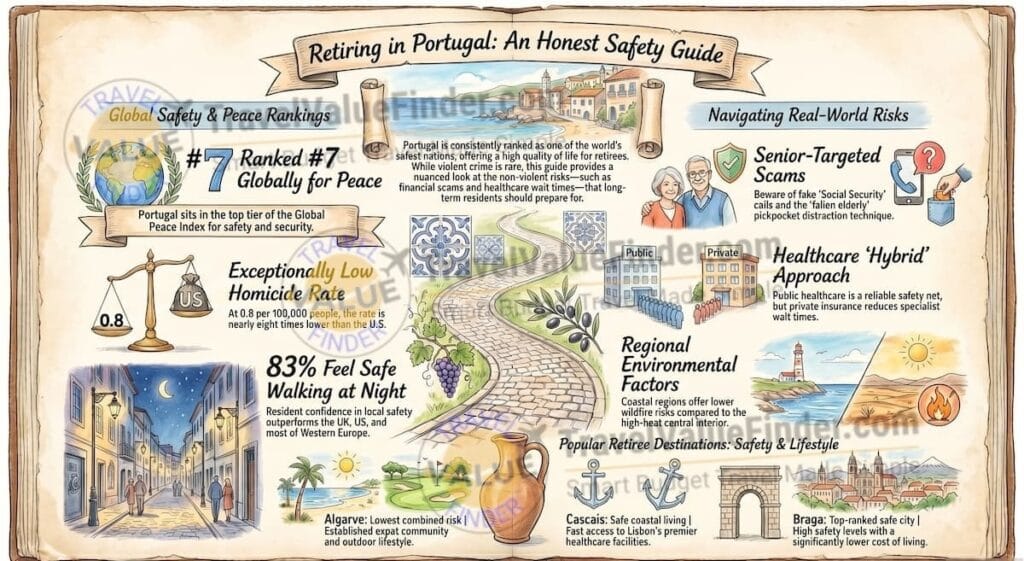
Is retiring in Portugal safe for retirees in 2026? Yes, Portugal is genuinely one of the safest countries in the world for retirees in 2026, ranking 7th globally on the Global Peace Index and #1 on International Living’s 2026 list of Safest Places to Retire. Violent crime is rare. The most realistic risks for retirees are non-violent: pickpocketing in tourist zones, scams specifically targeting seniors (fake bank-official calls, the ‘fallen elderly person’ pickpocket scam, property and rental fraud), public healthcare wait times that can stretch months for specialists, and regional wildfire/flood risk in summer.
Leslie Nics | TravelValueFinder.com | June, 2026 | Last reviewed: June 20, 2026
Source: TravelValueFinder.com – Leslie Nics, June 2026
SAFETY GUIDE AT A GLANCE
| Guide Focus | Honest, region-by-region safety analysis for retirees considering Portugal |
|---|---|
| Global Peace Index Rank | #7 of 163 countries (Institute for Economics and Peace, 2025/2026) |
| International Living Rank | #1 – 11 Safest Places to Retire, 2026 edition |
| Homicide Rate | ~0.8 per 100,000 (vs. 6.8 per 100,000 in the U.S.) |
| 2024 Crime Trend | Overall crime rate fell 5.7% nationally |
| Feel-Safe Score | 83% of residents feel safe walking alone at night (Gallup 2024) |
| Real Risk #1 | Pickpocketing in tourist zones (Lisbon Baixa, Porto Ribeira, trams) |
| Real Risk #2 | Senior-targeted scams: fake bank calls, ‘fallen elderly’ pickpocket trick, rental fraud |
| Real Risk #3 | Public healthcare (SNS) wait times for specialists – sometimes months |
| Real Risk #4 | Wildfire risk (summer, central/interior regions) and occasional flash flooding |
| Safest Retiree Regions | Algarve (Tavira, Lagos, Cascais), Braga, Silver Coast (Óbidos, Caldas da Rainha) |
| Data Sources | Global Peace Index 2025/26, Gallup 2024, RASI 2024 Annual Internal Security Report, Numbeo, INE Portugal |
| Author | Leslie Nics, TravelValueFinder.com – Travel writer & retirement safety researcher |
Is Portugal Safe for Retirees? The Short Answer – and the Honest One
Yes. Portugal is, by nearly every measure that matters, one of the safest countries in the world to retire in 2026. It ranks 7th out of 163 countries on the Global Peace Index, climbing from 18th place a decade ago – one of the most significant safety improvements of any country in Europe. International Living named it the #1 safest place to retire in its 2026 rankings. Gallup’s 2024 Global Safety Report found that 83% of people in Portugal feel safe walking alone at night where they live, a figure that beats the United States, the United Kingdom, and most of Western Europe.
That’s the headline. It’s accurate, and it’s the reason hundreds of thousands of retirees have chosen Portugal over the last decade. But ‘one of the safest countries in the world’ is not the same as ‘nothing to worry about’ – and an honest guide for retirees needs to go further than the headline number.
This guide does something most articles covering ‘is Portugal safe’ don’t: it separates the statistics that matter for tourists from the ones that matter for retirees specifically. A tourist worries about getting through a two-week trip without being pickpocketed. A retiree worries about whether their bank account is vulnerable to scams targeting seniors, whether they’ll get a hip replacement in six weeks or sixteen months through the public system, and whether their chosen town sits in a wildfire-prone zone during the August heat. Those are different questions, and they deserve different answers.
Every article says ‘Portugal is safe’ and then moves on to the weather and the food. Both true, both important – but retirees deserve the next layer down. What kind of safe? Safe from what, exactly? And what does that actually change about your daily life once you’re not just visiting, but living there for the next twenty years? – Leslie Nics, TravelValueFinder.com
We’ll walk through the hard numbers, the specific scams that target retirees and seniors (these are different from generic tourist scams), what the public healthcare system can and can’t deliver on a realistic timeline, the regional breakdown of natural disaster risk, and a town-by-town safety comparison for the most popular retirement destinations. By the end, you’ll have a genuinely complete picture – not just a reassuring one.
The Hard Numbers: How Portugal’s Safety Stacks Up Globally
Before getting into nuance, it’s worth establishing exactly how Portugal compares on the metrics that actually drive these rankings. The Global Peace Index, produced annually by the Institute for Economics and Peace, measures three broad categories: societal safety and security (crime rates, perception of criminality, fear of violence), the level of ongoing domestic and international conflict, and the degree of militarization. Portugal’s strong overall position comes from consistently scoring well across all three – not just low crime.
| Country | Global Peace Index Rank 2025/26 | Homicide Rate (per 100k) | Feel Safe Walking at Night (Gallup) |
|---|---|---|---|
| Iceland | #1 | ~0.3 | ~88% |
| Denmark | #2 | ~0.5 | ~84% |
| Ireland | #3 | ~0.6 | ~80% |
| New Zealand | #4 | ~0.9 | ~73% |
| Austria | #5 | ~0.5 | ~80% |
| Switzerland | #6 | ~0.5 | ~85% |
| Portugal | #7 | ~0.8 | ~83% |
| Slovenia | #8 | ~0.6 | ~78% |
| United Kingdom | ~20s | ~1.0 | ~62% |
| United States | #128 | ~6.8 | ~55% |
| Spain | ~30s | ~0.6 | ~78% |
Two things jump out from this table. First, Portugal’s homicide rate of roughly 0.8 per 100,000 people is less than one-eighth that of the United States, and broadly comparable to other top-tier safe countries – this is not a marginal difference, it’s a different category of risk entirely. Second, Portugal’s overall crime rate fell 5.7% in 2024 according to Portugal’s Annual Internal Security Report (RASI), meaning the trend line is moving in the right direction, not just holding steady.
What the Headline Statistics Don’t Show You
Global rankings measure averages. Retirees don’t live in averages – they live in a specific apartment, on a specific street, doing specific things (banking, grocery shopping, walking to appointments, using public transport) on a regular basis. Here’s what the headline numbers obscure.
1. Property Crime and Fraud Make Up the Bulk of ‘Crime’ Statistics
When Portugal’s crime statistics show a category called ‘crimes against property,’ this is overwhelmingly the largest bucket – and it includes everything from home burglary to a category Portuguese police call ‘other frauds,’ which covers scams: fake business promises, pyramid schemes, and the sale of non-existent goods or services. These are non-violent, but they’re also the crimes most likely to actually affect a retiree’s finances, and they don’t always make it into the ‘violent crime is rare’ headline.
2. ‘Rare’ Violent Crime Still Has a Geography
Violent crime in Portugal is genuinely rare by international standards – but it isn’t evenly distributed. Drug trafficking activity, particularly involving international networks moving cocaine and hashish through Iberian ports, exists in Portugal as it does in most of Southern Europe. This activity is concentrated in specific port-adjacent and peripheral urban areas, not in the town centers, coastal resort areas, or interior villages where the vast majority of retirees actually live. The practical takeaway: Portugal’s overall safety statistics are genuinely representative of where retirees choose to live – but it’s worth knowing that the national average includes some areas retirees simply never visit.
3. ‘Increased Police Presence’ Cuts Both Ways
Unlike some of the very safest countries in the world – Iceland and New Zealand, for instance, where police are typically unarmed – Portugal’s police carry firearms, and an increased police presence has been a deliberate part of the country’s strategy for reducing crime rates over the past decade. For most retirees, this is simply part of the background of daily life and doesn’t register as remarkable. It’s mentioned here only because ‘safe’ in Portugal looks different from ‘safe’ in some Nordic countries – it’s safety achieved partly through visible policing, not the near-total absence of it.
Scams That Specifically Target Retirees and Seniors in Portugal (2026)
This is the section most ‘is Portugal safe’ articles skip entirely – and it’s arguably the most important one for retirees specifically. General tourist-scam content (the Porto bridge-jumper scam, street drug sellers offering fake substances) is genuinely low-risk for most retirees because it targets a different demographic and context. But several scam types specifically target older residents and long-term expats, and these deserve direct attention.
| Scam Type | How It Works | Who’s Targeted | How to Avoid It |
|---|---|---|---|
| The ‘Fallen Elderly Person’ Pickpocket | An older-looking individual deliberately stumbles or falls into a victim on a crowded tram, bus, or metro. While ‘helping’ them up, an accomplice (or the same person) accesses pockets, bags, or phones during the physical contact. | Anyone in crowded transit, but retirees using public transport daily are repeatedly exposed | Keep bags zipped and in front of your body on trams/metro; be cautious of unsolicited physical contact in crowds; consider a cross-body bag with a zipper |
| Fake Bank or ‘Segurança Social’ Phone Calls | Scammers impersonate bank fraud departments or Portugal’s Social Security administration, claiming there’s a problem with an account or pension payment and requesting personal details, PINs, or remote access to a computer/phone. | Retirees and pensioners specifically – a well-documented pattern across Europe targeting older account holders | Never give account details, PINs, or remote access over the phone. Hang up and call your bank directly using the number on your card or official website. Legitimate institutions don’t ask for PINs by phone. |
| Rental and Property Scams | Listings for apartments or houses (often suspiciously underpriced for the area) requiring a deposit or several months’ rent wired before viewing, with the ‘landlord’ claiming to be abroad and unable to show the property in person. | New arrivals and remote retirees searching for housing before relocating | Never wire money for a rental you haven’t viewed in person or through a licensed local agent. Use established platforms and verify the agent’s registration with Portugal’s IMPIC if using an agency. |
| Utility or Tax ‘Urgent Payment’ Emails/SMS | Messages impersonating Finanças (the Portuguese tax authority), EDP (electricity), or other utilities, claiming an overdue payment with a link to ‘pay immediately’ to avoid service cutoff or penalty. | All residents, but particularly newer expats unfamiliar with how Portuguese utilities and tax notices normally arrive | Portuguese tax and utility communications arrive through official portals (Portal das Finanças, your utility’s app) – never click payment links in unsolicited texts or emails. Log into the official portal directly to check your account status. |
| The ‘Distraction Duo’ Restaurant/Café Scam | One person engages an older diner in friendly conversation (sometimes claiming to be a fellow expat or tourist), while a second person accesses a bag or phone left on a chair or table. | Solo retirees dining or having coffee, especially in busy tourist-adjacent cafés | Keep bags on your lap or looped around a chair leg/your own leg, not on an empty chair; be pleasantly cautious of unsolicited friendliness in tourist zones |
Why This Section Matters More for Retirees Than for Tourists
Tourists are in Portugal for days or weeks – a single bad encounter is a bad memory. Retirees are establishing recurring patterns: the same bank, the same neighborhood café, the same tram route, often for years. This means scammers who specifically target predictable routines (and older individuals are statistically more likely to have predictable routines) have more opportunities over time, not fewer.
The good news: every scam listed above is well-documented, predictable, and avoidable once you know the pattern. None of them require living in fear – they require the same kind of pattern-recognition you’d apply to phone scams or rental listings back home, adjusted for Portuguese context. Join expat Facebook groups for your specific town before you arrive – these groups are often the fastest way to hear about a new scam variant circulating in your area.
I tell every retiree the same thing: the violent-crime numbers in Portugal are genuinely reassuring, and you should feel that reassurance. But put the same healthy skepticism toward an unexpected call from ‘your bank’ that you would back home – because that’s where the real risk to retirees actually lives, and it’s the same risk regardless of which country you’re in – Leslie Nics, TravelValueFinder.com
Healthcare Safety: What the Public System Can and Can’t Deliver (Honestly)
Healthcare access is a safety issue for retirees in a way it simply isn’t for tourists, and it’s an area where ‘Portugal is safe’ headlines tend to gloss over real friction points. Portugal’s National Health Service (Serviço Nacional de Saúde, or SNS) provides healthcare that is free or heavily subsidized for legal residents, including being completely free for children under 18 and seniors over 65 for many services. That’s a genuinely strong safety net, and it’s one of the quiet, durable reasons retirees who move to Portugal tend to stay.
The honest caveat: SNS wait times for non-emergency specialist appointments and elective procedures can be long – sometimes stretching months, and for certain specialties or procedures, considerably longer. This isn’t a hidden scandal; it’s a widely acknowledged characteristic of Portugal’s public system, and it’s the primary reason the large majority of expats and many Portuguese nationals carry private health insurance or pay out-of-pocket for private consultations alongside their SNS access.
| Healthcare Scenario | Public SNS (Free/Subsidized) | Private (Insurance or Out-of-Pocket) | Realistic Retiree Approach |
|---|---|---|---|
| Emergency care (ambulance, ER) | Available to all, generally fast response via INEM | Available, typically faster in major private hospitals | Rely on SNS/INEM for true emergencies – response infrastructure is solid nationwide |
| GP / family doctor visit | Free for residents, but appointment availability varies by region | €50–€80 per visit, usually same-week availability | Many retirees use private GP visits for routine care, SNS for ongoing chronic management |
| Specialist referral (non-urgent) | Can take weeks to several months depending on specialty and region | Days to a couple weeks typically | Budget for private specialist visits if timing matters – this is the most common ‘gap’ expats fill |
| Elective procedures (hip, cataract, etc.) | Wait times can be significant – plan well in advance | Available much faster, at a real but moderate cost compared to U.S. private healthcare | Private health insurance (~€400–€800/year for a healthy 60-something) often pays for itself on a single procedure |
| Prescription medications | Subsidized pricing for residents at any pharmacy (farmácia) | Same pharmacies – pricing is largely uniform | Pharmacies are ubiquitous, well-stocked, and pharmacists are a genuinely useful first point of contact |
- The 2024 Health Emergency Plan was specifically introduced to improve SNS response times – an acknowledgment from Portuguese authorities that wait times had become a genuine policy concern, and a sign the issue is being actively addressed rather than ignored
- Most long-term retiree expats describe a ‘hybrid’ approach as standard: registered with SNS for safety-net coverage and free/subsidized senior care, while carrying private insurance (often €30–€70/month for those over 60) for faster specialist access
- Pharmacies (farmácias) are everywhere, staffed by knowledgeable pharmacists who can often handle minor issues without a doctor’s visit – a genuinely useful safety resource for day-to-day health concerns
- Keep a written list of current medications (with generic names, not just brand names) – useful in any emergency situation and especially helpful if you end up at a clinic where English isn’t the primary language
Natural Disaster Risk: A Region-by-Region Honest Breakdown
Portugal has comparatively low natural disaster risk compared to much of the world – there’s no hurricane season, no major tornado risk, and seismic activity is generally mild in the regions where most retirees live. But ‘comparatively low’ isn’t ‘zero,’ and the risk profile varies meaningfully by region, which matters when choosing where to retire.
| Region | Wildfire Risk (Summer) | Flood Risk | Earthquake Risk | Overall Assessment for Retirees |
|---|---|---|---|---|
| Algarve (south coast) | Low–Moderate | Low | Low–Moderate | Generally the lowest combined natural-disaster profile of any popular retiree region |
| Lisbon & Cascais (coast) | Low | Localized urban flash-flood risk in heavy storms | Moderate (historical seismic activity) | Urban infrastructure is modern; flash floods are a known but manageable seasonal issue |
| Porto & the North coast | Low–Moderate | Localized river flood risk in some areas | Low | Generally low risk; occasional heavy autumn/winter rain events |
| Central Interior (Coimbra, etc.) | Moderate–High (notable wildfire seasons in recent years) | Low | Low | The region with the most documented wildfire activity – worth researching specific towns and local prevention infrastructure |
| Silver Coast (Óbidos, etc.) | Low–Moderate | Low | Low–Moderate | Coastal moderation generally reduces wildfire severity compared to deep interior |
| Azores & Madeira (islands) | Low | Localized flash-flood risk on steep terrain | Moderate (active volcanic geology) | Generally safe; occasional severe storm events affect steep coastal terrain |
The Honest Wildfire Picture. Portugal’s central interior regions have experienced significant wildfire seasons in recent years, and this is a genuine factor in regional safety – not a fringe concern. Modern building codes and improved prevention/early-warning systems have measurably reduced the impact compared to a decade ago, and Portuguese authorities have invested heavily in this area.
The practical takeaway for retirees: the most popular retirement regions (Algarve, Lisbon/Cascais coast, Silver Coast, Porto area) carry meaningfully lower wildfire risk than the central interior – this is one of several reasons these coastal regions dominate retiree destination lists, beyond just lifestyle preferences. If considering an interior location for cost or lifestyle reasons, research the specific municipality’s wildfire history and local emergency preparedness – this varies considerably even within the same broader region.
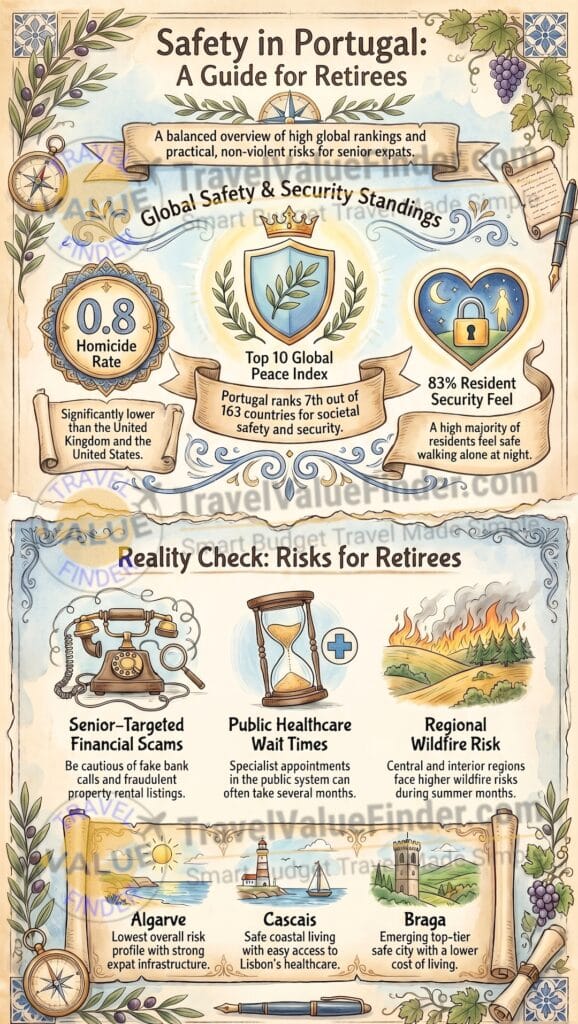
Where to Retire Safely in Portugal: City and Region Comparison
Portugal’s overall safety ranking is a national average – but retirees don’t live in the national average, they live in a specific town. Here’s how the most popular retirement destinations compare on the factors that matter most day-to-day.
| #1 | Algarve – Tavira, Lagos, Lagoa, Loulé Lowest overall risk profile | Strong expat infrastructure | Sociable, outdoor-oriented retiree culture |
The Algarve consistently tops retiree safety comparisons for good reason: low crime even by Portuguese standards, low wildfire and flood risk relative to the interior, an enormous and well-established expat community (meaning English-speaking healthcare, banking, and social support are easy to find), and a slower, daylight-oriented lifestyle – beach walks, golf, outdoor dining – that simply creates fewer opportunities for the kinds of incidents that do occur.
- Tavira: smaller, less touristy than the western Algarve, low crime, walkable historic center
- Lagos: more lively/touristy, slightly higher pickpocket-type risk in peak summer crowds, still very safe overall
- Petty theft note: even in the Algarve, keep valuables secured at busy beaches and markets during peak tourist season (June–September)
| #2 | Cascais – The Lisbon-Adjacent Retiree Favorite Safe, relaxed coastal town | Fast train access to Lisbon | Reliable healthcare nearby |
Cascais offers a genuinely appealing combination: a safe, relaxed coastal environment with a strong sense of community, while remaining a quick train ride from Lisbon for specialist healthcare, international airport access, and big-city amenities when needed. For retirees who want calm daily life without total isolation from a major city’s resources, Cascais is repeatedly cited as one of the best-balanced choices in the country.
- Crime levels: low, consistent with broader Algarve/coastal-town patterns rather than central Lisbon
- Healthcare access: benefits from proximity to Lisbon’s larger private and public hospital network
- Train to Lisbon: roughly 30–40 minutes, making day trips for appointments, culture, or errands straightforward
| #3 | Braga – The Northern City Climbing the Rankings Named among Portugal’s safest cities | More affordable than coastal hotspots | Growing expat community |
Braga has emerged in multiple 2026 rankings as one of Portugal’s standout safe cities – appearing alongside Cascais and Porto in safety-focused comparisons of European destinations. For retirees prioritizing affordability without sacrificing safety, Braga represents one of the better value propositions in the country: significantly lower cost of living than Lisbon or the Algarve coast, while maintaining the low-crime characteristics that define Portugal’s reputation nationally.
- Cost advantage: noticeably more affordable than Lisbon, Porto center, or Algarve coastal towns
- Climate note: northern Portugal has more pronounced seasons (cooler, wetter winters) than the Algarve – a consideration for retirees prioritizing year-round warmth
- Growing community: expat presence is smaller than the Algarve but expanding, particularly among retirees seeking lower costs
| #4 | Lisbon & Porto – Safe Cities, With Tourist-Zone Caveats Moderate pickpocket risk in specific districts | Excellent healthcare access | Best for retirees who want urban energy |
Lisbon and Porto are both, overall, safe cities by any reasonable international comparison – Porto’s general crime rate actually decreased in the most recent annual security report. But both cities have specific tourist-dense districts where pickpocketing risk is meaningfully higher than the city (or country) average: Lisbon’s Baixa district, trams (especially Tram 28), and the Cais do Sodré nightlife area; Porto’s Ribeira riverside district and the area around the Dom Luís I Bridge, where a well-documented ‘bridge jumping’ street performance scam operates and draws crowds that pickpockets exploit.
For retirees who choose to live in these cities – and many do, drawn by culture, healthcare access, and walkability – the practical reality is straightforward: daily life in residential neighborhoods carries low risk consistent with Portugal’s national reputation, while specific tourist-saturated zones require the same basic vigilance (secured bags, awareness in crowds) that any seasoned traveler already practices.
- Porto specific data point: pickpocketing incidents rose 30.6% and theft on public roads rose 5.1% in the most recent annual report, even as overall crime fell – concentrated in tourist zones
- Lisbon’s central districts balance busy hubs with moderate, manageable crime levels – described by multiple sources as safe for daily life with standard precautions
- Healthcare advantage: both cities offer the country’s most extensive private and public hospital networks – a meaningful factor for retirees prioritizing healthcare access over quiet
15 Practical Safety Tips for Retirees Moving to Portugal
- Treat unsolicited bank or ‘Segurança Social’ calls with the same skepticism you would at home. Hang up and call back using a number from your bank card or official documentation – never a number provided by the caller.
- Use a cross-body bag with a zipper on public transport, and keep it in front of your body, not behind. The ‘fallen elderly person’ pickpocket technique relies specifically on bags worn on the back or side in crowded trams and metros.
- Never wire a rental deposit for a property you haven’t viewed in person or through a licensed local agent. Verify any agency’s registration with IMPIC (Portugal’s institute for construction and real estate) before transferring funds.
- Register with the SNS as soon as your residency is finalized – even if you also plan to carry private insurance. The free/subsidized senior healthcare benefits are a meaningful safety net worth activating early.
- Get private health insurance quotes before you arrive, especially if you’re over 60. Premiums are genuinely reasonable (often €30–€70/month for a healthy senior) and meaningfully reduce specialist wait times for non-emergency care.
- Keep a written, updated list of medications – generic names, not just brand names – in both English and Portuguese. This is useful in any medical situation and essential if you’re seen by staff with limited English.
- Wear supportive, grippy footwear for daily life, especially in Lisbon, Porto, and other hilly towns with cobblestone streets (calçada portuguesa). Falls on uneven, sometimes-wet cobblestones are a far more statistically likely safety issue for retirees than crime.
- Avoid walking during peak afternoon heat in summer months, particularly in interior and southern regions. Heat-related health risks for retirees are a genuine, underdiscussed safety factor in Mediterranean climates.
- If choosing an interior location, research the specific municipality’s wildfire history and local emergency communication systems (Portugal’s early-warning alert systems have improved significantly) before committing to a property.
- Join your target town’s expat Facebook group or forum before relocating. These communities are often the fastest source of information on new scam patterns, reliable local services, and which streets/areas locals consider safe versus less desirable.
- In Lisbon and Porto, exercise standard tourist-level caution specifically in Baixa, Bairro Alto, Cais do Sodré, and Porto’s Ribeira/Dom Luís I Bridge area – daily life in residential neighborhoods of both cities is calm and low-risk.
- Decline ‘helpful strangers’ who approach with unusual friendliness in tourist-dense areas, particularly if it involves unexpected physical contact or distraction (the ‘distraction duo’ pattern). A polite decline is completely normal and expected.
- Verify all tax (Finanças) and utility communications through official portals directly – never via links in unsolicited emails or SMS messages, which are a documented scam vector regardless of which country you’re in.
- Keep both a digital and physical copy of key documents (residency permit, passport, health card) in a secure location separate from where you carry daily-use copies – useful in case of loss or theft.
- Learn basic Portuguese phrases for emergencies and pharmacy visits, even if you primarily speak English. INEM (Portugal’s emergency medical service) and local pharmacists are reliable, but basic Portuguese smooths every interaction and is appreciated by locals.
Quick Answers: FAQs
Is Portugal safe for retirees in 2026?
Yes. Portugal ranks 7th out of 163 countries on the Global Peace Index for 2025/2026 and was named the #1 safest place to retire by International Living’s 2026 rankings. The homicide rate is approximately 0.8 per 100,000, roughly one-eighth the U.S. rate. The main risks for retirees are non-violent: pickpocketing in specific tourist zones, scams targeting seniors (fake bank calls, rental fraud), public healthcare wait times for specialists, and regional wildfire risk in summer, particularly in the central interior.
Is Portugal safe for senior citizens specifically?
Yes, with some specific considerations. Portugal’s free/subsidized healthcare for residents over 65 is a meaningful safety net. However, seniors are a documented target for specific scams – fake bank or Social Security phone calls, and a pickpocketing technique where someone deliberately falls into a victim on crowded public transport. These are well-documented, predictable, and avoidable with basic awareness, but they’re worth knowing about specifically because they target the senior demographic in ways generic ‘tourist scam’ content doesn’t cover.
What is the safest area in Portugal for retirees?
The Algarve (particularly Tavira and similar smaller towns), Cascais, and Braga consistently rank among the safest and most retiree-friendly regions. The Algarve combines low crime with low natural-disaster risk and a large expat community. Cascais offers a safe coastal lifestyle with fast train access to Lisbon’s healthcare resources. Braga has been named among Portugal’s safest cities while remaining significantly more affordable than coastal hotspots.
Is the healthcare system in Portugal good for retirees?
Portugal’s public healthcare system (SNS) provides free or heavily subsidized care for legal residents, including largely free coverage for seniors over 65. The system is solid for emergencies (INEM emergency response is reliable nationwide) and routine care, but non-emergency specialist appointments and elective procedures can have wait times stretching weeks to months. Most retiree expats use a hybrid approach: SNS registration plus affordable private insurance (often €30–€70/month for healthy seniors) for faster specialist access.
What crimes should retirees in Portugal be most aware of?
Violent crime is rare and not a significant concern for retirees in Portugal’s popular retirement regions. The realistic risks are: pickpocketing in crowded tourist areas (trams, metro, busy squares in Lisbon and Porto), scams targeting seniors specifically (impersonation phone calls from ‘banks’ or ‘Social Security,’ rental and property fraud, distraction techniques in cafés), and general property crime/fraud, which makes up the largest category in Portugal’s official crime statistics.
Are there earthquakes or natural disasters in Portugal?
Portugal has comparatively low natural disaster risk overall – no hurricane season and generally mild seismic activity in popular retirement regions, though Lisbon and the Azores/Madeira have moderate historical earthquake risk due to their geology. The most significant regional risk is wildfires in the central interior during summer months; coastal regions popular with retirees (Algarve, Lisbon/Cascais area, Silver Coast, Porto area) carry meaningfully lower wildfire risk than the interior.
Bottom Line: Portugal Is Safe – and Now You Know What ‘Safe’ Actually Means Here
The headline is true: Portugal is one of the safest countries on earth, and the data backs it up from every direction – the Global Peace Index, Gallup’s safety perception surveys, International Living’s retiree-specific rankings, and Portugal’s own falling crime statistics. For a retiree weighing where to spend the next chapter of life, that’s not marketing. It’s a genuinely rare combination of low violent crime, political stability, and a culture that – by multiple independent measures – makes people feel calm and secure in their daily lives.
But ‘safe’ in Portugal looks like specific things: a healthcare system that’s a strong safety net but requires realistic expectations about specialist wait times. A scam landscape that specifically includes tactics aimed at seniors, alongside the generic tourist scams every guide already covers. A natural disaster profile that’s genuinely low but not zero, and that varies meaningfully if you’re choosing between the Algarve coast and the central interior.
None of this changes the bottom line. It just makes the bottom line something you can actually act on – choosing a region with the natural-disaster profile that fits your risk tolerance, setting up the hybrid healthcare approach that most long-term expats land on, and knowing the specific phone-call and pickpocket patterns to watch for so they never become more than a minor inconvenience. That’s what an honest safety guide looks like, and it’s the version of ‘Portugal is safe’ that actually holds up after you’ve lived there for a decade.
I’ve never told a retiree not to move to Portugal because of safety – the numbers simply don’t support that concern. What I do tell them is: know the specific things, not just the big reassuring number. The big number is real. The specific things are what make your day-to-day life here feel as easy as the statistics promise. – Leslie Nics, TravelValueFinder.com
Ready to compare cities now?
- Use our Free Retirement Cost of Living Calculator – get your personalized report in 30 seconds – Free PDF download.
- How to Use a Retirement Cost of Living Calculator – to Compare Cities Worldwide
- Best European Countries to Retire In: The 2026 Destination & Visa Guide
Ready to plan the trip? Use our Free AI Trip Planner to build a day-by-day food-focused itinerary for any destination, and browse our destination guides to find exactly where to stay for the best local food access. Find more about 50 Best Places to Visit in Retirement (The Definitive Bucket List).
About the Author
Leslie Nics Travel Writer & Retirement Safety Researcher | TravelValueFinder.com. Leslie Nics is the lead travel writer and research lead at TravelValueFinder.com, where she focuses on practical, ground-level guides for retirees and long-term travelers evaluating life abroad. Her Portugal research draws on extended time spent in the Algarve, Lisbon, Cascais, and the Silver Coast, combined with continuous tracking of official safety data – including the Global Peace Index, Portugal’s Annual Internal Security Report (RASI), and Gallup’s Global Safety Report – alongside on-the-ground expat reporting from forums and communities across the country. Her safety and retirement guides are referenced across expat Facebook communities, Reddit’s r/expats, and international relocation forums. She cross-checks every safety claim in this guide against official government and institutional sources rather than relying solely on general reputation – including verifying healthcare wait-time patterns and region-specific natural disaster data directly from Portuguese institutional reporting where available.
Core Expertise: Retirement safety analysis | Healthcare access planning for expats | Scam awareness and senior fraud prevention | Portugal & Southern Europe regional research
Sources & References (June 2026)
- Institute for Economics and Peace – Global Peace Index 2025/2026 (Portugal ranked 7th)
- International Living – 11 Safest Places to Retire, 2026 edition
- Gallup – Global Safety Report 2024 (feel-safe-at-night statistics)
- Portugal Internal Security System – Annual Internal Security Report (RASI), 2024
- World Population Review – Safest Countries in the World 2026
- idealista/news – The Safest Places to Live in Portugal (January 2026)
- idealista/news – Why Portugal Is One of the Safest Countries in the World (January 2026)
- Global Citizen Solutions – 10 Safest Countries in Europe in 2026
- Portugal Residency Advisors – Is Portugal Safe? 2026 Complete Guide for Expats
- simpletravelpath.com – Is Portugal Safe for Tourists? Crime, Scams, and Real Risks
- Wikipedia / Crime in Portugal – citing Global Organized Crime Index and official crime data
- Trading Economics – Portugal Terrorism Index (Institute for Economics and Peace data)