Travel Value Finder

ETIAS 2026 is the mandatory European travel authorization system launching in late 2026 – and it arrives alongside two other entry systems that apply to the same trip, creating a compliance picture that most travel articles have not fully explained. For travelers from the United States, Canada, Australia, the United Kingdom, Japan, South Korea, and 60 other previously visa-exempt countries, a single Europe trip now requires understanding three separate pre-clearance systems, two of which carry fees. This guide explains all three, calculates your exact cost, and gives you the step-by-step checklist to make sure nothing is missing before your departure date.
Leslie Nics | TravelValueFinder.com | Travel Value Alert | April 2026 | Last reviewed: April 19, 2026
Note: This article is part of the Travel Alerts series. See Best Travel Destinations 2026 for the full list of destinations benefiting from redirected European travel demand, and the Japan Tourist Tax 2026 for the full breakdown of Asia’s most significant cost change this year. Update June 2026: ETIAS Europe Travel Permit 2026: The Coming Deadline That Will Blindside 1.4 Billion Travelers
Table of Contents
What Is ETIAS 2026 and Why Does It Change Your Europe Trip?
For more than two decades, traveling to Europe from the United States, Canada, Australia, New Zealand, Japan, South Korea, and dozens of other countries meant showing up at the airport with a valid passport and a flight confirmation. No visa. No pre-registration. No online form. That simplicity is ending in late 2026.
ETIAS 2026 – the European Travel Information and Authorisation System – will require travelers from 60+ previously visa-exempt nationalities to obtain an electronic travel authorization before boarding any flight, train, or ferry to 30 European countries. It is not a visa. It does not replace your passport. But it is a mandatory pre-travel step, carried out online, that links your approval to your specific passport number.
At the same time, the EU’s Entry/Exit System (EES) is rolling out biometric data collection at Schengen borders. And travelers visiting the United Kingdom – which operates outside ETIAS – must already have a UK Electronic Travel Authorisation (UK ETA) in place. The result is that a single trip combining London, Paris, and Rome now involves three separate electronic entry requirements, two of which carry fees, and all of which are linked to your specific passport.
Most travel portals have covered ETIAS 2026 in isolation. This is TravelValueFinder’s complete guide – the only source that maps all three systems side by side, calculates your combined cost, tells you which applies to your specific itinerary, and gives you a decision tree for when to apply based on your travel profile.
The Three ETIAS 2026 Entry Systems – What Applies to Your Trip
Before diving into the checklist, it is essential to understand which systems apply to your specific itinerary. Many travelers make the mistake of only researching ETIAS 2026 without realizing the EES or UK ETA may also be required on the same trip.
| System | Countries Covered | Who Needs It? | Cost | Validity | Status April 2026 |
| ETIAS 2026 | 30 Schengen countries (EU + Iceland, Norway, Liechtenstein, Switzerland) | 60+ visa-exempt nationalities: U.S., UK, Canada, Australia, NZ, Japan, South Korea, and others | €7 (~USD 7.50) – FREE for under 18 and over 70 | 3 years or until passport expires | Launching Q4 2026 – exact date TBC |
| EES – Biometric Entry/Exit | Same 30 Schengen countries as ETIAS | All non-EU/EEA nationals on every entry and exit from Schengen Area | Free | Per trip – biometric data stored electronically | Rolling out from late 2025; phased to April 2026 |
| UK ETA – Electronic Travel Auth. | England, Scotland, Wales, Northern Ireland | Non-UK and non-Irish nationals (includes U.S., Canada, Australia, most EU citizens) | £16 (~USD 21) | 6 months from approval date | Already required – apply at gov.uk now |
The ETIAS 2026 launch date is tied to the full EES deployment – ETIAS becomes operational six months after EES is fully in place. As of April 2026, the confirmed Q4 2026 go-live date has not been announced. Monitor travel-europe.europa.eu/etias_en for the official date.
What Does ETIAS 2026 Mean for Your Wallet and Trip Planning?
The direct cost of the new ETIAS 2026 framework is modest – but the administrative complexity and consequences of getting it wrong are not.
| Cost for a U.S. couple doing UK + Schengen in late 2026: UK ETA £16 × 2 = £32 (~USD 42). ETIAS 2026 €7 × 2 = €14 (~USD 15). EES: Free. Total new system cost: approximately USD 57 for two people. This is manageable – the danger is not the cost, it is missing an application step and being denied boarding. The 3-year value calculation: At €7 for three years of unlimited Schengen short-stay trips, ETIAS 2026 is exceptional value for frequent Europe travelers. A single application made in Q4 2026 covers all your European travel through late 2029. Apply immediately when the system opens – do not wait until your next trip. The passport trap: ETIAS 2026 and the UK ETA are both linked to your specific passport number. If your passport expires before your ETIAS validity period ends, you must reapply with your new passport. Before applying for ETIAS, confirm your passport is valid for at least 6 months beyond your planned departure from Europe. If it expires within 18 months, renew first – then apply for ETIAS with your new passport to avoid paying twice. Border queue warning: During the EES rollout, border crossing queues may be longer than usual as biometric data is collected for first-time visitors. Build an extra 45 to 90 minutes into your airport arrival time for Schengen entry during the system’s first year of full operation. |
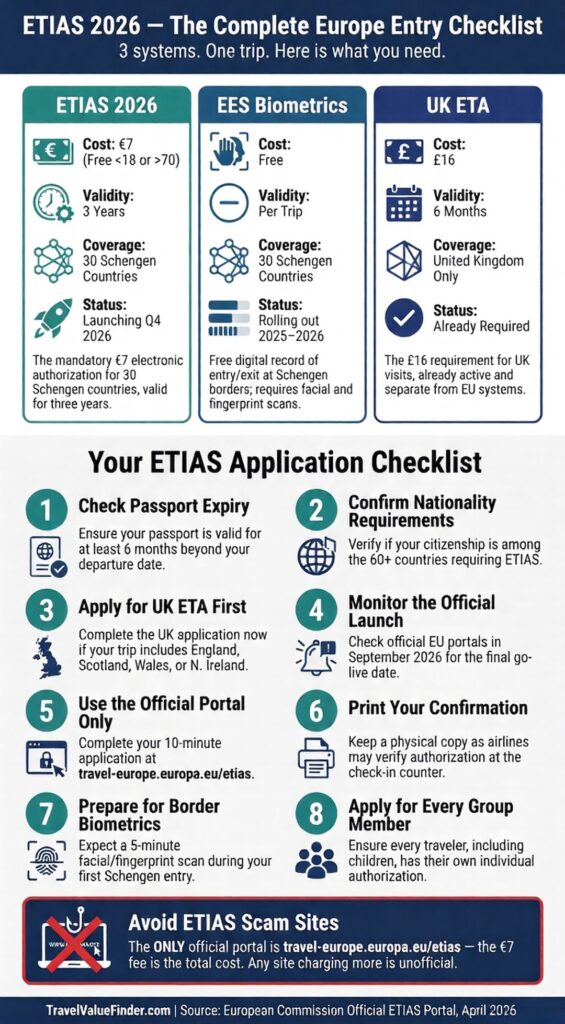
New ETIAS requirements mean there are a few extra steps before you board your flight. This infographic gives you a clear, quick snapshot of the essential checklist-from application basics to key documents-so you can travel with confidence. Since rules and requirements can change, be sure to read the full article for the most accurate and detailed guidance before your trip.
ETIAS 2026 Decision Tree – When Should You Apply?
The right time to apply for ETIAS 2026 depends entirely on your travel profile. This is the strategic guidance that distinguishes a value travel intelligence article from a generic news summary – and it is what no major portal has published.
| Your Travel Profile | When to Apply for ETIAS 2026 | Reason | Your Cost |
| Frequent Europe traveler (2+ Schengen trips/year) | Apply within first 2 weeks of launch | 3-year validity = maximum ROI on single €7 fee; covers all Schengen travel through late 2029 | €7 once – no reapplication until 2029 |
| One Schengen trip planned in Q4 2026 | Apply 4+ weeks before travel date | Early-launch demand may slow processing beyond the usual minutes; buffer recommended | €7 – apply once regardless of trip length |
| Schengen trip planned before ETIAS 2026 launches | No action needed yet – monitor launch date | During 6-month transition, you won’t be denied entry solely for lacking ETIAS | €0 now; budget €7 for future |
| Under 18 or over 70 years old | Apply when traveling – authorization still required but free | Fee is waived; authorization is mandatory but costs nothing | €0 – still required, just free |
| Trip includes UK + Schengen countries | Apply UK ETA now; ETIAS 2026 when launched | UK ETA already required; do both early to avoid last-minute overlap | £16 ETA + €7 ETIAS per person |
| Passport expires within 18 months | Renew passport first, then apply for ETIAS 2026 | ETIAS tied to passport number – renewing invalidates existing ETIAS | Renew first; then single €7 ETIAS |
The Complete ETIAS 2026 Application Checklist
Work through these eight steps in order before any Europe trip planned for late 2026 or beyond.
Step 1 – Check Your Passport Expiry Date
Your passport must be valid for the entire duration of your planned stay in the Schengen Area, and ideally for at least 3 to 6 months beyond your departure date from Europe. If your passport expires before January 2028, consider renewing before ETIAS 2026 launches so your authorization covers the maximum three-year validity window. U.S. passport processing currently takes 6 to 8 weeks for standard service – book an appointment now if renewal is needed.
Step 2 – Confirm Whether Your Nationality Requires ETIAS 2026
Citizens of EU member states, EEA countries, Switzerland, and several other countries are exempt from ETIAS. The 60+ nationalities that require ETIAS 2026 include: United States, United Kingdom, Canada, Australia, New Zealand, Japan, South Korea, Brazil, Mexico, and many others. Check the official list at travel-europe.europa.eu/etias_en. If your nationality is not on the required list, no ETIAS is needed – but EES biometric registration at the border still applies to all non-EU nationals.
Step 3 – Apply for UK ETA If Your Trip Includes the United Kingdom
The UK ETA is already required for most non-EEA nationals visiting England, Scotland, Wales, or Northern Ireland. Apply now at the official UK government portal – do not use any third-party site. Cost: £16. Decision time: up to 3 working days. Validity: 6 months from approval.
Apply at the only official portal: gov.uk/apply-electronic-travel-authorisation.
Step 4 – Monitor the Official ETIAS 2026 Launch Date
Set a calendar reminder for September 2026 to check for the confirmed go-live date at the European Commission’s official ETIAS portal. Do not rely on travel blogs or third-party sites for the launch date announcement – they may lag the official announcement by days or weeks.
Bookmark the official source: travel-europe.europa.eu/etias_en.
Step 5 – Apply at the Official ETIAS 2026 Portal Only
When ETIAS 2026 opens, apply only at the official European Commission portal. Have ready: your passport, email address, and a credit or debit card. The application takes approximately 10 minutes. Most decisions arrive within minutes, but the system may take up to 96 hours (4 days) during high-demand periods at launch – do not book non-refundable travel until your authorization is confirmed.
Step 6 – Save and Print Your ETIAS Confirmation
Save your ETIAS 2026 authorization confirmation email. Print a backup copy. Airlines may check ETIAS compliance at check-in – not just at the border crossing – so carry evidence of your authorization from the moment you arrive at the departure airport.
Step 7 – Prepare for EES Biometric Registration at the Border
On your first Schengen entry after EES is fully deployed, proceed to the EES biometric registration kiosk or use the smartphone app if provided by the entry country. This is free and takes approximately 5 minutes. Your fingerprints and facial scan are stored electronically – you will not repeat this at every subsequent Schengen entry during the same trip. Build extra time into your airport arrival schedule during the system’s first year of operation.
Step 8 – Share This Checklist With Every Person in Your Travel Group
ETIAS 2026 is per-person. Every traveler in your party who is a national of an ETIAS-required country – including children over age 2 – must have their own individual authorization linked to their own passport. Group applications are not available. The under-18 fee waiver still requires an individual application for each child.
ETIAS 2026 Scam Warning – Protect Your Money
- Third-party websites posing as the official ETIAS 2026 application portal are already operating ahead of the official launch date. These sites charge USD 50 to USD 90 for what will be a €7 official application. You may still receive a valid authorization through them – they typically act as intermediaries – but you are overpaying by up to USD 83 per person.
- The ONLY official ETIAS 2026 application portal: travel-europe.europa.eu/etias_en The ONLY official UK ETA portal: gov.uk/apply-electronic-travel-authorisation – cost is £16.
- Search engines currently show unofficial ETIAS sites in paid advertising positions above the official result. Check the URL carefully before entering any personal details or payment information. Bookmark the official ETIAS URL now, before you need it.
Which 30 Countries Require ETIAS 2026?
ETIAS 2026 covers all 26 Schengen Area member states plus four associated countries:
- EU Schengen members (22): Austria, Belgium, Croatia, Czech Republic, Denmark, Estonia, Finland, France, Germany, Greece, Hungary, Italy, Latvia, Lithuania, Luxembourg, Malta, Netherlands, Poland, Portugal, Slovakia, Slovenia, Spain.
- Schengen associates (4): Iceland, Liechtenstein, Norway, Switzerland.
- NOT covered – separate systems apply: Ireland (its own entry rules), United Kingdom (UK ETA system, already in effect).
A single ETIAS 2026 authorization covers all 30 countries listed above for the full three-year validity period, with stays of up to 90 days within any 180-day period.
Related Guides on TravelValueFinder.com
- Planning a Europe trip on a budget? Read How to Travel Europe on a Budget: The 2026 Guide – cheap flights, rail passes, hostels, and the most affordable European destinations this year.
- Considering Portugal? See Portugal Travel Guides: Cities, Attractions, Tips & Things to Do – with neighborhood-by-neighborhood pricing and booking timing advice.
- Looking at longer stays in Europe? Read Spain vs Portugal Retirement: Which Is Better for American Retirees? – covers visa requirements, cost of living, and healthcare for both countries.
- Read the companion article: Best Travel Destinations 2026: Skip the U.S. and Save Up to $2,600 – 7 destinations winning redirected travel demand this year.
- Cruises Have Never Cost This Much – Why Cruise Prices 2026 Have Hit a Record High and What Every Traveler Must Know Before Booking
- Spirit Airlines Is Gone: The Complete Traveler’s Guide to Refunds, Rescue Fares, Higher Airfares, and What Comes Next
- Europe ETIAS 2026: The Only Checklist Every Traveler Needs Before Flying
- Your Mexico Hotel Just Got 1,000% More Expensive – Here’s the Only Way Around the FIFA World Cup 2026 Price Crisis
- Global Travel Alerts May 2026: The Complete Briefing Every International Traveler Needs Before Booking
- Travel Alerts May 2026: Ebola Crisis, Thailand-Cambodia Conflict & Summer Disruptions Every Traveler Must Act On Now
- Find out more about What Croatia Actually Costs: A Week in Dubrovnik and Split, Broken Down
FAQ – ETIAS 2026
Q: What happens if I arrive in Europe without completing ETIAS 2026?
A: During the six-month ETIAS 2026 transitional period after launch, travelers who meet all other entry conditions will not be refused entry solely for lacking an ETIAS. However, once the transitional period ends, airlines will be required to verify ETIAS compliance before boarding – meaning you could be denied boarding at your departure airport. The safest approach is to apply as soon as the official portal opens. The €7 fee and 10-minute application is a trivial insurance policy against a denied boarding event that could cost hundreds of dollars in rebooking fees.
Q: Can I use my ETIAS 2026 authorization for multiple Europe trips?
A: Yes. ETIAS 2026 is valid for three years from the date of issue, or until your passport expires – whichever comes first. One €7 application covers unlimited short-stay visits (up to 90 days within any 180-day period) across all 30 ETIAS-covered countries during that validity period. For frequent Europe travelers, this is exceptional value. Note that ETIAS 2026 does not extend the 90/180-day Schengen stay limit – it only authorizes entry. Each trip still resets against the 90-day rolling counter.
Q: Do children and senior travelers need ETIAS 2026?
A: The €7 ETIAS 2026 fee is waived for travelers under 18 and those aged 70 or older. However, the authorization itself is still required – it is simply free for these age groups. Every traveler in your party who is a national of an ETIAS-required country, regardless of age, must have their own individual ETIAS 2026 authorization linked to their own passport before traveling to any of the 30 covered countries.
Action Steps – What to Do This Week
- Check your passport expiry date today. If it expires before January 2028, book a passport renewal appointment now – U.S. standard processing currently takes 6 to 8 weeks.
- If you have any UK travel planned and are not a UK or EEA citizen, apply for your UK ETA at gov.uk/apply-electronic-travel-authorisation today. It is already required and takes approximately 10 minutes.
- Bookmark travel-europe.europa.eu/etias_en and set a September 2026 calendar reminder to check for the confirmed ETIAS 2026 launch date.
- If your Europe trip combines UK and Schengen countries, apply for the UK ETA now and budget €7 per person for ETIAS 2026 when it launches.
- Share this ETIAS 2026 checklist with every person in your travel group – every traveler needs their own individual application.
Sources and Editorial Transparency
Primary Sources: European Commission – Official ETIAS Portal • UK Home Office – ETA Application • National Geographic – 2026 Travel Changes • Trafalgar – 2026 Travel Trends
This article is based on the official European Commission ETIAS framework published at travel-europe.europa.eu, UK Home Office ETA regulations at gov.uk, National Geographic Travel’s 2026 international travel guide, and Trafalgar Travel’s 2026 trend analysis. All fee amounts are sourced directly from official government portals as of April 2026. ETIAS 2026 operational details are subject to change pending the official confirmed launch date – this article will be updated when the European Commission confirms the go-live date. Last reviewed: April 19, 2026. | Leslie Nics, TravelValueFinder.com.