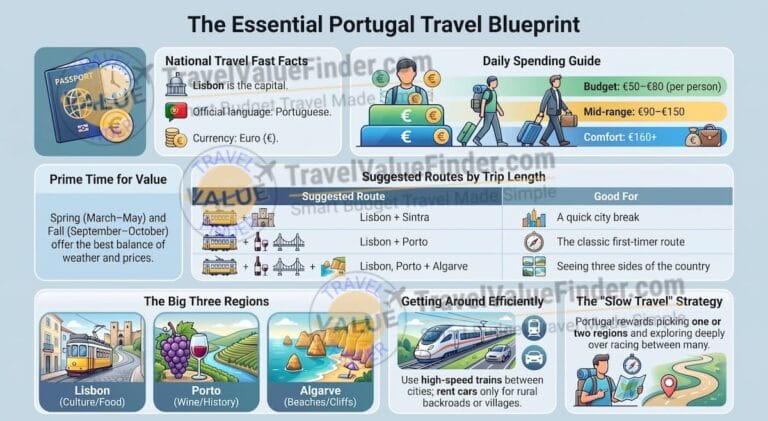
Travel Value Finder


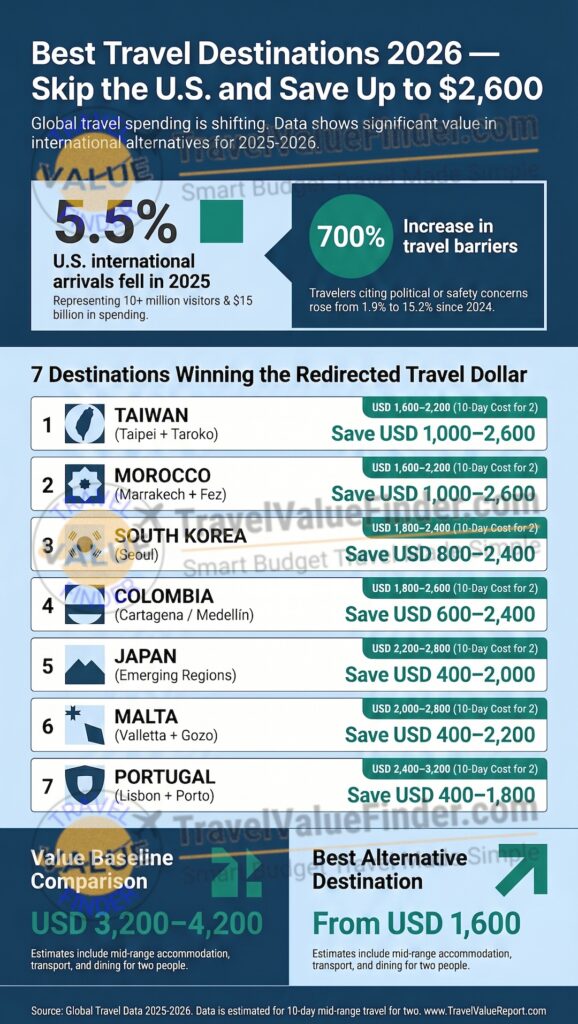
The best travel destinations 2026 are not where most people expect – and a seismic shift in global tourism spending is creating one of the biggest value opportunities for travelers in recent memory. U.S. international arrivals fell 5.5% in 2025, leaving more than USD 15 billion in global travel spending redirected toward seven specific destinations that are actively competing for it. This guide identifies exactly where that money is flowing, calculates real cost savings versus a comparable U.S. trip, and gives you the precise booking window for each destination.
Leslie Nics | TravelValueFinder.com | Travel Value Alert | April 2026 | Last reviewed: April 19, 2026
Note: This article is part of the Travel Alerts series. Read: Japan Tourist Tax 2026 for the full breakdown of Asia’s most significant cost change this year, and the Europe ETIAS 2026: The Only Checklist Every Traveler Needs Before Flying.
Table of Contents
Why the Best Travel Destinations 2026 Are Not in the United States
Something significant is happening in global travel that most travelers have not noticed yet. The United States – which has been the world’s highest-earning tourism destination for much of the past three decades – is in the middle of an accelerating visitor decline. The numbers are striking: international arrivals to the U.S. dropped to approximately 68 million in 2025, down 5.5% from the year before and more than 10 million below the pre-pandemic peak of 2019.
The causes are real and documented. New U.S. entry fees have been introduced. A proposed USD 250 visa integrity fee – not yet enacted but widely reported – has already damaged international perceptions of the U.S. as a welcoming destination. Expanded visa bans and lengthened wait times have complicated travel planning for visitors from multiple regions. And the share of global travelers citing political and safety concerns as a top travel barrier has jumped from 1.9% in 2024 to 15.2% in 2026, according to the Going.com 2026 State of Travel Report – a 700% increase in just two years.
For the value-conscious traveler, this creates a rare and time-limited opportunity. The global travel spending that was previously flowing toward the United States is being redirected – actively and measurably – into specific alternative destinations. Those destinations are responding with better air access, more competitive hotel rates, and tourism boards actively working to capture the demand. The result is that the best travel destinations 2026 for budget and mid-range travelers are overwhelmingly outside the U.S., with cost savings of USD 400 to USD 2,600 on a 10-day trip for two people.
What the U.S. Tourism Decline Looks Like in Real Numbers
| Metric | 2019 Baseline | 2025 / 2026 Figure | Change |
| International arrivals to U.S. | ~79 million | ~68 million (2025) | -10.8 million (-13.7%) |
| Safety/political concern as top barrier | 1.9% of travelers | 15.2% of travelers (2026) | +700% increase |
| Proposed U.S. visa integrity fee | None | USD 250 proposed (not yet law) | New deterrent |
| European travel enthusiasm (all destinations) | Indexed 100 | Down ~5 points YoY | Cooling sentiment |
| Asia travel demand | Indexed 100 | Holding and growing | Strongest regional gain |
| Travelers avoiding overtourism destinations | Not tracked | 70%+ report active avoidance | Major new booking factor |
Sources: Going.com 2026 State of Travel Report; Skift Research; U.S. Travel Association.
What Does This Mean for Your Wallet and Trip Planning?
| The best travel destinations 2026 are benefiting directly from this shift. When a destination of the U.S.’s scale loses 10+ million visitors, that is not just a statistic – it is USD 15+ billion in travel spending looking for a new home. Tourism boards in the seven destinations below have responded with expanded flight routes, promotional hotel packages, and in several cases, relaxed or eliminated entry requirements specifically to attract redirected demand. The pricing window is right now. These destinations are in the early stages of a demand surge, before mainstream media fully catches up and before tour operators reprice their packages to reflect the new demand. For travelers who move quickly, the savings versus a comparable U.S. trip range from USD 400 to USD 2,600 on a 10-day trip for two people – money that can fund another trip entirely. Key rule: Book before the destination becomes the headline. Every destination on this list has appeared in travel media in the past 12 months. The ones that appeared first are already seeing early price pressure. The ones that appeared most recently – Malta, Colombia, and Taiwan in particular – still have their best promotional windows open. |
The 7 Best Travel Destinations 2026 for Value-Focused Travelers
Each destination below was selected using three criteria: measurable redirected demand from U.S. tourism data, expanded direct flight connectivity in 2026, and verified cost advantage over a comparable U.S. trip. They are ordered from most to least cost-efficient for a mid-range 10-day trip for two people.
1. Taiwan – The Most Affordable Destination on This List
Taiwan consistently delivers some of the highest value-per-dollar of any destination in East Asia, and 2026 is its strongest year yet for attracting Western travelers. Taipei’s famous night markets – Shilin, Raohe, and Tonghua – serve complete meals for USD 3 to USD 7. A day pass on Taipei’s efficient, air-conditioned Metro system costs approximately USD 7. Well-reviewed mid-range hotels in the Da-an or Zhongzheng districts start from USD 50 to USD 75 per night.
Beyond Taipei, Taiwan offers remarkable variety in a compact space: the dramatic marble gorge of Taroko National Park, the high-mountain tea terraces of Alishan, the hot spring towns of Jiaoxi, and the surf beaches of Kenting in the south. New direct routes from North American and European hubs have expanded in 2026, and the Taiwan Tourism Bureau has been aggressively targeting outbound travelers who previously defaulted to U.S. destinations.
Best booking window: April to June and September to October. Avoid the Lunar New Year window for competitive accommodation pricing. A 10-day mid-range trip for two: USD 1,600 to USD 2,200.
2. Morocco – Extraordinary Value, Zero Visa Required
Morocco has been one of 2026’s most-searched alternative destinations among European and North American travelers seeking high-impact, affordable experiences. Marrakech riads – rooms in converted historic mansions with central courtyards and rooftop terraces – start from USD 40 to USD 70 per night, representing a quality of accommodation that would cost four times as much in a comparable European boutique hotel.
The value proposition extends across Morocco’s full geography. A guided two-day Sahara Desert excursion from Marrakech – including transport, desert camp accommodation, and a camel ride – runs USD 120 to USD 180 per person. The blue-painted medina of Chefchaouen, the Roman ruins of Volubilis, the medieval souks of Fez, and the Atlantic coastline of Essaouira all offer world-class experiences at everyday Moroccan prices. U.S., UK, EU, and Canadian citizens enter Morocco visa-free for up to 90 days.
Best booking window: March to May and October for the best weather. Avoid August heat in Marrakech. A 10-day mid-range trip for two: USD 1,600 to USD 2,200.
3. South Korea – K-Culture Tourism Meets Genuine Value
Seoul has quietly become one of the most cost-competitive major cities in the developed world for Western travelers. A mid-range hotel in Myeongdong, Hongdae, or Insadong runs USD 60 to USD 90 per night – comparable to a mid-range hotel in a secondary U.S. city, but with dramatically higher quality infrastructure, food culture, and safety. A full sit-down Korean barbecue dinner with unlimited side dishes costs USD 10 to USD 18 per person. A day pass on Seoul’s immaculate Metro: USD 4 to USD 7.
South Korea has made strategic moves to attract redirected demand: visa requirements have been relaxed for a growing list of nationalities, and K-culture tourism – driven by K-drama, K-pop, and Korean cuisine’s global moment – is delivering unprecedented first-quarter 2026 booking volumes. Incheon International Airport, consistently ranked among the world’s best, has expanded its direct routes from North America and Europe significantly in 2026.
Best booking window: March to May for cherry blossom season, September to November for autumn foliage. A 10-day mid-range trip for two: USD 1,800 to USD 2,400.
4. Colombia – Cartagena and Medellín in Their Moment
Colombia has undergone one of the most dramatic destination transformations of the past decade, and 2026 is a tipping point in its mainstream acceptance. JetBlue’s new 2026 direct service to Cali joins established competitive routes to Bogotá and Cartagena, making Colombia the Latin American destination with the fastest-growing North American flight connectivity.
Cartagena’s walled colonial city delivers a full Caribbean atmosphere at a fraction of Caribbean island resort prices. Mid-range boutique hotels within the walls: USD 55 to USD 85 per night. Fresh-caught ceviche lunch: USD 5 to USD 8. Full-day historical walking tour: USD 25 to USD 35 per person. Medellín offers year-round spring climate, a world-class food and design scene, and co-working spaces from USD 10 to USD 15 per day – making it the most practical entry point for travelers combining holiday with remote work.
Best booking window: December to March for Cartagena’s dry season. A 10-day mid-range trip for two: USD 1,800 to USD 2,600.
5. Portugal – Europe’s Most Consistent Value for Western Travelers
Portugal has been a go-to value destination in Europe for several years, and its position strengthens in 2026 as European enthusiasm for U.S. travel cools and transatlantic airfares from the U.S. East Coast to Lisbon and Porto continue to fall with expanded competition. Lisbon and Porto remain measurably cheaper than Barcelona, Rome, Paris, or London – and both are now directly connected to multiple U.S. East Coast hubs.
A mid-range dinner in Lisbon’s Alfama or Porto’s Ribeira with wine: USD 15 to USD 22 per person. A well-reviewed guesthouse in central Lisbon: USD 70 to USD 100 per night. A day trip from Lisbon to Sintra’s UNESCO-listed palaces by train: USD 12 to USD 15 round trip. TravelValueFinder’s own guides to both cities are among the most detailed cost breakdowns available for Portugal.
Related: See our full Portugal Hotel Deals: Discounts, Booking Tips & Travel Perks for accommodation options at every price point, including properties from €60 per night.
Explore: Portugal Travel Guides: Cities, Attractions, Tips & Things to Do
Best booking window: April to June and September to October. Avoid August when domestic Portuguese tourism peaks. A 10-day mid-range trip for two: USD 2,400 to USD 3,200.
6. Malta – Europe’s Most Underrated Best Travel Destination 2026
Malta has been quietly building its case as one of the best travel destinations 2026 for travelers who want European culture, Mediterranean climate, and world-class history without the crowds or prices of Italy, France, or Spain. Delta Air Lines’ new direct service from the U.S. to Malta International Airport has moved this island nation of 500,000 people from ‘interesting alternative’ to ‘genuinely accessible’ for North American travelers for the first time.
Malta packs an extraordinary density of UNESCO-listed sites into a small area: the Neolithic temples of Ħaġar Qim (older than Stonehenge), the baroque fortified capital Valletta, the medieval walled city of Mdina, and the clear-water diving of sister island Gozo. Mid-range hotels in Valletta or Sliema: USD 65 to USD 95 per night. English is an official language. No advance visa required for U.S., UK, EU, or Canadian citizens.
Best booking window: May to June and September – peak August temperatures exceed 35°C. A 10-day mid-range trip for two: USD 2,000 to USD 2,800.
7. Japan – Emerging Regions Still Offer Exceptional Value
Japan makes this list specifically for its emerging rural regions – Tohoku, Shikoku, the San-in Coast, Kanazawa, and Beppu – which as detailed in Article 1 of this Travel Value Alert series will receive significant infrastructure investment from Japan’s new tourist tax revenue. These regions offer accommodation at 40 to 60% below Tokyo or Kyoto rates, dramatically smaller crowds, and some of Japan’s most distinctive cultural and natural experiences.
For travelers building an Asia itinerary, combining South Korea or Taiwan with one of Japan’s emerging regions delivers the strongest value combination available in Asia in 2026. Read the full breakdown in Article 1 of this series.
Related: Japan Tourist Tax 2026: Your Trip’s True Cost – the full cost breakdown including the departure tax tripling in July 2026.
Explore: Japan Travel Guides | Best Japan Itineraries, Tips & Destinations
Best booking window: Book flights departing Japan before July 1, 2026 to pay the lower departure tax. A 10-day mid-range trip for two in emerging regions: USD 2,200 to USD 2,800.
This infographic highlights some of the best travel destinations outside the U.S., offering stunning scenery, rich culture, and fewer crowds. It’s a quick snapshot of where to go for a more relaxed and unique travel experience, whether you’re after nature, history, or vibrant city life. Keep in mind that travel conditions and popularity can change, so be sure to read the full article for more detailed insights and recommendations.
Cost Comparison: 10 Days for Two People
The table below uses mid-range accommodation, local transport, and dining costs for two adults. Airfares are from the U.S. East Coast or a major European hub where applicable. All figures are indicative – use Google Flights and Booking.com to confirm current live pricing for your specific dates.
| Destination | Est. 10-Day Cost (2 People) | Saving vs. U.S. Trip | Best Window | Direct Flights From |
| Taiwan (Taipei + Taroko) | USD 1,600 – 2,200 | Save USD 1,000 – 2,600 | Apr – Jun, Sep – Oct | New York, LA, Vancouver |
| Morocco (Marrakech + Fez) | USD 1,600 – 2,200 | Save USD 1,000 – 2,600 | Mar – May, October | Hub connection via Casablanca |
| South Korea (Seoul) | USD 1,800 – 2,400 | Save USD 800 – 2,400 | Mar – May, Sep – Nov | New York, LA, Chicago, Toronto |
| Colombia (Cartagena/Medellín) | USD 1,800 – 2,600 | Save USD 600 – 2,400 | Dec – Mar | New York, Miami, Fort Lauderdale |
| Japan (Emerging Regions) | USD 2,200 – 2,800 | Save USD 400 – 2,000 | Pre-July 2026 | Tokyo then domestic rail |
| Malta (Valletta + Gozo) | USD 2,000 – 2,800 | Save USD 400 – 2,200 | May – Jun, September | New York via Delta; London direct |
| Portugal (Lisbon + Porto) | USD 2,400 – 3,200 | Save USD 400 – 1,800 | Apr – Jun, Sep – Oct | New York, Boston, London direct |
| Comparable U.S. 10-Day Trip | USD 3,200 – 4,200 | Baseline | Varies | N/A – domestic |
All costs estimated from live booking data on Google Flights, Booking.com, and Hostelworld as of April 2026. Figures will vary by season, booking timing, and personal travel style.
Related Guides on TravelValueFinder.com
- Traveling to Europe? Read our How to Travel Europe on a Budget: The 2026 Guide – covering cheap flights, hostels, rail passes, and the best affordable European destinations.
- Considering Portugal? See Portugal Travel Guides: Cities, Attractions, Tips & Things to Do – with neighborhood-by-neighborhood pricing and booking timing advice.
- How Much Does a Greece Trip Cost? Budget Breakdown for 2026
- How Expensive Is Portugal? A Real Cost Guide for Budget Travelers
- Best Budget Travel Destinations in Southeast Asia for 2026
FAQ – Best Travel Destinations 2026
Q: Which of the best travel destinations 2026 is easiest for a first-time international traveler from the U.S.?
A: Portugal and Malta are the most accessible for first-time international travelers from the U.S. Both destinations use English widely – it is an official language in Malta and near-universal in Lisbon and Porto’s tourist areas. Neither requires advance visa paperwork for U.S. citizens. Both have direct or near-direct transatlantic flights. South Korea is also an excellent first choice – Incheon Airport’s English signage and Seoul’s navigation apps make the city highly accessible despite the language difference. All three have strong safety records and reliable healthcare infrastructure.
Q: Will the proposed U.S. $250 visa integrity fee affect travel planning?
A: As of April 2026, the USD 250 visa integrity fee has been proposed but not enacted into law. The U.S. Travel Association and major industry stakeholders have publicly opposed it, warning that implementation would further reduce international arrivals that are already 10+ million below 2019 levels. For current trip planning purposes, do not budget for this fee. Monitor the U.S. State Department website for any confirmed changes before booking inbound U.S. travel.
Q: Is Asia replacing Europe as the top region for best travel destinations 2026?
A: For value-focused travelers, yes – Asia is gaining strongly relative to Europe. The Going.com 2026 State of Travel Report shows European travel enthusiasm fell by five points year-on-year – the steepest regional decline in the survey – driven by rising costs, a strong euro, and growing overtourism awareness. Asia, by contrast, is holding and growing, driven by K-culture demand in South Korea, infrastructure improvements in Japan’s emerging regions, and expanding flight connectivity into Taiwan and Vietnam. For pure cost efficiency, Taiwan and South Korea currently offer the strongest value in any major world region.
Action Steps – What to Do This Week
- Open Google Flights Explore map for your target dates and compare fares to Seoul, Taipei, and Lisbon simultaneously from your home airport – this gives you a real-time side-by-side cost view in under two minutes.
- Search JetBlue’s new 2026 Colombia routes specifically. New routes in their first year of operation typically carry the most competitive introductory fares before demand stabilizes.
- Check Delta’s new Malta route from New York – new long-haul routes often have the lowest fares in the first 6 months of operation.
- For Portugal: search accommodation in Porto’s Cedofeita neighborhood and Lisbon’s Mouraria area – both offer central locations at consistently lower rates than the most touristed zones, as covered in our Cheap Hotels in Porto guide.
- If Japan is on your list, book flights departing Japan before July 1, 2026 to pay the lower JPY 1,000 departure tax – after that date it triples to JPY 3,000 per person.
Sources and Editorial Transparency
Primary Sources: Going.com – 2026 State of Travel • Skift – U.S. Travel Restrictions 2026 • National Geographic Travel • U.S. Travel Association
This article draws on the Going.com 2026 State of Travel Report, Skift Research’s analysis of U.S. international arrival data, National Geographic Travel’s updated 2026 guide, and U.S. Travel Association published positions. Destination cost estimates are synthesized from live data on Google Flights, Booking.com, Hostelworld, and Kayak as of April 2026. All internal links connect to verified, published pages on TravelValueFinder.com. This article will be updated quarterly. Last reviewed: April 19, 2026. | Leslie Nics, TravelValueFinder.com.