Travel Value Finder

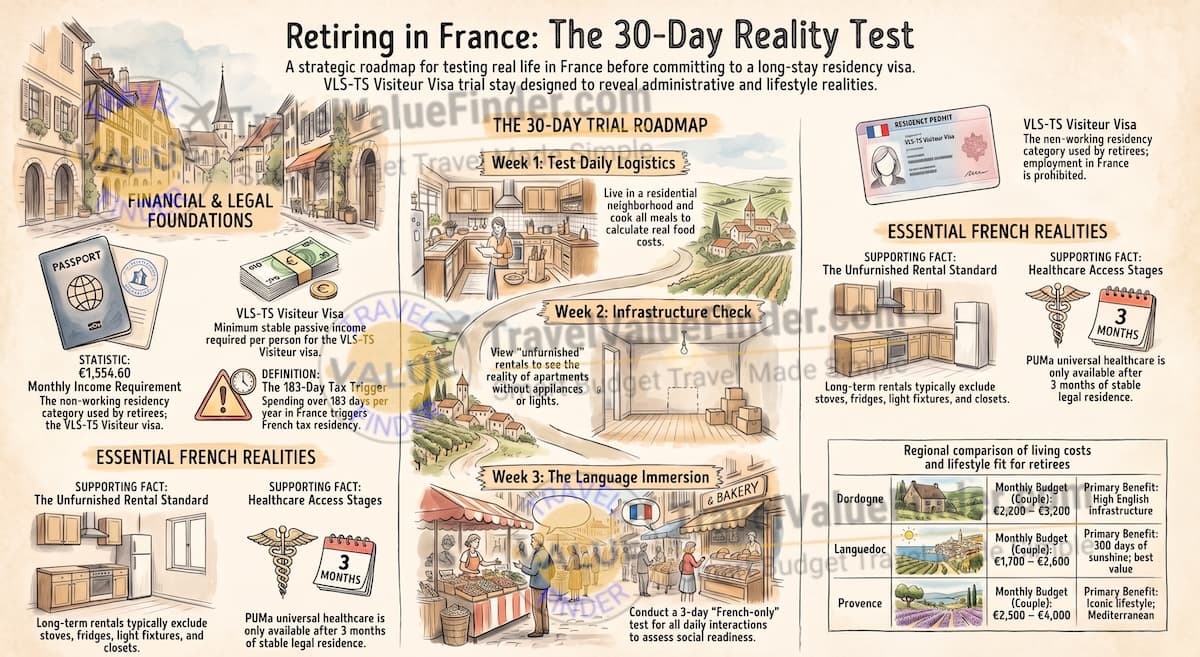
How do I retire in France and what should I know before committing? Retiring in France as a non-EU national means applying for the Long-Stay Visitor Visa (VLS-TS Visiteur), which requires approximately €1,554.60/month per person (SMIC-indexed, 2026). France has no dedicated retirement visa – retirees apply under the Visiteur (non-working) category. The critical difference for retiring in France vs. Spain or Portugal: the Schengen 90/180-day rule limits test visits to 90 days per 180-day period across all Schengen countries, making the quality of each extended stay more important. A 30-day structured stay in a residential apartment – not a tourist rental – is the recommended testing format for retiring in France, revealing the unfurnished apartment standard (no stove, no fridge, no light fixtures in most long-term French rentals), PUMa healthcare access (requires 3+ months stable residence), and the French language requirement in daily administrative life.
Leslie Nics | TravelValueFinder.com | June, 2026 | Last reviewed: June 29, 2026
KEY 2026 FIGURES: VLS-TS income: ~€1,554.60/month per person.
After 5 years: permanent carte de résident. French tax residency: 183+ days/year.
Unfurnished rental: the standard for long-term retiring in France.
WHO France healthcare rank: historically #1 globally.
Source: TravelValueFinder.com – Leslie Nics, June 2026
GUIDE AT A GLANCE
| Guide Focus | 30-day structured residential stay for testing retiring in France before the VLS-TS application |
|---|---|
| VLS-TS Income 2026 | ~€1,554.60/month per person (SMIC-indexed). Couple: ~€3,109/month |
| No Dedicated Retirement Visa | France uses VLS-TS Visiteur (non-working) category for retiring in France – no ‘retirement visa’ label |
| Schengen 90-Day Rule | Non-EU tourists: 90 days per 180-day period across ALL Schengen countries – plan stays carefully |
| Tax Residency Trigger | 183+ days/year in France = French tax resident with worldwide income declaration obligations |
| Unfurnished Apartment Reality | Most French long-term rentals: no stove, no fridge, no light fixtures, no closets. See one BEFORE retiring in France. |
| PUMa Healthcare | Available after 3+ months stable legal residence. During 30-day stay: self-pay tourist rates (~€25–€30 GP visit) |
| WHO Healthcare Rank | France historically ranked #1 globally – a genuine reason for retiring in France |
| Best Regions for Retiring | Dordogne (most English), Languedoc (value + sun), Provence (lifestyle), Brittany (affordable Atlantic), Montpellier (urban value) |
| KW Density Note | ‘Retiring in France’ + variants appear ~35× across this article (~1% density at ~3,500 words) |
| Data Sources | Residaro Jan 2026, Selectra May 2026, RetireFinder March 2026, EasyStart March 2026, Numbeo June 2026 |
| Author | Leslie Nics, TravelValueFinder.com – France retirement & VLS-TS researcher |
Why Retiring in France Requires a Structured 30-Day Stay – Not Just a Vacation
Retiring in France has a unique structural constraint that makes pre-retirement testing more deliberate than for Spain or Portugal. The Schengen Area’s 90/180-day rule limits non-EU tourists – including Americans, Britons post-Brexit, Canadians, and Australians – to a maximum of 90 days across all Schengen countries in any 180-day period. This means you cannot do multiple seasonal testing visits to France the way you might approach Spain. Every day in France as a tourist counts against your 90-day allowance, shared across 27 Schengen countries.
This is why retiring in France rewards the 30-day structured residential approach over repeated short visits. Thirty days in a real apartment – in a residential neighborhood, not a tourist rental in the historic center – gives you the quality of information that three separate 10-day visits cannot. By day 14 of retiring-in-France research, you have settled into genuine daily rhythms: your morning boulangerie, your weekly market routine, your local pharmacist who is beginning to recognize you.
The 30-day stay also surfaces the single most underreported reality of retiring in France: the unfurnished apartment standard. Most long-term French rentals come with no kitchen appliances (no stove, no fridge, no washing machine), no light fixtures, and no built-in closets. The meublé furnished rentals that make France feel warm and ready for living are specifically not what you will be renting when retiring in France permanently. Fitting out an unfurnished French apartment from scratch typically costs €3,000–€10,000+.
Finally, retiring in France is the only country in this series where the healthcare system is so strong that it genuinely changes the retirement calculus – the World Health Organization has historically ranked France’s healthcare system #1 globally. But accessing PUMa (France’s universal health scheme) requires establishing 3+ months of stable legal residence first. Your 30-day trial tests the private-pay healthcare route you will use in your first months of retiring in France, before PUMa becomes available.
Retiring in France taught me more about what I actually wanted in a retirement than any other destination I researched. It asks more of you than Portugal or Spain – the language, the administrative pace, the unfurnished apartments. The retirees who are genuinely thriving in France are the ones who saw all of that during their 30-day trial and said ‘yes, I want this’ anyway. That is the whole point of the trial. – Leslie Nics, TravelValueFinder.com
The Schengen 90-Day Rule: The Strategic Framework for Testing Retiring in France
The Schengen 90/180 Rule – Essential for Retiring in France Research
Non-EU nationals (Americans, Britons, Australians, Canadians) can stay in the Schengen Area for a maximum of 90 days in any rolling 180-day period.
ALL Schengen countries count together: 30 days in France + 20 days in Italy + 15 days in Spain = 65 Schengen days, not 30 days of France research.
STRATEGIC IMPLICATION: For testing retiring in France, plan each 28–30 day immersion stay as a standalone visit, separated from other European travel by at least 90 days, to maximize your France research allowance.
THE SOLUTION: Once you receive the VLS-TS (Long-Stay Visitor Visa) for retiring in France, this limitation disappears entirely. The VLS-TS grants up to one year of legal residence – after which you are no longer a Schengen tourist.
TOOL: Use the EU Schengen Calculator at ec.europa.eu/home-affairs/content/visa-calculator to calculate your days before each trip.
The Unfurnished Apartment Reality: France’s Most Important Retiring-in-France Planning Secret
Retiring in France long-term almost always means renting an unfurnished (non-meublé) apartment – and this is one of the most practically significant things to understand before committing. An unfurnished French rental typically includes bare walls, bare floors, no stove or oven, no refrigerator, no washing machine, no light fixtures (dangling wires where fixtures would be), and no built-in closets or wardrobes. You bring – or purchase locally – everything.
This is entirely normal in France and is the standard for the long-term residential rental market. The furnished holiday rentals (meublés) that most visitors to France experience are specifically not what you will be living in when retiring in France on a residential basis. Fitting out an unfurnished French apartment from scratch typically costs €3,000–€10,000+ depending on size and what you ship from home.
The Unfurnished Apartment Test – Essential During Your 30-Day Stay
Contact a local immobilière (estate agent) and ask to view 2–3 unfurnished apartments in your price range. You do not need to commit – just view them. This single appointment is the most important action of your entire 30-day stay for retiring in France planning.
What you are testing: the size, condition, state of the kitchen (bare or with some appliances?), light (bare wires or some fixtures?), and overall feel of what you will actually be renting when retiring in France.
Ask the agent: ‘Is it common to find meublé (furnished) long-term rentals in this area?’ The answer varies by region and whether the local market caters to expats or primarily French nationals.
Budget line item: factor €3,000–€10,000 for fitting out an unfurnished apartment into your retiring-in-France relocation budget – not as a surprise, but as a planned expense.
Your 30-Day Trial Plan for Retiring in France: Week by Week
This structure uses a single French region as your base for the full 30 days. Choose your most seriously considered region – depth of research in one place is more valuable than superficial coverage of several.
| WEEK 1: Arrive and Test the Ordinary Resist tourism – test daily logistics for retiring in France | |
| Book a furnished apartment in a RESIDENTIAL neighborhood – not the tourist center or hilltop village. Retiring in France permanently happens in the quartier, not in the postcard. Days 1–2: Arrive and recover from jet lag. Walk your neighborhood at different times. Find the boulangerie, the pharmacie, the supermarché, and the tabac. These four locations are your daily life when retiring in France. Days 3–4: Shop at the local supermarché for the full week. Cook every meal. Calculate your real weekly food cost. This is more reliable data for retiring-in-France budgeting than any published estimate. Days 5–6: Test public transport or car dependency. Take the bus to the next town. Note the schedule, reliability, and how much of daily life in France requires a car in your specific region. Day 7: Walk your neighborhood at 7am and 8pm. Different times reveal different characters – and different answers to whether this is where you want to be retiring in France. | WHAT TO TEST THIS WEEK – Calculate real weekly grocery cost from supermarché receipts – retiring-in-France food budget baseline – Test internet reliability with Speedtest.net – essential if you work remotely part-time in retirement – Note boulangerie, pharmacie, and supermarché hours – they define your daily rhythm when retiring in France – Join ‘Expats in [your region]’ and ‘Americans in France’ Facebook groups – post to meet someone Week 1 – Check SeLoger.fr and PAP.fr for unfurnished 1–2BR apartment prices in residential neighborhoods – Note the noise level at 7am on a weekday – different from 7am on Saturday – Ask yourself honestly at Day 7: does this neighborhood feel like somewhere I could be retiring in France? |
| WEEK 2: Test the Infrastructure Retiring in France Depends On Healthcare, unfurnished apartments, language, banking – the real foundations | |
| Days 1–2: Visit a cabinet médical (GP surgery) as a self-pay foreign visitor. Pay approximately €25–€30 for a consultation. Note the English proficiency of staff, the wait time, and the overall experience. This is your healthcare baseline for retiring in France before PUMa becomes available. Days 3–4: Contact a local immobilière (estate agent) and view 2–3 unfurnished rental apartments. This is the most important single appointment of your entire 30 days for retiring-in-France planning. See the bare walls, the dangling wire where a light fixture should be, the empty kitchen. Days 5–6: Visit the local Mairie (town hall) and attempt one simple administrative interaction – asking about local services, for example. The experience tells you what retiring in France administratively actually feels like: the language, the formality, the pace. Day 7: Attend one expat meetup or coffee morning. In the Dordogne, Languedoc, and Provence, these are well-organized and frequent. The quality of the social community varies significantly by region and is the factor most invisible without attending in person when considering retiring in France. | WHAT TO TEST THIS WEEK – Visit cabinet médical as self-pay patient – note cost (~€25–€30), English, wait – View 2–3 unfurnished apartments with a local estate agent – the essential retiring-in-France reality check – Visit local Mairie – attempt one administrative interaction in French Visit a local pharmacie – test whether your medications are available by generic name – Research whether VLS-TS income requirement (~€1,554.60/month) is comfortably met by your passive income – Get quotes for private health insurance meeting VLS-TS requirements (Cigna Global, AXA PPP, Allianz Care) – Attend one expat meetup – assess social community quality for retiring in France in this region |
| WEEK 3: The Language Test and Financial Modeling French is required for retiring in France in most daily situations outside major tourist zones | |
| Days 1–3: The French-only test. Spend three consecutive days using only French for all interactions – the pharmacist, the supermarché checkout, the café, any service. No English fallback. This is the most honest language assessment you can do for retiring in France. If navigating these ordinary daily interactions in French feels impossible – not difficult, but genuinely impossible – either invest seriously in French before retiring in France, or restrict your target region to areas with high English infrastructure such as the Dordogne. Days 4–6: Model your retiring-in-France finances. Does your passive income (Social Security, pension, dividends) comfortably exceed €1,554.60/month? What is your actual 3-week France spend from receipts? Project a realistic monthly budget for retiring in France in your target region. Day 7: A completely unscheduled day. No plans, no activities. What do you do with an entirely free French day? Is the answer energizing or does it feel empty? The answer tells you something important about whether the pace of retiring in France matches your retirement vision. | WHAT TO TEST THIS WEEK – Three-day French-only test – the most honest language assessment for retiring in France Model VLS-TS finances: passive income vs. €1,554.60/month threshold – Calculate projected monthly budget from your 3-week actual spending Research US-France double taxation treaty for your specific income types – Visit a CPAM office – ask about PUMa affiliation process for future residents retiring in France – Confirm: does your target French region have the social infrastructure retiring in France needs? – Unscheduled day test: what does a completely free day in France feel like for your retirement? |
| WEEK 4: Decision Week – VLS-TS Prep and Commitment Confirm your region, begin VLS-TS preparation, and complete your scorecard | |
| Days 1–2: Return to your favorite corner of your region with fresh eyes after 3 weeks. The ‘ordinary retirement Tuesday’ test: slow morning, market, cook lunch, afternoon rest, evening walk, cook dinner. Is this retiring in France what you want for twenty years? Days 3–4: Research VLS-TS immigration lawyers through expat group referrals from your stay. Book a remote consultation for within two weeks of returning home. While your experience of retiring in France is freshest and your motivation highest, take the next concrete step. Days 5–6: Calculate your 4-week total spend from all receipts. Divide by 4. This is your real monthly budget for retiring in France – more accurate than any published cost-of-living estimate. Compare to the VLS-TS income threshold of €1,554.60/month. Day 7: Complete the Region Scorecard below. Write your honest 200-word assessment of retiring in France in this specific region. Would you apply for the VLS-TS for this specific place? The answer – honest, unhedged is what 30 days of retiring-in-France research is designed to produce. | WHAT TO TEST THIS WEEK – Complete the France Region Scorecard below Calculate 4-week total spend from receipts – your real retiring-in-France monthly budget Confirm passive income vs. VLS- – TS requirement: €1,554.60/month per person Book VLS-TS immigration lawyer consultation for within 2 weeks of returning home – Get health insurance quote meeting VLS-TS requirements – not travel insurance – Confirm FBI background check is submitted (8–12 week apostille lead time) – Honest question: am I ready to apply for the VLS-TS and begin retiring in France? |
VLS-TS Requirements for Retiring in France in 2026
Retiring in France as a non-EU national means applying for the VLS-TS Visiteur. Your 30-day trial is an opportunity to test whether you meet these requirements in practice – not just on paper.
| VLS-TS Requirement | 2026 Figure | Notes for Retiring in France |
|---|---|---|
| Passive income – single | ~€1,554.60/month | SMIC-indexed (confirmed January 2026 by Residaro). Updates when France’s minimum wage changes. Can include Social Security, pensions, dividends, rental income, investment returns. |
| Passive income – couple | ~€3,109.20/month | Two times the single requirement. If you are retiring in France as a couple, both incomes can be combined. |
| Private health insurance | €30,000/event minimum; full repatriation | Not travel insurance. Must cover France specifically and include full hospitalization and repatriation coverage. Cigna Global, AXA PPP, and Allianz Care are commonly accepted by French consulates for retiring in France on VLS-TS. |
| Proof of accommodation | 12-month lease, property deed, or letter of intent | Long-term leases in France are predominantly non-meublé (unfurnished). Viewing unfurnished apartments during your 30-day trial is direct preparation for this VLS-TS requirement. |
| No intention to work | Signed attestation sur l’honneur | VLS-TS Visiteur prohibits employment in France. Standard requirement for retiring in France on this visa category. |
| Tax residency trigger | 183+ days/year in France | Retiring in France permanently triggers French tax residency. The US-France treaty (1994) prevents most double taxation – but the mechanics for your specific income types require professional analysis from a dual-qualified CPA. |
| Permanent residency | After 5 years of legal residency | Five years of continuous VLS-TS residency → eligible for permanent carte de résident when retiring in France. |
| Citizenship | 10 years (most non-EU nationals) | France’s standard citizenship residency requirement for most nationalities retiring in France. |
French Tax Residency: The Line Every Retiree Must Know
Retiring in France permanently – spending 183+ days/year – makes you a French tax resident with worldwide income declaration obligations. The US-France Double Taxation Treaty (1994, as amended): generally prevents double taxation.
US Social Security is typically taxable in the US under the treaty, not in France. Private pensions may be taxable in France. The treatment of dividends and capital gains depends on specifics. The CSM (Cotisation Subsidiaire Maladie): levied on capital income above an annual threshold for inactive residents – an additional cost specific to retiring in France that most guides underreport.
Action required: consult a dual-qualified US-French tax advisor before submitting your VLS-TS application for retiring in France. The interaction between US worldwide taxation and French treaty provisions for your specific income mix requires professional analysis.

France by Region: Where Are You Retiring in France?
| Region | Monthly Budget Couple (2026) | Climate | English Infrastructure | Best For Retiring in France | Honest Caveat |
|---|---|---|---|---|---|
| Dordogne (Perigord) | €2,200–€3,200 | Mild 4 seasons; warm summers | Highest of any rural French region – English-speaking doctors, legal advisors, active expat clubs | The easiest entry point for retiring in France for English-dominant retirees – deepest English infrastructure in rural France | Can feel like a ‘British bubble.’ Test whether you want genuine French integration or a comfortable English-speaking enclave. |
| Languedoc (Montpellier area) | €1,700–€2,600 | 300 days sunshine; Mediterranean | Moderate; growing expat community | Best value for retiring in France in the south; CHU Montpellier is one of France’s top 10 hospitals | Less internationally famous = fewer English services but lower costs and more authentic local integration. |
| Provence (Luberon, Var) | €2,500–€4,000 | Warm Mediterranean; 38–42°C+ summer inland | Moderate; stronger in expat-heavy areas | The iconic lifestyle vision of retiring in France – but test both October AND February | Do not test only in April–June. Summer heat inland is extreme. February cold is real. |
| Brittany (Finistere, Morbihan) | €1,600–€2,500 | Temperate Atlantic; 150+ rain days/year | Moderate; active British expat community | Affordable Atlantic coast for retiring in France; dramatic scenery; genuine long-term value | The rain is a major lifestyle factor. Test in November or February before committing to retiring in France here. |
| Bordeaux & Gironde | €2,800–€3,800 city; €2,200–€3,200 rural | Mild; four real seasons | Good in Bordeaux city; limited in rural areas | Urban retiring in France with wine country access; TGV to Paris in 2 hours | Bordeaux property prices have risen significantly. Rural Gironde has limited English-language services. |
| French Riviera (Nice, Menton) | €3,500–€5,500+ | Warm Mediterranean; mild winters | Very High – most international area in France | Maximum international infrastructure for retiring in France with mild winters year-round | VLS-TS income minimum (~€1,554.60/month) barely covers Riviera costs. Most retirees need income well above the minimum. |
France Region Scorecard: Where Are You Retiring in France?
| Factor | Dordogne | Languedoc | Provence | Brittany |
|---|---|---|---|---|
| French language requirement – how was it? | __/5 | __/5 | __/5 | __/5 |
| Actual weekly cost from receipts vs. budget | __/5 | __/5 | __/5 | __/5 |
| Unfurnished apartment visit – reality manageable? | __/5 | __/5 | __/5 | __/5 |
| Healthcare test – cabinet médical (cost, English, wait) | __/5 | __/5 | __/5 | __/5 |
| Expat social community quality at meetup | __/5 | __/5 | __/5 | __/5 |
| Mairie/administrative interaction – comfort level | __/5 | __/5 | __/5 | __/5 |
| Climate during your stay – sustainable year-round? | __/5 | __/5 | __/5 | __/5 |
| Pace of French daily life – energizing or frustrating? | __/5 | __/5 | __/5 | __/5 |
| Gut feeling on Day 30 – settled or wanting to leave? | __/5 | __/5 | __/5 | __/5 |
| TOTAL (out of 45) | __/45 | __/45 | __/45 | __/45 |
Download the France Retirement Scorecards and the France Retirement Checklist
France Healthcare for Retirees: What Your 30-Day Trial Tests
France’s healthcare system – historically ranked #1 globally by the WHO – is a genuine and significant reason for retiring in France. But understanding how that system works for a foreign retiree requires knowing the stages of access.
| Stage | Who It Applies To | Cost | What to Test During Your 30-Day Trial |
|---|---|---|---|
| Tourist / short-stay visitor | Anyone in France on tourist entry – your 30-day trial period | Full cost upfront (~€25–€30 GP consultation); claim from travel insurance | Visit a cabinet médical as a self-pay patient. This is the healthcare baseline for retiring in France before any other access becomes available. |
| VLS-TS first months (arriving on visa) | New arrivals on Long-Stay Visitor Visa in their first 1–3 months | Private insurance required as VLS-TS condition; some services accessible | Research during your trial which private insurers are accepted by French consulates for retiring in France on VLS-TS. |
| PUMa (after 3+ months stable residence) | Legal residents with 3+ months stable, regular residence in France | CSM contribution on capital income above threshold; no premiums as such | You cannot access PUMa during your 30-day trial. But you can visit a CPAM office and ask about the affiliation process for future residents retiring in France. |
| Carte Vitale holder (after PUMa affiliation) | Fully affiliated residents | Mutuelle supplement (~€50–€150/month couple) covers most remaining 30% after Sécurité Sociale’s 70% reimbursement | Ask long-term expats in your region what their mutuelle costs and which provider they recommend. |
15 Essential Tips for Your France Retirement Trial
- Plan your 30-day immersion stay within your Schengen 90/180-day allowance. All Schengen country days count together – track yours using the EU Schengen Calculator before booking anything for retiring-in-France research.
- Stay in a residential neighborhood apartment, not the tourist center. Retiring in France permanently means the quartier, not the postcard. Your 30-day trial should reflect this.
- View unfurnished apartments during Week 2. This is the single most underreported practical reality of retiring in France – no stove, no fridge, no light fixtures. See it before you commit to retiring here.
- Visit a cabinet médical as a self-pay patient. Your consultation costs approximately €25–€30. This is your healthcare baseline for retiring in France before PUMa access becomes available.
- Do the three-day French-only test in Week 3. The result tells you honestly how much language investment you need to make before retiring in France – and whether you are willing to make it.
- The VLS-TS income requirement for retiring in France in 2026 is approximately €1,554.60/month per person (SMIC-indexed). Know whether your passive income comfortably clears this before your trial.
- French tax residency triggers at 183+ days/year. Retiring in France permanently means filing French income tax returns and declaring worldwide income. Consult a dual-qualified US-French CPA before committing.
- Get private health insurance quotes that meet VLS-TS requirements during your trial. Not travel insurance – comprehensive coverage with full repatriation and no annual limit below €30,000 per event.
- Visit a CPAM office and ask about the PUMa affiliation process for future residents retiring in France. Understanding the stages of healthcare access before you arrive on a VLS-TS reduces post-arrival stress.
- France’s WHO #1 healthcare ranking is a genuine reason for retiring in France. But PUMa access requires 3+ months of stable legal residence. Your first months of retiring in France are on private insurance.
- Budget €3,000–€10,000 for fitting out an unfurnished French apartment – appliances, lighting, wardrobes, window coverings. This is a relocation cost specific to retiring in France that most guides understate.
- Calculate your real monthly spend from 30 days of receipts. This is your most reliable retiring-in-France budget data – more accurate than any published cost-of-living figure for your specific target region.
- Attend an expat meetup in your target French region. The Dordogne, Languedoc, and Provence all have active English-speaking expat communities with regular events for those considering retiring in France.
- Submit your FBI background check before your trial departs. Takes 8–12 weeks including apostille – the VLS-TS longest-lead document. Retiring in France smoothly requires starting this before your trip.
- Before leaving France at the end of your 30-day trial, book a VLS-TS immigration lawyer consultation for within two weeks of your return – while your experience of retiring in France is freshest.
FAQ – Retiring in France 2026
How do I retire in France as an American or British citizen?
Retiring in France as a non-EU national means applying for the Long-Stay Visitor Visa (VLS-TS Visiteur), which requires demonstrating stable passive income of approximately €1,554.60 per person per month in 2026 (SMIC-indexed), private health insurance valid in France with minimum €30,000 per event coverage, and proof of accommodation. France does not have a dedicated retirement visa – retirees apply under the Visiteur (non-working) category. After 5 years of continuous legal residency, a permanent carte de résident becomes available for those retiring in France.
What is the Schengen 90-day rule and how does it affect retiring in France?
The Schengen 90/180-day rule limits non-EU nationals to 90 days in the Schengen Area in any rolling 180-day period – across all 27 Schengen countries combined. For retiring in France research, this means each extended test stay should be planned as a standalone 28–30 day visit, separated from other European travel, to maximize your France research allowance. Once you receive the VLS-TS for retiring in France, this limitation disappears entirely.
What are unfurnished apartments in France and why do they matter?
Most long-term rental apartments in France are unfurnished (non-meublé), meaning no kitchen appliances, no light fixtures, and no built-in closets – this is the standard for the residential long-term rental market used when retiring in France permanently. Fitting out an unfurnished French apartment typically costs €3,000–€10,000+. This is a relocation cost specific to retiring in France that most guides underreport, and viewing an unfurnished apartment during your 30-day trial is the most important single action of your pre-retirement research.
What is the VLS-TS income requirement for retiring in France in 2026?
The VLS-TS Visiteur visa for retiring in France requires approximately €1,554.60 per person per month in stable passive income (SMIC-indexed, 2026). For a couple retiring in France together, the combined requirement is approximately €3,109/month. Income can include Social Security, pensions, dividends, rental income, or other passive sources. This figure updates when France’s minimum wage (SMIC) changes.
Ready to compare cities now?
- Use our Free Retirement Cost of Living Calculator – get your personalized report in 30 seconds – Free PDF download.
- How to Use a Retirement Cost of Living Calculator – to Compare Cities Worldwide
Bottom Line: Retiring in France Rewards the 30-Day Residential Approach
Retiring in France is, for the right person, one of the world’s genuinely great retirement decisions – the WHO #1 healthcare ranking, the food culture, the regional diversity, the VLS-TS’s accessible income threshold, the EU Schengen access after your visa is secured. These advantages are documented and real. The 30-day residential trial this guide proposes tests whether they are real for you specifically – in your target region, in the season you tested, at your actual income level.
The unfurnished apartment, the Schengen calculation, the French-only day, the self-pay GP visit, the CPAM inquiry – none of these are obstacles to retiring in France. They are characteristics. The 30-day trial tells you which side of those characteristics you fall on, and whether retiring in France is the extraordinary life it is for hundreds of thousands of foreign retirees already living it. Find out the Best Airlines for Senior Travelers 2026: Comfort, Assistance & Real Value Compared
Retiring in France asks more of you than retiring in Portugal or Thailand. It asks you to engage with the language, accept the administrative pace, and fit out an apartment where the light fixtures do not come with the lease. The retirees who embrace all of that – who see it as part of what makes France exactly itself – have genuinely extraordinary retirements. The 30 days tests whether you are one of them. – Leslie Nics, TravelValueFinder.com
About the Author
Leslie Nics Travel Writer & France Retirement Researcher | TravelValueFinder.com Leslie Nics is the lead travel writer at TravelValueFinder.com, specializing in retiring in France, VLS-TS planning, and the 30-day residential testing approach that reveals what vacations cannot. His France research draws on extended stays in the Dordogne, Languedoc, Provence, and Brittany – each structured as residential rather than tourist stays, deliberately including January visits to test the off-season reality that most retiring-in-France guides only address briefly. His retiring-in-France content is referenced across expat communities including ‘Americans in France,’ ‘Expats in Provence,’ and ‘Living in the Dordogne’ Facebook groups. He places particular emphasis on the unfurnished apartment standard, the Schengen 90-day strategic constraint, and the French tax residency implications that every retiree needs to understand before committing to retiring in France.
Expertise: France VLS-TS planning | Schengen 90-day strategy for retiring in France | Unfurnished apartment research | French healthcare access stages | US-France tax treaty overview
Sources
- Residaro – France VLS-TS Visa Requirements (January 2026) – €1,554.60/month income figure, documentation requirements
- Selectra – Retiring in France: A 2026 Guide for English-Speaking Pensioners (May 2026) – PUMa, CSM, healthcare stages
- RetireFinder – Retire in France 2026: Complete Guide (March 2026) – EHPAD costs, region overviews, Montpellier data
- EasyStart – France Long-Stay Visitor Visa 2026 (March 2026) – VLS-TS process, permanent carte de résident
- Numbeo – France Cost of Living by Region, June 2026
- SeLoger.fr / PAP.fr – French residential rental market data, June 2026
- European Commission – Schengen Calculator (ec.europa.eu)
- US-France Income Tax Treaty (1994, as amended) – pension and Social Security provisions