Travel Value Finder

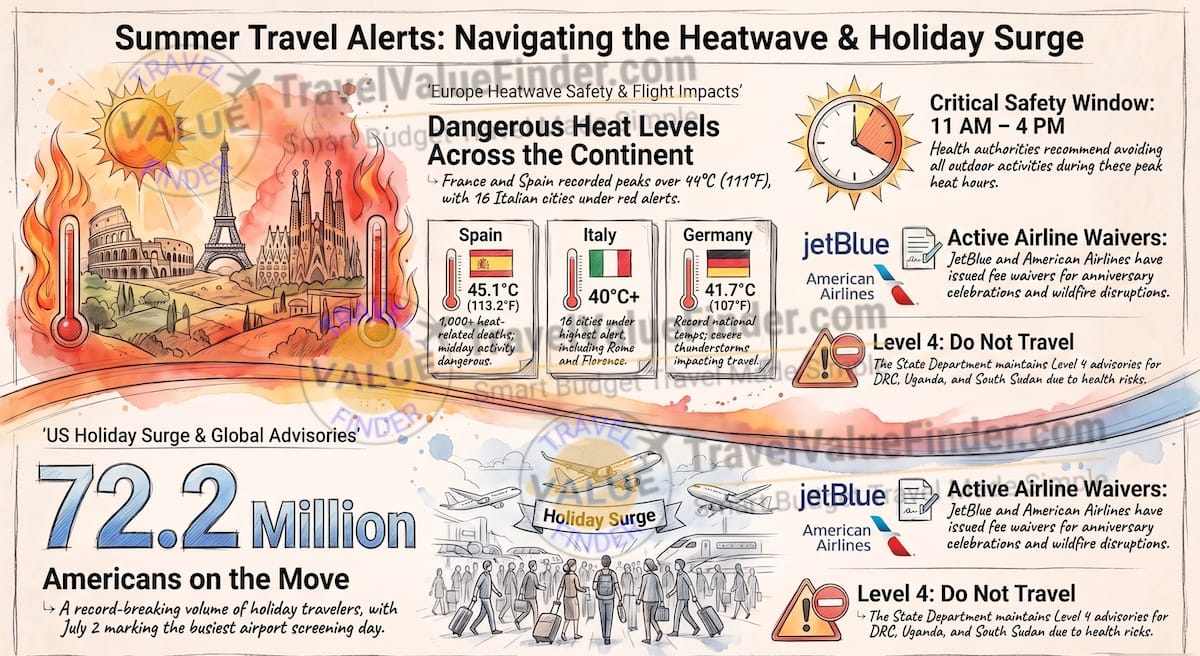
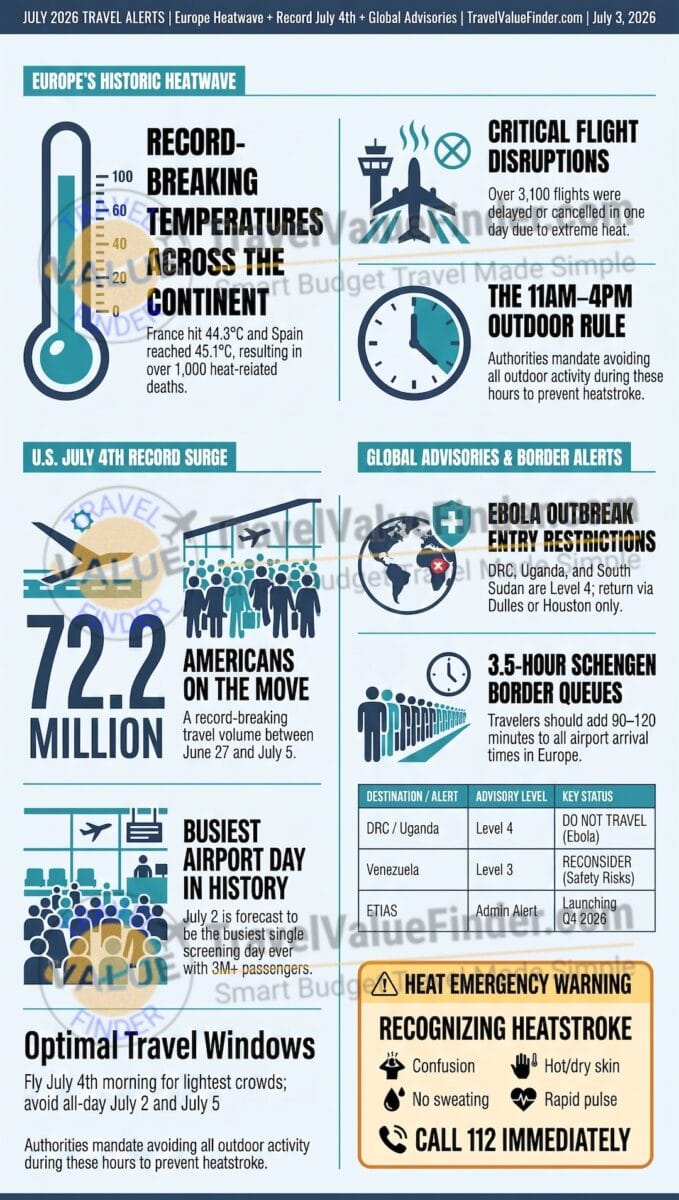
July 2026 Travel Alerts: Europe’s Deadly Heatwave, Record July 4th Crowds & Critical Global Advisories. Is it safe to travel to Europe during the July 2026 heatwave? Europe’s summer 2026 heatwave is historic and ongoing. France recorded its hottest day ever on June 24, reaching 44.3°C (111.7°F). Spain linked over 1,000 deaths to heat in June alone. As of July 3, Germany, Italy, and the Balkans remain under red and amber heat alerts, with temperatures forecast above 40°C continuing into early July. Italy placed 16 major cities – including Rome, Florence, Bologna, Milan, and Verona – under its highest heat alert.
Travel to Europe is not cancelled – but the WHO, CDC, and all national health authorities recommend avoiding outdoor activity between 11am and 4pm, staying hydrated, wearing light clothing, and seeking air-conditioned spaces regularly. The heatwave has also directly disrupted air travel: heat and storms combined to cancel or delay more than 3,100 European flights in a single 24-hour period around June 21, affecting Schiphol, Zurich, Fiumicino, Athens, Málaga, and Luxembourg. Most-at-risk travelers: older adults, young children, pregnant women, and anyone with heart or respiratory conditions.
By Leslie Nics | Founder & Travel Value Expert, TravelValueFinder.com | Published: July 03, 2026
July 2026 opens with two major travel stories running simultaneously – one in Europe, one at home in the United States – that together affect more travelers than any single week this year. For the 72.2 million Americans hitting the road and airports this Independence Day holiday period, the immediate alert is logistical: TSA expects to screen 18.7 million air travelers this week alone, with July 2 the single busiest screening day in US aviation history. For the millions more with summer Europe trips booked, the alert is medical: the continent is in the grip of a historic heat dome that has already killed more than 1,000 people in Spain alone.
This month’s travel alerts from TravelValueFinder.com cover four verified, primary-sourced stories: Europe’s deadly heatwave and its direct impact on flights, health, and travel plans; the record July 4th travel surge and what it means for US airports; updated US State Department global and regional advisories; and a consolidated snapshot of all active travel alerts heading into the peak summer month.
Alert #1 – Europe’s Deadly 2026 Heatwave: What Every Traveler Needs to Know
Forty-four degrees Celsius in France. Forty-five in Spain. Sixteen Italian cities simultaneously under red alert. This is not a hot summer – this is a climate emergency that happens to coincide with the busiest tourist season on earth. Travelers need to approach Europe this July the same way they would approach any destination with an active health advisory: with preparation, flexibility, and a clear plan for the hottest hours of the day. – Leslie Nics, TravelValueFinder.com
The Scale of What Has Happened
Since late May 2026, Europe has experienced two successive severe heatwaves driven by a ‘heat dome’ – a stalled high-pressure system trapping hot North African air over the continent. Temperature records have been broken in Belgium, Czechia, Denmark, France, Germany, Hungary, Italy, the Netherlands, Poland, Romania, Spain, and the United Kingdom.
The June 24 peak: France recorded its hottest day since measurements began in 1947, with 44.3°C (111.7°F) in Pissos. A record 58 French departments – most of the country – were simultaneously under top-level Red Alert. Spain’s AEMET recorded 45.1°C (113.2°F) in Andújar on June 22. Spain’s Carlos III Health Institute attributed at least 1,028 heat-related deaths to the June heatwave. Germany broke temperature records for three consecutive days, with Coschen reaching 41.7°C on June 28.
| Country | Peak Temp Recorded | Key Impact for Travelers |
|---|---|---|
| Spain | 45.1°C (113.2°F) – Andújar | 1,000+ heat deaths in June. AEMET red alerts ongoing in south and interior. Midday outdoor activity dangerous. |
| France | 44.3°C (111.7°F) – Pissos | Hottest day on record June 24. ~50 deaths linked to heat/drowning. Most departments now cooling – storms moving in. |
| Italy | 40°C+ in multiple regions | 16 cities under highest heat alert incl. Rome, Florence, Milan, Bologna, Verona. Ongoing through early July. |
| Germany | 41.7°C – Coschen (record) | Three consecutive national temp records. Severe thunderstorms accompanying heat. Berlin Open suspended 6 hrs. |
| Portugal | 40°C (104°F) | High heat plus ongoing EES border queue crisis at Lisbon (3.5 hrs peak). Double burden on travelers. |
| Greece | 38°C+ in Athens area | Ongoing heat. EES queues at Athens led to Ryanair departing without passengers stuck in border control. |
| UK | Record June temperatures | Met Office issued rare Red extreme heat warning. Now cooling. No active red alert as of July 3. |
How the Heatwave Is Disrupting Flights – and Your Rights
3,100+ flights cancelled or delayed in one day: Around June 21, the combination of extreme heat and severe thunderstorms triggered by the heat dome cancelled or significantly delayed more than 3,100 European flights in a single 24-hour period. Airports most affected were Amsterdam Schiphol, Zurich, Rome Fiumicino, Athens, Málaga, and Luxembourg. Heat directly causes aviation disruption: runway surfaces and aircraft systems have thermal limits, and tarmac temperatures significantly above 40°C can restrict takeoff weight or require schedule adjustments.
Your Rights When Heat Delays or Cancels Your European Flight
COMPENSATION (EU261 €250–€600): Weather is classified as an ‘extraordinary circumstance’ under EU Regulation 261/2004 – meaning financial compensation does NOT apply to delays or cancellations caused directly by extreme heat or related storms.
DUTY OF CARE: Always applies regardless of cause. Your airline must provide: meals and refreshments during waits of 2+ hours; hotel accommodation if stranded overnight; transport between hotel and airport.
REFUND OR REROUTING: You are entitled to a full cash refund for any cancelled flight, or rebooking on the next available flight at no extra cost.
TRAVEL INSURANCE: A CFAR (Cancel for Any Reason) policy is your best protection if you want to voluntarily change plans due to heat conditions. Standard policies do not cover heat-related voluntary cancellations. Keep all receipts and request rerouting in writing. Source: EU Regulation EC 261/2004 | AirHelp.
Health Guidance for Europe Travelers: July 2026
- Avoid outdoor activity between 11am and 4pm local time – this is the official guidance from WHO, the NHS, and all national health ministries across affected countries
- Drink water frequently – at least 1.5 to 2 litres per day in extreme heat, more if physically active. Limit alcohol and caffeine
- Wear light-coloured, loose, breathable clothing and a hat outdoors
- Seek air-conditioned environments regularly throughout the day – museums, shopping centres, and metro stations provide relief
- Know the signs of heat exhaustion (heavy sweating, weakness, cold/pale/clammy skin, rapid weak pulse, nausea) and heatstroke (high body temperature, hot/red/dry skin, rapid strong pulse, confusion). Heatstroke is a medical emergency – call 112
- Most-at-risk traveler groups: adults over 65, children under 5, pregnant women, and anyone with cardiovascular or respiratory conditions – take extra precautions and consider adjusting itinerary timing
- Wildfire risk: avoid woodland and mountain areas in Spain, France, Portugal, and Italy during the heatwave – follow local evacuation orders immediately if issued
| HEATWAVE EMERGENCY: SIGNS REQUIRING IMMEDIATE ACTION Call 112 (European emergency number) immediately if anyone shows: confusion or loss of consciousness, hot dry skin with no sweating despite high temperatures, very high body temperature (above 39.5°C / 103°F), rapid strong pulse. These are signs of heatstroke – a life-threatening emergency. Do NOT give fluids to an unconscious person. Move to shade/cool area and call emergency services immediately. Drowning risk is elevated during heatwaves as more people swim in rivers, lakes, and coastal areas. Stick to supervised swimming areas only. Source: WHO Heat and Health | NHS Heatwave Guidance | European Centre for Disease Prevention and Control |
Alert #2 – Record July 4th Travel Surge: 72.2 Million Americans, Busiest Screening Day in History
Seventy-two million travelers, one weekend, and July 2 is the single biggest airport screening day ever recorded. The math on this is simple: if you are flying anywhere in the United States this week and you are not already at the airport, add an hour to whatever buffer you think you need. – Leslie Nics, TravelValueFinder.com
AAA projects a record 72.2 million Americans will travel at least 50 miles from home between June 27 and July 5 – edging past last year’s record of 71.8 million. Eighty-five percent of them are driving. The remaining 15% – approximately 10.8 million – are flying, taking trains, or cruising.
TSA confirmed it expects to screen nearly 18.7 million air travelers between June 30 and July 6, 2026 – with July 2 projected as the single busiest screening day, expecting more than 3 million passengers through airport checkpoints. TSA has confirmed checkpoints are fully staffed for the holiday period and has added support at World Cup host city airports as part of a broader summer security plan.
| Metric | Figure | Source |
|---|---|---|
| Total July 4th travelers (June 27–July 5) | 72.2 million (record) | AAA |
| Road travelers | ~61.4 million (85%) | AAA |
| Air travelers screened (June 30–July 6) | 18.7 million | TSA |
| Busiest single screening day | July 2 – 3M+ passengers | TSA |
| JetBlue waiver window | July 3–5 (rebook by July 8) | JetBlue Travel Alerts |
| American Airlines wildfire waiver (Flagstaff AZ) | July 1–7 (travel July 1–10) | American Airlines Travel Alerts |
| Top domestic destinations (AAA bookings) | Seattle, Orlando, Anchorage | AAA / Deep Arrival |
Active Airline Waivers This Week – Use Them Now
JetBlue – US 250th Anniversary Waiver: JetBlue is waiving change and cancel fees for customers traveling July 3–5, 2026, to or from a range of cities affected by temporary airspace restrictions during US 250th anniversary celebration events. Customers can rebook for travel through July 8, 2026. Original travel must have been booked before June 29, 2026. Visit jetblue.com/travel-alerts for the full city list.
American Airlines – Flagstaff Wildfire Waiver: Customers booked on American Airlines flights to/from Flagstaff, Arizona (FLG) between July 1–7, 2026 can rebook in the same cabin (or pay the fare difference for an upgrade) for new travel July 1–10, 2026. Tickets must have been purchased by June 30. Changes must be made by July 7, 2026. Customers can reroute to Phoenix (PHX) as an alternative.
Best Times to Travel This Weekend – INRIX / AAA Data
- BEST times to fly: July 4th itself (Friday) – historically the lightest airport day of the holiday period once most travelers have reached their destination
- WORST times to fly: Thursday July 2 (peak volume) and Sunday July 5 (peak return traffic)
- BEST times to drive: before noon Thursday or after 7pm Thursday; early Saturday morning; avoid Monday afternoon return traffic (July 6)
- WORST road corridors: I-95 Northeast, I-10 Florida, I-5 California, I-90 Seattle – all forecast for significant congestion Thursday afternoon through Friday
- TSA PreCheck / Global Entry holders: use your trusted traveler lanes – lines in standard security will be significantly longer than usual all week
Alert #3 – US State Department Worldwide Caution & Key Regional Advisories
Worldwide Caution – Elevated Vigilance for All International Travelers
The US State Department’s Worldwide Caution advisory – which advises all Americans traveling or living abroad to exercise increased caution – remains in active effect. The Department specifically highlights that US diplomatic facilities have been targeted and that groups supportive of Iran may target US interests or locations associated with Americans worldwide, including outside the Middle East. American travelers abroad should: enroll in STEP (step.state.gov), follow embassy security alerts for their destination, and avoid large gatherings or demonstrations.
| Country / Region | Level | Key July 2026 Note |
|---|---|---|
| DRC (Democratic Republic of Congo) | L4 – DO NOT TRAVEL | Ebola Bundibugyo outbreak ongoing. US Title 42 entry restrictions: return via Dulles (IAD) or Houston (IAH) only. |
| Uganda | L4 – DO NOT TRAVEL | Ebola confirmed including Kampala. WHO PHEIC in effect. No Bundibugyo vaccine available. |
| South Sudan | L4 – DO NOT TRAVEL | Preventive Level 4 – Ebola border risk with DRC/Uganda. |
| Venezuela | L3 – RECONSIDER | Updated June 9 – flights between US and Venezuela resuming for first time in nearly a decade. Still: crime, kidnapping, terrorism, poor health infrastructure risk. Avoid: Venezuela-Colombia border, Amazonas, Apure, Aragua, Bolivar, Guarico, Tachira. |
| Rwanda | L3 – RECONSIDER | Regional Ebola proximity risk. No confirmed cases. Updated June 2026. |
| Uganda (Update) | L4 – DO NOT TRAVEL | Africa advisory updated June 2026. Also: Mali (L4), Nigeria (L3), Lesotho (L2), Botswana (L2). |
| Canada | L1 – EXERCISE NORMAL CAUTION | Updated June 5 ahead of World Cup. Top 15 Global Peace Index. Standard safety precautions apply. |
| Middle East – Broader Region | ELEVATED CAUTION | Worldwide Caution specifically elevated for Middle East. Periodic airspace closures may disrupt travel. Monitor local embassy alerts. |
People Also Ask
Is Europe’s heatwave over in July 2026?
Not fully. The first wave of severe heat – which peaked in France and Spain on June 21–24 – is easing in Western Europe as Atlantic storms move in. However, as of July 3, the heat dome has shifted eastward, with Germany, Italy, the Balkans, and Central Europe still experiencing temperatures above 40°C. The WMO’s Climate Watch guidance indicates excessive heatwave conditions are likely to persist into early July, especially in southern and central Europe. Travelers to Italy, Greece, and the Balkans in early July should continue to follow all heat safety guidelines.
Will heat cancel my Europe flight in July 2026?
Heat itself rarely cancels flights directly, but it can restrict aircraft performance (affecting maximum takeoff weight) and cause cascading delays across the network. The more significant July risk is the combination of extreme heat and severe thunderstorms – which together caused 3,100+ flight disruptions in a single day in late June. July thunderstorm activity over central Europe (Germany, Austria, Switzerland, northern Italy) is historically high. Check your airline’s travel alerts in the 72 hours before departure and download a flight tracker (FlightAware or FlightRadar24) alongside your airline’s app for the most current status.
Can I get a refund if Europe’s heatwave ruins my trip?
A straightforward refund for ‘the weather was too hot’ is not available under standard travel insurance or EU passenger rights rules. However, your options are: (1) If your flight was cancelled by the airline due to heat or storms, you are entitled to a full cash refund or free rebooking under EU261. (2) If your hotel or resort has a ‘severe weather’ or ‘force majeure’ clause, check whether extreme heat qualifies. (3) If you have Cancel for Any Reason (CFAR) travel insurance, you can cancel for any reason – including heat – and receive 50–75% reimbursement. (4) If a government Red Alert evacuation order is issued for your specific area, most comprehensive travel insurance policies will cover trip interruption. Always read your specific policy wording.
What is the US 250th anniversary flight disruption about?
The United States is celebrating its 250th anniversary of independence on July 4, 2026, with major celebrations across multiple cities. As part of these events, temporary flight restrictions (TFRs) and airspace limitations are in place in certain cities to accommodate aerial displays and official ceremonies. JetBlue has proactively issued a travel waiver allowing free changes for flights between July 3–5 to/from affected cities. If you are flying domestically this weekend and experience disruption, check whether your airline has issued a similar waiver – American, Delta, United, Southwest, and Alaska have all historically issued July 4th waivers in past years.
Leslie Nics’ 8-Point July 2026 Travel Action Plan
- Europe travelers: reschedule any strenuous outdoor activities (hiking, cycling, theme parks, all-day sightseeing tours) to before 10am or after 5pm. The 11am–4pm window is genuinely dangerous in July across Spain, Italy, southern France, and the Balkans.
- Check your specific European destination’s current alert level at the national meteorological authority website or at meteoalarm.org – which aggregates real-time warnings across all European countries in one place.
- If your Europe flight was cancelled or severely delayed due to heat or storms: do not accept a voucher. Request a cash refund or free rebooking in writing. Keep every receipt for food, accommodation, and transport – your airline owes you duty of care.
- Flying in the US this July 4th week: arrive at least 30 minutes earlier than your usual buffer. On July 2 specifically – the busiest screening day ever forecast – allow a full 2.5 hours for domestic, 3 hours for international departures from major hubs.
- Check JetBlue and American Airlines travel alert pages now if you have bookings through July 10 – active fee waivers may allow you to adjust travel dates at no cost.
- Do not travel to DRC, Uganda, or South Sudan. Level 4 advisories remain in effect. If returning to the US from these countries: route via Washington Dulles (IAD) or Houston George Bush (IAH) – title 42 screening requirements remain active.
- Venezuela travelers: check the June 9 State Department Level 3 advisory before booking – US-Venezuela flights have resumed but significant safety risks remain. Review the specific restricted provinces and regions.
- Subscribe to TravelValueFinder.com/travel-alerts for weekly updates through July – World Cup final is July 19, ETIAS launch is Q4 2026, and hurricane season peaks in August. All three will generate significant travel alerts in the coming weeks.
July 2026 Travel Alerts – Master Snapshot
| Alert | Status | Who Is Affected | Action |
|---|---|---|---|
| Europe Heatwave – Spain, France, Italy, Germany, Balkans | ONGOING | All Europe travelers July 2026 | Avoid 11am–4pm outdoors. Know heatstroke signs. Call 112. |
| Europe Flight Disruptions (heat + storms) | ELEVATED RISK | All flights through Southern/Central Europe | Check FlightAware 72 hrs before. Keep receipts. Know EU261 rights. |
| EES Border Queues – Lisbon, Rome, Paris, Athens | UP TO 3.5 HRS | All non-EU Schengen travelers | Add 90–120 min minimum. 3 hrs for Lisbon/Rome. Pre-register via EU app. |
| July 4th US Travel Surge | RECORD – 72.2M | All US travelers June 27–July 6 | Arrive 2.5 hrs early on July 2. Avoid Thu afternoon traffic. |
| JetBlue waiver (July 3–5) | ACTIVE | JetBlue bookings before June 29 | Rebook free through July 8 at jetblue.com |
| AA waiver – Flagstaff wildfire | ACTIVE | AA FLG bookings through July 7 | Rebook to July 10 or reroute to PHX. |
| Ebola – DRC, Uganda, South Sudan | L4 DO NOT TRAVEL | All travelers | Cancel travel. US return via Dulles/Houston only. |
| Venezuela | L3 RECONSIDER | US citizens | Flights resumed. Review restricted provinces before travel. |
| US Worldwide Caution | IN EFFECT | All Americans abroad | Enroll in STEP at step.state.gov. Monitor embassy alerts. |
| ETIAS – EU Travel Permit | COMING Q4 2026 | All visa-exempt EU visitors | Do NOT apply anywhere yet. Monitor TravelValueFinder.com. |
| Atlantic Hurricane Season | ACTIVE – Below-normal | Caribbean/Gulf travelers | Peak risk Aug 15–Oct 15. Buy CFAR insurance at booking. |
Find latest Mid-July 2026 Travel Alerts: Syria Reopens, World Cup Finals & the EES Border System Under Pressure
About the Author
Leslie Nics is the founder of TravelValueFinder.com and a travel value strategist with over a decade tracking global travel alerts, health advisories, and passenger rights. All data in this article is sourced from primary authorities: the World Meteorological Organization (WMO), Météo-France, Spain’s AEMET, the WHO, Wikipedia’s 2026 European Heatwaves tracker, Reuters, Time Magazine, Wego Travel Blog, the US Transportation Security Administration (TSA), AAA, Deep Arrival, JetBlue Travel Alerts, American Airlines Travel Alerts, the US State Department travel.state.gov, and the CDC Travelers’ Health page.
Conditions verified as of July 3, 2026.
Sources
- WMO – Record-breaking heat grips Europe (updated July 2, 2026) | wmo.int
- Wikipedia – 2026 European Heatwaves (ongoing update) | en.wikipedia.org
- Time Magazine – Europe’s Deadly Heatwave: What Travelers Need to Know (June 23, 2026) | time.com
- Wego Travel Blog – Europe Heatwave 2026: Countries Affected, Travel Warnings and What Travellers Should Do | blog.wego.com
- Reuters – Spain attributes over 1,000 excess deaths to heat in second-hottest June ever (July 1, 2026)
- Severe-Weather.eu – Heat Dome Europe: Excessive Historic Heatwave June-July Summer 2026 | severe-weather.eu
- Deep Arrival – TSA Expects 18.7 Million Travelers Over Fourth of July Week (June 30, 2026) | deeparrival.com
- Deep Arrival – Best and Worst Times to Travel July 4th 2026 | deeparrival.com
- AAA – July 4th Travel Forecast 2026 | aaa.com
- JetBlue – Travel Alerts: US 250th Anniversary + World Cup Waiver | jetblue.com/travel-alerts
- American Airlines – Travel Alerts: Flagstaff Wildfire July 2026 | aa.com
- US State Department – Worldwide Caution Advisory | travel.state.gov
- TravelPulse – Key Travel Advisories Announced in June 2026 (June 27, 2026) | travelpulse.com
- CDC Travelers’ Health – Ebola, Malaria, Chikungunya notices | wwwnc.cdc.gov/travel/notices
| Travel Smarter This July — Free Monthly Alerts from TravelValueFinder.com From Europe’s historic heatwave to the World Cup final on July 19 to ETIAS launching later this year — summer 2026 is the most complex travel season in recent memory. TravelValueFinder.com’s Travel Alerts, updated bi-weekly by Leslie Nics, keeps you ahead of every disruption, advisory, and policy change. Explore: TravelValueFinder.com/travel-alerts | /europe-travel-tips | /travel-insurance-guide | /etias-europe-travel-permit-2026 | /flight-deals |