Travel Value Finder


How do I retire in Portugal, and what should I test before committing? Retiring in Portugal in 2026 means applying for the D7 Passive Income Visa (€920/month income, €11,040 savings in a Portuguese bank), getting your NIF tax number, and proving accommodation. The trial visit framework tests the decisions that matter before you invest 6–9 months of visa processing: which region, whether cobblestone terrain suits your mobility, what groceries and rent actually cost on Idealista.pt (not Airbnb), and what private healthcare access looks like in your specific city.
Leslie Nics | TravelValueFinder.com | June, 2026 | Last reviewed: June 26, 2026
KEY 2026 UPDATES:
D7 income: €920/month. Citizenship extended to 10 years (most non-EU nationals) under May 2026 Nationality Law. NHR ended 2024 – pension income now taxed at standard Portuguese progressive rates (12.5%–48%) for new arrivals. AIMA biometric wait: 2–6 months.
Portugal is 31% cheaper than USA including rent (Numbeo June 2026). Global Peace Index 2026: #7 globally.
Source: TravelValueFinder.com – Leslie Nics, June 2026
GUIDE AT A GLANCE
| Guide Focus | 4-week structured trial for retiring in Portugal before D7 Visa application |
|---|---|
| D7 Income Req. 2026 | €920/month single | €1,380/month couple – indexed to Portuguese minimum wage |
| D7 Savings Req. | €11,040 in a Portuguese bank account (12 months minimum income) |
| NHR Status 2026 | Ended for new arrivals 2024. IFICI replaces it – most retirees do NOT qualify. Pensions taxed at standard progressive rates. |
| Citizenship 2026 | 10 years for most non-EU nationals (May 2026 Nationality Law signed May 3, 2026) |
| AIMA Wait Time | 2–6 months for biometric appointment – start D7 paperwork DURING your trial |
| NIF Number | Free, same-day, any Finanças office with your passport – get this Week 1 of your trial |
| Cost vs. USA | 31% cheaper than USA including rent (Numbeo, June 2026) |
| Safety Rank | #7 globally (Global Peace Index 2026) |
| Best Trial Regions | Algarve (most expat infrastructure), Cascais/Lisbon (urban), Porto or Silver Coast (value) |
| Author | Leslie Nics, TravelValueFinder.com – Portugal retirement & D7 Visa researcher |
Why Retiring in Portugal Starts With a 4-Week Trial – Not a Visa Application
Retiring in Portugal is one of the strongest retirement decisions available to Americans and British nationals in 2026. The evidence is consistent across every major index: 7th safest country in the world, 31% cheaper than the USA including rent, €920/month D7 Visa threshold that is the lowest passive-income residency requirement in Western Europe, and a quality of life that has drawn hundreds of thousands of expat retirees over the past decade. These advantages are documented, current, and real.
But retiring in Portugal successfully – meaning not just arriving but thriving for a decade or more – requires testing before committing. The D7 Visa process takes 6–9 months and costs thousands of dollars in legal fees, documentation, and relocation expenses. Making that investment based on a two-week holiday in Lisbon’s most beautiful neighborhoods is making a major decision on incomplete information.
The 4-week trial this guide proposes tests the things that determine whether your specific version of retiring in Portugal actually works: whether the cobblestone terrain of your target city suits your mobility (Alfama’s hills vs. Cascais’s flat seafront), what groceries and rent genuinely cost in residential neighborhoods (not tourist areas), how English-accessible your day-to-day services are, and whether the pace of Portuguese daily life is what you want for twenty years.
This guide also covers the two administrative actions that make retiring in Portugal significantly faster once you decide to proceed: getting your NIF (Portugal’s tax identification number) in person during Week 1, and potentially opening a Portuguese bank account before you leave. Both are possible as a tourist. Both save weeks of remote paperwork later.
Retiring in Portugal is the recommendation I make most confidently – the safety, the cost, the D7 threshold, the healthcare value. But the retirees who retire in Portugal and stay for decades are almost always the ones who tested it first. Not a holiday. A trial. They walked Alfama with a grocery bag. They found out what rent actually costs on Idealista. They visited a health center. They came back knowing they were ready. This guide is that test, written down. – Leslie Nics, TravelValueFinder.com
The 6 Decisions Your Trial Answers Before Retiring in Portugal
| Decision | Why It Matters for Retiring in Portugal | How the 4-Week Trial Answers It |
|---|---|---|
| Which region of Portugal to retire in | Retiring in Portugal in the Algarve vs. Porto vs. Cascais vs. the Silver Coast means dramatically different costs, terrain, English availability, and social communities | 4 weeks across 3 regions with scored comparison at the end |
| Whether cobblestone terrain suits your mobility | Retiring in Portugal in Lisbon’s Alfama or Porto’s Ribeira means daily hill-climbing on wet cobblestones. For retirees with joint issues, this defines daily life for 20+ years. | Walk your target neighborhood uphill with a grocery bag on a wet morning. This single test answers the question more honestly than any description. |
| What rent actually costs (not Airbnb) | Retiring in Portugal long-term means renting in the non-tourist residential market. The gap between Airbnb and Idealista.pt prices can be 40–60% in the same neighborhood. | Search Idealista.pt daily in each region. Visit 2 residential apartments per city. |
| What private healthcare costs and how English-accessible it is | Retiring in Portugal means using both the SNS (public, free/subsidized for residents) and private clinics for faster specialist access. The cost and English proficiency varies by city. | Walk into CUF Saúde or Lusíadas as a self-pay patient. Pay ~€50–€80. Note the English, the wait, the cleanliness. This is your baseline. |
| Whether the D7 income threshold fits your finances | Retiring in Portugal through the D7 requires €920/month in passive income (single) or €1,380/month (couple) plus €11,040 in savings. After 4 weeks of real living costs, you know whether your income comfortably covers retirement in your target region. | Calculate your actual 4-week spend from receipts. Does your income leave a comfortable surplus above the D7 minimum? |
| Whether the NHR tax change affects your plans | Retiring in Portugal since 2024 means pension income is taxed at standard Portuguese progressive rates – not the 10% NHR flat rate that drew many retirees before 2024. This changes the financial picture for some income profiles. | Research your specific income tax exposure in Portugal with a dual-qualified CPA. The trial is a good time to book that consultation remotely. |
The 4-Week Trial Plan for Retiring in Portugal
| WEEK 1: Algarve – The Most Established Region for Retiring in Portugal Tavira, Lagos, Silves – residential neighborhoods, not tourist centers | |
| The Algarve is Portugal’s most popular region for retiring expats, and the infrastructure shows it: English-speaking doctors, English-language legal services, active expat social calendars, and a community that has been settling here for decades. Days 1–2: Arrive. Walk your residential neighborhood. Find the local Pingo Doce, farmácia, and café. Deliberately avoid tourist restaurants for the first week. Days 3–4: Full grocery shop at Pingo Doce AND the local weekly mercado. Cook all meals from local ingredients. Calculate your real weekly food cost – this data point is worth more than any published estimate for retiring in Portugal. Days 5–6: Test terrain. Walk from your apartment to the nearest supermarché and back, carrying a full bag, on whatever weather the day offers. Then walk the historic center of your chosen town – Tavira’s bridge area, Lagos’s city walls. Note how your knees feel. Day 7: Get your NIF at the local Finanças office. Bring your passport. It is free, takes 1–2 hours, and is the most strategically valuable action of your entire trial for retiring in Portugal faster. | WHAT TO TEST THIS WEEK – Get NIF at Finanças – passport only, free, 1–2 hours, same day – Calculate real weekly grocery cost from Pingo Doce + mercado receipts – Search Idealista.pt for unfurnished 1–2BR apartments in residential neighborhoods – Walk your neighborhood uphill with a loaded bag – your mobility test for retiring in Portugal – Test English at: farmácia, health center, Câmara Municipal, supermarket checkout – Join ‘Expats in the Algarve’ and ‘Americans in Portugal’ Facebook groups before arriving – Note neighborhood noise levels at 7am and 10pm – different times reveal different thing |
| WEEK 2: Lisbon Area – Cascais vs. Alfama: The Terrain Test That Defines Everything Cascais (flat), Belém (flat), Alfama (steep) – honest comparison for retiring in Portugal | |
| Travel: AP train from Faro to Lisboa – 3.5 hours, very comfortable, book in advance. Base: A residential apartment in Cascais (flat – strongly recommended for mobility testing) OR Belém/Ajuda in Lisbon (flat alternatives to the hilly historic center). Days 1–2: Walk Cascais deliberately. It is noticeably flatter than Lisbon. Test the 35–40 minute commuter train to Lisbon Cais do Sodré. This train is daily life for many people retiring in Portugal near Lisbon. Days 3–4: Walk Alfama and Mouraria in Lisbon specifically – with a grocery bag, going uphill. Then walk Belém. The difference is the difference between two completely different retirements. Your knees will know immediately. Days 5–6: Full Lisbon day on public transport only – metro, bus, ferry. Navigate a Finanças office or bank visit. Test whether the city infrastructure for retiring in Portugal here works without a car. Day 7: Day trip to Sintra or Setúbal. Assess: is the Lisbon area your retirement location, or is it a day-trip destination from the Algarve? | WHAT TO TEST THIS WEEK – Walk Alfama hills with a grocery bag on a wet day – the definitive terrain test for retiring in Portugal in Lisbon – Test the Cascais–Lisbon commuter train at rush hour on a weekday – Visit CUF Saúde Cascais or Lusíadas – self-pay GP consultation (~€50–€80) – Check Cascais rental prices on Idealista.pt vs. Algarve – compare your two regions – Attend a Cascais or Lisbon expat meetup – check ‘Americans in Portugal’ Facebook group for events – Visit Mercadona and Campo de Ourique market – compare grocery costs to Algarve week – Confirm: is retiring in Portugal here what you want, or is Cascais better as a weekend escape- |
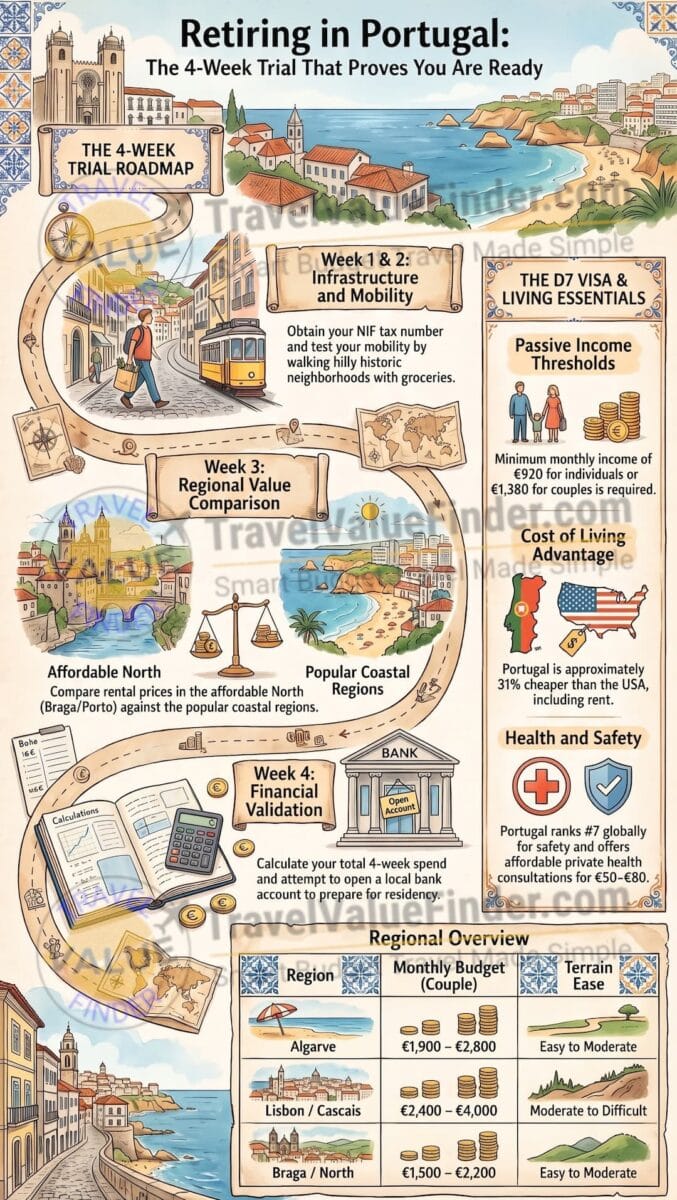
| WEEK 3: Porto and Silver Coast – The Affordable North Bonfim/Paranhos (Porto), Braga day trip, Óbidos/Caldas (Silver Coast) | |
| Travel: Alfa Pendular train from Lisbon to Porto – 3 hours, very comfortable, book in advance. Base: Bonfim or Paranhos neighborhoods in Porto – residential, local, flat, and significantly cheaper than Ribeira or Baixa. This is where retiring in Portugal in Porto actually looks like. Days 1–2: Walk Porto honestly. The Ribeira/Baixa area is beautiful and steep. Bonfim is manageable. This distinction matters for retiring in Portugal here long-term – not for a weekend visit. Days 3–4: Day trips to Braga (40 min by train – Portugal’s most affordable major city for retiring expats) and the Silver Coast (Óbidos, Caldas, Peniche – car recommended). Days 5–6: Calculate Porto vs. Algarve actual costs from your receipts. Braga’s gap vs. coastal Portugal is significant and directly affects the financial case for retiring in Portugal in the north. Day 7: Complete your Region Scorecard. Which region of Portugal are you retiring in? | WHAT TO TEST THIS WEEK – Compare Braga rental prices (Idealista.pt) vs. Porto vs. Algarve – real numbers – Walk from Bonfim to Ribeira – feel the elevation change with a loaded bag – Test car dependency on Silver Coast – can you live here without driving? – Visit a Braga health center – compare SNS access experience vs. Algarve – Ask 2 long-term Porto expats: why Porto for retiring in Portugal, not the Algarve? – Calculate Porto vs. Algarve real weekly costs from receipts – not published averages – Confirm your Portugal retirement region – and book your immigration lawyer consultation |
| WEEK 4: Decision Week – D7 Prep and Commitment Return to your top region, open a bank account, and confirm your next step | |
| Return to your highest-scoring region from Weeks 1–3 with fresh eyes after comparison. Days 1–2: The ‘ordinary retirement Tuesday’ test. No activities planned. Walk to the café. Do the market. Cook lunch. Rest in the afternoon. Evening walk. Cook dinner. Is this retiring in Portugal the life you want? Days 3–4: Attempt to open a Portuguese bank account with your NIF from Week 1. Millennium BCP and Novo Banco have the most accessible non-resident processes. An account is not required now but saves significant time later for retiring in Portugal. Days 5–6: Research immigration lawyers from expat group referrals. Book a remote consultation for within two weeks of returning home. Model your D7 finances: your passive income vs. €920/month, your savings vs. €11,040 minimum. Day 7: Complete your Region Scorecard. Calculate your 4-week total spend from receipts – divided by 4, this is your real monthly budget for retiring in Portugal, more accurate than any published figure. | WHAT TO TEST THIS WEEK – Attempt to open bank account with NIF – Millennium BCP or Novo Banco – Calculate 4-week total spend from receipts – your real retiring-in-Portugal monthly budget – Confirm passive income vs. D7 requirement: €920/month + €11,040 savings – Get health insurance quote meeting D7 requirements (Cigna Global, AXA, or Allianz Care) – Book immigration lawyer consultation for within 2 weeks of returning home – Confirm your FBI background check is submitted (8–12 week apostille lead time) – Decide: am I ready to apply for the D7 Visa for retiring in Portugal? |
The D7 Visa: What Retiring in Portugal Requires in 2026
| D7 Requirement | 2026 Figure | Notes for Retiring in Portugal |
|---|---|---|
| Passive income – single | €920/month (~$1,085 USD) | Social Security, pension, dividends, rental income all qualify. Indexed to Portuguese minimum wage – updates when minimum wage changes. |
| Passive income – couple | €1,380/month (~$1,630 USD) | Primary applicant €920 + 50% for dependent spouse. Each dependent child: +30% (~€276/month). |
| Savings in Portuguese bank | €11,040 minimum | Many consulates require 12 months’ income deposited before application. Open the account during your trial. |
| Private health insurance | Required – valid in Portugal | Not travel insurance. Must cover Portugal specifically. Cigna Global, AXA PPP, Allianz Care commonly accepted by consulates. Cost: €40–€100/month. |
| Proof of accommodation | 12-month lease or property deed | Most D7 consulates require a signed long-term rental contract for at least 12 months. This is why viewing actual rental apartments during your trial matters. |
| FBI background check (apostilled) | Required | Submit at bibs.cjis.gov before your trial. Takes 8–12 weeks including apostille – the D7’s longest-lead document. |
| NIF number | Required before D7 application | Get in person at any Finanças office during Week 1. Free. Same-day. Required for bank account, lease, and D7 application. |
| Citizenship timeline (2026) | 10 years (most non-EU nationals) | Extended from 5 years by Portugal’s May 2026 Nationality Law revision. 7 years for EU and CPLP nationals. |
The NHR Ended: What Every Retiree Considering Portugal Must Know
Portugal’s Non-Habitual Resident (NHR) tax regime ended for new applicants on December 31, 2023.
The IFICI regime replaced it in 2024 – but IFICI targets tech professionals and researchers. General retirees retiring in Portugal from 2024 onward do NOT qualify.
This means: pension income (Social Security, private pension, 401k distributions) is now taxed at standard Portuguese progressive income tax rates – up to 48% for higher incomes – for new arrivals.
The UK-Portugal Double Taxation Treaty (2024): gives Portugal exclusive taxing rights on UK private pensions. UK retirees pay Portuguese income tax on private pensions.
US-Portugal Treaty: allows Foreign Tax Credit to offset Portuguese tax against US federal liability. Consult a dual-qualified CPA before retiring in Portugal to understand your specific tax exposure.
Bottom line: retiring in Portugal is still financially compelling (31% cheaper than the USA, €920/month D7 threshold). The tax picture is different from 2022. Plan around it, not against it.
Portugal Region Comparison: Where Are You Retiring in Portugal?
| Region | Monthly Budget Couple (2026) | Terrain for Daily Life | English Ease | Best For | Honest Caveat |
|---|---|---|---|---|---|
| Algarve (Tavira, Lagos, Silves) | €1,900–€2,800 | Easy–Moderate. Coastal towns flat. | Very High – most English-saturated zone in Portugal | Established expat infrastructure. Retiring in Portugal here is the easiest path for English-dominant retirees. | Rents rose 40%+ since 2020. Tourist-facing prices in summer. Less authentic Portuguese culture. |
| Cascais (Lisbon Coast) | €2,400–€3,400 | Easy – notably flat | Very High | Flat terrain + fast Lisbon access + coastal lifestyle. Retiring in Portugal here suits urban-leaning retirees. | One of Portugal’s pricier areas. Smaller apartments for the price. |
| Lisbon (City) | €2,800–€4,000 | Moderate–Difficult (steep cobblestone hills in historic neighborhoods) | High in expat zones | Cultural depth + urban energy + best private hospital access. Retiring in Portugal in Lisbon for city lovers. | Hills and cobblestones are a daily physical factor – not occasional. Rents have risen dramatically since 2019. |
| Porto (City) | €2,000–€3,000 | Moderate–Difficult (Ribeira very steep; Bonfim manageable) | Moderate | Wine country, authentic culture, lower cost than Lisbon. Retiring in Portugal in Porto for cultural depth. | Wetter winters. Less English-saturated than Algarve. |
| Braga (North) | €1,500–€2,200 | Easy–Moderate | Moderate | Lowest monthly costs of any major Portuguese city. Retiring in Portugal in Braga for maximum value. | Smaller expat community. Fewer English-language services. |
| Silver Coast (Óbidos, Caldas) | €1,600–€2,200 | Easy (flat coastal areas) | Low–Moderate | Authentic, affordable, slower pace. Retiring in Portugal away from tourist zones. | Car required. Very small expat community. |
Region Scorecard: Where Are You Retiring in Portugal?
| Factor | Algarve | Lisbon Area | Porto/North |
|---|---|---|---|
| Terrain comfort – your own honest test | __/5 | __/5 | __/5 |
| Real rental cost from Idealista.pt | __/5 | __/5 | __/5 |
| Healthcare: private clinic test | __/5 | __/5 | __/5 |
| English in daily services | __/5 | __/5 | __/5 |
| Weekly grocery cost from receipts | __/5 | __/5 | __/5 |
| Expat community quality at meetup | __/5 | __/5 | __/5 |
| Climate during your stay | __/5 | __/5 | __/5 |
| ‘Could I live here?’ gut feeling on Day 28 | __/5 | __/5 | __/5 |
| TOTAL (out of 40) | __/40 | __/40 | __/40 |
Download the Portugal Retirement Scorecards and Portugal Retirement Checklist
Ready to compare cities now?
- Use our Free Retirement Cost of Living Calculator – get your personalized report in 30 seconds – Free PDF download.
- How to Use a Retirement Cost of Living Calculator – to Compare Cities Worldwide
15 Essential Tips for Your Portugal Retirement Trial
- Get your NIF in person at a Finanças office in Week 1. Free. 1–2 hours. Required for bank account, lease, and D7 Visa application. This is the highest-return action of your entire trial for retiring in Portugal faster.
- Search Idealista.pt daily for unfurnished 1–2BR apartments in residential neighborhoods. The prices you see are your actual retiring-in-Portugal housing costs – not Airbnb. The gap is significant.
- Walk the steep streets of your target Lisbon or Porto neighborhoods with a grocery bag on a wet morning. This is the definitive terrain test for retiring in Portugal in a historic city.
- Visit an unfurnished apartment. Long-term rentals for retiring in Portugal are predominantly unfurnished – no stove, no fridge, no light fixtures in many cases. See this before you commit.
- Attend at least one expat meetup in each region. Retiring in Portugal’s social sustainability depends on the community quality – which varies enormously by region and is invisible from outside.
- Walk into CUF Saúde or Lusíadas as a self-pay patient. Pay ~€50–€80 for a GP consultation. Note the English proficiency, wait time, and cleanliness. This is your retiring-in-Portugal healthcare baseline.
- Submit your FBI background check before your trial departs. It takes 8–12 weeks (including apostille) and is the D7 Visa’s longest-lead document. Retiring in Portugal smoothly requires starting this early.
- Understand that the NHR tax regime has ended for new retirees. Retiring in Portugal from 2024 onward means pension income is taxed at standard Portuguese progressive rates. Consult a dual-qualified CPA.
- The D7 income requirement is €920/month in 2026 for a single applicant. After 4 weeks of real spending in Portugal, you will know whether your retirement income covers your target region with a comfortable surplus.
- Attempt to open a Portuguese bank account with your NIF during Week 4. Most D7 consulates expect income to be deposited into a Portuguese bank account – the earlier you open it, the better for retiring in Portugal.
- Join expat Facebook groups for your target regions BEFORE arriving: ‘Americans in Portugal,’ ‘Expats in the Algarve,’ ‘Porto Expats.’ These provide current intelligence that no guide can replicate.
- Note that Portugal’s May 2026 Nationality Law extended citizenship to 10 years for most non-EU nationals (extended from 5 years). If EU citizenship is part of your retiring-in-Portugal long-term plan, factor this into your timeline.
- Research AIMA appointment wait times (currently 2–6 months for biometric processing) during your trial. This reflects the current D7 processing reality that affects your retiring-in-Portugal timeline.
- Visit the local Centro de Saúde in each region and ask about registration for future residents. This tests both English availability and bureaucracy ease – two of the most relevant practical indicators for retiring in Portugal.
- Before leaving Portugal at the end of your trial, book an immigration lawyer consultation for within two weeks of your return. While your motivation is highest and your experience of retiring in Portugal is freshest, take the next concrete step.
FAQ – Retiring in Portugal 2026
What is the income requirement for retiring in Portugal in 2026?
Retiring in Portugal through the D7 Passive Income Visa requires demonstrating stable passive income of at least €920 per month for a single applicant in 2026. This is equivalent to Portugal’s national minimum wage and is indexed to it. For a couple, the requirement is €1,380/month (primary applicant €920 plus 50% for a dependent spouse). Income sources qualifying for retiring in Portugal include Social Security, pensions, dividends, rental income, and investment returns. Additionally, most consulates require savings of at least €11,040 (12 months of the minimum income) deposited in a Portuguese bank account.
Is retiring in Portugal still worth it after the NHR tax regime ended?
Yes, retiring in Portugal remains one of the world’s strongest retirement decisions in 2026. The D7 Visa’s €920/month income threshold is the lowest passive-income residency requirement in Western Europe. Portugal ranks 7th globally for safety and costs 31% less than the USA including rent. The financial picture for retiring in Portugal has changed since the NHR ended in 2024 – pension income is now taxed at standard progressive rates rather than the 10% NHR flat rate – but the lifestyle and access advantages are unchanged, and the D7 remains fully accessible.
Which region is best for retiring in Portugal?
The best region for retiring in Portugal depends on priorities. The Algarve has the most established English-speaking expat infrastructure and mild year-round climate but is the priciest coastal option. Cascais offers flat terrain and fast Lisbon access. Porto offers cultural depth and wine-country access at lower cost than Lisbon. Braga is the most affordable major city for retiring in Portugal. The Silver Coast offers authentic Portuguese life at lower prices with the trade-off of requiring a car and having a smaller English-speaking community. A 4-week trial across at least three regions is the best method for deciding where to retire in Portugal.
Bottom Line: Retiring in Portugal Works Best When You Test It First
Retiring in Portugal in 2026 is, for the right person, one of the best retirement decisions available anywhere in the world. The data is consistent and well-sourced: the safety ranking, the cost advantage, the D7 Visa’s accessible threshold, the EU Schengen access, the quality of life. These are not marketing claims – they are documented facts from independent global indices.
The 4-week trial this guide proposes is the difference between retiring in Portugal on a hypothesis and retiring in Portugal with certainty. It answers whether Alfama’s hills are a daily joy or a daily obstacle for your knees. It tells you what groceries and rent actually cost in residential neighborhoods. It gets your NIF – the administrative foundation of retiring in Portugal – in your pocket before you leave. And it gives you 28 days to honestly ask whether this pace, this language, this culture, this community is genuinely what you want for twenty years.
Almost universally, the answer is yes. But it is better to know.
Retiring in Portugal is the most consistently positive outcome I see in retirement planning. The math works. The lifestyle delivers. The community supports. But the retirees who retire in Portugal and thrive for a decade are the ones who walked Alfama on a rainy Tuesday with a grocery bag before they signed a lease. The trial is not a delay. It is the first step of the retirement itself. – Leslie Nics, TravelValueFinder.com
About the Author
Leslie Nics Travel Writer & Expat Retirement Researcher | TravelValueFinder.com
Leslie Nics is the lead travel writer at TravelValueFinder.com, specializing in retiring in Portugal, the D7 Visa process, and practical pre-move research for retirees. His Portugal research draws on extended firsthand stays in the Algarve, Lisbon, Cascais, Porto, and the Silver Coast – each structured specifically to test the daily-life reality of retiring in Portugal rather than experiencing it as a tourist. He has navigated Finanças offices, private clinics, unfurnished apartment viewings, and expat community networks across multiple regions. His retiring-in-Portugal content is referenced across expat communities including ‘Americans in Portugal,’ ‘Expats in the Algarve,’ and Portugal-focused Reddit communities. He places particular emphasis on the NHR tax change context, real Idealista.pt rental pricing versus published estimates, and the specific cobblestone-terrain mobility test that determines whether historic Portugal neighborhoods suit long-term retirees.
Expertise: Portugal D7 Visa planning | NHR/IFICI tax changes | Region-by-region cost and lifestyle analysis | Pre-retirement trial planning
Sources
- Global Citizen Solutions – Portugal D7 Visa Guide, June 2026 (€920/month income, citizenship 10-year update)
- GetGoldenVisa – Portugal D7 Visa 2026 (D7 requirements, nationality law changes)
- PortuTax – D7 Visa Portugal: Complete Guide 2026 (NHR ended, IFICI, standard progressive rates)
- The Portugal Brief – Retiring in Portugal 2026 (UK-Portugal tax treaty, April 2026)
- Numbeo – Portugal Cost of Living, June 2026 (31% cheaper than USA)
- Global Peace Index 2026 – Portugal ranked 7th globally
- Idealista.pt – Portuguese residential rental market data, June 2026
- Portal das Finanças (portaldasfinancas.gov.pt) – NIF application process