Travel Value Finder


What are the cheapest countries to retire abroad in 2026? The cheapest countries to retire abroad in 2026 include Georgia (Tbilisi, ~$1,000–$1,400/month couple), the Philippines (Cebu, ~$1,000–$1,500/month), Vietnam (Da Nang, ~$1,100–$1,700/month), Ecuador (Cuenca, ~$1,200–$1,800/month), and Colombia (Medellín, ~$1,500–$2,000/month). All support comfortable living on or under $2,000/month for a couple and are reachable on average U.S. Social Security income of $2,081/month (April 2026, SSA).
KEY FACTS: Average Social Security check (April 2026): $2,081/month. 2026 COLA: +2.8%. Countries where Social Security alone covers retirement: Vietnam, Philippines, Georgia, Ecuador, Colombia. Medicare does NOT cover care abroad. Countries where SSA cannot send payments: Cuba, North Korea, and several former Soviet states.
Leslie Nics, TravelValueFinder.com | Last updated: June 2026 | Last Reviewed: June 14 2026
COST GUIDE AT A GLANCE
| Guide Focus | Cheapest countries to retire abroad under $2,000/month (2026) |
|---|---|
| Countries Ranked | 12 destinations: SE Asia, Latin America, Eastern Europe, Europe |
| Budget Floor | $900–$1,100/month (single, frugal) in Vietnam, Philippines, Georgia |
| Budget Ceiling | $2,000/month (couple, comfortable) – the guide’s upper limit |
| Social Security | Average $2,081/month (April 2026, SSA) – covers full budget in most destinations |
| 2026 COLA | +2.8% applied January 2026 |
| Medicare Abroad | Does NOT cover international care – private insurance required |
| SSA Blocked Countries | Cuba, North Korea, Azerbaijan, Belarus, Kazakhstan, Kyrgyzstan, Tajikistan, Turkmenistan, Uzbekistan |
| Visa Income Mins | Lowest: $0 (Georgia, Vietnam) – $1,000/month (Philippines SRRV, Panama) |
| Data Sources | Numbeo (June 2026), International Living Index, SSA, Greenback Tax, Kiplinger |
| Author | Leslie Nics, TravelValueFinder.com – Travel writer & expat budget researcher |
The Average Social Security Check in 2026 Can Fully Fund Retirement Abroad
Here’s a number that changes the entire conversation about retiring cheap abroad: $2,081. That’s the average monthly Social Security check for a retired worker as of April 2026, according to the Social Security Administration. After the 2.8% cost-of-living adjustment that kicked in January 2026, the average retiree is receiving more than $2,000 a month – every month, for life, indexed to inflation.
In most U.S. cities, that $2,081 barely covers rent. In the cheapest countries to retire abroad in 2026, that same check funds a complete lifestyle – a furnished apartment, restaurant meals, private healthcare insurance, transportation, utilities, and enough left over for travel and leisure.
This guide is built around a specific, honest question: where can a single retiree or a couple live well on under $2,000 a month in 2026? Not survive. Not count every penny. But genuinely live – with dignity, comfort, safety, and access to quality healthcare.
I talk to retirees every week who assume that retiring abroad on Social Security alone is wishful thinking. Then I show them what $1,800 a month actually buys in Medellín or Chiang Mai. The conversation changes completely. The number isn’t the problem – the assumption is. – Leslie Nics, TravelValueFinder.com
A 2026 analysis from Live and Invest Overseas notes that the number of Americans receiving Social Security payments abroad has grown by nearly 19% over the past decade. More than 463,000 American retirees already receive their checks while living outside the United States, and that figure rises every year. The reason isn’t mystery – it’s math.
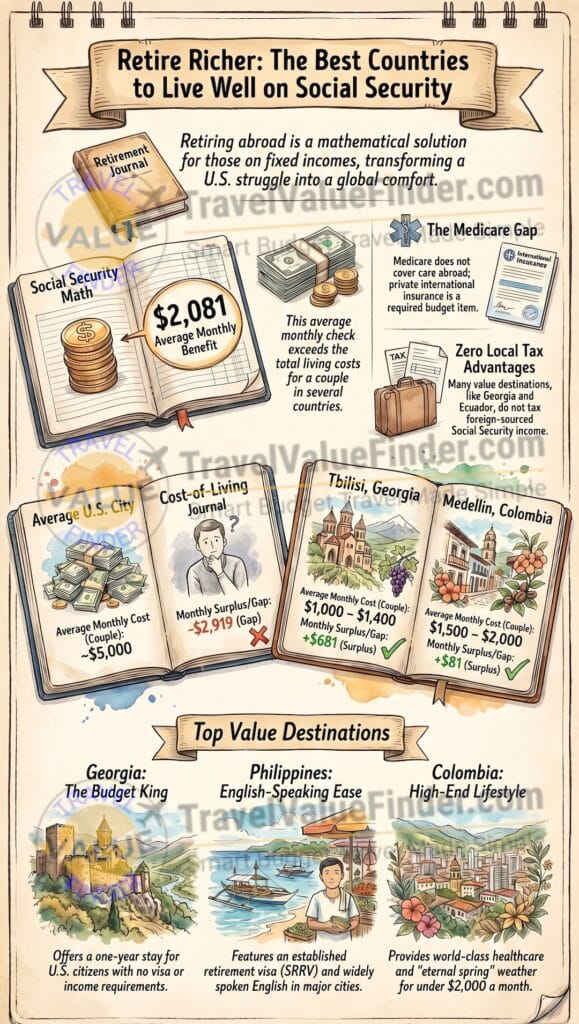
The $2,000/Month Retirement Reality Check Average Social Security retired worker benefit (April 2026): $2,081/month Average annual retiree spending in the U.S.: ~$60,000/year ($5,000/month) Gap on Social Security alone in the U.S.: roughly -$2,900/month Gap on Social Security alone in Cuenca, Ecuador: SURPLUS of ~$300/month Gap on Social Security alone in Chiang Mai, Thailand: SURPLUS of ~$200–$500/month Takeaway: Social Security alone can cover retirement in the right destination abroad.
2026 Master Ranking: Cheapest Countries to Retire Abroad Under $2,000/Month
The table below ranks 12 destinations by their total monthly cost for a couple living comfortably – not frugally. All figures are in USD, reflect mid-2026 data, and include rent, food, transport, utilities, and basic private health insurance.
| # | Country / Best City | Couple/Month | Single/Month | Visa Min. Income | SS Covers It? | Overall Rating |
|---|---|---|---|---|---|---|
| 1 | Georgia – Tbilisi | $1,000–$1,400 | $620–$900 | None required | Yes | ⭐⭐⭐⭐½ |
| 2 | Philippines – Cebu / Davao | $1,000–$1,500 | $650–$950 | ~$800/mo (SRRV) | Yes | ⭐⭐⭐⭐ |
| 3 | Vietnam – Da Nang / Hanoi | $1,100–$1,700 | $700–$1,050 | None (no retire visa) | Yes | ⭐⭐⭐⭐ |
| 4 | Ecuador – Cuenca | $1,200–$1,800 | $750–$1,100 | ~$800/mo | Yes | ⭐⭐⭐⭐½ |
| 5 | Bolivia – Sucre / Cochabamba | $900–$1,400 | $580–$850 | ~$500/mo | Yes | ⭐⭐⭐½ |
| 6 | Colombia – Medellín | $1,500–$2,000 | $900–$1,250 | ~$750/mo | Yes | ⭐⭐⭐⭐⭐ |
| 7 | Indonesia – Bali | $1,400–$2,000 | $850–$1,200 | No official retire visa | Tight | ⭐⭐⭐⭐ |
| 8 | Thailand – Chiang Mai | $1,400–$1,900 | $900–$1,200 | $1,800/mo (O-A) | Tight | ⭐⭐⭐⭐⭐ |
| 9 | Malaysia – Penang | $1,500–$2,000 | $900–$1,300 | MM2H (TBC 2026) | Tight | ⭐⭐⭐⭐ |
| 10 | Mexico – Oaxaca / Mérida | $1,300–$2,000 | $800–$1,250 | ~$1,620/mo (2026) | Tight | ⭐⭐⭐⭐ |
| 11 | Sri Lanka – Galle / Kandy | $1,000–$1,600 | $620–$1,000 | Improving visa options | Yes | ⭐⭐⭐½ |
| 12 | Portugal – Interior / Alentejo | $1,700–$2,000 | $1,050–$1,300 | €920/mo D7 | Tight | ⭐⭐⭐⭐½ |
Note: Yes = average single SS benefit ($2,081) comfortably covers couple budget. Tight = average SS covers it but with little margin; supplemental income or savings recommended. All healthcare insurance estimates are for basic international coverage, ages 55–65.
Retire Overseas on Social Security: What You Need to Know First
Before diving into individual countries, every American considering retirement abroad needs to understand exactly how Social Security works once you leave the U.S. – because this income stream is often the single biggest variable in your retirement abroad budget.
The Good News: Social Security Continues in Most Countries
The SSA states clearly: if you’re a U.S. citizen, you can travel to or live in most foreign countries without any effect on your Social Security benefits. The payments continue – deposited to your U.S. bank account, from which you can transfer funds internationally or use with a global-friendly debit card.
As of April 2026, over 57.1 million retired workers and family members receive monthly benefits from the Social Security Administration. The average monthly check hit $2,081.16 in April 2026 – up from $2,071 at the start of the year after the 2.8% COLA took effect.
The Important Asterisk: Countries Where SSA Cannot Send Payments
A small but critical list of countries are off-limits for Social Security payments. The SSA cannot send payments to Cuba, North Korea, Azerbaijan, Belarus, Kazakhstan, Kyrgyzstan, North Korea, Tajikistan, Turkmenistan, and Uzbekistan. None of the destinations in this guide fall on that list.
The Tax Question: Will You Owe U.S. Tax on Your Social Security Abroad?
Possibly. Up to 85% of your Social Security benefits may be subject to U.S. federal income tax depending on your combined income – a rule that applies whether you live in Denver or Da Nang. Some countries also have bilateral tax treaties with the U.S. that affect how Social Security is taxed locally. The best countries for retirees on Social Security tend to be those with territorial tax systems (like Georgia, Ecuador, and Panama), where foreign-sourced income – including U.S. Social Security – is simply not taxed locally.
| Country | Taxes U.S. Social Security Locally? | Tax System | Treaty with U.S.? | Net Tax Advantage |
|---|---|---|---|---|
| Georgia | No – foreign income not taxed | Territorial | No | Excellent – zero local tax |
| Ecuador | No – territorial (11yr exemption) | Territorial | No | Excellent – zero local tax |
| Philippines | No for most retirees | Residency-based | Yes | Strong treaty protection |
| Vietnam | No for short-stay retirees | Residency-based | No | Good – limited local exposure |
| Colombia | Exempt first years (non-resident) | Residency-based | No | Good for first 1–4 years |
| Bolivia | No – territorial | Territorial | No | Good – low local tax burden |
| Bali/Indonesia | Subject to residency rules | Residency-based | Yes | Moderate – get advice |
| Thailand | Remittance rules apply | Territorial (rem.) | Yes | Good with proper planning |
| Malaysia | No for MM2H holders | Territorial | Yes | Good for qualifying visa holders |
| Mexico | Treaty governs | Residency-based | Yes | Moderate – treaty reduces exposure |
| Sri Lanka | No for most retirees | Territorial | No | Good – limited local exposure |
| Portugal | Standard EU rates (NHR ended) | Residency-based | Yes | Moderate – NHR replaced by IFICI |
Not sure which city to compare? Compare up to 3 retirement destinations side by side →
Country Deep Dives: The 12 Cheapest Retirement Destinations in 2026
| #1 | Georgia (Tbilisi) – Europe’s Secret Budget Retirement Destination Cheapest all-around | No visa required | Territorial tax | Under $1,400/month couple |
Georgia – the country in the South Caucasus, nestled between Russia, Turkey, Armenia, and Azerbaijan – has emerged as one of the most remarkable retirement discoveries of the 2020s. And it keeps getting better. Tbilisi, the capital, is a city that manages to be simultaneously ancient and dynamic, with a walkable old town of carved wooden balconies, world-class wine (Georgia invented wine, literally), extraordinary food culture, and a cost of living that rivals Southeast Asia.
For Americans, the entry path is as simple as it gets: U.S. citizens can stay in Georgia for up to 365 days without a visa. No application. No income threshold. No minimum deposit. You arrive, you stay. After a year, you can renew relatively easily or apply for a residence permit.
| Expense Category | Budget Level | Comfortable Level | Premium Level |
|---|---|---|---|
| 1-BR Apartment (Tbilisi center) | $300–$450 | $450–$650 | $650–$950 |
| Groceries (weekly, couple) | $60–$90 | $90–$130 | $130–$200 |
| Dining Out (mix local/western) | $100–$160 | $160–$250 | $250–$400 |
| Transportation (monthly) | $20–$40 | $40–$80 | $80–$150 |
| Utilities (all, monthly) | $50–$80 | $80–$120 | $120–$180 |
| Internet + phone | $20–$30 | $30–$50 | $50–$80 |
| Health Insurance (couple, intl) | $150–$250 | $250–$400 | $400–$600 |
| Entertainment / misc | $80–$120 | $120–$200 | $200–$350 |
| TOTAL (Couple / Month) | $780–$1,220 | $1,220–$1,880 | $1,880–$2,860 |
- Best neighborhoods: Vera, Saburtalo, Vake (central, walkable, expat-friendly)
- Language: Georgian (unique script) but English widely spoken in Tbilisi among younger locals and in service industry
- Healthcare: improving rapidly; major hospitals in Tbilisi have English-speaking staff; strong international insurance essential
- Wine culture: Georgian wine is world-class and costs $3–$10 for an excellent bottle
- Caveat: Georgia’s political situation requires monitoring given its regional geography – follow State Department advisories
Georgia is what I recommend to anyone who asks me ‘where can I retire on Social Security alone without sacrificing quality of life?’ The answer is Tbilisi. Period. The food, the wine, the history, the architecture – and an all-in monthly cost that’s lower than a one-bedroom apartment in Phoenix. – Leslie Nics, TravelValueFinder.com
| #2 | Philippines – Official Retiree Visa, English-Speaking, English Menus SRRV program | English widely spoken | $1,000–$1,500/month couple | World-class private hospitals |
The Philippines holds a position that’s unique among budget retirement destinations: it offers one of the world’s most established formal retirement visa programs, speaks English as a co-official language, and delivers a cost of living that puts it firmly in the sub-$1,500/month range for a couple – even at a comfortable standard.
The Special Resident Retiree’s Visa (SRRV) is administered by the Philippine Retirement Authority and comes in several tiers. For those 50 and older with a monthly pension, the ‘Smile’ option requires a $10,000 deposit plus proof of approximately $800/month in pension income. For those without a pension, a $20,000 deposit (ages 50+) suffices, with no income requirement. The visa grants permanent residency from day one and can be used as a multiple-entry visa.
| Expense | Cebu City | Davao City | Dumaguete | Angeles City |
|---|---|---|---|---|
| 1-BR Apartment | $250–$450 | $220–$400 | $200–$350 | $230–$420 |
| Groceries (couple/mo) | $150–$220 | $140–$200 | $130–$190 | $140–$210 |
| Dining Out (couple/mo) | $120–$200 | $110–$180 | $100–$160 | $120–$200 |
| Transport | $40–$80 | $35–$70 | $30–$60 | $40–$70 |
| Utilities + internet | $80–$130 | $75–$120 | $70–$110 | $80–$120 |
| Healthcare Ins. | $150–$280 | $150–$280 | $150–$280 | $150–$280 |
| COUPLE TOTAL | $940–$1,560 | $880–$1,450 | $830–$1,350 | $910–$1,500 |
- Healthcare: major private hospitals in Cebu and Metro Manila are JCI-accredited and internationally regarded
- Climate: tropical year-round; typhoon season (June–November) affects northern areas more than Cebu and Mindanao
- Expat community: one of the largest English-speaking expat communities in Southeast Asia
- SRRV Deposit note: the $10,000–$20,000 deposit is held in a Philippine bank account – it’s not spent, just held
- Best cities for retirees: Cebu City (urban, hospitals), Davao (safe, clean), Dumaguete (small, university town), Bacolod
| #3 | Vietnam – Da Nang & Hanoi – Budget Paradise With No Retirement Visa Sub-$1,700 couple | Street food culture | Long coastline | Growing expat scene |
Vietnam has no formal retirement visa – and that’s the one caveat every retiree needs to understand up front. Most long-term residents work around this through tourist visa extensions, e-visas, and ‘visa runs’ to neighboring countries. It’s a workable system that thousands of expats navigate successfully, but it requires flexibility and an acceptance that your residency is technically temporary.
With that acknowledged: Vietnam is extraordinary value. Da Nang, in particular, has become a top-tier retirement destination in the past five years – it has a world-class beach, modern infrastructure, a growing international food scene, excellent private hospitals, and monthly costs that can comfortably sit below $1,500 for a couple. Hanoi offers imperial history and cultural depth at similar costs. Ho Chi Minh City (Saigon) is busier and slightly pricier but still well under $2,000.
| Expense | Da Nang | Hanoi | Ho Chi Minh City | Hoi An |
|---|---|---|---|---|
| 1-BR Apartment | $300–$500 | $280–$480 | $320–$550 | $250–$430 |
| Groceries (couple/mo) | $120–$180 | $110–$170 | $130–$190 | $100–$160 |
| Dining Out | $100–$200 | $100–$190 | $120–$220 | $100–$180 |
| Transport | $30–$60 | $30–$60 | $40–$70 | $25–$50 |
| Utilities + internet | $60–$100 | $60–$100 | $70–$110 | $55–$90 |
| Healthcare Ins. | $150–$280 | $150–$280 | $150–$280 | $150–$280 |
| COUPLE TOTAL | $1,060–$1,620 | $1,030–$1,580 | $1,130–$1,720 | $980–$1,490 |
Vietnam Visa Reality Check Vietnam does not have an official retirement visa as of June 2026. E-visa stays are capped at 90 days per entry. Common workarounds: business visa (available through agents, renewable), multiple-entry tourist visas, or extended 3-month e-visas. Vietnam has been signaling intent to create a long-stay visa option but has not yet enacted one. Best approach: spend 1–2 months per visit initially; connect with local expat lawyers for the current best legal long-stay method. This limitation does not reduce Vietnam’s cost advantage – it just adds a layer of administrative management.
| #4 | Ecuador – Cuenca – The Americas’ Most Underrated Retirement Value Colonial mountain city | $800/month visa | U.S. dollar economy | 11-year tax exemption |
Ecuador uses the U.S. dollar. Read that again. For American retirees, this means zero currency risk, no conversion fees, and the ability to transfer money from your U.S. bank to your Ecuadorian account with perfect predictability. Combined with a cost of living among the lowest in Latin America, this makes Ecuador an arithmetically compelling destination.
Cuenca – Ecuador’s third-largest city – is the expat hub. It sits at 8,400 feet elevation, which keeps temperatures comfortable year-round (low 60s to mid 70s Fahrenheit), and its UNESCO-listed historic center is one of the best-preserved in South America. Fresh produce at local mercados is extraordinary: a couple can eat well for $30–$50 per week buying local. Private hospital care runs $25–$50 for a consultation. A furnished 1-bedroom apartment in the historic center runs $350–$550/month.
Ecuador’s retirement visa requires demonstrating approximately $800/month in pension or retirement income. Approval typically takes 1–3 months. After three years of legal residency, permanent residency becomes available. Ecuador’s territorial tax system also provides an 11-year exemption on foreign-sourced income – meaning U.S. Social Security, pensions, and investment income are not taxed locally for your first 11 years.
| Expense | Cuenca (Budget) | Cuenca (Comfortable) | Quito | Loja |
|---|---|---|---|---|
| 1-BR Apartment | $300–$450 | $450–$650 | $400–$600 | $250–$380 |
| Groceries | $100–$150 | $150–$220 | $130–$200 | $90–$140 |
| Dining Out | $80–$150 | $150–$260 | $130–$240 | $70–$130 |
| Transport | $20–$40 | $40–$70 | $40–$70 | $20–$35 |
| Utilities | $50–$80 | $80–$120 | $70–$110 | $45–$75 |
| Healthcare Ins. | $150–$280 | $280–$400 | $150–$280 | $150–$280 |
| COUPLE TOTAL | $1,000–$1,550 | $1,550–$2,220 | $1,320–$1,900 | $875–$1,340 |
- Dollar economy: zero currency risk – the single biggest financial advantage in the region
- Altitude note: 8,400 feet requires acclimatization for the first 1–2 weeks; those with heart or lung conditions should consult a doctor first
- Healthcare: Cuenca has two excellent private hospitals – Monte Sinaí and Humanitaria – with English-speaking staff
- Flight access: best routing is through Quito (connecting), or Guayaquil (coastal city, 3 hrs away)
- Galapagos: living in Ecuador gives you the easiest and cheapest access to one of the world’s great natural wonders
| #5 | Bolivia – Sucre & Cochabamba – The Cheapest Country in the Americas Under $1,400/month couple | $500/month visa income | Altitude lifestyle | Rare destination |
Bolivia is not on most retirement radar screens – and that’s exactly why it makes this list. Sucre, the constitutional capital, is a UNESCO World Heritage city of whitewashed colonial architecture, perfect eternal spring climate (around 68°F year-round at 9,200 feet), and a cost of living so low it verges on implausible for Western retirees. A couple can live genuinely well in Sucre for $900–$1,300/month.
Bolivia’s retirement visa requires demonstrating income of approximately $500/month – among the lowest thresholds in the Western Hemisphere. Cochabamba, at a lower altitude (8,390 feet) with a warmer climate, is another popular expat city, slightly pricier than Sucre but still remarkable value.
- Sucre couple budget: $900–$1,400/month
- Cochabamba couple budget: $1,000–$1,500/month
- Altitude caveat: Bolivia’s cities sit at high altitude (8,000–12,000 feet) – serious acclimatization period required; not suitable for those with certain cardiac or respiratory conditions
- Healthcare: private clinics in Sucre and Cochabamba are affordable; for serious conditions, plan for travel to Santa Cruz or abroad
- Bonus: extraordinary natural environment – salt flats, Amazon access, Andean culture
| #6 | Colombia – Medellín – The Best All-Around Lifestyle Under $2,000 Eternal spring | World-class food | 5-star hospitals | $750/month visa | Top expat community |
If you want the best lifestyle for the money on earth – not just the cheapest bed – Medellín is the answer. No city in this guide, or arguably in the world, delivers the combination of climate, food, culture, infrastructure, and cost that Medellín offers in 2026. The ‘eternal spring’ is real: Medellín sits at 4,900 feet, producing temperatures between 65–80°F year-round, no air conditioning needed.
El Poblado, the upscale expat neighborhood, has cafés, international restaurants, rooftop bars, and co-working spaces that rival any major world city – at about 30–40% of what they’d cost in the U.S. Laureles and Envigado are slightly cheaper alternatives with equally pleasant daily life. And Medellín’s private hospitals – particularly Clínica Las Américas, Hospital Pablo Tobón Uribe, and Clínica Medellín – are internationally accredited, English-speaking, and dramatically more affordable than their U.S. equivalents.
Colombia’s Pensionado Visa requires approximately $750/month in pension income – one of the most accessible thresholds in the region. Permanent residency after five years. Citizenship possible after five years of residency.
| Expense | El Poblado | Laureles | Envigado | Cartagena (Coast) |
|---|---|---|---|---|
| 1-BR Apartment | $550–$850 | $420–$650 | $380–$600 | $600–$900 |
| Groceries | $150–$220 | $130–$200 | $120–$190 | $150–$230 |
| Dining Out | $150–$280 | $130–$250 | $120–$230 | $180–$320 |
| Transport | $40–$80 | $35–$70 | $35–$65 | $50–$90 |
| Utilities | $60–$100 | $55–$90 | $50–$85 | $80–$130 |
| Healthcare Ins. | $150–$300 | $150–$300 | $150–$300 | $150–$300 |
| COUPLE TOTAL | $1,400–$2,030 | $1,220–$1,860 | $1,155–$1,770 | $1,510–$2,270 |
Medellín is my number-one recommendation for retirees who want a real life, not just cheap living. The culture is rich, the food is world-class, the people are warm, the weather is perfection, and your dollar goes further than almost anywhere in Latin America. If you’ve been on the fence about Colombia, stop hesitating. – Leslie Nics, TravelValueFinder.com
| #7 | Indonesia – Bali – Tropical Paradise, Budget Lifestyle, Visa Complexity $1,400–$2,000/month couple | No official retirement visa | Stunning environment | Strong expat scene |
Bali is perhaps the world’s most visually iconic retirement destination – rice terraces, Hindu temples, volcanic mountains, world-class surf breaks, and a culture so distinct and beautiful it has drawn spiritual seekers and lifestyle seekers for decades. And it’s affordable. A couple can live comfortably on $1,400–$2,000/month in the right neighborhood.
The challenge in 2026 remains the visa situation. Indonesia does not offer a formal retirement visa. Most long-term residents use the Social Cultural Visa (available for up to 180 days, extendable), or a Second Home Visa launched in 2022 (requires a $135,000 deposit held in an Indonesian bank – significant but available for wealthier retirees). The e-visa is capped at 60 days. This requires careful planning.
- Best areas: Ubud (cultural heart, cooler climate), Canggu (hip, digital nomad scene), Seminyak (upscale beach), Sanur (quieter, great for older retirees)
- Sanur couple budget: $1,200–$1,700/month – the most manageable on this list in Bali
- Ubud couple budget: $1,300–$1,800/month – cultural depth, cooler air, rice field views
- Healthcare: BIMC Hospital in Kuta is international-standard; serious cases evacuate to Singapore or Kuala Lumpur
- Visa note: consult a Bali immigration specialist before committing – rules change frequently
| #8 | Thailand – Chiang Mai – The Classic for Good Reason $1,400–$1,900/month couple | Formal retirement visa | World-class healthcare | Huge expat network |
Thailand has been on every budget retirement list for twenty years because it keeps delivering. The O-A (Non-Immigrant Retirement) visa is well-established, widely understood by immigration officials, and straightforward to renew annually. The expat community in Chiang Mai is among the most developed in the world – English is everywhere, international food is abundant, and the support network for new arrivals is genuinely impressive.
The one friction point in 2026 is that Thailand’s retirement visa income threshold ($1,800/month or ~$22,000 in a Thai bank account) puts it slightly above what an average single Social Security check fully covers. A couple combining benefits easily clears it. A single retiree with a modest SS payment plus some savings can manage it. And for those who qualify, it’s one of the best-run retirement programs in Asia.
| Expense | Chiang Mai (Budget) | Chiang Mai (Comfortable) | Hua Hin | Pattaya |
|---|---|---|---|---|
| 1-BR Apartment | $300–$450 | $450–$700 | $380–$600 | $350–$550 |
| Groceries | $120–$180 | $180–$260 | $140–$200 | $130–$200 |
| Dining Out | $100–$200 | $200–$350 | $150–$280 | $150–$280 |
| Transport | $40–$80 | $80–$140 | $60–$100 | $50–$90 |
| Utilities | $60–$110 | $100–$160 | $80–$130 | $80–$130 |
| Healthcare Ins. | $120–$240 | $200–$350 | $120–$240 | $120–$240 |
| COUPLE TOTAL | $1,140–$1,660 | $1,610–$2,160 | $1,330–$1,750 | $1,280–$1,690 |
- Thai retirement visa (O-A) requires age 50+ and 800,000 THB (~$22,000) in a Thai bank account OR 65,000 THB/month (~$1,800) in pension income
- Healthcare: Bangkok and Chiang Mai’s private hospitals are JCI-accredited and genuinely excellent – many Americans fly to Bangkok specifically for medical procedures
- Food scene: Thai street food is one of the great culinary cultures of the world; eating local costs $1–$3 per meal
- Community: Chiang Mai has an enormous English-speaking expat network, active social calendar, and countless resources for new arrivals
| #9 | Malaysia – Penang – World Food Capital, Modern Infrastructure, Budget Price $1,500–$2,000/month couple | MM2H (verify 2026 requirements) | Best healthcare in SE Asia |
Penang, Malaysia is consistently cited by long-term expats as one of the most livable places on earth. It’s a UNESCO-listed city with arguably the best street food culture in Southeast Asia, world-class private hospitals, strong English proficiency, modern infrastructure, and a cost of living significantly below comparable quality cities in the West.
The My Second Home (MM2H) program has undergone several revisions in recent years and requirements as of 2026 should be verified directly with Malaysian authorities – the program was suspended, relaunched, and revised between 2021 and 2024. Currently, the program requires substantial financial proof including offshore income and fixed deposits. Not all retirees will qualify under the current scheme. Penang also has a state-level program (Penang My Second Home, P-MM2H) which some retirees find more accessible.
- Penang couple budget: $1,500–$2,000/month
- Kuala Lumpur couple budget: $1,700–$2,300/month (more expensive, more urban)
- Healthcare: Penang Adventist Hospital, Gleneagles Penang, and Loh Guan Lye are all internationally regarded
- No capital gains tax, no inheritance tax in Malaysia
- Strong Indian, Chinese, and Malay food cultures creating the most diverse food scene in Southeast Asia
- Verify MM2H requirements: check the official Tourism Malaysia site or consult a licensed agent before applying
| #10 | Mexico – Oaxaca & Mérida – Culture-Rich, Under-$2,000 Alternatives to Crowded Expat Hubs $1,300–$2,000/month couple | Close to U.S. | Great food culture | 2026 visa threshold raised |
Mexico’s most popular retirement cities – Puerto Vallarta, San Miguel de Allende – are approaching the $2,000–$2,500/month range for a couple in 2026. But Mexico is a big country, and its more off-the-beaten-path cities offer genuine value that still falls comfortably under $2,000/month.
Oaxaca City – known globally for its food, its art, its Zapotec culture, and its mezcal – sits at a comfortable 5,100 feet elevation and has an average couple budget of $1,300–$2,000/month. Mérida in the Yucatán Peninsula is safe (frequently cited as one of the safest large cities in Mexico), charming, and increasingly popular with retirees who want proximity to Caribbean beaches – Mérida to Progreso beach is 35 minutes.
Important 2026 update: Mexico raised its financial requirements for the Temporary Resident Visa. Applicants must now demonstrate monthly income of approximately $1,620 USD. This is within reach for retirees combining Social Security with modest additional income, but it’s a meaningful increase from previous thresholds.
- Oaxaca City couple budget: $1,300–$2,000/month
- Mérida couple budget: $1,600–$2,200/month
- Tlaxcala / Querétaro: quieter alternatives, growing expat communities, $1,300–$1,900/month
- Healthcare: major cities have solid private hospitals; Mérida has several internationally-regarded facilities
- Proximity advantage: 2–3 hour flights to most U.S. hubs; same or near-same time zones
| #11 | Sri Lanka – Galle & Kandy – Indian Ocean Island Life at Southeast Asia Prices $1,000–$1,600/month couple | Post-recovery boom | Extraordinary scenery | Improving infrastructure |
Sri Lanka went through a severe economic and political crisis in 2022 but has been in recovery and stabilization since mid-2023. By 2025–2026, it has re-emerged as a genuinely compelling destination for adventurous retirees – with the additional advantage that real estate and rental prices remain depressed from the crisis, making it exceptional value.
International Living has featured Sri Lanka prominently in its 2026 cheapest places reports, citing couples living comfortably for $1,000–$1,400/month in smaller towns, with more indulgent lifestyles running $2,000–$2,200/month. Galle Fort in the south is picturesque, walkable, and increasingly well-served by international-standard restaurants and services. Kandy in the highlands offers cooler climate and deep cultural heritage.
- Sri Lanka couple budget: $1,000–$1,600/month (comfortable)
- Visa situation: improving; the Tourist Visa (extendable) and Resident Guest Visa are common paths – check current status
- Healthcare: major hospitals in Colombo are solid; smaller cities have more limited specialist access
- Best for: retirees who value adventure, nature, and culture over infrastructure certainty
- Caveat: political stability has improved significantly but should continue to be monitored
| #12 | Portugal – Alentejo & Interior – Europe’s Most Affordable Retirement Abroad Under $2,000 D7 Visa | UNESCO heritage villages | SNS healthcare | $2,000/month possible outside Lisbon |
Portugal is the only Western European country that can genuinely be discussed in a guide about retiring abroad under $2,000/month – and only if you skip Lisbon and the Algarve coast’s most popular tourist areas. But outside those zones, Portugal delivers remarkable value: the Alentejo wine region, the Silver Coast (Óbidos, Caldas da Rainha, Peniche), Braga and Guimarães in the north, and the Douro Valley wine country all offer high quality of life at under $2,000/month for a couple.
Portugal’s D7 Passive Income Visa requires demonstrating €920/month (~$1,000 USD) in stable income. It’s one of the most accessible European visas available. After five years of legal residency, you can apply for permanent residency and eventually citizenship – although note that Portugal’s May 2026 Nationality Law amendment extended the citizenship timeline to 10 years for most nationalities.
| Expense | Alentejo (Évora) | Silver Coast (Óbidos) | Braga (North) | Lisbon (for comparison) |
|---|---|---|---|---|
| 1-BR Apartment | $550–$800 | $600–$850 | $500–$750 | $1,000–$1,500 |
| Groceries | $200–$280 | $200–$280 | $180–$260 | $260–$360 |
| Dining Out | $160–$280 | $160–$280 | $150–$260 | $280–$450 |
| Transport | $50–$90 | $50–$90 | $50–$90 | $80–$130 |
| Utilities | $80–$130 | $80–$130 | $80–$130 | $110–$160 |
| Healthcare Ins. | $200–$380 | $200–$380 | $200–$380 | $200–$380 |
| COUPLE TOTAL | $1,640–$2,160 | $1,690–$2,210 | $1,560–$2,070 | $2,730–$3,780 |
- D7 income requirement (2026): €920/month single; €1,380/month couple
- Portugal’s SNS public healthcare covers registered D7 residents – quality varies; many expats supplement with private insurance (~€400/year for basic plan)
- EU access: once you have Portuguese residency, travel throughout the Schengen Area is unrestricted
- Language: Portuguese; English widely spoken in cities and tourist areas but less so in rural interiors – worthwhile to learn basic Portuguese
- Best budget cities: Braga (#1 city in Portugal by several liveability metrics), Guimarães, Castelo Branco, Évora
How $2,000 a Month Actually Compares: Abroad vs. the U.S.
The best way to internalize these numbers is to see them side by side with what $2,000/month buys domestically. This comparison is what shifts the retirement abroad conversation from theoretical to urgent for most retirees.
| What $2,000/Month Gets You | Midwest U.S. City | Sun Belt U.S. City | Tbilisi, Georgia | Medellín, Colombia | Chiang Mai, Thailand |
|---|---|---|---|---|---|
| 1-BR Apartment | Small, dated | Studio or shared | Large, modern, city views | Large, modern, El Poblado | Furnished, with pool access |
| Dining Out | 1–2x/week max | 1–2x/week max | Daily restaurant dining | Daily, incl. fine dining | Daily, mix local & western |
| Healthcare Coverage | None (no Medicare) | None | Full intl. insurance | Full intl. insurance | Full intl. insurance |
| Transportation | Car required | Car required | Walkable + metro/taxi | Walkable + Uber | Scooter or Grab |
| Entertainment / Travel | Very limited | Very limited | Regular local + regional | Regular + day trips | Regular + regional travel |
| Overall Lifestyle | Survival budget | Tight survival | Comfortable | Comfortable to premium | Comfortable |
The numbers make a compelling case. The same Social Security income that doesn’t cover rent in Phoenix or Chicago funds a complete, comfortable lifestyle in Tbilisi, Medellín, or Chiang Mai – including housing, food, healthcare, transportation, and leisure.
Healthcare in Cheap Retirement Countries: Costs, Quality, and What Medicare Won’t Cover
Healthcare is the line item most retirees get wrong when planning cheap retirement abroad. Medicare – the U.S. federal health insurance program for those 65 and older – does not cover medical care received outside the United States in the vast majority of situations. You are not protected abroad by your Medicare card.
That sounds alarming. But here’s what the numbers actually show: private international health insurance in most of these destinations costs $150–$400/month per couple at ages 55–65. And once insured, the out-of-pocket costs for actual care – consultations, prescriptions, specialist visits, minor procedures – are dramatically lower than in the U.S. even before insurance kicks in.
| Country | Intl. Health Ins. (Couple, 60–65) | Doctor Visit (OOP) | Hospital Day Rate (Private) | Healthcare Quality Rating |
|---|---|---|---|---|
| Georgia | $250–$450/month | $15–$40 | $150–$300/day | Good in Tbilisi; improving |
| Philippines | $250–$400/month | $20–$50 | $100–$200/day | Excellent in Cebu/Manila |
| Vietnam | $220–$380/month | $15–$40 | $80–$200/day | Good in Da Nang/Hanoi/HCMC |
| Ecuador | $250–$420/month | $25–$50 | $100–$200/day | Good in Cuenca; excellent in Quito |
| Bolivia | $200–$350/month | $10–$25 | $60–$120/day | Basic; Cochabamba better than Sucre |
| Colombia | $280–$450/month | $25–$60 | $120–$250/day | Excellent (JCI hospitals) |
| Bali | $250–$420/month | $30–$70 | $100–$200/day | Good in tourist areas; evac for serious |
| Thailand | $220–$380/month | $20–$50 | $80–$200/day | World-class in Bangkok/CMai |
| Malaysia | $250–$400/month | $20–$50 | $100–$200/day | Excellent (best in SE Asia) |
| Mexico | $280–$500/month | $30–$70 | $150–$350/day | Excellent in major cities |
| Sri Lanka | $220–$380/month | $15–$35 | $60–$130/day | Good in Colombo; improving nationwide |
| Portugal | $200–$380/month | $15–$70 | $200–$400/day | Excellent (EU standard; SNS access) |
The Medicare Gap Strategy for Early Retirees (Under 65) If you retire before age 65 – the Medicare eligibility age – your healthcare planning abroad requires even more attention. Private international health insurance for a 60–64 year old costs significantly more than for a 55-year-old, ranging from $300–$600/month per person in some cases.
Three strategies to manage this:
(1) Budget for this premium explicitly – don’t be surprised by it.
(2) Consider a high-deductible international plan paired with a Health Savings Account (HSA, if you’re still contributing).
(3) In countries with excellent, affordable private care (Thailand, Colombia, Malaysia), many retirees use a ‘catastrophic + pay as you go’ model: insure against major events, pay out-of-pocket for routine care.
The pre-Medicare years are your highest healthcare cost years abroad. Plan for them specifically.
15 Practical Tips for Retiring Cheaply Abroad – From Someone Who’s Tracked the Numbers
These are the insights that separate retirees who successfully make the transition from those who return home within 12 months.
- Don’t pick a country – pick a city. Country-level budgets are averages. The real number is city-specific, neighborhood-specific, and lifestyle-specific. ‘Thailand’ can mean $1,200/month or $3,500/month. ‘Portugal’ can mean $1,700/month or $4,000/month. Drill down.
- Your first 90 days is a research trip, not a move. Test the city before you commit to a lease. Stay in a furnished monthly rental, eat locally, do your daily shopping, visit the hospital, commute to different neighborhoods. The city that looks perfect on paper may not feel right in practice – and that’s information you need before signing a year-long lease.
- Learn the local market price before you rent. Landlords in popular expat areas often have a ‘tourist price’ that’s significantly higher than what locals pay. Join local expat Facebook groups before you arrive and ask what the current market rate is for your target area. This saves real money.
- Use Wise (formerly TransferWise) for currency transfers. Traditional international wire transfers can cost $25–$45 per transfer plus unfavorable exchange rates. Wise charges roughly 0.4–1% with mid-market exchange rates. On $2,000/month of transfers, that difference adds up to $500–$800/year.
- Schwab International checking account is your best debit card abroad. It reimburses all ATM fees worldwide and uses the real exchange rate. This is the standard recommendation among long-term expats and for good reason.
- Build a 6-month emergency fund in USD before you leave. Keep it in a U.S. savings account. You’ll need it for: unexpected medical costs, emergency flights home, lease breaks, or the scenario where your target city doesn’t work out and you need to move.
- Get your FBI background check and documents apostilled before you leave the U.S. Many retirement visa applications require a background check, financial statements, or birth certificate – all apostilled (internationally notarized). Getting these from abroad is a significant hassle and can take months. Do it before you go.
- Connect with a local immigration attorney in your target city before arrival. A 30-minute Zoom consultation ($75–$150) will tell you the current visa path, recent changes to requirements, and common pitfalls. Immigration rules change faster than guides can track them.
- Don’t buy a car in the first year. In most of these destinations, public transport, ride-sharing apps (Grab in SE Asia, Uber in Latin America, Bolt in Georgia), and taxis are cheap and reliable. Buying a car too early locks you into a neighborhood and a cost before you know where you want to be.
- Learn to eat like a local. This single behavior has the largest impact on your monthly food budget. In Vietnam, a full local restaurant meal costs $2–$4. In Colombia, a ‘menú del día’ (set lunch) costs $3–$6. In Thailand, street food is $1–$2 per dish. Retirees who insist on eating at Western restaurants and importing American brands spend 2–3x more than those who genuinely engage with local food culture.
- Set up Medicare carefully before you go. If you’re 65+, don’t cancel Medicare Part B – the late enrollment penalty is 10% for every 12 months you went without coverage, applied permanently. If you return to the U.S. later, this penalty follows you. Keep Part B; evaluate whether to also buy a Medicare Supplement or whether international coverage handles your needs while abroad.
- File your FBAR if you have over $10,000 in foreign bank accounts. The penalty for non-filing is severe – up to $10,000 per violation for non-willful violations. This is a separate filing from your tax return, due April 15 (extendable to October). Use FinCEN 114. This is not optional.
- Consider a two-base strategy in year one. Spend 4–5 months in your target city, 1–2 months back in the U.S. (or another destination), and 1–2 months in a neighboring country. This covers your visa flexibility, reconnects you with family, and gives you comparison data before you commit fully.
- Budget for trips home. They’re expensive from most of these destinations. A round-trip from Medellín to the U.S. runs $400–$700. From Bangkok: $800–$1,400. From Tbilisi: $700–$1,200. Budget two trips home per year and include this in your annual abroad budget, not as an exceptional expense.
- Join the expat community before you arrive. Online communities for each destination exist on Facebook, Reddit (r/expats, r/digitalnomad, destination-specific subreddits), and WhatsApp. Ask questions, read pinned posts, and learn from people already living the life you’re planning. The knowledge transfer is invaluable and saves you from mistakes others have already made.
Ready to compare cities now?
- Use our Free Retirement Cost of Living Calculator – get your personalized report in 30 seconds – Free PDF download.
- How to Use a Retirement Cost of Living Calculator – to Compare Cities Worldwide
Quick Answers: FAQs
What is the cheapest country to retire abroad in 2026?
The cheapest countries to retire abroad in 2026 are Georgia (Tbilisi), the Philippines (Cebu/Davao), Bolivia (Sucre/Cochabamba), Vietnam (Da Nang), and Ecuador (Cuenca). A couple can live comfortably in these destinations for $1,000–$1,600/month, and a single person can retire on $700–$1,000/month. All support a comfortable (not frugal) lifestyle at these costs.
Can I retire abroad on Social Security alone in 2026?
Yes, in many countries. The average Social Security benefit reached $2,081/month in April 2026. In Georgia, the Philippines, Vietnam, Ecuador, and Bolivia, this single income stream covers a couple’s full monthly expenses. In Colombia and Thailand, it covers a couple with some margin. In Mexico, Portugal, and Malaysia, a single retiree can cover expenses, while couples may need modest supplemental income or savings. Find more information to Retire Abroad on Social Security: Which Countries Work Best in 2026?
What are the cheapest countries to retire abroad under $1,500/month?
For a couple under $1,500/month in 2026: Georgia (Tbilisi, $1,000–$1,400), Philippines (Cebu, $1,000–$1,500), Vietnam (Da Nang, $1,100–$1,500 budget range), Ecuador (Cuenca, $1,200–$1,500 budget range), and Bolivia (Sucre, $900–$1,400). For a single person, Vietnam, Philippines, and Georgia all fall well under $1,000/month at a comfortable standard.
Does Medicare cover me if I retire overseas?
No. Medicare generally does not cover medical care received outside the United States. Retirees abroad need private international health insurance, which typically costs $150–$450/month per couple depending on age, destination, and coverage level. Despite this added cost, total healthcare spending (insurance + out-of-pocket) is typically far lower abroad than comparable U.S. healthcare spending for uninsured or underinsured seniors.
Which cheap retirement countries have the best retirement visas?
The retirement visa programs with the best combination of low income requirements and long-term residency rights in 2026 include: Panama (Pensionado: $1,000/month, immediate permanent residency), Ecuador ($800/month, PR in 3 years), Philippines SRRV ($800/month pension + $10K deposit, immediate PR), Colombia ($750/month, PR in 5 years), and Portugal D7 (€920/month, PR in 5 years with citizenship path).
What is the cheapest country in Europe to retire in 2026?
For retirees on a strict budget, Georgia in the South Caucasus (which sits at Europe’s boundary) is the cheapest option at $1,000–$1,400/month for a couple, with no income requirement. Within the European Union proper, Portugal’s interior – Alentejo, Algarve’s smaller towns, Braga, Silver Coast – allows comfortable couple retirement for $1,700–$2,100/month with the D7 visa. Outside the EU, Albania and North Macedonia are emerging ultra-budget options.
Ready to plan the trip? Use our Free AI Trip Planner to build a day-by-day focused itinerary for any destination, and browse our destination guides to find exactly where to stay for the best local food access.
Final Thoughts: The Cheapest Retirement Abroad Is Also Often the Best
There’s a persistent assumption that ‘cheap retirement abroad’ means sacrifice – giving up comfort, safety, quality, and connection in exchange for lower costs. The 12 destinations in this guide prove that assumption wrong.
Medellín has better weather than most U.S. cities and internationally accredited hospitals. Chiang Mai has a food culture that rivals world capitals and a community of English-speaking retirees larger than many American towns. Cuenca has cobblestone plazas, baroque churches, and fresh market produce that makes eating well effortless and cheap. Tbilisi has ancient history, extraordinary wine, and a warmth of culture that many retirees describe as transformative.
These are not consolation prizes for Americans who can’t afford to retire at home. They are genuinely better retirement environments for the right person – with the specific advantage that the average Social Security benefit funds them entirely.
The question isn’t whether you can afford to retire cheaply abroad. In 2026, the math makes it clear that you can. The real question is whether you’re ready to pursue the life that’s been waiting for you.
The retirees who get it right aren’t the ones who spent months agonizing over spreadsheets. They’re the ones who booked a 90-day trial, landed in their target city, and discovered that $1,700 a month bought them a life they’d been dreaming of for decades. The numbers matter. But at some point you have to go. – Leslie Nics, TravelValueFinder.com
For detailed informational retirement guide, find out about:
- Greece on $2,000 a Month: The Real 2026 Numbers
- Cheapest Countries to Retire In: Top Picks for 2026
- Retire in Thailand on $1,500 a Month: The Complete 2026 Guide
- Retire in France on $3,000 a Month: What the 2026 Numbers Actually Say
- Retire in Spain on $2,500 a Month: The Honest 2026 Cost Guide
- Can You Retire in Portugal on $2,000 a Month? (2026 Real Cost Guide)
- The Retirement Travel Bucket List: 50 Experiences to Have After 60
- Best Destinations for Retirees in 2026: Where to Go This Year
- How to Travel in Retirement: The Complete 2026 Guide
- Solo Travel for Women Over 60: The Complete Safety & Destination Guide
About the Author
Leslie Nics Travel Writer & Retirement Abroad Researcher | TravelValueFinder.com – Leslie Nics is the lead travel writer and budget cost researcher at TravelValueFinder.com, where she focuses on practical, numbers-driven guides for long-term travelers, digital nomads, and retirees exploring affordable life abroad. Drawing on extended firsthand research across Southeast Asia, South America, Eastern Europe, and the Mediterranean – including stays in Thailand, Colombia, Ecuador, Portugal, and Georgia – he brings verified, on-the-ground accuracy to retirement cost guides that many others cover only theoretically. His retirement abroad content is trusted by expat communities across Facebook groups, Reddit’s r/expats, and international relocation forums worldwide. He cross-references all budget figures against Numbeo’s live cost-of-living database, International Living’s Annual Global Retirement Index, official government immigration sources, and current expat community reports.
Core Expertise: Budget retirement planning abroad | Social Security strategy for expats | Retirement visa research | SE Asia, Latin America & Eastern Europe cost analysis
Sources & References (June 2026)
- Social Security Administration – Monthly Statistical Snapshot, April 2026 (Kiplinger / SSA.gov)
- SSA Publication EN-05-10035 – Retirement Benefits 2026 (Social Security abroad rules)
- International Living – 2026 Annual Global Retirement Index & Cheapest Places to Live Report
- Numbeo Cost of Living Database – May–June 2026 (numbeo.com)
- Greenback Tax Services – 15 Best Tax-Free Retirement Countries for U.S. Expats, April 2026
- Live and Invest Overseas – 2026 Overseas Retirement Index
- Global Citizen Solutions – Portugal D7 Visa & Retirement Guide 2026 (globalcitizensolutions.com)
- WheresNext.com – 15 Countries to Retire Under $2,000/Month, April 2026
- GOBankingRates – Cheapest Places to Retire in 2026 / International Living expat data
- Taxes for Expats – Best Tax-Friendly Countries for U.S. Retirees 2026 (taxesforexpats.com)
- U.S. Bureau of Labor Statistics – Consumer Expenditure Survey (average retiree spending)
- Due.com – Cheapest Countries to Retire Abroad 2026 (due.com, March 2026 update)