Travel Value Finder

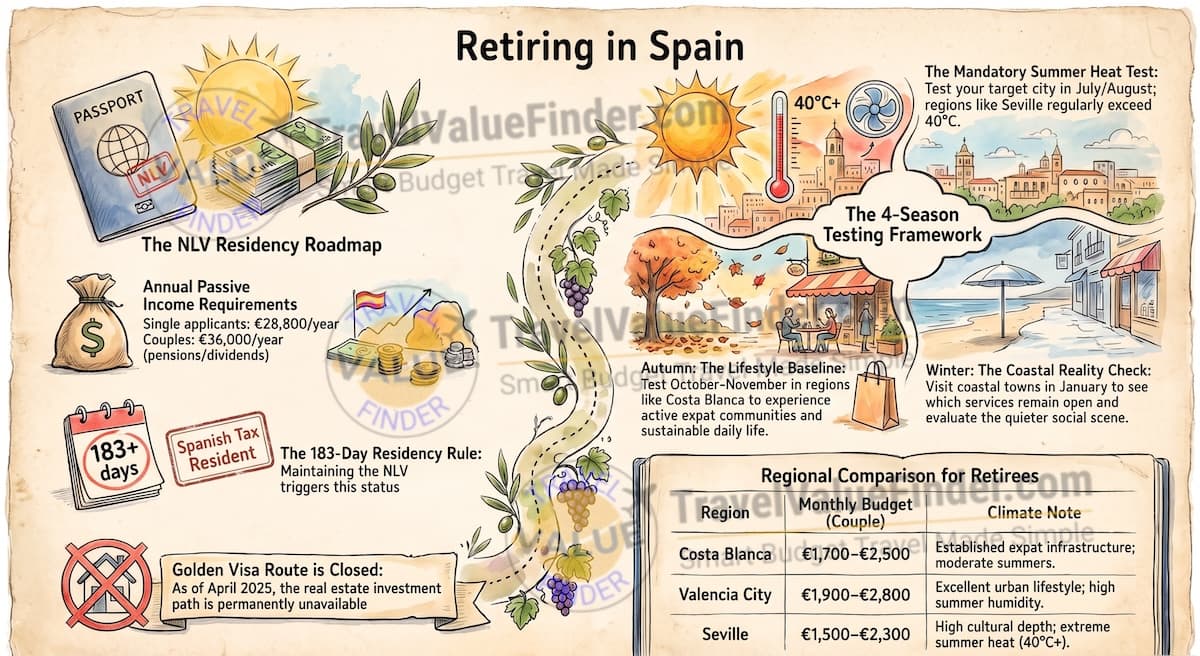
How do I retire in Spain and what should I test before applying for the NLV? Retiring in Spain as a non-EU national means applying for the Non-Lucrative Visa (NLV), which requires €28,800/year (~€2,400/month) for a single applicant in 2026. Spain’s Golden Visa permanently closed to real estate applicants on April 3, 2025 (Organic Law 1/2025). Retiring in Spain successfully requires testing at least two seasons – including summer in your target city – because Spain’s regional temperature variation is the most commonly underestimated factor in retirement satisfaction. NLV holders must spend 183+ days/year in Spain, which triggers Spanish tax residency.
Leslie Nics | TravelValueFinder.com | June, 2026 | Last reviewed: June 27, 2026
KEY 2026 FIGURES: NLV income: €28,800/year single | €36,000/year couple.
Golden Visa (real estate): permanently closed. 183-day rule: automatic Spanish tax residency.
NIE: get at Policia Nacional or Spanish consulate.
Source: TravelValueFinder.com – Leslie Nics, June 2026
GUIDE AT A GLANCE
| Guide Focus | Why seasonal testing is essential for retiring in Spain – and the framework to do it right |
|---|---|
| NLV Income 2026 | €28,800/year (~€2,400/month) single | €36,000/year (~€3,000/month) couple (400% IPREM) |
| Golden Visa Status | PERMANENTLY CLOSED to real estate: Organic Law 1/2025, effective April 3, 2025 |
| NIE Number | Spain’s foreigners’ ID – get at Policia Nacional or Spanish consulate. Required for everything. |
| 183-Day Rule | NLV requires 183+ days/year in Spain → automatic Spanish tax resident with worldwide income obligations |
| Summer Heat Test | MANDATORY: Seville regularly hits 40°C+. Test your specific target city in summer before committing. |
| Best First Season | Autumn (Oct–Nov) Costa Blanca: best overall conditions, active expat community |
| Key 2026 Change | Golden Visa real estate route permanently closed April 3, 2025 |
| Best Cities for Retiring | Valencia (value + lifestyle), Malaga (established expat zone), Alicante (affordable coast), Seville (culture + heat test) |
| Data Sources | Pellicer & Heredia NLV Guide 2026, JURO Spain NLV 2026, Klev & Vera May 2026, Numbeo June 2026 |
| Author | Leslie Nics, TravelValueFinder.com – Spain retirement & NLV researcher |
Why Retiring in Spain Requires Seasonal Testing – Not a Single Trial Visit
Retiring in Spain is one of Europe’s most popular retirement decisions for Americans and Britons in 2026, and the reasons are consistent: world-class healthcare system (ranked among the top 10 globally), Mediterranean climate, extraordinary food culture, diverse regional landscapes from Atlantic coast to Mediterranean coast to islands, and a Non-Lucrative Visa with a clear, achievable income threshold. The case for retiring in Spain is well-documented and genuinely strong.
But retiring in Spain contains a structural complication that Portugal and France do not have to the same degree: extreme regional and seasonal variation. The Spain where you test retiring in April is not the country you will be living in during July. Seville in spring is one of the most beautiful urban environments in Europe – orange blossoms, tapas culture, flamenco performances in the plazas. Seville in July records temperatures above 40°C regularly, empties its streets between 2pm and 7pm, and becomes a city where outdoor life essentially stops for the hottest hours of the day. This is not a minor detail for someone retiring in Spain who plans to enjoy outdoor daily life year-round.
The Non-Lucrative Visa – the primary route for retiring in Spain as a non-EU national – requires spending 183 or more days per year in Spain. This minimum is necessary to renew the visa at the end of Year 1. It also means you automatically become a Spanish tax resident, with the full reporting obligations that entails. Before committing to that obligation and the 6–9 month visa process, you need to know that Spain – and your specific target city – works across the full year, not just in the season that photographs best.
One critical 2026 update every prospective retiree needs: Spain’s Golden Visa program for real estate investment permanently closed on April 3, 2025, under Organic Law 1/2025. Any guide or agent still presenting the real estate Golden Visa as a current path to retiring in Spain is working from pre-April 2025 information. The NLV is now the primary and most straightforward route for retirees.
Retiring in Spain on the strength of a spring visit is the most common way to end up back home within two years. The spring is real, and it is genuinely extraordinary. The July afternoon when you cannot leave your apartment because the street is 42 degrees is also real. Both are retiring in Spain. Test both before you sign anything. – Leslie Nics, TravelValueFinder.com
The 4-Season Testing Framework for Retiring in Spain
Retiring in Spain sustainably means testing your target city in at least two different seasons before submitting an NLV application. Here is what each season reveals – and where to test it most effectively.
| Season | Best Test Region | What It Reveals for Retiring in Spain | Priority |
|---|---|---|---|
| Autumn (Oct–Nov) | Costa Blanca (Alicante, Javea, Denia) | The expat community is most active and accessible. Temperatures are low-to-mid 20s. Restaurants are on full schedule. Active expat clubs, golf leagues, and social events resume after summer. The most complete picture of sustainable daily life when retiring in Spain. | TEST FIRST – highest overall value for decision-making |
| Winter (Jan–Feb) | Canary Islands OR Costa del Sol (Malaga, Estepona) | The critical reality test for retiring in Spain on mainland coasts. Some restaurants reduce hours. Bus schedules thin. The social pace slows. The Canaries are the exception – genuinely 18–24°C in January, proving their year-round case definitively. | TEST SECOND – most skipped, most important for long-term commitment |
| Spring (Mar–May) | Seville or Valencia | Spain at its most persuasive – and most misleading without a summer follow-up. Spring in Seville gives no indication of July in Seville. Do not make a retiring-in-Spain decision from spring alone in any inland or southern city. | USEFUL – but always pair with a summer visit |
| Summer (Jun–Aug) | YOUR specific target city | The non-negotiable test. Heat, crowds, tourist saturation, and whether your neighborhood still functions as a place to live. Retiring in Spain in Seville, Valencia, or Madrid without testing summer is making a decision on incomplete data. | MANDATORY – cannot be substituted or skipped |
The Spain Non-Lucrative Visa: Requirements for Retiring in Spain in 2026
Retiring in Spain as a non-EU national means navigating the NLV – Spain’s Non-Lucrative Visa. These are the 2026 requirements, updated to reflect the Golden Visa closure and current IPREM-linked income thresholds.
| NLV Requirement | 2026 Figure | Notes for Retiring in Spain |
|---|---|---|
| Income – single applicant | €28,800/year (~€2,400/month) | 400% of Spain’s IPREM (€7,200/year in 2026). Passive income only – pensions, Social Security, dividends, rental income. Employment income does not qualify for retiring in Spain on the NLV. |
| Income – couple | €36,000/year (~€3,000/month) | Principal €28,800 + €7,200 per dependent. Couple with one child: €43,200/year. |
| Health insurance | €30,000 minimum coverage per claim | Must cover all medical treatment in Spain. No co-payment clause above 20%. No annual limit below €30,000. From an insurer authorized in Spain. Travel insurance is NOT accepted for retiring in Spain on the NLV. |
| 183-day residency minimum | 183+ days/year in Spain required | Minimum for NLV annual renewal. Also the threshold for Spanish tax residency – automatic with 183+ days when retiring in Spain. |
| NIE number | Required | Spain’s foreigners’ identification number. Get at Policia Nacional in Spain or at a Spanish consulate in the US before your trip. Required for: bank account, rental lease, NLV application, and property purchase. |
| Golden Visa (real estate) | CLOSED – April 3, 2025 | Organic Law 1/2025 permanently ended real estate investment as a route to retiring in Spain on a Golden Visa. The NLV is now the primary path. |
| Citizenship | 10 years (general rule); 2 years (Ibero-American nationals) | After 10 years of continuous legal residency in Spain, citizenship is available for most nationalities retiring in Spain. |
The 183-Day Rule and Spanish Tax Residency
Retiring in Spain on the NLV requires spending 183+ days per year in Spain – the minimum to renew your visa. 183+ days automatically makes you a Spanish tax resident. This means filing a Spanish income tax return and declaring worldwide income to Hacienda (Spain’s tax authority).
Spain has a Double Taxation Treaty with the US (1990) and the UK. These treaties generally prevent being taxed twice on the same income – but the mechanics for your specific income types (Social Security, pension, dividends) require professional analysis.
The US-Spain treaty generally allows a Foreign Tax Credit against US federal tax for Spanish income taxes paid. Consult a dual-qualified US-Spain CPA before retiring in Spain and establishing tax residency.
NIE number: must be obtained before or during your first serious test stay – at a Spanish consulate in the US before you travel, or at a Policia Nacional comisaria during your first visit to Spain.
Four Weeks of Seasonal Testing: Your Framework for Retiring in Spain
| WEEK 1 – Autumn: Costa Blanca (Alicante, Javea, Denia) The golden window – test the daily life of retiring in Spain at its most sustainable | |
| October–November is the optimal first season for testing retiring in Spain. The summer crowds have gone. Temperatures settle into the low-to-mid 20s Celsius. Local restaurants resume full schedules. Expat clubs, golf leagues, and social groups restart after the August pause. The Costa Blanca is Spain’s most established English-speaking retirement region – Alicante’s population is approximately 20% expat, with over 13,000 British nationals. This gives you the densest English-language retirement infrastructure of any region for retiring in Spain. Days 1–3: Base in a residential Alicante neighborhood – NOT the tourist center. Book a furnished monthly apartment in Alicante’s Carolinas, San Blas, or Vistahermosa areas. These are where people who are retiring in Spain actually live. Days 4–6: Day trips to Javea (upscale, very English) and Denia (more local, lower cost). Note terrain, English availability, community feel, and which type of retiring-in-Spain lifestyle suits you. Day 7: Attend an expat social event. The Alicante and Costa Blanca expat community has active clubs, coffee mornings, and sport groups. This is the social infrastructure that makes retiring in Spain sustainable long-term. | WHAT TO TEST THIS WEEK – Get your NIE at Policia Nacional or Spanish consulate before this trip – Check NLV income requirement vs. your actual monthly passive income – Visit Quironsalud or Vithas clinic as a self-pay patient – note cost and English – Calculate real weekly grocery cost from Mercadona receipts – your retiring-in-Spain food baseline – Check Idealista.es for unfurnished 1–2BR rental prices in residential neighborhoods – Attend one expat club meeting or coffee morning – assess community quality – Ask long-term residents: what is January like here for retiring in Spain year-round? |
| WEEK 2 – Winter: Canary Islands (Tenerife or Gran Canaria) or Costa del Sol The reality test: what does retiring in Spain look like when the tourist season ends? | |
| January is the most important month to test for anyone seriously considering retiring in Spain on the mainland coasts – and the most frequently skipped. Many retirees who come home within two years of retiring in Spain cite ‘the winter was not what I expected’ as the reason. On the Costa del Sol and Costa Blanca, January means: some beach restaurants closed or on reduced hours, thinner bus schedules, a quieter social scene that some retirees find peaceful and others find isolating. This is not a criticism – it is information you need for retiring in Spain permanently. The Canary Islands (Tenerife, Gran Canaria) are the exception: genuinely 18–24°C in January, with year-round sunshine and full infrastructure. If you are seriously considering retiring in Spain with true year-round warmth, a January Canaries test proves their case definitively. Days 1–3: Your mainland coastal target in January. Walk the main promenade. Count what is open vs. closed. Note the social scene. Ask expats: what do you do in January when retiring in Spain here? Days 4–7: Canary Islands comparison. The difference in January experience between the mainland and the Canaries is one of the most useful data points for retiring-in-Spain decisions. | WHAT TO TEST THIS WEEK – Walk the main promenade of your target coastal town on a cold January day – Count closed restaurants vs. open – this is winter’s honest infrastructure test for retiring in Spain – Test getting a walk-in appointment at a private clinic in January hours – Confirm: does the expat social calendar continue year-round or pause in winter? – Canaries comparison: note the January experience vs. the mainland for your retiring-in-Spain decision – Calculate monthly budget with heating vs. your autumn test month – Ask 3 long-term retirees: do you leave Spain in winter, and does that affect your NLV renewal? |
| WEEK 3 – Summer: YOUR specific target city for retiring in Spain The mandatory heat test – retiring in Spain without testing summer is incomplete research | |
| Summer is the non-negotiable test for retiring in Spain. Without testing summer in your specific target city, you are making a decision based on incomplete data – regardless of how thorough your other seasonal testing was. Seville at 40°C+ is a different city from Seville in April. Retiring in Spain in Seville means this heat is your July and August. The siesta culture, the evening-heavy social schedule, and the strict indoor-afternoon routine are not inconveniences – they are how Seville functions in summer. Test whether this suits your retirement lifestyle. Valencia in August has a different character from Valencia in October – more tourists, more noise, higher prices. Even the cooler Costa Blanca changes significantly in peak summer. Every city you are seriously considering for retiring in Spain must be tested in summer. Days 1–3: Three consecutive days in your target city during a typical July or August week, going about a normal daily routine between noon and 4pm. This is the most honest heat tolerance test for retiring in Spain you can do. Days 4–6: Test whether your target neighborhood still functions for daily life in summer, or whether tourist saturation has changed its character. Your morning café, your market, your quiet street – are they still yours in August? Day 7: The honest question for retiring in Spain: can I spend 183+ days per year here – including these summer months – and be genuinely happy? | WHAT TO TEST THIS WEEK – Spend noon–4pm outdoors in open air on the hottest available summer day – Confirm your apartment has adequate A/C – test it under real summer conditions – Ask your landlord for previous summer electricity bills – A/C cost reality check – Test whether your target café, market, and neighborhood still feel like daily life in August – Note: is your neighborhood pleasant for retiring in Spain, or overrun with tourists in summer? – Confirm: do expat clubs and social groups continue actively through summer? – The 183-day test: with required days for NLV renewal, do summer months feel sustainable for retiring in Spain here? |
Spain by Region: What Your Seasonal Testing Reveals
| Region | Monthly Budget Couple (2026) | Summer Heat | English Infrastructure | Best For Retiring in Spain | Honest Caveat |
|---|---|---|---|---|---|
| Costa Blanca (Alicante, Javea) | €1,700–€2,500 | Moderate (30–35°C coast) | Very High – largest English-speaking expat zone in Spain | Value-focused retiring in Spain with the most established English expat community | January is quieter and greyer than photos suggest. Test winter before committing. |
| Valencia City | €1,900–€2,800 | Moderate-High (35–38°C peak) | High in expat zones, moderate elsewhere | Urban retiring in Spain with culture, beaches, excellent tram system, and strong food scene | Summer transforms Valencia. The neighborhoods you loved in spring look different in August. |
| Costa del Sol (Malaga, Estepona) | €2,200–€3,200 | Moderate coast (30–34°C); cooler than inland | Very High – very established expat zone | Mild winters make retiring in Spain on Costa del Sol the most year-round-viable mainland coastal option | Marbella is premium. Estepona and Fuengirola offer lower costs. |
| Seville (inland Andalusia) | €1,500–€2,300 | EXTREME (40–44°C+ regularly) | Moderate – lower English than coastal areas | Cultural depth, extraordinary food, lower cost – for those retiring in Spain who test AND accept the heat | Retiring in Spain in Seville without testing July is the most common expensive mistake on this list. |
| Canary Islands (Tenerife, GC) | €2,000–€3,000 | Mild year-round (22–28°C) | High in tourist areas, moderate locally | Retiring in Spain with genuine year-round warmth – no seasonal grey or extreme heat | Higher cost than mainland. US flight times are longer than to mainland Spain. |
| Northern Spain (Bilbao, Santander) | €2,000–€3,000 | Cool and pleasant (22–25°C summer) | Low outside tourist areas | Atlantic scenery, green landscape – for those retiring in Spain who prefer cooler temperatures | English is genuinely limited outside tourist zones. Rainy winters require genuine enthusiasm. |
Region Scorecard: Where Are You Retiring in Spain?
| Factor | Costa Blanca | Costa del Sol | Valencia | Your City:____ |
|---|---|---|---|---|
| Summer heat tolerance – your own honest test | __/5 | __/5 | __/5 | __/5 |
| English in daily services (pharmacy, clinic, market) | __/5 | __/5 | __/5 | __/5 |
| Expat social community quality at meetup | __/5 | __/5 | __/5 | __/5 |
| Healthcare: private clinic test (cost, English, wait) | __/5 | __/5 | __/5 | __/5 |
| Real rental cost from Idealista.es | __/5 | __/5 | __/5 | __/5 |
| Weekly grocery cost from Mercadona receipts | __/5 | __/5 | __/5 | __/5 |
| Car dependency (can you live here without one?) | __/5 | __/5 | __/5 | __/5 |
| Seasonal variation comfort (Jan and Aug both tested) | __/5 | __/5 | __/5 | __/5 |
| Gut feeling on day 28 – settled or wanting to leave? | __/5 | __/5 | __/5 | __/5 |
| TOTAL (out of 45) | __/45 | __/45 | __/45 | __/45 |
Download the Spain Retirement Scorecards and Spain Retirement Checklist

Practical Prep You Can Do During Your Spain Seasonal Testing
| Task | Do During Seasonal Test? | Action | Why It Matters for Retiring in Spain |
|---|---|---|---|
| Get NIE number | YES – Policia Nacional or Spanish consulate | Book appointment at sede.administracionespublicas.gob.es or at nearest Spanish consulate in US | Required for: bank account, rental lease, NLV application. The modelo 790 tax form (~€10.20) must be paid at a Spanish bank before the appointment. |
| Open Spanish bank account | YES (with NIE) | Visit Sabadell or Santander – most expat-accessible banks for retiring in Spain | Simplifies NLV financial documentation. Some banks offer non-resident accounts. Ask specifically. |
| Meet NLV immigration lawyer | YES – in Spain or remote | Get referrals from expat groups in your test region. NLV requirements changed with the Golden Visa closure (April 2025). Current-year legal advice is essential for retiring in Spain. | NLV requirements change annually. An NLV specialist who handles these every week is your most reliable current-year source. |
| Health insurance for NLV | YES – research during test | Must be from a Spain-authorized insurer with €30,000 minimum coverage and no co-payment above 20%. Get quotes from Sanitas, Adeslas, or Cigna Global. | Travel insurance fails NLV requirements. Get quotes during your test when motivation is highest. |
| FBI background check | NO – start before you travel | Submit at bibs.cjis.gov before your seasonal test departs | Takes 8–12 weeks including apostille – the NLV’s longest-lead document. Start before your trip. |
| Test 183-day commitment | During your test | After 4–6 weeks in Spain, honestly assess: do you want MORE of this, or are you ready to leave? | The NLV requires 183+ days annually. If you feel ready to leave after 4 weeks, the 183-day minimum may feel constraining. This is critical information before retiring in Spain permanently. |
Ready to compare cities now?
- Use our Free Retirement Cost of Living Calculator – get your personalized report in 30 seconds – Free PDF download.
- How to Use a Retirement Cost of Living Calculator – to Compare Cities Worldwide
15 Essential Tips for Seasonal Testing Before Retiring in Spain
- Test your target Spanish city in summer. This is the single most important test for retiring in Spain that most guides recommend but most prospective retirees skip. The heat question defines 3–4 months of every retirement year.
- The Golden Visa for real estate permanently closed April 3, 2025. Any guide presenting real estate investment as a current residency route for retiring in Spain is outdated. The NLV is your route.
- Get your NIE before your seasonal testing trip at a Spanish consulate in the US – or during your first week in Spain at a Policia Nacional. Required for everything when retiring in Spain.
- The NLV income requirement for retiring in Spain in 2026 is €28,800/year (~€2,400/month) for a single applicant. This is 400% of Spain’s IPREM. Know whether your passive income meets this threshold before applying.
- 183+ days/year in Spain triggers Spanish tax residency. Before retiring in Spain permanently, consult a dual-qualified US-Spain CPA about how the treaty applies to your Social Security, pension, and investment income.
- Check Idealista.es – not Airbnb – for actual retirement rental prices. Long-term rentals in Spain are predominantly unfurnished. The furnished tourist apartment you stay in during your test is not what you will rent when retiring in Spain permanently.
- Test the English infrastructure in your specific target neighborhood, not just the city. Retiring in Spain in central Alicante is very different from retiring 20km inland in terms of English-language service availability.
- Attend expat social events in every region you test. The quality of the social community when retiring in Spain varies dramatically by region and is the factor most invisible without attending in person.
- Visit a private clinic (Quironsalud, Vithas, HM Hospitales) during each seasonal test as a self-pay patient. This is your healthcare baseline for retiring in Spain – cost, English, wait, and overall experience.
- Spain’s public healthcare (SNS) is world-ranked and covers legal residents of Spain. It is a genuine advantage of retiring in Spain. But NLV holders in their first year are required to have private insurance as a visa condition.
- Research the US-Spain Double Taxation Treaty before retiring in Spain. It generally allows a Foreign Tax Credit against US federal tax for Spanish taxes paid. Your Social Security and pension income treatment requires professional analysis.
- The NLV renewal requires 183+ days in Spain in the prior year. Build your travel calendar around this requirement before retiring in Spain – prolonged absences can endanger renewal.
- Renting before buying is strongly recommended for the first 2 years of retiring in Spain. Property markets, neighborhood character, and personal preferences clarify significantly with lived experience.
- For the NLV health insurance, confirm the policy: covers all medical treatment in Spain, has no annual limit below €30,000, has no co-payment clause above 20%, and is from an insurer authorized to operate in Spain.
- Before leaving Spain at the end of each seasonal test, book an immigration lawyer consultation for within two weeks of your return – while your motivation and experience of retiring in Spain are freshest.
FAQ – Retiring in Spain 2026
How do I retire in Spain as an American or British citizen?
Retiring in Spain as a non-EU national means applying for the Non-Lucrative Visa (NLV), which in 2026 requires passive income of at least €28,800/year (~€2,400/month) for a single applicant, private health insurance with minimum €30,000 coverage from a Spain-authorized insurer, and a clean criminal record. The NLV grants one year of initial residency, renewable for two-year periods, with permanent residency available after five years. Spain’s Golden Visa real estate route permanently closed on April 3, 2025. Retiring in Spain also requires spending at least 183 days per year in Spain – which triggers Spanish tax residency.
Is Spain’s Golden Visa still available for retiring in Spain?
No. Spain’s Golden Visa for real estate investment permanently closed to new applicants on April 3, 2025, under Organic Law 1/2025. This means purchasing property in Spain no longer qualifies as a path to residency for retiring in Spain. The Non-Lucrative Visa (NLV) is now the primary route for retirees with sufficient passive income.
Why should I test multiple seasons before retiring in Spain?
Retiring in Spain requires seasonal testing because Spain’s regional temperature variation is extreme. Seville regularly records 40–44°C in July – a city that is extraordinary in April. The NLV also requires spending 183+ days per year in Spain, meaning your retirement includes the full seasonal cycle. Testing retiring in Spain in only one season – especially only in spring or autumn – gives you a deeply incomplete picture of the 183+ days per year you are committing to.
What is the income requirement for retiring in Spain in 2026?
Retiring in Spain on the Non-Lucrative Visa requires €28,800/year (~€2,400/month) for a single applicant in 2026. This is 400% of Spain’s IPREM (€7,200/year). For a couple, the requirement is €36,000/year. Income must be passive – pensions, Social Security, dividends, rental income, or investment returns. Employment or freelance income does not qualify for the NLV for retiring in Spain.
Bottom Line: Retiring in Spain Rewards the Retirees Who Test All Seasons
Retiring in Spain is one of the world’s genuinely great retirement decisions – the healthcare system, the food, the climate, the NLV’s clear income pathway, the lifestyle diversity. The retirees who retire in Spain and stay for decades are almost universally those who tested summer. Who tested January. Who asked the long-term expats what they do in burning August and grey February and came away with honest answers. The seasonal testing framework in this guide is not a delay – it is the research phase of retiring in Spain, done properly.
The Golden Visa closure changed the landscape. The 183-day rule creates real obligations. The summer heat is a genuine factor. None of these make retiring in Spain the wrong answer. They make it a decision you want to make with clear eyes – which is exactly what seasonal testing gives you. Find out more about Retire in Spain on $2,500 a Month, Common Mistakes When Moving to Spain, and the Best Places to Live in Spain After 55: A Practical Comparison
Retiring in Spain successfully is about choosing the right city for the full year, not the city that was most beautiful on the day you visited. The four-season test is the most important piece of research you can do – it tells you not just whether you can retire in Spain, but whether you will want to stay. – Leslie Nics, TravelValueFinder.com
About the Author
Leslie Nics Travel Writer & Spain Retirement Researcher | TravelValueFinder.com
Leslie Nics is the lead travel writer at TravelValueFinder.com, specializing in retiring in Spain, NLV planning, and seasonal testing strategy for retirees. His Spain research draws on extended stays in Valencia, the Costa Blanca, Malaga, Seville, and the Canary Islands across multiple seasons – including deliberate July visits to test the summer heat reality that most retiring-in-Spain guides only mention briefly. His retiring-in-Spain content is referenced across expat communities including ‘Americans in Spain,’ ‘Expats in Valencia,’ and ‘British Expats in Spain.’ He places particular emphasis on the Golden Visa closure context, the 183-day rule’s tax residency implications, and the summer heat test that is the most commonly skipped – and most consequential – seasonal test for retiring in Spain.
Expertise: Spain NLV planning | Seasonal regional testing | Golden Visa closure context (Organic Law 1/2025) | US-Spain tax treaty overview | Healthcare access for retiring in Spain
Sources
- Pellicer & Heredia – Spain Non-Lucrative Visa Guide 2026 (NLV income threshold, health insurance requirements)
- JURO Spain – NLV Requirements for Retiring in Spain 2026 (IPREM calculation, documentation list)
- Klev & Vera – Retiring in Spain 2026: Visa, Tax, and Healthcare (May 2026)
- Global Citizen Solutions – Spain Golden Visa Closure Update (Organic Law 1/2025, April 2025)
- Numbeo – Spain Cost of Living by City, June 2026
- IQAir – Spain AQI data by region and city, June 2026
- Idealista.es – Spanish residential rental market data, June 2026